A shabby little woman detached herself from the steadily marching crowd on the avenue and paused before a shop window, where solid rows of electric bulbs blazed brilliantly into the December twilight. The ever-increasing stream of Christmas shoppers flowed on around her. Now and then it parted, like the waters of the Jordan, while a lady in rich warm furs made safe passage from her car to the warmth of the great department store.
Heat and the savory smells from a bakery drifted up through a nearby pavement grating, softening the cold air. The shabby little woman, only half-aware of this small comfort, adjusted her eyes to the brightness and looked hungrily at the costumes shimmering under the lights. Wax figures draped in rainbow-tinted evening gowns caught her passing admiration, but she lingered over the street clothes — the silk-lined coats and soft, warm furs. Elbowed by others just as eager to look, even if they could not buy, she held her ground until she had made her choice.
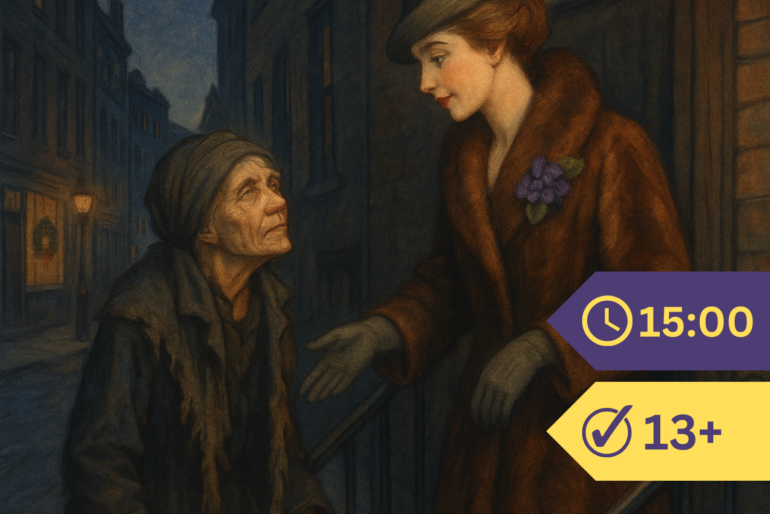
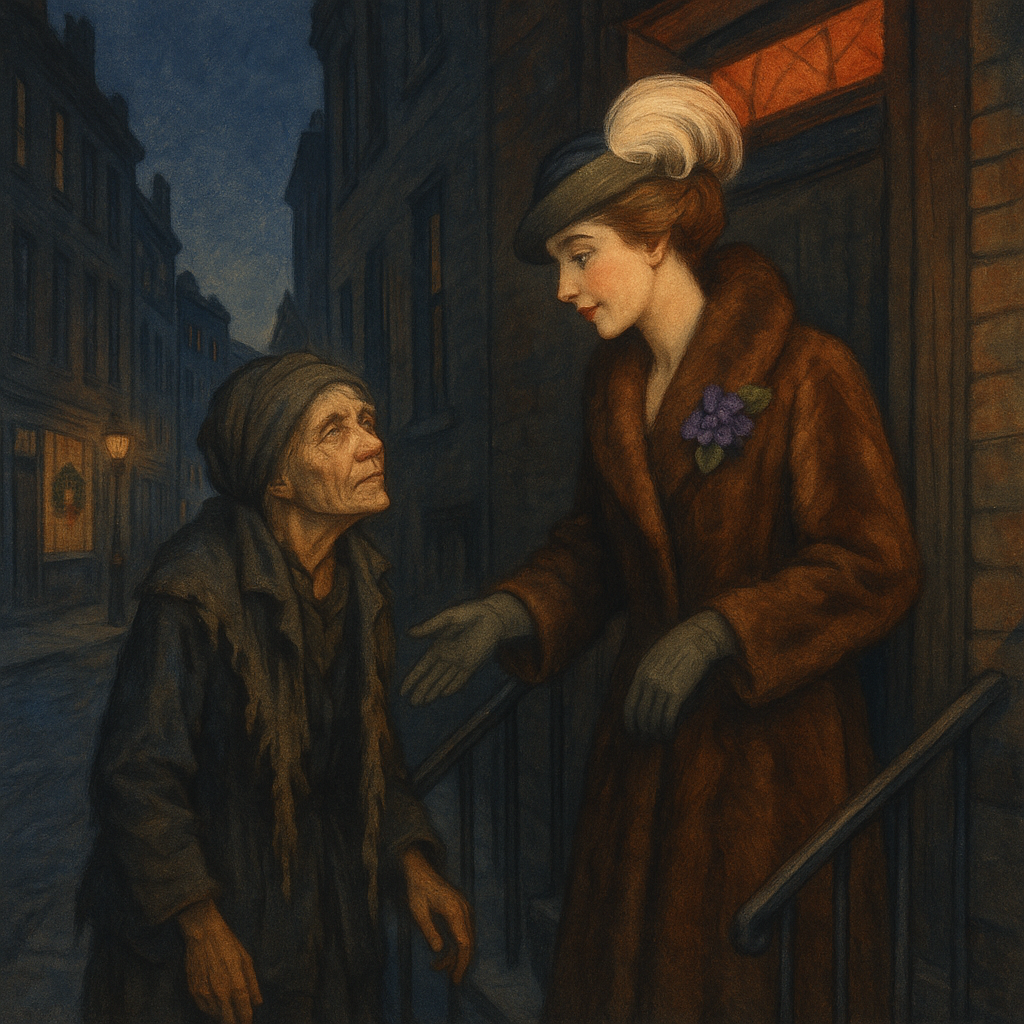
With her wistful gaze still fixed on her favorite, she had begun to edge through the crowd at the window when she felt, rather than saw, someone different from the rest, close at her side. At the same instant she caught the scent of fresh-cut flowers and looked up into the eyes of a tall young woman in a white-plumed velvet hat, with a bunch of English violets pinned to her brown mink fur.
As their glances met, the shabby little woman flinched and looked quickly down. The smile that had shone briefly from the girl’s warm eyes had stirred in her something unfamiliar, and strangely intimate. There had flashed across that mobile face beneath the velvet hat a look of unmistakable personal interest — an impulse, barely suppressed, to speak.
The thrill of that response died suddenly. The color rising in the woman’s grayish cheeks was the color of shame. Through the window, in a mirrored panel blazing with light, she saw herself: her remade turban, her short jacket of a style long out of fashion, and her old fur cape with its strange dangling tails and yellowed cracks showing through the plucked and ragged fur.
One glance at her own reflection was enough. She pushed her way into the slow-moving crowd and headed for the nearest elevated station, carried irresistibly along by the army of pedestrians.
She caught one last glimpse of the tall young woman coming in her direction, still watching her with that same eager look. But what of that? She knew why women stared at her. By the time she reached her station, the encounter had taken on a painful weight that seemed to press down on all the grayness of her evening routine. She made her way along a narrow, dimly lit street, walking with the aimless pace of someone who neither expects nor is expected.
Loiter as she might, she soon reached a neighborhood where rows of narrow brick tenements hunched over dingy basement shops. Here she was forced to quicken her pace to make way for romping children and bareheaded women hurrying home with their suppers in paper bags.
For all the wintry chill, the neighborhood had a life of its own. It was not without touches of Christmas cheer, either. In the window of a small news and fruit shop, a holly wreath hung against the smudged and partly frosted glass, and inside stood a rack of gaudy, tinsel-trimmed Christmas cards. The woman hesitated as if she might go in, then moved on. She climbed one of the stoops, all of them exactly alike, and stood in a blur of reddish light filtering through the cracked glass above the door.
She looked back the way she had come.
For a moment her pulse quickened again, as it had on the avenue downtown. At the corner, a tall girl in a white-plumed velvet hat was picking her way with a smile through the crowd — so foreign, apparently, to someone of her class. As the white plume drew nearer and nearer, the trembling little woman steadied herself. It was only one of the city’s coincidences, she told herself, and turned resolutely away. The door closed behind her.
Strange, she thought, as she felt her way through the dim lower hall and the complete darkness of the upper one, that a girl like that should be living in such a neighborhood. Then, with an effort, she put it from her mind.
Lighting the sputtering gas required only a few steps in her tiny room. When that was done, she could think of nothing more to do. The little taste of excitement had killed her appetite for the small domestic rituals that on other evenings were the main events of her day. She sank onto the cot without removing her wraps, greeted by the familiar creak of rusty springs. Her table sat in its corner with its meager arrangement of dishes, its coffee pot and small alcohol burner, inviting the preparation of her supper. But she had no wish to eat tonight. She hadn’t stopped at the bake-shop on her way home. She hadn’t even bought her daily paper at the corner stand where the postcards were — those cheerful Christmas cards that bring greetings from friends.
As she slowly removed her turban, her jacket and fur cape and, without getting up, tossed them across the chair against the opposite wall, the dull ache in her chest sharpened into a clear, fierce desire. She wanted something to happen. She wanted anything that might break the grey routine of her days.
Still, habit would force at least part of that routine upon her. She glanced at her fingers, stained to an oily dark grime by the cheap dye of the garments that made up her day’s work. Mechanically she got up to wash.
While her hands were immersed in the lather of strongly scented soap, there came a gentle knock at the door.
“Come in,” the woman called, expecting some hard-pressed neighbor in need of a spoonful of coffee or a cup of tea.
The door opened slowly.
“May I come in?” asked a voice sweeter than the breath of violets that preceded the caller into the room.
With the towel clutched in her dripping hands, the woman flung the door wide open, then rushed to move her wraps from the chair — her only chair.
“Thank you; don’t bother,” said the visitor. “I shall like sitting on the couch.”
There was a warmth of enthusiasm in this that even the protesting of the cot, as the girl dropped easily onto it, could not quite drown.
The woman, towel forgotten on the doorknob, stared at her visitor. She could hardly believe her eyes. It was — it was indeed the girl in the white ostrich plume, with the violets in her brown mink fur.
“I feel like an intruder,” the girl began, “and, do you know—” her quick glance toward the old fur cape on the chair was guiltily withdrawn as she spoke — “do you know, I’ve such a silly excuse for coming.” She laughed, and the laugh made her voice even lovelier.
The woman, drawn at last from her daze, smiled, and the weariness left her face. She settled herself at the far end of the creaking cot.
“I’m sure you’ll understand,” the girl resumed. “At least, I hope you won’t be offended. I noticed you had a rare fur piece” — her bright glance returned briefly to the pile of wraps on the chair — “and I want to ask a very great favor. I’ve been looking all over the city for something like it, and” — with the air of someone taking a plunge — “I should like to buy it from you.”
“Buy it!” the woman said, a dull flush rising in her pale cheeks. “I can’t see why anyone would want to pay money for a thing like that.”
“It’s a rare pattern, you know,” the girl said, a persuasive warmth entering her voice, “and you don’t know how glad I’d be to have it.”
The flush faded. “If you really want it—” the woman put the strange old piece abruptly into her visitor’s lap — “If you really want it—but I don’t see—” a yearning crept into her work-worn eyes, struggling with something like disillusionment. “Tell me,” she said suddenly, “is that all you came here for?”
Apparently not hearing the question, the young woman rose to her feet. “You’ll sell it to me then!” she said, triumphant, opening her gold-clasped purse.
“But—” the woman hesitated. “I can’t—it ain’t worth—”
The girl’s gloved hands went fumbling into the purse, while the old cape hung across one velvet arm.
“You leave it to me,” she said, and smiled — a radiant, winning smile.
Impulsively, the woman moved closer to her guest. “Excuse me,” she faltered, “but — do you know — you look so much like a little niece of mine. Back home.”
“Do I? That’s nice.” The visitor glanced at her watch. A note of distraction had come into her beautiful voice, though it still held the warmth that had invited the woman’s confidence.
“Yes, my little niece — excuse me — I haven’t seen her in twelve years. Almost fifteen, I suppose. She’d be grown up by now, but I thought — when I saw you downtown—”
“Oh, you remember me, then! Forgive me for following—” The girl seized the woman’s soap-reddened hands in a sudden, fervent clasp. “I understand,” she said softly. “You must be lonely. I’ll try to see you again — I surely will. Goodbye.”
The girl was gone, and all at once the room seemed colder and dingier than it ever had before. But the woman was not cold. As she sat huddled on the cot, warmth and life glowed within her, kindled by the memory of a kind human touch.
The following evening, after work, the shabby woman — wearing a faded scarf in place of her old fur collar — walked diffidently up to a saleswoman at the Sixth Avenue department store. She wanted to buy a brown mink collar, just like one in the window display, on a figure wearing green.
It was unusual to sell expensive furs to a customer like her. But the store didn’t ask questions, provided the money was there. And in this case it was. She produced three crisp ten-dollar bills — the astonishing sum the girl had pressed into her hand at parting — and two more from her worn little purse, from savings carefully kept. Then, hugging the big flat box against the front of her jacket, she walked out of the store in something close to triumph.
In a kind of tender happiness she drifted along until she came to a florist’s window. She paused to look at great bunches of carnations and roses tied with streaming ribbons, and the anxious expression of the uncertain shopper returned to her face. Would it be any use to go in? Unable to stand still or let herself be carried along, she pushed through the revolving door.
“English violets — fifty cents for the small bunches,” said the red-cheeked salesgirl promptly, before the woman had quite finished asking.
The woman turned reluctantly away, hesitated, then asked: “But the roses — a single rose, half-open?”
“Twenty-five cents apiece,” replied the girl in the same brisk tone, rearranging a basket of flowers.
“I’ll take the rose.”
At the express office, where a long line waited ahead of her, the woman had time to untie the box and slip the rosebud beneath the inner tissue paper wrapping. Then she retied it carefully, stuck a Do Not Open Until Christmas tag in a prominent place, and took her place in line. When her turn finally came at the desk, a stout clerk who worked like a machine tore the package from her reluctant hands and dashed across the wrapper the address she gave.
She paid the charges, tucked the receipt into her purse, and turned briskly away.
She stopped at the bake-shop for fresh crullers on her way home, bought them from a dark, stout woman behind the counter, and wished her a Merry Christmas in a voice that almost sang. At dusk she made coffee in her room. It was Christmas Eve, and she must begin early to claim her full share of the season’s particular pleasures. After reading her paper for an hour or so by the cheerfully wasteful gas flame, she brewed another cup of coffee and feasted on crullers a second time. At last she filled a hot-water bottle from the tap in the hall and prepared for bed.
The chill of the bedclothes — which the barely warm bottle did little to help — could not touch the comfortable warmth around her heart. Nor were the happy memories of her strange and lovely visitor disturbed by anything happening at that very hour across the city. As she bounced into her cot, humming a small tune, she did not know that at a theater downtown a popular young actress was taking curtain call after curtain call. Nor could she have recognized the graceful girl stepping out from the wings in a new character part — an extreme type of eccentric old-maidhood — except for the plucked and ragged fur piece that formed the key note of the performer’s quaint costume.
No knowledge of this cast any shadow over the half-drowsy, half-blissful state that settled over the woman that night in place of sleep. It cast no cloud over her eager awakening, nor held her in bed for a moment, when her landlady’s voice startled her with a shout on Christmas morning.
“Eggs-press, eggs-press — a package for Miss Law-lor-r-r!”
Full-voiced and lingering, the call rolled up three flights of bare stairs, and by the time the woman had pulled on her skirt and sweater and come out into the dim upper hall, curious heads were poking from every doorway.
She carried the bulky Christmas package to her own room with deliberate steps, in shy and half-guilty triumph, and set it on the cot. Behind her closed door she untied it, lifted the lid, and bent down with a smile to breathe in the scent from the tissue folds. Then, with careful fingers, she parted the crisp inner wrappings — and unearthed a wilting, half-blown rose from its nest in the brown mink fur.