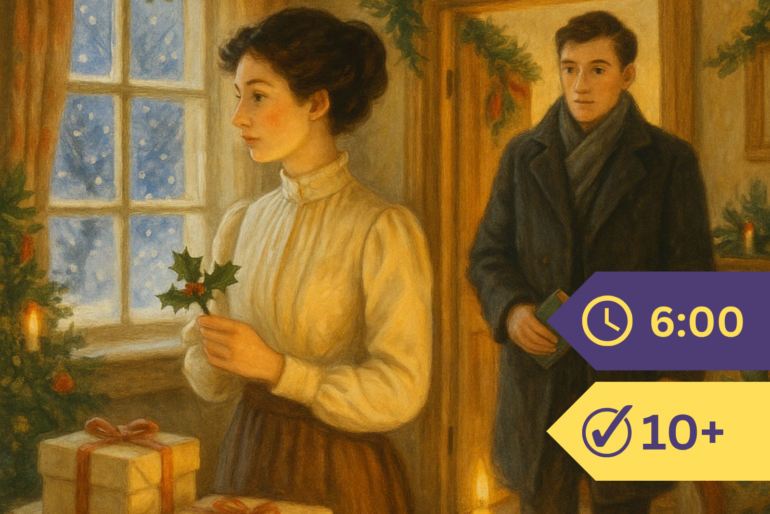
“So I’m a heartless flirt who doesn’t understand the meaning of the word love, am I, Mr. William Dunning?” stormed Marjorie to herself, in answer to the final decree of rage and defiance that gentleman had hurled at her by means of a vigorous slam of the front door.
“I believe he would have shaken me, if he hadn’t rushed out in time to prevent himself from doing it,” she went on, the ever-ready dimples venturing out of their hiding places — but she banished them severely. “I’ll never, never forgive him, even though he asks me to. Which, of course, he won’t! And he calls me stubborn!”
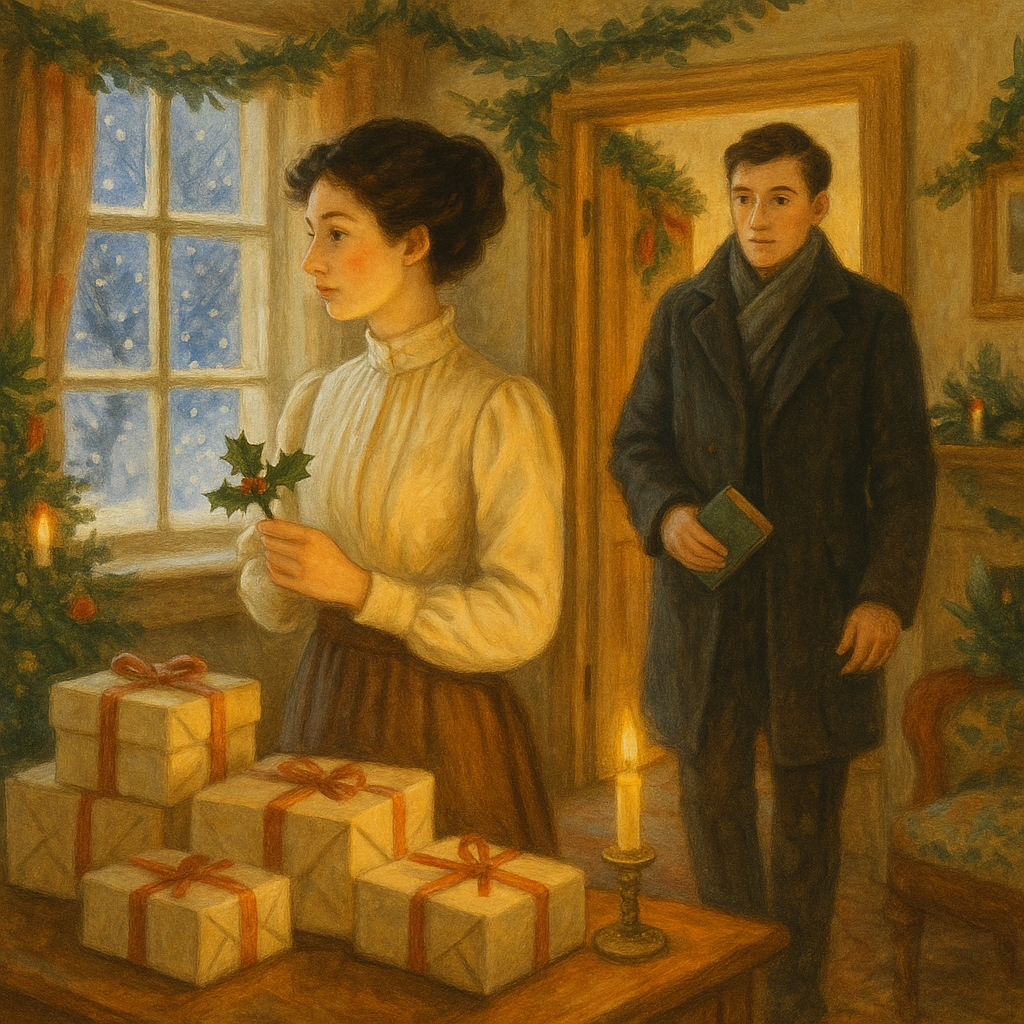
The next morning Marjorie was tremendously busy wrapping up dainty little parcels, for the next day was Christmas, and her many friends must be remembered — quarrels and Billy notwithstanding. Still, she seemed very much preoccupied over her work; and quite suddenly she threw aside the sprig of holly she had been toying with and fairly flew to the telephone.
In answer to her impatient summons, she was quickly connected with Brown & Co.’s bookstore. “Have you sent out those books that were ordered for Mr. William Dunning?” she asked anxiously.
The answer evidently pleased her, for she breathed a sigh of relief. “That’s all right — I’m glad you haven’t, for I’ve changed my mind about them. Please cancel the order.”
Marjorie hung up the receiver with an air of triumph. “There! I’m glad I thought of that. Billy would have construed a Christmas present into an abject apology.” Her indignation rose at the very idea.
But when she went back to her parcels and picked up the little twig of holly she’d meant to tuck into one of them, her face softened. “I know that isn’t the right kind of Christmas spirit to have,” she argued with herself, “but I can’t have Billy thinking I’m admitting I was wrong — when I know I wasn’t.”
The joyous ringing of Christmas bells and the merry shouts of her younger sisters and brothers, when they discovered their stockings the next morning, only served to deepen her low spirits.
“Billy never loved me. If he really and truly did, he could never treat me like this,” she told herself, standing and looking with unseeing eyes at the snowy Christmas world.
Just then a young man came tearing around the corner and arrested her attention. It was no less a person than Billy himself, coming post-haste to see her. Marjorie stared in wonder. What had come over him? Why this sudden contrition — when, she admitted now for the first time even to herself, she had been greatly, if not altogether, to blame for their quarrel?
“Oh, Billy — I’m so glad you came!”
Billy took a little time to express his appreciation of her welcome. Then: “Glad I came? Why wouldn’t I come, dear?”
“Because you vowed you wouldn’t — unless I apologized,” Marjorie explained mischievously.
“You didn’t really think I’d be so narrow and unforgiving as to ignore your dear little peace offering? I brought one of the books along, to read you something,” he told her — and, diving into his pocket, he produced a small copy of Romeo and Juliet.
Marjorie was startled for a second; then it flashed over her what it all meant. Brown & Co. had forgotten to cancel her order, and Billy had received the books. He had construed her sending them as a humble plea for forgiveness — and most probably wouldn’t have come at all if it hadn’t been for that.
She stiffened visibly, and all her love was swallowed up in a wave of rebellious pride. “You are mistaken,” she began coldly — but Billy interrupted her.
“Here — I’ve found it:
‘My bounty is as boundless as the sea,
My love as deep; the more I give to thee,
The more I have, for both are infinite.’“
And the simple beauty of the lines woke something in Marjorie stronger than pride or resentment, so that she only smiled when he added, tenderly:
“My Christmas greeting to you, dear.”