Asaph had exactly the Christmas presents he wanted. “Wanted” is hardly the right word — he had never imagined that a boy like him could own such things. His father and mother gave him a camera with thirty glass plates, all ready for taking photographs using the new dry-plate process, so that Asaph could roam wherever he liked and make pictures without fussing over chemicals.
What the other children gave him there is no room to tell. But of all the children in Boston opening parcels at the breakfast table that Christmas morning, none was happier than Asaph Sheafe.
The grief came afterwards.
When his mother’s turn came to open her presents — for in the Sheafe house everyone had their own present-table — she worked her way past the little children’s offerings and arrived at Asaph’s gift to her. It was a large box wrapped in a German newspaper. She opened it carefully and lifted out a Bohemian coffee-pot that Asaph had bought from the German woman’s shop on Shawmut Avenue. Mrs. Sheafe exclaimed with delight, marvelling that Asaph had remembered she wanted one.
But no amount of love could hide the fact that the spout was broken at the end, the remaining piece jagged with splinters.
Poor Asaph saw it the same moment she did. The tears came to his eyes in spite of himself. He bent his head onto his mother’s shoulder, and the hot drops fell on her cheek. She kissed him and told him not to mind for a moment. It would pour just as well, she said, and she would use it every single morning. She knew how many months of his allowance had gone into that coffee-pot. She remembered how much she had admired Mrs. Henry’s. And she praised Asaph warmly for having noticed that.
“This is the real joy of a gift,” she said, “that my boy watches what his mother wishes, and thinks of her. A chip off the end of a spout is nothing at all.”
Asaph would not let his own sadness spoil the others’ happiness. He pretended to be comforted. But all the same, a great lump sat in his throat for the rest of that day.
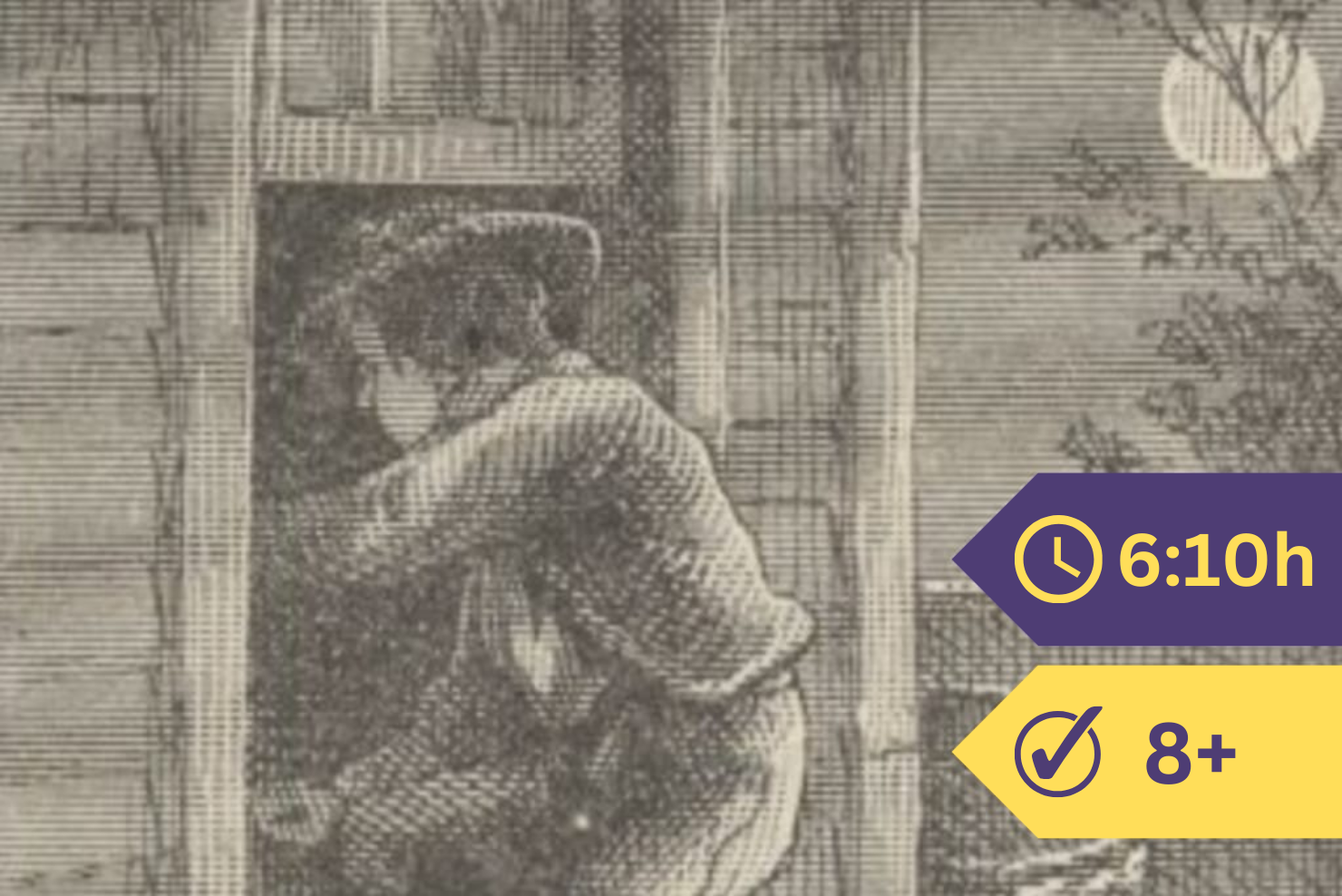
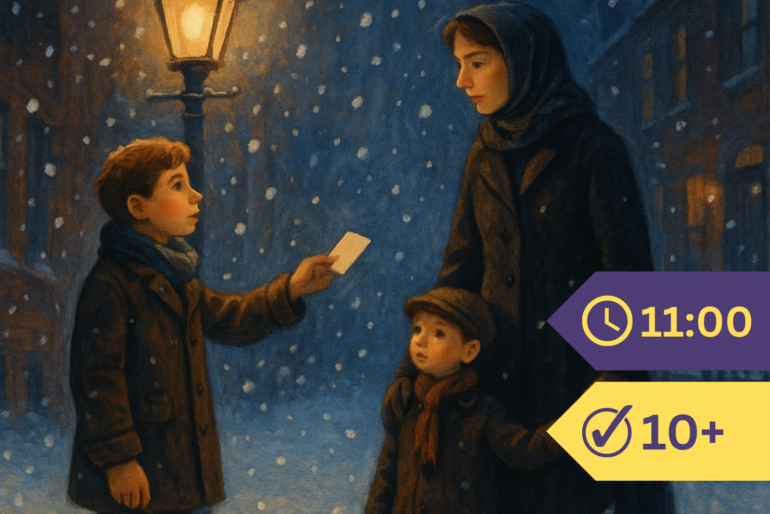
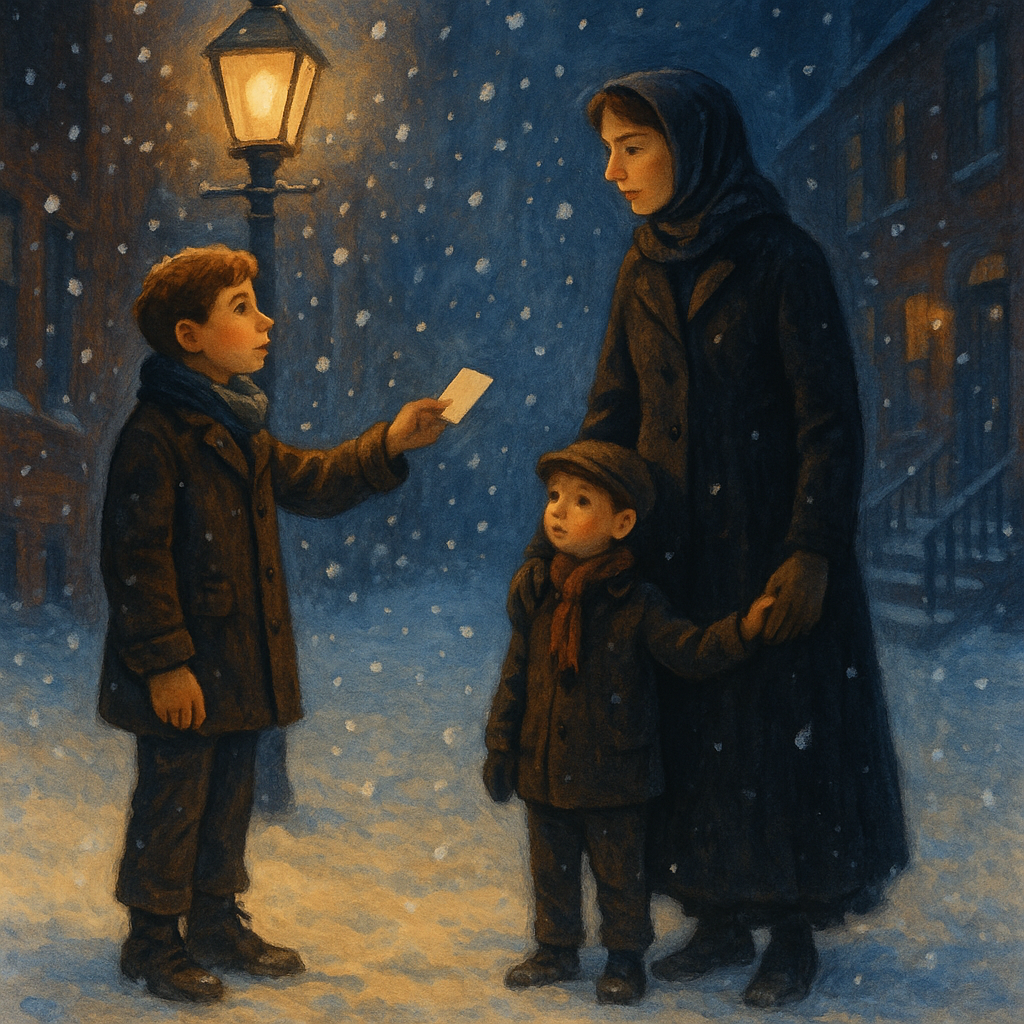
When the children went to church, he walked with his sister Isabel and told her the whole story — the part he would never tell his mother, and made Isabel swear she never would either. He had spent every last penny on Christmas presents. He had carried them home in the big basket they’d bought at the Pier. He’d walked home in the dark because he had no money left for the horse-car. Then, all of a sudden, a small German boy with a tall woman beside him stopped him in the street. In a very comical accent, the boy said: “East Canton street,” and thrust out a card that read, Karl Shoninger, 723 East Canton Street.
“Belle, I was in despair,” Asaph told her. “It was late. I was on Dwight Street, and I led them to Shawmut Avenue and tried to explain. But Belle — they didn’t know one word of English except ‘East Canton street.’ They kept saying it, the way a dog says ‘Bow-wow.’ I looked for a police officer and couldn’t find one. The snow came down harder and harder. I was coward enough to think of slipping away. But then I said to myself: Lie and cheat on Christmas Eve to lug home your Christmas presents — that’s too mean. So I said very loudly, ‘Kom hier!’ — that’s good German, anyway — and I dragged them all the way to their 723 East Canton Street. It’s a mile if it’s an inch. I climbed the snowy steps to read the number. But I slipped coming down and knocked my own basket off the step where I’d left it standing. That’s how Mamma’s coffee-pot got broken, I suppose — only everything looked so steady in the basket that I never even thought of it at the time. And that’s why I was late to supper. But Belle, don’t you ever tell Mamma as long as you live.”
And Belle never did. She told me.
That evening, when the Christmas dancing was half over — when they had acted out Lochinvar and Lord Ullin’s Daughter, but before they got to Villekens and Johnny the Miller — supper was served in Mrs. Sheafe’s dining room. All the best china was out: Grandmamma’s Spode, the silver pitcher the workers had given Papa on his fiftieth birthday, and what remained of Mrs. Sheafe’s wedding breakfast set. And Asaph’s coffee-pot held the place of honour. One broken fragment had been cemented back in place, but it was still a sorry little snout, and the lump rose in Asaph’s throat again as he looked at it. He almost wished his mother had put it away rather than tell Uncle Eliakim the whole story.
The lump was still there when he went to bed. He fell asleep soon enough. I will confess there were a few damp spots on his pillow. His last waking thought was of all his saved-up monthly allowances, spent for a coffee-pot with a broken nose.
The two angels who watch by his bedside looked at one another, and one said, “Would you not tell him?” The other answered: “Wait a little longer.”
What the angels would not tell him, I will tell you.
It happened that I was driving about in my sleigh that Christmas night, through the very snow that was falling when Asaph was fumbling up the steps of East Canton Street. I stopped at a house not far from Boylston Station, near the turn into Lamartine Street, and found myself in the middle of the cheerfulest little celebration imaginable.
The father was sitting with two babies on his knee. The older children were rummaging in a trunk for something that had worked its way to the very bottom. The mother clearly had no idea where anything was — in the trunk or anywhere else. But there was a broad grin on every face, and whatever anyone said was broken up by laughter and occasional kisses.
At last the lost parcel showed itself: a collection of glass Christmas-tree balls, which these good people had carried all the way from Linz on the Danube, quite certain that no such wonders would be known in that faraway America.
I wish I had room to tell you all the adventures that house-mother and her three boys and two girls and twin babies had met with on their journey from Linz to find Hans Bergmann, husband and father of the seven.
Hans had come over the year before. The family had followed now, travelling by way of Antwerp and landing in Philadelphia. But the ship had made such a quick crossing that when they arrived, Hans Bergmann was not there to meet them. Frau Bergmann ought to have waited in Philadelphia as he had told her to. But a talkative woman on the pier, who spoke fluent Bohemian and claimed to know exactly where Hans boarded in New York, persuaded her to take the whole family there instead — only for Frau Bergmann to discover that Hans had left that boarding house three months before. Still determined to spend Christmas with him, she had pressed on to Boston to ask his uncle Karl where he was. She arrived in Boston with the snowstorm, the day before Christmas, after an accidental detour through Bridgeport and Westfield.
And it was Asaph — kind, cold, penniless Asaph — who had led her to Uncle Karl’s lodgings at the very moment Uncle Karl was about to leave for Chicago.
Uncle Karl had the sense to bundle the whole family into a carriage and send them to a friend near Boylston Station, with instructions to keep them safe and warm. Then he telegraphed Hans Bergmann: Find your wife at Burr Street, No. 40, Boylston Station.
Hans Bergmann, who had been demanding answers from every police station in New York City, caught the early train and spent his Christmas ploughing through snowdrifts to Boston.
And so it was that at nine o’clock on Christmas night, I watched seven children at a Christmas party — not quite as well arranged as others I saw that day, but every bit as happy.
And all of it happened because Asaph Sheafe forgot himself on Christmas Eve and showed Frau Bergmann the way to East Canton Street.
As it happened, I also saw the diamond necklace that John Gilder gave his bride that night. But it gave nothing like as much pleasure as Asaph Sheafe’s Christmas present to the Bergmanns.
And yet he never knew he gave it.