“Then it is ‘yes,’ father dear?” said Angela, looking across the breakfast table with a smile. It was her mother’s smile, and the girl had filled her mother’s vacant chair for more than a year.
The eyes of the father and daughter met, and Angela knew, before a word was said, that she had conquered.
“I hate to see you at your age, beginning to worry over these things,” Ephraim Frazier said, regretfully. “Let the old women take care of the charities, dear. You keep on dancing in the sunshine a while longer, daughter.”
Angela’s smile grew graver, but not less sweet.
“I am twenty, dear,” she said. “Too old to dance all the time, and I cannot help thinking, you know. And — it’s no use, papa dear! I must do something. It is ‘yes,’ isn’t it?”
“You are sure you won’t mind being criticised and ridiculed?”
“Quite sure!” answered Angela.
“And sure you won’t take your failures and disappointments to heart too deeply?”
“Quite sure I can bear them bravely,” answered the girl. “If only one, just one, of those poor creatures may be helped, and lifted up, and brought out of darkness, it will be worth trying for!”
“And what does Robert Johns say about it?”
A glow kindled in Angela’s face.
“Robert is in perfect sympathy with me,” she said softly. Then again — this time having risen and gone around to his side, to speak with her face against the old banker’s smoothly shaven cheek — “It is ‘yes,’ isn’t it, daddy dear?”
“Well, yes! Only you must go slow, dear. You are not over strong, you know.”
And soon it came to pass that on a vacant lot, hitherto given over to refuse heaps and haunted by stray cats, ragpickers, and wandering children, in one of the bleakest quarters of the city, there sprang up with magic swiftness a large, cheerful frame building surrounded by smooth green grass. In the neighbourhood it was known as the Locust Street Home; in polite society it was laughingly called “Angela’s Experiment.”
Angela did not mind. It was mostly good-natured laughter, and many of the laughers ended by lending willing hands and hearts to the cause. Word spread through the city’s poorer streets that here was a sanctuary where cold, hunger, and fatigue dared not intrude — a place which anyone might enter and be made welcome, their dignity as carefully respected as though they were New York’s finest.
That was Angela’s theory. No man, woman, or child should be compelled to anything. First make their bodies comfortable, then surround them with warmth and music and beauty; entertain them, arouse them, hold out the helping hand, and leave the rest to God. “They shall not even be compelled to be clean!” she said, laughing. “If the beautiful bathrooms and fresh clothing do not tempt them, then so be it! I will have no rules — only influences. You will see!”
And people did see, and wondered.
Sometimes, on warm summer evenings, the spacious, cheerful hall would be nearly empty. But on nights like that on which this story opens — a dark, cold December night — the seats were well filled: tired women and hollow-eyed children sitting in rows, half-stunned by the warmth and quiet that were so foreign to their lives.
Outside, a dismal sleet was falling, but from the open vestibule door a great sheet of light fell upon the wet pavement, and above it glowed a sign bearing the words:
A Merry Christmas to All! Come In!
It was while the singing was going on, led by a high, sweet voice, that a figure came hobbling out of a side street and stopped short at the very edge of the lighted space.
A woman — an old, old woman, with a seamed, blotched face; a human wreck, battered and worn by the storms of a hard life. This was old Marg, known in the haunts that knew her best by an unkind nickname she’d long since stopped answering to. Her history? She had likely forgotten it herself, and there was no one left to know or care — no one in the wide world to care if she should at any moment slip from a dock into the black river. The garret that lodged her would find another tenant; the children of the gutters another target for their teasing. Not that she was worse than others — only that she was old, and sharp of tongue, and the world — even her world — has no use for such as she.
For some minutes the old woman hovered on the edge of the lighted square. The sleet had turned to snow; a thin white film already covered the pavement, and the cold deepened by the moment. She drew her shawl tighter, her jaw chattering, yet she seemed unable to move toward the open door. Her eyes — alert as a cat’s beneath their grey brows — moved from the door to the sign and back, but she stayed where she was.
Two rough, bearded men stopped near her and, after a moment’s consultation, slunk across the square of light and disappeared inside. As the door opened, a burst of warm air reached her, fragrant with coffee and oysters. Old Marg’s whole body shuddered with longing. Food, warmth, rest — everything her miserable frame craved — were there within easy reach, for the mere asking; nay, for the mere taking. Yet still the stubborn pride in her would not let go.
At last, as a bitter blast swept snow stingingly against her face, she uttered a hoarse sound — half snarl, half surrender — and, glancing about to see that no mocking eye was upon her, crept across the pavement, climbed the stone steps, and pushed open the door.
The hall was unusually full. Numbers of women and children occupied the front rows. A few men sat further back, hunched forward, hats gripped between their knees, eyes fixed on the floor. The women and children, by contrast, followed the young women on the platform with wide, watchful eyes.
The simplicity of dress which Angela and her friends had adopted did not deceive even the smallest child present — these were ladies, and everyone accorded them genuine if reluctant admiration.
Old Marg, once past the embarrassment of the first moment, took in everything with a single sharp glance: the Christmas greens on the clean white walls, a curtained space at the rear that hid some pleasant mystery, the men and women on the platform.
At the organ sat a young girl, leaning on the silent keys, her face turned toward the young man who was speaking. Old Marg could not take her eyes from that face — pale, serious, sweet, surrounded by pale golden hair. The sight of it stirred something strange in the old woman’s chest. Like a violet flung on a refuse heap, the thought of her own girlhood lay for an instant across sixty years of harder memories.
I was light-haired, too, ran old Marg’s thoughts. Light-haired, and fair-complexioned, like her.
The thought breathed across her soul and was gone. Still she gazed from under her shaggy brows, and without meaning to listen, found herself hearing what the speaker was saying. He was telling, simply and without pretence, the story of Christ — and with care and feeling, presenting the lesson of His life.
“This joy of giving, of sacrificing for others,” the young man was saying in his earnest, musical voice — “so far beyond the joy of receiving, is within the reach of every human being. Think of that. The poorest man or woman or child who breathes on earth tonight may know this joy — may give some pleasure, some help, some comfort to some fellow creature. Whether it be a human creature or a dumb beast, it is all one in God’s sight, being an act of love and kindness and sacrifice.”
Old Marg looked down at her squalid rags. Her rough features twisted with a scornful smile. “That’s a lie!” she muttered. “What could the likes of me do for anybody, I’d like to know!”
But still she listened; and at last, as the warmth stole through her sodden clothing and into her chilled bones, and the peace of the place worked its way into the turbulent corners of her soul, the man’s voice became like a voice heard in a dream, and the old outcast slept.
A great confused sound greeted her awakening. Someone was playing the organ jubilantly. Girls moved through the hall with trays of steaming dishes. Children were talking and laughing all at once. The curtain at the rear had been drawn back to reveal a great Christmas tree that blazed with light, and around its base lay heaped gifts of every description.
Old Marg stared about in bewilderment — at the tree, at the people, at her own worn rags. A fierce shame rose up inside her. She wanted nothing more than to get out of sight, to be swallowed up again by the darkness that was her proper element. She lurched to her feet. A young girl approached with a tray of fragrant food. Old Marg could have fallen upon it — but instead she pushed the girl roughly aside and fumbled at the door-knob.
A hand was laid on her arm. The girl with the sweet, pale face was looking at her with a friendly smile.
“Won’t you stay and have something warm to eat before going into the cold?” she asked gently.
Old Marg shook the hand from her arm. “No!” she snarled. “I don’t want nothin’! Let me go!”
With a patient smile, Angela opened the door.
“I am sorry you will not stay,” she said softly. “It would give me great pleasure. There is a gift for you on the tree, too. It is Christmas Eve, you know.”
A hoarse, choking sound came from the old woman’s lips. She pushed past into the vestibule. Angela followed.
“If you should feel differently tomorrow,” she said, in her kind, gentle voice, “come here again, about eleven o’clock. I shall be here.” Without waiting for a reply, she re-entered the hall. A young man — the same who had been speaking — met her at the door.
“Angela! You should not be out there in the cold!” She smiled, still looking past him. “Did you see her, Robert?”
“That poor old woman? Yes, I saw her. A hopeless case, I fear.”
Angela’s eyes kept their distant look. “It was awful to see her go like that, into the cold and snow, hungry and half-clad.”
The young man leaned nearer. “Angela,” he said quietly, “you must not let these things sink into your heart as you do, or you cannot bear the work you have taken on. As for that old creature — it is terrible to think of her, but she seemed to me beyond our reach.”
“But not beyond God’s reach through us,” said Angela.
Meantime old Marg was facing the storm with rage and pain in her face and in her heart. The streets were deserted, lit only by the dim glow from shop windows and saloons. From these last came the sounds of rough company and arguing voices. At one or another doorway the old woman paused, listening. Ought she to go in? Someone might give her a drink, to ease for a time the terrible gnawing in her chest. Might — but more likely she’d be thrust out with jeers and curses, and tonight she had no stomach for a fight. So she staggered on until the crumbling tenement was reached, stumbled up five dark flights of stairs, and fell into the dismal garret she called home.
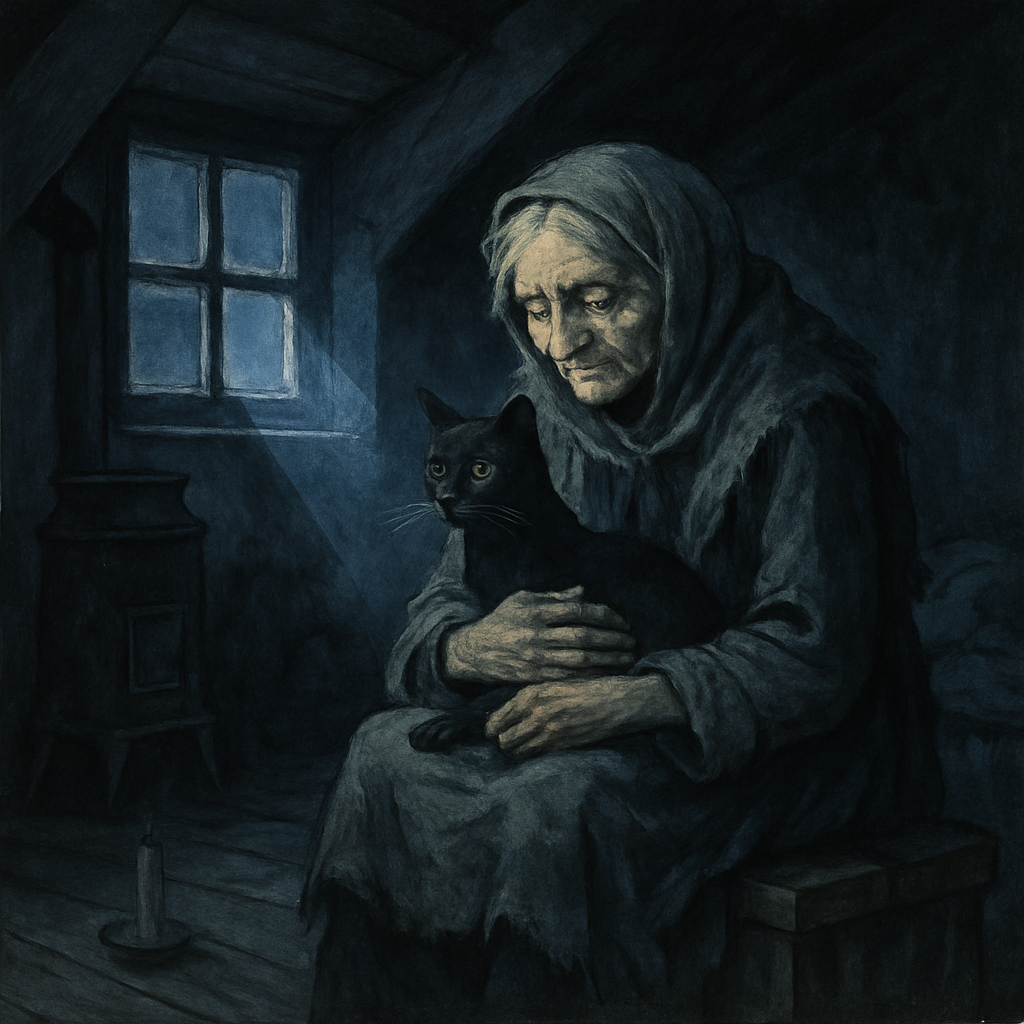
Feeling about in the darkness, she found a match and lit a stub of candle wedged in the neck of an empty bottle. It burned uncertainly, as if reluctant to reveal what it must illuminate: a smoke-stained, sloping ceiling; a blackened floor; a shapeless mattress heaped with rags; a rough wooden box; a rusty stove propped on two bricks, supporting an ancient frying-pan, a chipped saucer, and a battered tin can — the cup from which, when times were slightly better, old Marg served herself her afternoon tea.
There was no fire, nor any means of making one. But on the box lay a piece of paper holding a slice of bread and a soup-bone with some scraps of meat still clinging to it — a gift from a neighbour hardly less wretched than herself.
Old Marg’s eyes lit up at the sight. She seized the food and sank onto the box, working at it with her toothless gums — but they were stiff with cold and made no impression on the tough meat and hard bread. She let it drop to the floor and sat rocking back and forth, whimpering tearlessly, like a suffering animal.
Strangely, within the withered bosom of this most wretched creature, there had welled up from somewhere a fierce self-pity, and with it a no less fierce self-loathing. That was what a single moment’s contact with all she had so long lost — warmth, order, kindness — had brought to pass.
That fair young girl, pale and sweet, stood before her like a living memory pointing back across the years to the time when she, too, had been young, and pretty, and hopeful — too pretty and too hopeful for a poor working girl! That was where the trouble had begun.
“I was light-haired, too,” old Marg moaned, twisting her knotted fingers. “Light-haired, and fair-complexioned! A pretty girl, and a good girl — once. Little the likes of her knows what the likes of me has to face. Lord!”
The candle guttered and went out. The cold deepened. The snow had stopped; a sharp wind had arisen, tearing the clouds into shreds through which stars gleamed. Presently the moon climbed up behind the belfry of the old church across the square and sent a broad white ray through the dingy window and across the floor. The great bell began to strike midnight, its slow vibrations filling the garret.
The vision of the fair girl faded. Old Marg was herself again: a hard, bitter, exhausted woman, with a burning ache where her heart had been. She had had enough. She had been wrung dry of everything. There was nothing left.
After a long while she rose and hobbled along the moon-ray to the window and pushed it open. The cold rushed in, and she stood there, looking out at the sleeping city, with its white rooftops and the sharp shadow of the church tower stretching across the square below — looking at nothing, feeling nothing, wanting only for it to be over.
She was about to pull the window shut again when a shadow that lay alongside the chimney showed signs of life. Slowly it rose on four thin and bony legs and became a cat — a lean black cat that crept meekly toward her, its pale eyes gleaming, its jaws parting in a soundless attempt to mew.
Old Marg drew back, startled. The cat crept closer, rubbing its thin body against the outstretched arm.
The cruel, exhausted old face softened without warning. “Lord!” muttered old Marg. “If she ain’t a-tryin’ to purr! Well, that beats me.”
The poor beast continued its piteous appeal, arching its starved frame, waving its tail, fawning trustingly against the very hand that had—
Old Marg drew the animal inside and closed the window.
“She’s been somebody’s pet,” said the old woman, setting her down on the floor. “She ain’t always been like this.”
Something new stirred in her chest — something she had no name for, having not felt it in a very long time. The man at the hall had not been lying, after all. Here was another creature of God as miserable as herself — more so, even, for she had a roof, and she could share it.
“Poor puss!” muttered old Marg, stroking the rough fur. “You’re starving, too, ain’t ye? And I ain’t got nothing to give ye — not a bite or a sup. Ah!”
Her eyes fell on the discarded food. She seized it and placed it before the cat; the starving creature gnawed at the bone a moment, then looked up with a hopeless sound.
Old Marg felt a sharper pang of pity.
“Poor beast! Ye can’t eat it, can ye? No more could I. We’re in the same box, puss — old, and toothless, and nobody belonging to us. We’ll have to starve together, I guess. And it’s Christmas Day! Did ye know that, puss? Christmas Day. Lord! Lord!”
The cat rubbed against her skirts, watching her face.
“Seems to understand every word I say,” old Marg muttered. “If only I had a drop of milk for her!”
Hobbling to the stove, she examined the battered tin can in the moonlight. A little cold tea remained at the bottom. With this she moistened some of the bread and placed it before the cat, which devoured it eagerly. Then she took the animal in her arms, lay down on the mattress, and drew the ragged covers over them both. The cat nestled against her side. The warmth of the two poor bodies mingled, and both slept.
The moon-ray crept along and spread itself over the heap of rags — the knotted fingers resting on the cat’s rough fur, the seamed old face — then passed away. Morning dawned, with bells pealing and footsteps on the pavement below, and still the two slept on.
Angela stood near the door of the Locust Street Home, receiving her Christmas guests. They came straggling in, in twos and threes — some boldly, some ashamed, some eager, some indifferent, but all poverty-worn. Each was pleasantly welcomed and passed on to the feast. Angela watched and waited.
At last the door opened slowly to admit old Marg. She stopped short on the threshold with a look at once stubborn, appealing, suspicious, and ashamed — like a wild creature on alert for the faintest sign of rejection. She stood there, and Angela only smiled and offered her hand: a soft hand, bare of rings, but the hand of a lady.
“A Merry Christmas!” Angela said brightly.
“I was ugly to ye last night,” said old Marg, her voice rough.
“Never mind. You were tired.”
“I am a bad old woman,” said old Marg, mistrustfully.
“Never mind that either,” said Angela. “Let me be your friend. If you will, you shall never be cold or hungry again.”
A profound wonder came into the old face — and then it began to work, and from each eye came the scanty tears of age, finding their channels in the worn creases of her cheeks.
“You will let me be your friend,” Angela urged gently.
Old Marg wept in silence.
“You shall have a pleasant home, and —”
A sharp, suspicious look darted from the wet eyes. “Not a ‘sylum, miss, please!”
“No,” said Angela quietly. “Not an asylum. A home — a bright, clean, comfortable home.”
“I can work, miss!” put in old Marg, holding up her knotted hands to show their strength. “I can wash, and scrub —”
“Yes,” said Angela. “You may work all you are able, helping to keep things comfortable.”
Still old Marg looked doubtful. She wiped her cheeks with a corner of her shawl and half turned toward the door.
“Have you any family?” Angela asked. “Anyone belonging to you?”
“Yes,” said the old woman, with sudden firmness. “I have a cat. Where I go, she must go, too!”
Angela took the grimy hand and patted it, laughing a laugh that was good to hear.
“I understand you perfectly,” she said. “I have a cat of my own. You and your cat shall not be separated.”
Half an hour later, Robert came in from the street to find Angela standing quietly near the fire. She pointed, without speaking, to old Marg settled in a warm corner, contentedly making her way through a Christmas dinner.
“What have you done to her?” he asked. “She looks more human already.”
Angela laughed again — that same laugh that goes to one’s heart so.
“I have adopted her,” she answered. “And her cat. That’s all!”