Chapter I
Alice’s Christmas tree started as a modest idea — a small, intimate tree for perhaps fifteen or twenty of the poorest children from the neighborhood near the chapel. A cosy affair in the chapel parlor, the kind of cheerful Christmas jollity she had imagined: just herself and Lillie, and Mr. Williams, and Mr. Gilmore, and John Flagg, and I, with her mother keeping an eye on things.
But Alice had a generous nature, and the tree had a way of growing.
It became, as I can only call it, a truly universal tree — and everybody wanted to help. If someone sent round a box of dominos, or a jack-knife, or one of those open-eyed-shut-eyed dolls, who was Alice to say it shouldn’t go on the tree? And when Mrs. Hesperides sent a box of Fayal oranges, who was Alice to say the children shouldn’t have oranges? And when Mr. Gorham Parsons contributed nearly a barrel of Hubbardston Nonsuch apples, who was Alice to say they shouldn’t have apples? So the tree grew and grew and bore more and more fruit, until it was clear there would be upwards of eighty proper presents on it, besides apples and oranges and almonds and raisins without end.
This was a very great enlargement of Alice’s original plan, and it brought her to grief, as you shall see.
For now Alice began to fear there wouldn’t be enough children from the highways and byways to fill all those presents. So, as evening drew on, she set out herself — with George, the household’s trusted major-domo — and walked through the poorest streets near the chapel. Whenever she saw a particularly forlorn child, or a group of children huddled in a doorway, she sailed up with all the courage she could muster (though she was frightened half to death) and invited them to the tree. She handed out little admittance cards that read: 7 o’clock, Christmas Eve, 507 Livingstone Avenue — in case the children wouldn’t remember. She asked Mr. Flagg and Mr. Gilmore to take cards out toward Williamsburg and do the same, with instructions to find the dirtiest and most forlorn children they could. A friendly police officer of Alice’s acquaintance was also permitted to spread the word — though he was also stationed at the street door, armed with the authority of the City of New York, with orders to admit no more than eighty.
Ah, my poor Alice issued her cards too freely. Better, it might seem, had she held to her original plan. At least she thought so then, and thinks so still. But I am not so certain.
At quarter to seven, the street children were already crowding the door — along with a great many others who had heard rumour of a “free lunch” and drawn their own conclusions. Officer Purdy did his best; he admitted those with cards and turned away legions of others. But the throng only grew. Upstairs, Alice and Lillie and the young gentlemen and Mrs. MacNeil were still working, dressing the tree — which was, by the end, a perfect beauty. They lit the candles, and nothing could have been more lovely.
“Let them in!” cried John Flagg, rushing to the door as the knocking began. “Let them in — the smallest girls first!”
Smallest girls, indeed. The door swung open, and a tide of children — small, large, nearly grown — came surging in, screaming, scolding, pushing and pulling. Omitting the profanity, these are the Christmas carols that fell on Alice’s ear:
“Out o’ that!” “Take that, then!” “Who are you?” “Hold your jaw!” “Can’t you behave decent?” “You lie!” “Get out of my light!” “Oh dear, you killed me!” “Who’s killed?” “Golly, see there!” “I say, ma’am, give me that pair of skates!” “Shut up —” and so on, growing more impertinent by the minute as the crowd grew more comfortable with its position.
Young Gilmore — who was willing to oblige Alice but was not going to stand any nonsense, and would cheerfully have knocked the heads together of any five pairs from this rebel rout — climbed up onto the railing that Mr. Williams had thoughtfully built around the tree, and addressed the riotous assembly.
They stopped to hear him, supposing he was about to distribute the gifts.
He told them roundly that if they didn’t keep the peace and stop the crowding and yelling, they’d all be turned out; that the smallest children were to come forward first; and that nobody would eat anything until this was done.
Some approach to order followed. A few small waifs were found who could honestly be called little boys and girls. But as Alice looked down from her chair, she felt as if most of her guests were overgrown older boys and girls, already quite capable of managing for themselves in the world, and all too eager to claim what was offered without any thought of those smaller than themselves. She and Lillie tried to set this feeling aside. They kissed a few little girls and caught the faintest gleam of pleasure on one or two small faces — but even that was nearly extinguished by the older children howling all around.
So the howling resumed as the distribution got underway. “Give me that jack-knife!” “I say, Mister, I’m as big as he is.” “He had one before and hid it.” “Get down, Tom Mulligan — get off that fence or I’ll have you.” “I don’t want the book, give me them skates.” “You sha’n’t have the skates, I’ll have ’em myself —” and so on.
John Flagg finally knocked down Tom Mulligan, who had squeezed behind the tree and was attempting to steal something, and had the grim satisfaction of sending him bellowing from the room with blood streaming from his nose. Gilmore, meanwhile, was rapidly handing an orange and an apple to each child, which — while the oranges were being sucked — gave a moment of quiet. Alice and the ladies, thoroughly frightened, were stripping the tree as fast as they could and at last announced it was all gone with nearly as much relief as they had announced it was all full. “There’s a candy horn on top — give me that.” “Give me that little apple.” “Give me the old sheep.” “Hurrah for the old sheep!” — this last about a small carved lamb that had been placed as a decorative ornament at the front of the tree.
Then the howl about oranges began. “I want another orange.” “Bill’s got some and I’ve got none.” “I say, Mister, give me an orange.”
To which Mister replied by opening the window and calling down into the street: “Purdy! Call four officers and come up and clear this room.”
The room did not wait for the officers. It cleared itself with remarkable speed, and was left a scene of wreck and ruin. Orange-peel trampled into the floor; cake thrown down and mashed to mud, mixed with the mud that had come in on boots and the water that had sloshed from hastily seized mugs; sugar plums that had fallen in the scrambles, and little sprays of evergreen green, all ground together into something that looked like the pavement outside a market.
Poor Alice was half crying and half laughing. Poor Lillie was wholly crying. Gilmore and Flagg were explaining to each other at length how gladly they would have dealt more firmly with the lot.
The thought uppermost in Alice’s mind was that she had been a thoroughgoing fool. And that, probably, is the conclusion most readers would reach, seeing things from her point of view alone.
Chapter II
Perhaps the reader is willing to take another point of view.
As the group stood there talking over the disaster — as John Flagg tried to make Alice laugh by presenting her with a half-piece of frosted pound cake, solemnly assuring her it had not touched the floor — as Alice said, her eyes streaming, “I tell you, John, I am a fool, and I know it, and nobody but a fool would have started such a row” — at this moment, Patrick Crehore slipped back into the room.
Pat had come back for his little sister’s orange, which he had wrapped carefully in her handkerchief and left on one of the bookshelves. He was alone now and therefore properly sheepish, and got himself and the orange out of the room as quickly as he decently could. But he was sharp enough to take in the whole scene, and keen enough to catch Alice’s words as she spoke to Mr. Flagg. The general air of disappointment and chagrin, the contrast between the filthy wreck and the pretty elegance of an hour ago, were plain enough to be noticed by a far less observant boy than Patrick Crehore.
He went downstairs, found his little sister Bridget waiting, and walked home with the small toddler, thinking rather more than was his habit about Alice’s phrase: I am a fool. Still turning it over, he hauled Bridget up five flights of stairs and pushed into the little room where the table was set with a good spread of tea, baker’s bread, butter, cheese, and cabbage, waiting for them. Jerry Crehore, his father, sat smoking; his mother was tidying up.
“And had ye a good time, me darling? You’ve brought home your orange, and a doll too, and mittens! And what did you have, Pat?”
Pat explained, almost sulkily, that he had a checker-board and a set of checker-men, which he produced — then set aside as if he hated the sight of them. He helped little Bridget to her cabbage, ate something himself, drank some tea, and then delivered his grievance with great feeling and some incoherence, but to his own considerable relief.
“It’s a mean thing, all of it,” he said. “I don’t know who the lady is, but we’ve made her cry, I know that much, and the boys acted like the devil himself. They knew it, too. The man there had to knock one of them down — and served him right. The fellows fought and hollered and stole, and you’d have thought you were driving pigs down Eighth Avenue. And I was as bad as the worst of them. That’s what the boys did when a lady asked them to Christmas.”
“That was a mean thing to do,” said Jerry, removing his pipe from his mouth for a longer speech than he had ever been known to make while smoking.
Mrs. Crehore put down her dish-cloth, sat down, and gave her opinion. She had never in her life seen or heard of a Christmas tree. But she knew very well that those who went to visit a lady should show manners and behave like gentlemen — or not go at all. She expressed her firm conviction that Tom Mulligan had got exactly what he deserved, and her only regret was that he hadn’t come away with two black eyes instead of one. She would have been equally glad, she added, if certain Floyds and Sullivans and Flahertys she could name had shared the same fate.
This declaration, and his father’s quiet verdict still more, somewhat eased Pat’s mind; and when supper was finished, after a long silence, he said: “We’ll give her a Christmas present. We will. Tom Mulligan and Bill Floyd and I. The others won’t know. I know what we’ll give her. I’ll tell Bill Floyd that we made her cry.”
Chapter III
After supper, accordingly, Pat Crehore made his way to the various haunts of the neighbourhood’s younger population, in search of Bill Floyd. Bill was not at the first place, nor at the second — there being no principle known to men or angels by which Bill’s whereabouts at any particular moment could be reliably predicted. But Bill also, in his proud free-will, obeyed certain general laws; and so Pat eventually found him, serving as a self-appointed inspector of operations, watching the hauling-out and oiling of the hose at a neighbouring fire company.
“Come here, Bill. I’ve got something to show you.”
Bill had already carried home and put in safe keeping a copy of Routledge’s Robinson Crusoe, which had been his gift. He left the hose inspection willingly and hurried after Pat — past many interesting diversions, not even pausing where a brewer’s horse had fallen in the street — until Pat led him in triumph to the bright window of a shoe-shop, gaily lit and full of the wares by which even shoe-shops lure in customers at Christmas.
“See there!” said Pat, nearly breathless.
He pointed to the very centrepiece of the display: a pair of slippers made from bronze-gilt kid leather, with a hideous blue silk bow perched on the gilding. For what occasion these slippers had been designed, or by what standard of beauty, I cannot say. They were, at any rate, the crown jewel of the shop window. Pat looked at them with deep admiration — he had admired them many times before — and said to Bill Floyd: “Ain’t they handsome?”
“Golly,” said Bill. “I suppose so.”
“Bill, let’s buy those little shoes and give them to her.”
“Give them to who?” said Bill, from whose mind the Christmas tree had temporarily faded, displaced by the fire company, the fallen horse, and the shop window. “Give them to who?”
“Why, her — I don’t know who she is. The girl that put on the tree, you know, and gave us the oranges, where old Purdy was standing. I’ll tell you, Bill, it was a mean and dirty shame to make such a row when we’d been invited to a party. And I want to make the lady a present, because I saw her crying, Bill. Crying because of the row.”
“They are handsome,” said Bill, meditatively. “Aren’t the blue ones the handsomest?”
“No,” said Pat, who could see that he had gained his ground and that carrying his point was now only a matter of time. “The gold ones are the ones. We’ll give them to her for a Christmas present — you and I and Tom Mulligan.”
Bill Floyd did not object — being rather accustomed to following where he was led, as were most of the riotous company with whom he had been acting an hour before. He agreed entirely with Pat’s proposal. By “Christmas” both of them understood that the gift could be made any time before Twelfth Night; it need not be on Christmas Day itself. Neither of them had a penny; but both knew perfectly well that whenever they chose to get a little money, they could.
They soon tackled their first question: the price of the coveted slippers. They knew they would be turned out of the shop if they walked in to ask; but by lying in wait, they soon spotted Delia Sullivan, a respectable-looking girl they knew, passing by. Having taken her into their confidence — enough that she was certain she wasn’t being made a fool of — they sent her in to inquire. She returned with startling news: the shoes cost six dollars.
“Six dollars for those!” cried Pat. “I bought my mother’s new overshoes for one.” But not for one moment did he waver in his determination, and he and Bill Floyd went in search of Tom Mulligan.
Tom was found easily enough, but it was not so easy to pry him loose. He was in a corner liquor store, keeping company with men who were smoking, drinking, and telling rough stories. Either of the other boys would have been well punished at home if he’d been found in such a place. But Tom Mulligan had had no one to keep him straight for a long time — not until John Flagg had struck out so smartly from the shoulder. Perhaps, had there been some firm guidance along the way, it might have been better for Tom. The boys found him without trouble, but had some difficulty persuading him away. With many assurances that they had something to tell him and something to show him, they lured him out of the warmth and into the night.
Pat Crehore, who had more of the gift of persuasion than he knew, then boldly told Tom Mulligan the full story of the Christmas tree — everything that had happened after Tom’s ejection. Tom was sullen at first, but warmed to the account, and even managed to show indignation at the behaviour of boys who had seemed, by his lights, barely worse than himself. All three agreed that it had really been the fault of certain uninvited interlopers who ought to be ashamed of themselves; they further agreed that on some future occasion, not relevant to this story, they would settle scores with the Tidds and the Sullivans. When Pat wound up by describing how he had seen the ladies crying, and the pretty room looking like a pigsty, Tom Mulligan was the loudest of all in declaring that the whole thing had been wrong and that nobody but a blackguard could have taken part in it — particularly such blackguards as the Tidds and Sullivans aforesaid.
Then, to Tom’s sympathetic ear, was confided the project of the gold shoes, as the slippers were henceforth always called. Tom approved entirely. He even approved the price: it would be cheap and mean, he explained, to give a lady anything that cost less. This was precisely the figure that recommended itself to his better judgment. And so the boys went home, agreeing to reconvene Christmas morning as a Committee of Ways and Means.
I need not admit you to the deliberations of this committee. Many schemes were proposed, among them working through the holidays at certain bowling alleys they knew, or buying out a friend named Fogarty from his newspaper route for a few days. But the decision was that Pat — the most presentable of the three — should put on his Sunday suit and offer the services of himself and two unspecified friends as extra corking-boys at Birnebaum’s brewery, where Tom Mulligan had heard they were working nights to fill a rush order. This scheme succeeded. Pat and his friends were taken on for trial on the evening of the 26th; the foreman of the corking-room was satisfied with their work; and they kept their positions until New Year’s Eve, when they were each paid three dollars and resigned.
“Let’s buy her three shoes!” cried Bill, in an excess of enthusiasm at their success. This proposal was rejected. Each of the other boys, by this time, had a private plan for an additional gift of his own. The sacred six dollars was folded in a piece of straw-paper from the brewery; the young gentlemen went home to wash and change — something they had had no chance to do on Christmas Eve. After that, there was no difficulty about entering the shoe-shop, nor about completing the purchase, to the utter astonishment of the dealer. The gold shoes were bought, wrapped in paper, and ready for delivery.
Bill Floyd had meanwhile learned, by inquiry at the chapel, where she lived — though there was some doubt as to whether any of them actually knew her name. The others overruled his suggestion that they take the streetcar, and they walked the whole way on foot to Clinton Avenue, ringing the bell with no small amount of terror.
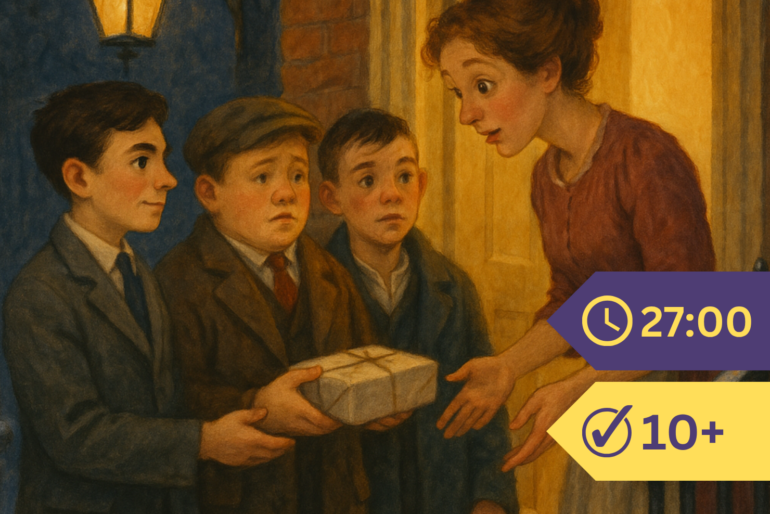
That terror did not decrease when George appeared at the door — the same man they had seen at the tree. But fortunately George did not recognise them in their Sunday best. When they asked for “the lady that gave the tree,” he asked them to wait a moment; and in less than a minute, Alice came running out to meet them.
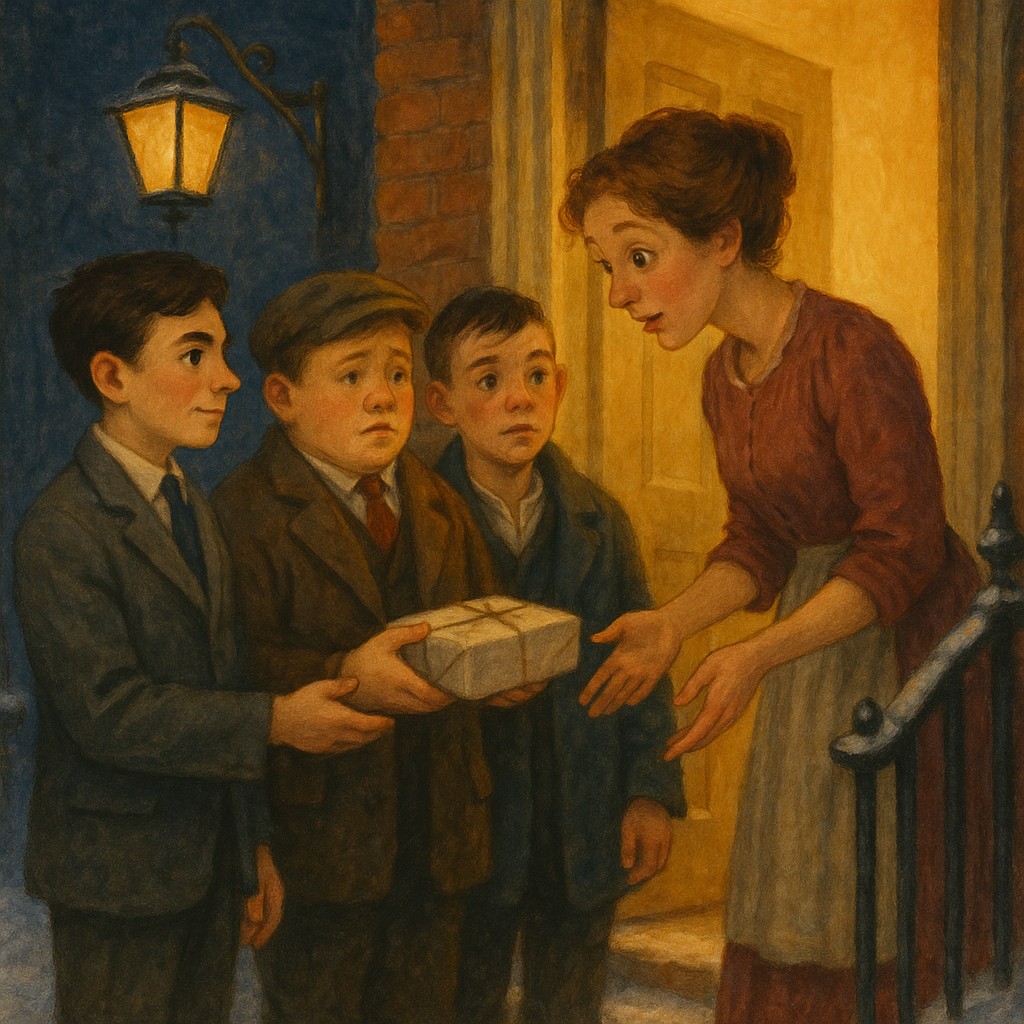
To the boys’ great relief, she was not crying now.
“If you please, ma’am,” said Tom, who had been appointed spokesman — “if you please, these are our Christmas present to you, ma’am. They’re gold shoes. And please, ma’am, we’re very sorry there was such a row at the Christmas, ma’am. It was mean, ma’am. Good-bye, ma’am.”
Alice’s eyes were growing wider and wider, and at that moment she did not quite understand. The words “gold shoes” and “row at the Christmas” lodged in her mind, however, and she understood there was a gift. And so, by instinct, she said and did exactly the right thing — being, through and through, a lady.
“No, you mustn’t go. Come in, boys, come in. I didn’t recognise you, of course.” As how should she. “Come in and sit down.”
“Can’t you take off your hat?” Tom said quietly to Pat, who had overlooked this courtesy upon entering. Tom was gratified to find himself the one offering such a reminder.
Alice opened the parcel. She had recovered her composure by now, and however astonished she was at the gold shoes, she showed not a trace of it — indeed, she slipped off her own slipper on the spot and showed that the gold shoe fit, to Tom’s great delight (he had been preparing to explain that the shopman would exchange them if they were too small). She found an apple for each boy and thanked and praised each one separately. The visit would have been entirely perfect had she not innocently asked Tom what had happened to his eye. Tom’s eye! — which was, of course, the black eye John Flagg had given him. Bill Floyd unfortunately sniggered; but Pat came forward this time and said quietly, “Someone hurt him.” Then Alice produced a pair of mittens that had been left behind at the party, and asked if anyone knew whose they were. The boys didn’t know.
When they reached the street again — all three in the particular mood that disguises strong feeling — Pat said: “I’m going down to the writing-school at the Union. Let’s all go.”
They agreed.
“I went there last Monday, with Meg McManus,” said Pat. “It’s real good fun, I tell you.”
The other two, still wearing their unfamiliar Sunday clothes, were well aware they could not return to their usual haunts, and both consented.
To the astonishment of the teacher, these three large and unlikely boys placed themselves on the side of order that evening, took their assigned seats without complaint, and — by their mere presence and attitude — turned the mood of the whole class. The worst corner of the school was its quietest corner that night.
To his further astonishment, the same thing happened the next night. And the next.
On Twelfth Night, Alice received a gilt envelope. Inside, on heavily ruled paper, were the following truths, laboriously set down:
MARM, — The mitins wur Nora Killpa trick’s. She lives inn Water street place behind the Lager Brewery.
Yours to command,
WILLIAM FLOYD.
THOMAS MULLIGAN.
PATRICK CREHORE.
The names — which the boys had copied from signs — were correctly spelled.
To Pat’s amazement, Tom Mulligan kept going to the writing-school all winter. By the end of the term, he had the best hand of any of them.
And to my own amazement: one evening, two years to the day after Alice’s tree, I stopped into Longman’s bookshop, where a bright-eyed young man was wrapping up the copy of Masson’s Milton I had given myself for a Christmas present. He said, “You don’t remember me.”
I admitted that I didn’t.
“My name is Mulligan — Thomas Mulligan. Would you thank Mr. John Flagg, if you see him, for a Christmas present he gave me two years ago at Miss Alice MacNeil’s Christmas tree? It was the best present I ever had — and the only one I ever deserved.”
I told him I would.
I told Alice afterward never to expect to catch every fish in any particular stretch of water. Cast your bait widely enough for all, I said — and thank God if your efforts are skilled enough to bring in one.