The man stepped on something yielding and soft, and instantly felt the fangs sink into his foot. He leaped forward, cursing, and spun around to see a yararacusú, coiled upon itself, poised for another strike.
He cast a swift glance at his foot, where two pinpricks of blood were slowly swelling, and drew the machete from his belt. The viper saw the threat, burying its head deeper into the center of its coils, but the flat of the blade struck home, shattering its spine.
The man bent to the bite, wiped away the gathering blood, and regarded it for a moment. A sharp pain bloomed from the two small violet punctures, beginning to invade his entire foot. Hurriedly, he knotted his kerchief tightly around his ankle and pushed on along the trail toward his ranch.
The pain in his foot worsened, bringing a sensation of taut, swollen fullness. Suddenly, two or three bolts of pain, like lightning flashes, shot from the wound halfway up his calf. He moved his leg now only with difficulty; a metallic dryness seized his throat, followed by a burning thirst that tore another oath from him.
He reached the ranch at last and threw himself against the wheel of the trapiche. The two violet dots had vanished now into the monstrous swelling of the whole foot. The skin looked thin, stretched taut to the point of bursting. He tried to call his wife, but his voice broke, a hoarse rasp from his parched throat. Thirst consumed him.
“Dorotea!” he managed to force out in a strangled cry. “Get me rum!”
His wife ran over with a full glass, which the man gulped down in three swallows. But he tasted nothing.
“I asked for rum, not water!” he roared again. “Get me rum!”
“But it is rum, Paulino!” the woman protested, frightened.
“No, you gave me water! I want rum, I tell you!”
The woman ran again, returning with the demijohn. The man swallowed one glass, then another, but felt nothing pass his throat.
“Well… this is getting ugly,” he muttered then, staring at his foot, livid now and taking on a gangrenous sheen. Above the tight binding of the kerchief, the flesh bulged like a monstrous blood sausage.
The shooting pains struck in relentless flashes, now reaching his groin. The atrocious dryness in his throat, which his own breath seemed to heat, intensified constantly. When he tried to straighten up, a violent wave of vomit seized him, holding him for half a minute with his forehead pressed against the wooden wheel.
But the man did not want to die. He made his way down to the shore and climbed into his canoe. Seating himself in the stern, he began paddling toward the center of the Paraná. There, the river’s current, running at six miles an hour near the Iguazú, would carry him to Tacurú-Pucú in under five hours.
With grim energy, the man managed to reach the middle of the river; but there his numb hands dropped the paddle into the canoe. After another bout of vomiting—blood, this time—he cast a look at the sun, already dropping behind the forested hills.
His entire leg, up to mid-thigh, was now a deformed, rock-hard block bursting the seams of his trousers. The man cut the binding and slit his trousers open with his knife: his lower abdomen swelled out, covered in large, livid blotches, excruciatingly painful. He knew he could never reach Tacurú-Pucú alone and decided to ask for help from his compadre Alves, though they had been estranged for a long time.
The current now drove toward the Brazilian shore, and the man could easily beach the canoe. He dragged himself up the trail climbing the bank, but after twenty meters, exhausted, he collapsed face down.
“Alves!” he shouted with all the strength he had, then listened in vain. “Compadre Alves! Don’t deny me this favor!” he cried again, lifting his head from the dirt. In the jungle silence, not a sound answered. The man found the strength to get back to his canoe, and the current seized it again, carrying it swiftly adrift.
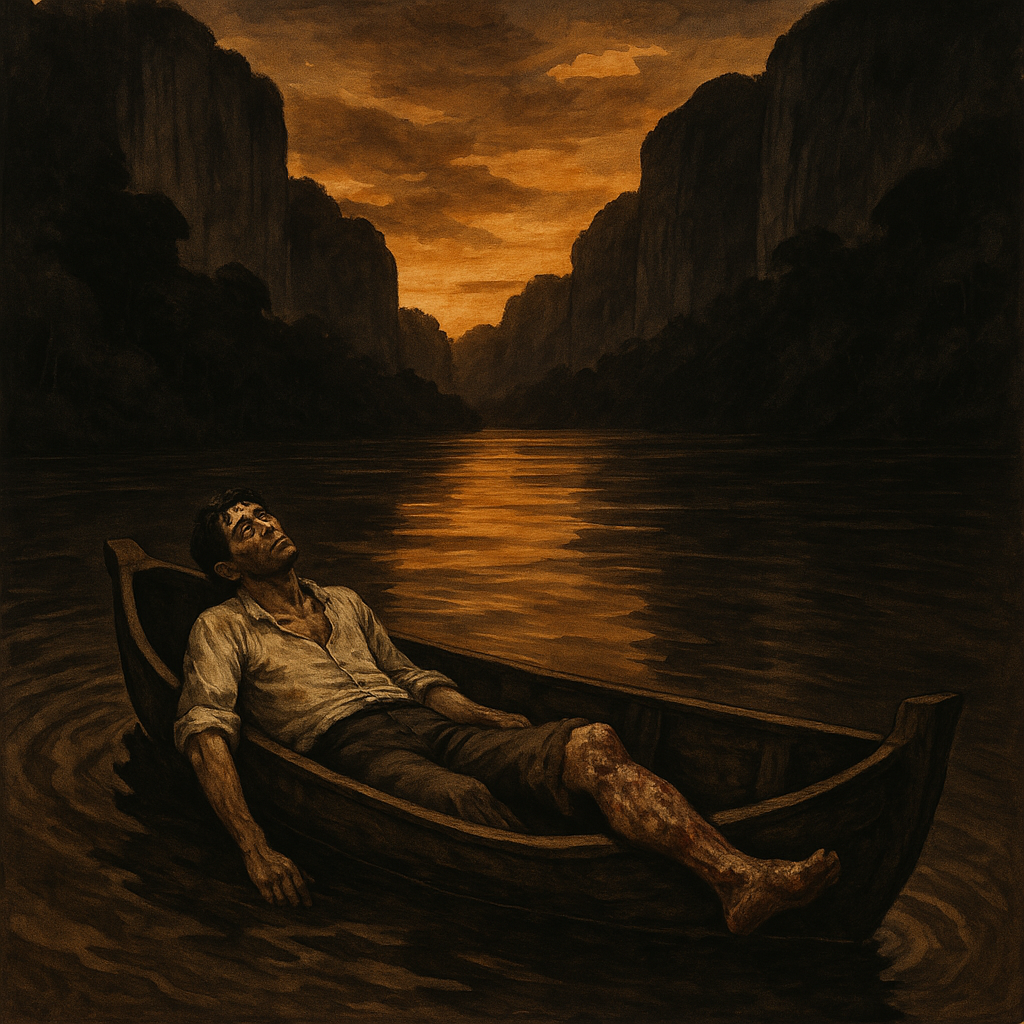
Here the Paraná flows deep in an immense basin, its walls, a hundred meters high, boxing the river in funereally. From the banks, lined with black blocks of basalt, the forest rises, black too. Ahead, behind, to the sides, the eternal, lugubrious ramparts, at whose base the swirling river rushes in incessant boils of muddy water. The landscape is aggressive; a deathly silence reigns. Yet at dusk, its somber, calm beauty assumes a unique majesty.
The sun had now set when the man, sprawled in the bottom of the canoe, was shaken by a violent chill. Then suddenly, with astonishment, he sluggishly raised his head: he felt better. His leg barely ached, his thirst was diminishing, and his chest, free at last, expanded in slow breaths.
The poison was beginning to recede, no doubt about it. He felt almost well, and though he lacked the strength to move his hand, he counted on the falling dew to restore him completely. He calculated he would be in Tacurú-Pucú in less than three hours.
The feeling of well-being grew, and with it, a drowsiness filled with memories. He felt nothing now, not in his leg, not in his belly. Would his compadre Gaona still be living in Tacurú-Pucú? Perhaps he might also see his former boss, Mister Dougald, and the timber agent from the company.
Would he arrive soon? The western sky opened into a screen of gold, and the river had taken on the color too. From the Paraguayan shore, already deep in shadow, the forest cast its twilight coolness over the river, carried on penetrating scents of orange blossom and wild honey. High overhead, a pair of macaws crossed in silence, heading toward Paraguay.
Down below, on the golden river, the canoe drifted swiftly, spinning at times in the boil of an eddy. The man inside felt better and better, thinking meanwhile about the exact time passed since he’d last seen his former boss Dougald. Three years? Maybe not, not that long. Two years and nine months? Perhaps. Eight and a half months? Yes, certainly that.
Suddenly, he felt frozen up to his chest. What could it be? And his breathing, too…
He had met Mister Dougald’s timber agent, Lorenzo Cubilla, in Puerto Esperanza one Good Friday… Friday? Yes, or Thursday…
The man slowly stretched out the fingers of one hand.
“A Thursday…”
And ceased to breathe.