Christmas week brought no school — but such a succession of dining days and visiting days, day parties and night parties, that Fanny, who had looked forward to the week as a season of rest, began to think the regular routine of school duties would have been less fatiguing.
Christmas at La Belle Prairie was the one great jubilee of the year, something to be talked about for six months beforehand and remembered as long after. It was a time of feasting and recreation for the whole household. Days before, preparations commenced in the kitchen. Various smells issued from thence — savory smells of boiled, baked, and roasted meats, and sweet, delicious smells of warm pastry and steaming cakes. Aunt Tibby was rolling pie-crust or stirring cake all day long, and the chopping of sausage-meat, the pounding of spices, and the beating of eggs were constantly heard. Everything was carried on with the greatest secrecy. The children were kept out of the kitchen, and when something good had to be transferred to Miss Caroline’s storeroom, Aunt Tibby came sailing in holding it high above the reach of the curious little heads.
“I don’t care,” said Cal. “There’s six pound-cakes all in a row on the storeroom shelf. I saw them when Ma opened the door — and Marthy says one of them has currants in it, and there’s a little roasted pig in there too. Oh, how I wish Christmas was come!”
Coming suddenly upon Maud one day, Fanny found her with her apron half full of bran, her fingers busy with a few pieces of faded silk. Maud tried to hide them at first, but finding by Fanny’s question — “What is it, Maud?” — that it was too late, she looked up with a tired, flushed face.
“Miss Fanny, don’t you tell now, will you? I’m making a pin-cushion for Aunt Phœbe, but it won’t come square, do what I will. It acts awfully.”
“Let me see what the trouble is,” said Fanny, and sitting down she examined the poor cushion, which indeed, under Maud’s hands, was not soon likely to come into shape.
“You see,” said Maud, “I want to give Aunty a Christmas gift, and I thought a cushion would be so nice — because her old one, the one she wears pinned to her waist, has burst a great hole, and the bran keeps tumbling out. I’m going to make her a right nice one, only I wish it were brighter, because Aunty loves red and yellow and all those colors so.”
Fanny searched her piece-bag and brought forth bits of gay ribbon, the sight of which threw Maud into ecstasies of delight. Then, giving up her morning to the task, she cut and planned and fitted and basted, getting everything in order so that Maud could do the sewing herself.
“Aunty wouldn’t think half as much of it if I didn’t,” said the child.
Well and faithfully Maud performed her labor of love, giving up her much-prized runs on the prairie and resisting all the children’s entreaties to come and play, until the Christmas gift was finished. It was no small task, for Maud most heartily hated to sew, and her fingers were anything but nimble at it. “I always did despise to sew, Miss Fanny,” she said, “but I’m going to make this cushion for Aunty anyhow.”
It was finished at last, and, as Maud expressed it, “was just as beautiful as it could be.” There was never a prouder or happier child. She did not thank Fanny in words for her help, but that night she came softly behind her, put her arms around her neck, and gave her an earnest kiss — a gesture that drew an exclamation of surprise from Mrs. Catlett, for Maud was very sparing of her caresses.
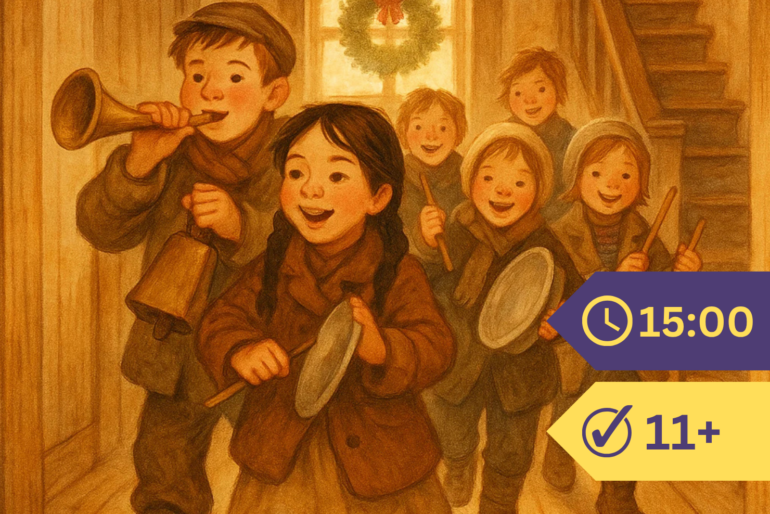
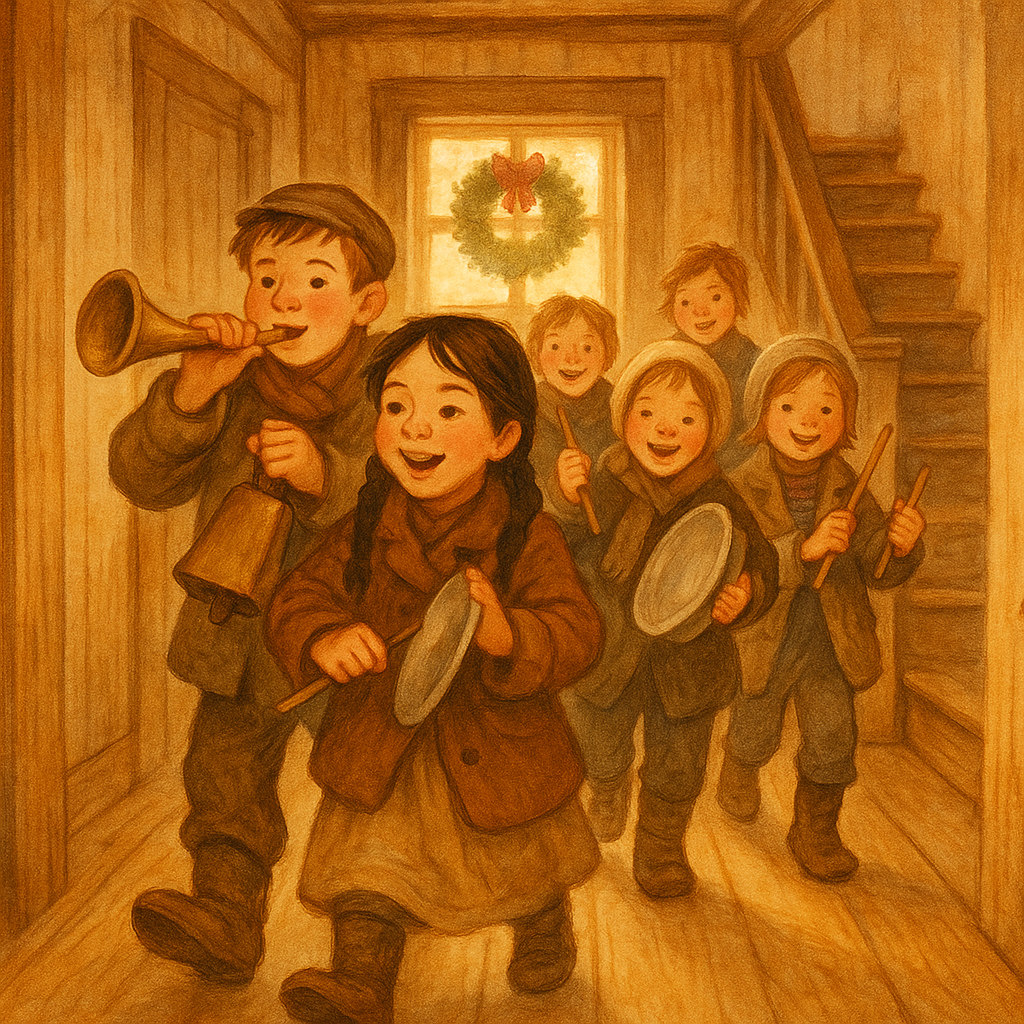
Christmas morning came, and long before daylight every child on the place was up and ready to “march in Christmas.” There had been mysterious preparations the night before — tin pans and glass bottles hidden under beds, and the faint tooting of an old horn heard down at the quarters, as though someone was rehearsing a part. Fanny had also been surprised by a visit from young Tom asking permission to borrow her school bell, the said instrument not being remarkable for sweetness of sound.
“Oh yes, Tom, you may take it — but whatever can you want with it?”
Tom only grinned. “You’ll know in the morning, Miss Fanny.”
Morning did indeed bring an explanation. The children assembled in the yard and marshaled themselves into marching order — Maud at the head as captain, bearing an old tin horn, with Tom bringing up the rear with Fanny’s unfortunate cowbell. In this order they commenced “marching in Christmas,” to the music of the horn, the beating of tin pans, the rattling of iron and bits of wood, the jingling of bells, and the clapping of hands. Into the house and up the stairs they went, right to the doors of the sleeping rooms, with their tremendous din. It was received with tolerably good humor by everyone except Nanny, who, deprived of her morning nap by the uproar, raved at the juvenile disturbers of the peace and finally threw her shoes at them as they stood on the stairway. These were immediately seized as trophies and carried off in triumph to the quarters, where the young performers went through the same operations all over again.
“Christmas gift! Christmas gift!” was the first salutation of the servants that morning — an old holiday custom, where the first to call it out would receive a small present in return. It was impossible to forget for a moment that it was Christmas. One could see it in the faces of all around, in the children’s boisterous merriment and their constant talk about the holidays, and in the great dinner — the one grand dinner of the year — over which Aunt Tibby had exercised all her skill.
“Oh, Miss Fanny,” said little Joy, “don’t you wish Christmas lasted the whole year round?”
The short December day was drawing to a close as a party of four rode leisurely along the road crossing La Belle Prairie. The ladies, scarcely recognizable in their close hoods, long blue riding skirts, and thick gloves, were none other than Miss Nancy Catlett and our friend Fanny, while their companions were Mr. Chester, a gentleman from town, and Dave Catlett, who had come over from his new home in Kansas expressly to enjoy the Christmas festivities on the prairie. One of those night parties Nanny had talked about so often was to be held at Colonel Turner’s, and that was their destination. In accordance with the customs of the country, they were to stay overnight, and accordingly Viny rode a little behind them, mounted on old Poke Neck and bearing the carpet-bags and valises containing the ladies’ party dresses.
At dusk the party reached their journey’s end. Dismounting at the horse-block in front of the house, they were met on the porch by Miss Bell Turner, Nanny’s particular friend — a young lady with long curls and a very slender waist, who performed the duties of hostess in a free and easy manner. The gentlemen were ushered into the parlor, where a fire blazed on the hearth, while the ladies were conducted upstairs to the dressing room.
Here a dozen or more were already engaged in the mysteries of the toilet, braiding, twisting, and curling, with as many attendants flying about, stumbling over one another, and creating the most dire confusion in their efforts to supply their respective mistresses. Beds and chairs were covered with dresses, capes, ribbons, curling irons, flowers, combs, and brushes — all the paraphernalia of an evening toilet — while the ladies themselves kept up a continual stream of conversation.
Into this scene Nanny entered with great spirit. Shaking hands all around and introducing Fanny, she hastily threw off her bonnet and shawl, and, bidding Viny unpack the things, set about dressing in good earnest.
“How nice to have arrived early,” she said. “Now we can have a chance at the glass, and plenty of room to move about in.”
Fanny wondered what she called plenty of room, but she had yet to learn the meaning of the term as applied to the dressing room of a western party. Thicker and faster came the arrivals, and since each lady needed to undergo a thorough transformation in dress before making her appearance downstairs, the labor and confusion necessary to bring this about can be imagined. Such hurryings to and fro, such knockings-down and pickings-up, such scolding and laughing — a perfect Babel of sounds — Fanny had never witnessed before. Completing her own toilet as quickly as possible, she seated herself on one of the beds to watch the proceedings.
“Bring me more pins, directly.” “Oh please, mind my wreath!” “How much longer are you going to keep the washbowl?” “Did you know Tom Walton was here?” “That’s my starch-bag!” “There now — don’t those slippers fit beautifully?” “Oh, just fasten up my dress, there’s a dear!” “Come, girls, do hurry — we shan’t be dressed tonight.”
How it was all accomplished Fanny could not tell, but at last every lady was dressed, the last sash pinned, and the last curl adjusted. Dresses of thin material, cut low at the neck with short sleeves, seemed to be the fashion of the evening, and with wreaths and bunches of artificial flowers in the hair, the assembled company looked quite handsome. With Miss Belle at the head they all descended to the parlor.
Games commenced soon after in the old log schoolhouse in the yard, and were carried on with great vigor, the young people making up in energy what was lacking in grace. Game after game was played, the ladies vying with each other to see who could laugh the most, while those who were left out chatted in groups or tried their powers of fascination upon some long-limbed specimen of frontier humanity.
“What calls the gentlemen upstairs so frequently?” inquired Fanny, as groups of two and three disappeared up the steps to the room above.
“You are not aware, then, what a formidable rival the ladies have up in the loft?” said Mr. Chester, gravely, though there was a comical expression about the corners of his mouth.
“No, indeed.”
“Well, I only hope you may not witness the overpowering influence sometimes exerted by this same rival,” said Mr. Chester. “But honestly, Miss Hunter, there is serious danger that some of these light-footed young gentlemen may, before long, be obliged to relinquish their places in our party — all through the attractions up yonder.”
“I don’t in the least know what you mean.”
“In plain words, they are talking about horses up there. Men are crazy over horses, you know.”
“Are you in earnest, Mr. Chester?”
“Certainly I am. It would not do for ladies to intrude upon their modest retirement — but I could convince you in a moment.”
“How can you joke about it? I think it is perfectly scandalous.”
“Well, it is bad enough,” said her companion, more gravely. “One who lives in the West becomes accustomed to such things.”
“I never will,” said Fanny. “If I had known these Christmas parties permitted such impoliteness, I would have stayed at home.”
The supper table was bountifully spread — not in the style of Fifth Avenue, perhaps, but admirably suited to the guests who partook of it. A roasted pig graced each end of the board, a side of bacon the center, while salted beef with pickles and cheese constituted the side dishes. Hot coffee, corn bread, and biscuits were passed to each guest, with pound-cake and preserved fruit for dessert. There was plenty of laughter and hearty joking at the table.
At last, as an old Scots proverb has it, the langest day maun hae an end — and it was with a sigh of relief that Fanny watched the fiddle laid down and the guests retire to seek the few hours of rest that remained of the night. Confusion reigned for a time in the room set aside for the ladies, where numerous couches spread upon the floor increased the difficulty of navigation. At last, when quiet seemed restored and Fanny was sinking into a peaceful sleep, she was roused by her neighbors in the adjoining bed — three young ladies who declared they were “all but starved, and must have something to eat before they could sleep.” Cold bacon was fetched from the storeroom, and sitting up in bed by candlelight, they made a hearty midnight repast.
“Of course, you can’t eat half as much as you want at table,” said one of the young ladies, apologetically. “One always wants to appear delicate-like before the gentlemen.”
They were riding home the following morning — or rather, noon — when Dave spoke up.
“What in goodness’ name made breakfast so late, Nan? I thought for a while we weren’t going to get any.”
“Well, you see, they hadn’t any wheat flour in the house for the biscuits,” said Nanny, “and they had to send three miles over the prairie to borrow some.”
“Twenty people invited to stay the night, and no flour in the house?” said Fanny, in amazement.
“It rather shocks your Yankee ideas of looking ahead, Miss Hunter,” said Mr. Chester, laughing. “We are used to such things out this way.”
“Oh, Miss Fanny, people can’t remember everything, you know,” said Nanny. “Belle says they never thought a word about it until this morning.”