I had spent fifteen Christmas Days with my battalion. On the sixteenth, I woke far away from it, and decided that since I couldn’t have a soldier’s Christmas, I wouldn’t have any Christmas at all.
I rang for my man as soon as it was light. He came in, saluted, and stood at attention. I had warned him, when I bought out his service, that if the Army had done with me, I hadn’t done with the Army. So he maintained military discipline.
“You will take every Christmas card that comes this morning and put it on the fire,” I commanded.
“Yes, sir.”
“And everything that looks like a Christmas circular, or an invitation, or—or anything else! Burn the lot!”
“Very good, sir.”
“And tell the porter that if anyone calls, I am out.”
“Yes, sir.”
“And tell his wife to send up just a plain lunch and dinner. If there’s Christmas pudding or anything of that sort, she’ll have no Christmas-box from me. Make that perfectly clear.”
“Yes, sir.”
“The post should come about eleven. When you’ve dealt with it, you can go for the day.”
“Thank you, sir.” He fidgeted in an unsoldierly fashion. “Quite sure you won’t want me, sir?”
“How dare you question my orders?” I snapped. “Do you think I don’t know my own mind because I’m on the retired list?” That wasn’t strictly correct, but they’d told me I should be gazetted out next week. “Beg pardon, sir. I was only thinking—”
I cut him short. “A soldier doesn’t think—he obeys. You and I are still soldiers, though a board of idiots say I’m ‘physically unfit for further service.’ Unfit! I’d like to have the whole board in this room and show them who’s physically unfit!” I kicked off the bedclothes and jumped out of bed. “Give me the dumbbells and go fetch my shaving water. Unfit, indeed! A mere kink in the leg! Those fools at the War Office will sit up when they read my protest!”
“Yes, sir. They don’t know what you did for the battalion, sir. The men are terribly cut up about you leaving—begging your pardon for mentioning it, sir. I had a letter from Conkey Davis—”
“Who?” I roared.
“6-2-4-3, A. Davis, E Company, sir. The one that—”
“I know, I know.” There wasn’t a man in the battalion I didn’t know all about. “What does the impudent scoundrel have to say?”
Harris fidgeted. “His exact words, begging your pardon, sir, were these: ‘You always got it straight from him, and we’d rather be sworn at by Old Mustard than kissed by the Colonel.'”
I sat down on the bed suddenly. It unsettled me a bit, to know the boys remembered me like that.
“Heaven bless ’em!” I said. “I—I— What are you gaping at? Go and get that shaving water.”
I understood those men. If I’d lost both arms and both legs I’d still have been able to manage the battalion. That’s what the clever gentlemen at the War Office didn’t grasp. I don’t say they didn’t mean to treat me well, but what’s the use of a DSO and a wounds pension to a man who can’t go on soldiering? And to turn him off just before Christmas, of all times!
Still, the Colonel had written that he was carrying out my plans for the Christmas dinner and the presents afterwards. That was some consolation.
I shaved and dressed and had breakfast, then hobbled out for a walk in the park. At least I started to go there, but there were so many children and beggars wishing me “A Merry Christmas” that I turned back soon enough. They didn’t know any better, but my relatives and friends—who kept writing to ask me to spend Christmas with them—ought to have had more sense. They might have known there wasn’t any Christmas for a man who’d been turned out of the Army. I hoped every member of the Medical Board might be choked by his Christmas dinner.
When I returned, Harris was waiting on the door mat with a handful of letters.
“I wasn’t quite sure if I understood the orders, sir,” he declared. “There’s one letter in particular that—”
He didn’t get any further. I have dressed down a few soldiers in my time for slackness in carrying out orders, but I surpassed myself on this occasion. Harris bolted to the kitchen fire so fast he even forgot to salute.
I think he was ashamed of himself, for he was particularly anxious to make me comfortable before he left. I’d got him out of trouble when he was young and raw, and the fellow was always grateful. He’d been so cut up when I was invalided that I’d had to bring him away with me.
When he’d gone, I got out all my papers—I’d kept them, from the first gazette—and read them through. Then I read a letter from the adjutant, which I liked better than any official document.
“You’ll still be running the regiment,” he wrote. “When I succeeded you as adjutant three years ago, I knew I’d stepped into the shoes of a real man, and I made up my mind to fill them. You have helped me do so all the time, and, thanks to your teaching, I think I shall be able to carry on as you’d have me carry on. I shall always feel that it’s your regiment.”
That was how I felt about it. The last two colonels had been easy-going men; they’d left everything to me when I was adjutant, and always consulted me afterwards. I had a note before me now asking my advice about some difficulties with the double-company messing system. I wrote the answer on the spot and sealed it. I hoped Harris hadn’t burnt anything from the battalion—I hadn’t thought to exempt Service letters from the bonfire. I was always a hasty beggar. Old Mustard! The boys knew me.
I had begun a letter to the adjutant, advising him to watch C Company, whose captain was too fidgety with the men, and to make sure F Company wasn’t too much in the hands of the pay sergeant. (I’d court-martial every officer who leaves cash payments to a sergeant, if I had my way.) I was going on to the question of non-regulation boots, when the front-door bell rang.
I didn’t answer it, and didn’t mean to. But presently I heard someone come into the hall—I hadn’t locked up after Harris. I hobbled to the door as fast as I could go.
“What the deuce do you mean by entering my hall?” I shouted. And then I stopped.
The intruder was my Cousin Alice—Mrs. Barkham. We’d been like brother and sister since we were children toddling together. She smiled, and I frowned.
“Well, what the deuce do you mean by it, Alice?” I asked. “You were brought up as a sportswoman. You ought to know there’s a close season for an old badger who’s licking his wounds in his lair.”
Alice came and put her gloved hand on my shoulder, and kissed me.
“I know,” she said, “dear old man. I felt so bad about it that I had to come to the wounded soldier.”
“I’m not a soldier any longer,” I growled. “They’re turning me out of the Army. ‘Physically unfit!’ The fools!”
“You are a soldier,” she contradicted, “and you’ll always be a soldier. And you’re coming back with me to spend Christmas like a soldier—a soldier”—she put her hand on my arm—”who is too brave to let his troubles hurt his friends. There’s a certain silly old friend who has had a little cry on Christmas morning over a letter, Dickie—”
“Dash it all!” I cried. “You don’t mean to say that you— Come, come, Commanding Officer”—I always called her that—”settle the case summarily. I’ve been malingering in my quarters instead of doing my duty. I’m an idiot! What’s the punishment?”
“The punishment,” she said, “is to come back with me and spend Christmas like a soldier who doesn’t mean to mourn about the soldiering he can’t do, but to do manfully the soldiering that he can.”
“That isn’t much, Al,” I said mournfully. “I was all right in the regiment, but I’m no use out of it—or in it now.”
“No use!” she cried, tossing back her head as she always did when she was very much in earnest. “Why, Dickie, just think! What’s the principal work of an old soldier? What would yours have been if you’d stayed on and commanded the battalion—as you would have, of course? Isn’t it to make soldiers? Well, you’ve trained plenty of men to do that—so many that your work will go on without you. You’re still training the battalion, Dickie!”
“That’s what Lane said,” I admitted. Lane was the adjutant. “It sounds very well—rather like an after-dinner speech. But I prefer to be doing the work myself, not by deputy.”
“And you will. Unless I’m very much mistaken, you’ll soon find some way of being useful to the Army. For one thing, you’ll put soldiers’ hearts into young men—into mine! Now, Dickie, get your hat and coat and come and do your soldiering. Show us how a brave soldier fights trouble and keeps a cheerful face, and—poor old man!”
Her voice quivered suddenly, and she pulled out her handkerchief.
“For goodness’ sake, don’t!” I begged. “You just be a brave soldier too, old girl. No waterworks.”
“I’m not,” she denied gallantly. “Don’t be a donkey! The cold has caught my eyes—that’s all. Hurry up, you slow soldier!”
I hurried up and went off with her. I hailed a taxi-cab, gave Alice’s address, and we drove away.
I meant to turn my mind off the Service entirely, but Alice artfully led me to talk about military matters, and once I started I went on until we reached her road.
“I’ve been boring you,” I apologised then.
“Indeed you haven’t!” she cried. “It’s been fascinating. I had no idea that officers thought things through so carefully. Why, the management of a regiment is a proper science, with laws and principles!”
“It ought to be,” I told her, “but generally isn’t. Most fellows just muddle from one thing to another and never grasp the underlying principles of regimental economy. It doesn’t occur to them that there are any. That’s the trouble with it. I always found men perfectly willing to do things the right way when I pointed it out.”
“Then,” she said, “why don’t you write a book of ‘proper ways’? That would be real soldier’s work, Dickie. You’d be making thousands of better soldiers throughout the whole Army.”
“I’m not much of a writer,” I confessed. “I can talk to soldiers, but I’m afraid I’m a—a bit blunt, you know.”
Alice laughed out loud.
“Old Mustard!” she said.
“Oh, you know about that, do you?”
“Of course I do. If you wrote bluntly—not too much mustard—it would be all the better. General Loringham wrote to me about you when you got the DSO, and he said that everyone knew your courage; but what they didn’t know was your remarkable understanding of regimental management. Write a good, blunt book about it, Dickie.”
“Nobody will read it,” I grunted, “outside the regiment.”
“One will,” she asserted.
That is how The Management of a Regiment came to be written. It went into three editions, and they used it as a textbook. If it was any good, the Army had my Cousin Alice to thank—and another lady. I’m coming to her presently.
Alice’s jovial husband met me on the doorstep.
“Good old man!” he cried. “I knew the Commanding Officer would drag you out. Here’s the Army!”
My “niece” rushed at me and dragged me under the mistletoe with a shout of “Uncle!” Then the boys flew out to shake hands.
“By Jove,” I cried, “how you’ve all grown! Here, give me a shoulder, Chris, and I’ll do without the stick. Santa Claus been, eh? What? You think I sent some of those? As if I would!… Yes, yes, I’ll come.”
They hauled me into the breakfast room. Chris sat on my knee, and the boys stood close and began asking questions. They wanted to hear all about the fight for which I got the DSO.
“The fight, eh?” I said. “It was just a wretched little affair in the hills—a lot of snipers who bolted whenever we tried to rush them. The leg? A poke from a rusty sword. It wouldn’t have been anything if it had been treated at once. Why wasn’t it? Because there was no doctor handy. We were cut off for five days. The whole regiment? No, about thirty of us, to begin with. The enemy made a rush and took six of our men, and the Colonel let me take a party out at night to get them back—they weren’t kind to prisoners. We recovered our fellows all right, but we couldn’t get away afterwards. Had to hold a sort of little temple until relief came. Much to eat? No, not much. Plenty of water, thank Heaven—that’s the main thing. How did I fight with my bad leg? Didn’t seem to notice it much at the time. It got worse afterwards. What was the temple like? Well, get me some paper and I’ll draw it.”
I spent the next hour describing the campaign to Chris and the boys—Arthur was fifteen and Dick (named after me) fourteen. They both said they wanted to be soldiers as soon as they could. I told them they could start making themselves soldiers now, because the first thing was to obey orders, and to obey them smartly. I promised to ask their father to let them learn fencing at school, and gave them an elementary lesson with walking sticks. Chris said she should like to be a nurse and look after wounded soldiers, and I told her a few things about First Aid. I felt I had spent quite a soldier’s morning when the gong sounded for dinner.
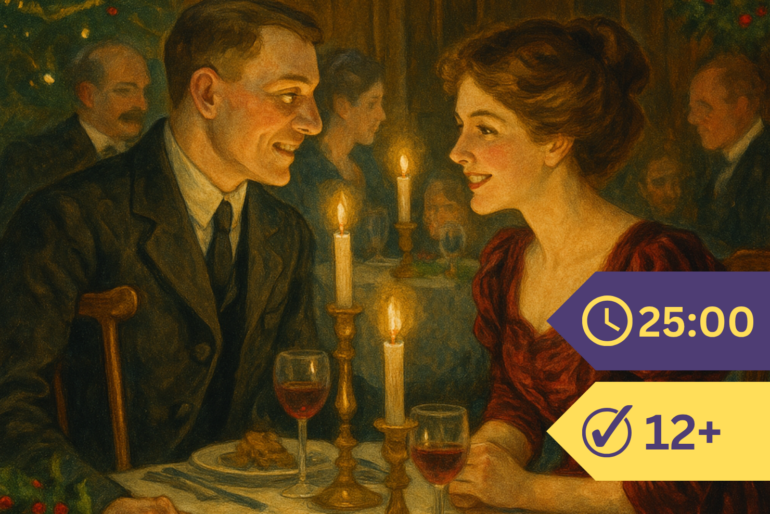
I will confess I was a bit of a coward going down to the dining room. The holly and decorations made me think of the old mess. I was perhaps a little inattentive to the lady I was seated next to, until I noticed her smile at me.
“I beg your pardon,” I apologised. “I was thinking—” I paused.
“Of a soldier’s Christmas,” she said. “So was I. You don’t remember me?”
“Good gracious!” I cried. “Ethel—I mean Mrs. Meadows!”
Her father had been Colonel of the East Farshire, and we’d been together in Ceylon. She’d been just a girl then, and we’d won the mixed doubles in the garrison tennis tournament. She had married Meadows, a subaltern in the West Loamshire—a poor fellow who’d died two years afterwards.
“Yes,” she said. “You were adjutant of your battalion just before we left, and father said: ‘Now they’ll soon be soldiers!’ I wasn’t at all surprised when I heard of the Pindi affair and your DSO. Do you remember how I used to wish I’d been born a boy, to go into the Army? And you called me ‘Young Soldier’!”
“And you called me ‘Old Soldier’! My men called me ‘Old Mustard’ afterwards.”
“They always have a name for the right sort. I know Tommy!” Her eyes brightened. “You disciplined me, I remember.”
“That was how we won the tournament,” I reminded her. “You obeyed orders and ran up to volley instead of playing a cautious back-line game. You see, I judged my soldier before I gave orders.”
“And I judged my leader before I obeyed them,” she replied in her old, daring way. “And threatened him, too. When you were grown-up, you’d discipline me, you said. Perhaps you would have, if you hadn’t gone so far away.”
I smiled at her. I used to call her my little sweetheart.
“I went further,” she said, “and fared—not too well.” She sighed. “Do you know, I always feel as if I want to be back with the regiment. Father had no son, so he used to talk to me; and Mother was a soldier at heart—a better soldier than some men.” Her lip curled slightly. “I ought to have been Mrs. Colonel Somebody. I would have looked after my battalion!”
“If I hadn’t had this little accident to my leg,” I jested, “I might have been able to offer you the appointment.”
“I might have taken it,” she retorted, with a flash of her old spirit, “and then you would have been sorry for yourself.”
“Only for you,” I declared. “If you remember, I used to tell you that, if I could choose my age, I’d be five years older than my Young Soldier.”
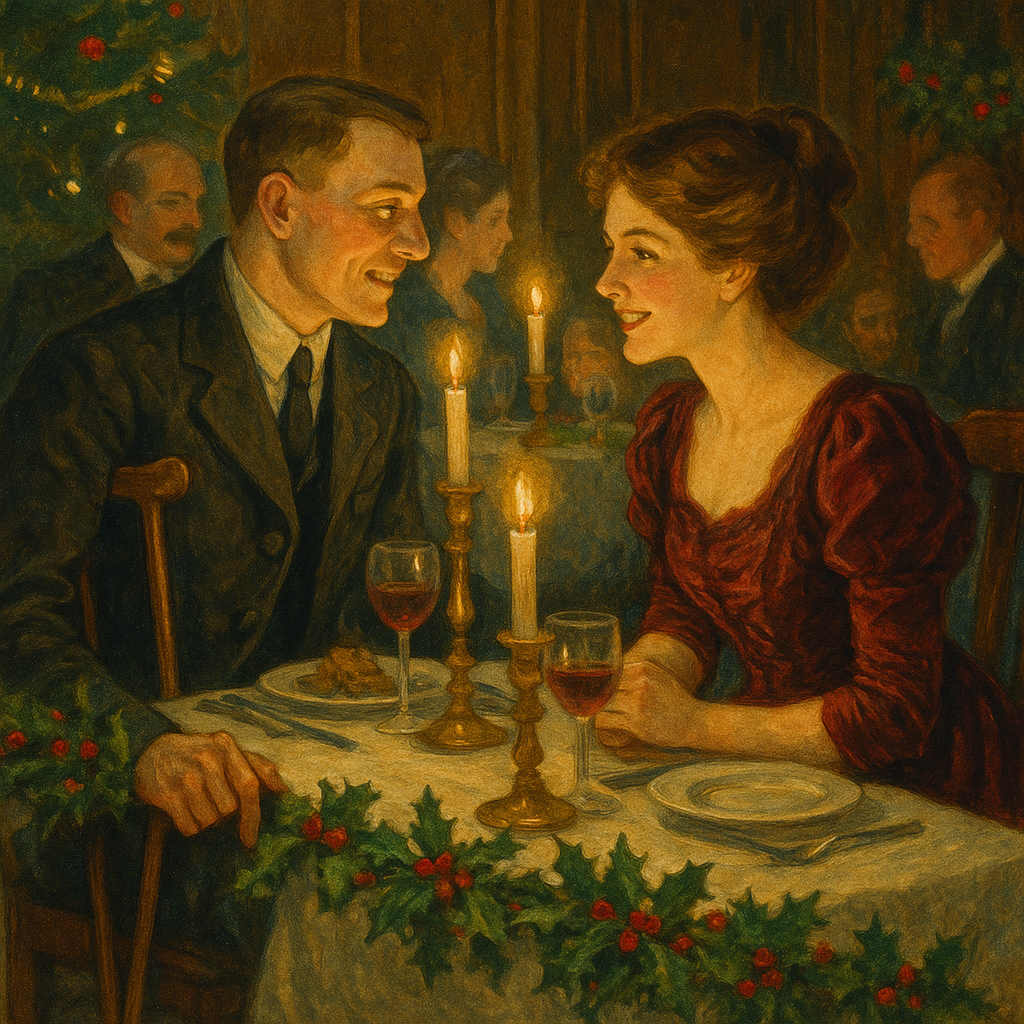
“Now we’re both old soldiers on the retired list! And I haven’t got a DSO. What are you going to do? You mustn’t let all your soldier-craft go to waste. Father always said that someone like you—a real regimental expert—ought to write a book, instead of leaving Staff College men to teach the regimental officer to suck eggs.”
“Alice has been talking to you,” I remarked. “Or you to Alice?”
“Both,” she confessed.
“You want to find something to amuse an old—Old Mustard?” I said.
“We do,” she replied frankly. “We both think a great deal of him, and I rather fancy we’ve found the right amusement. Seriously now?”
“Well,” I said, “I’m no writer—but if I understand anything, it’s regimental duties. You see—”
And then I launched off into my favourite topic. It lasted through dinner.
“You’ve let me bore you, to give an old soldier a pleasant Christmas,” I said when we rose.
“I would have let you bore me, with that object,” she said, smiling, “but as it happens, you haven’t. Oh, don’t I wish I could help you write that book! You call yourself old, but you’re only—let me think—about thirty-seven.”
“That’s it; and you’re twenty-four.”
“Twenty-five,” she corrected.
“If you were five years older,” I jested, “there’d be the appointment of Mrs. Major Military Author.”
“You’d better be careful!” she warned me, laughing. “There’s a DSO, and I always wanted a decoration.”
“Well,” Alice asked, when we were alone for a moment, “hadn’t I a nice surprise for you?”
“Very nice,” I agreed. “I always liked that girl—so frank and straightforward. It’s a pity she didn’t marry a real soldier. Her heart’s in the Service. I never met such a true Army woman.”
“If a certain old soldier had had more sense,” Alice observed, “I rather think—”
“You ridiculous matchmaking creature!” I cried. “She was a mere schoolgirl who looked on me as a sort of uncle. She never had any other idea.”
“Humph!” said Alice. “Girls have all sorts of ideas. A lot you know about women! No, I don’t suppose she had any serious idea—but she was uncommonly pleased when she found she was going to meet you.”
“Now, look here,” I protested, “don’t put foolish thoughts into the head of a man who’s ‘unfit for further service.’ The idiots! The—”
“Hush!” Alice entreated.
So I hushed, but I felt myself looking fierce for some time afterwards. If it hadn’t been for those three confounded pill-boxes on that board, I might have had a full colonelship to offer to—to anyone who seemed suitable.
However, I was soon dragged out of my corner to play blind man’s buff and snapdragon, and a dozen other games. Then we had supper, and the children went to bed. I was going home, but Alice and her husband said there was a spare room and I must stay the night. So I stayed. Ethel—I had taken to calling her that again—was staying there too, and the four of us sat round the stove.
“Harris will be worrying about me,” I remarked.
“Oh, no, he won’t!” Alice assured me. “I met him and told him I should bring you back and keep you.”
“Such conduct,” I protested, “is subversive of discipline.”
“Al doesn’t believe in other people’s discipline,” her husband remarked.
“It depends,” she said. “Discipline means obeying sensible orders and disregarding foolish ones. Now, confess, Dick—haven’t you sometimes wished an order had been disobeyed?”
“Never!” I asserted. “But I’ve sometimes wished I hadn’t given it.”
“For example,” she remarked, “when you ordered a whole post of letters to be burnt? Suppose there was an official letter among them, and the person to whom you gave the order was quite sure you didn’t mean that?”
“He had no business mentioning it to you,” I cried, “and if he’s disobeyed my orders, I’ll discharge the scoundrel tomorrow! I’ll—”
I paused for words suitable for ladies’ ears, and then Ethel’s quiet voice cut in.
“Isn’t it discipline to carry out orders in the spirit?” she asked. “Don’t say that would end by not carrying them out at all—that’s quite true of the rank and file, but Harris is your second in command for the moment, and he takes thought for you. You can take his good intention into account in sentencing him.”
“It’s you who ought to write a book,” I told her. “A lawyer’s book.”
She laughed. “But I’ve got the better of you. You won’t do anything to poor Harris?”
“No,” I said. “No. I suppose you’ve the letter, Alice?”
“Yes. It’s from the War Office. I’ll give it to you before I go to bed.”
“No,” I said, “give it to me now. I appealed, of course, but I knew it was no use. I suppose they’re right. I’m too lame for duty. No—only for that particular duty. You two good women have put some sense into me today and stopped me growing into a miserable old grumbler. I’ll find some duty in life, and, please Heaven, I’ll do it—and do it without whining that it isn’t exactly the duty that I— I loved the old regiment.” A woman’s hand touched each of my arms. “The decision was the only possible one, really, and I only appealed to blow off steam, instead of accepting the verdict like a good soldier. They can’t possibly alter it. I have to read the letter some time, so I’ll just glance at it and get it over.”
I opened the letter—and then I don’t know quite what I said or did. My chair seemed to be sailing through the air. When it came to anchor on the hearthrug, old George was pumping my hand, and Alice and Ethel were holding my arms. They were laughing and wiping their eyes. Ethel picked up the letter from the hearthrug and waved it as if she were a girl again.
“Soldier!” she cried, saluting as if she were one. “Soldier!“
I rose, holding my chair, and saluted her. I knew very certainly—one sees things clearly in those great moments—that I had found my commanding officer. My heart was too full to speak.
For the letter said that, while regretting my return to regimental duty was not practicable, the War Office considered that my knowledge of regimental economy would be valuable in the Adjutant-General’s Department, and offered me a staff appointment instead of retirement.
“It’s a soldier’s Christmas after all, Dickie,” Alice said, and kissed me. “Let’s go look at the children, George. I always do when I’m specially happy.”
They went off, and Ethel and I were left alone.
“Ethel,” I said, “there’s only one thing wanting to make my next soldier’s Christmas perfect—a real soldier’s wife. There hasn’t been anyone, because they didn’t come up to the dear soldier-girl I used to know. It isn’t a good enough appointment for you.”
“It happens to be an appointment I’d like,” she told me. “Oh, Dick—this is my best soldier’s Christmas!”