Most of the passengers in the small car had spent all day gazing out at the snow-filled air. The room was long and narrow and held six or eight people, each sitting quietly in his place with little conversation. The tall dark man with the white mustache and tired face had slept much, his head resting on his folded overcoat. A boy opposite — sullen anger and defiance in every line of his young face — had watched him and wondered how a man could sleep in the daytime. The boy didn’t know that those long, nervous white hands had wielded a surgeon’s knife the day before, saving a life, and that those tired eyes had watched for many hours following.
Nearby, an earnest bright-faced young woman had observed the sleeping man with keen interest, as she observed all her neighbors. There was the old lady in the corner, a man with sample-cases piled at his side, a shabby young woman holding a sleeping baby, and a middle-aged man with a stolid, joyless face who had read three newspapers straight through without any change of expression, and since then had sat staring ahead of him. The young woman had tried to weave these various figures into a story, then given it up with a sigh for their ordinariness.
An ill-assorted company, surely. They would have chosen to spend Christmas Eve together for no other reason than that they all needed to travel this branch line, which ran between the northern road from Little Falls and Grand Central.
The day was nearly over, and the journey should have been done. But the snow, which had been falling steadily since morning, grew heavier, the train’s speed perceptibly slowed, and the engine groaned and labored. The engineer watched apprehensively as they approached a certain cut in the hills — narrow and deep — and found it drifted high. Meeting that soft, still, resistless opposition, the great engine slowed and stopped.
The drifting snow had hidden all familiar landmarks. As the passengers anxiously questioned one another about the cause of the stop, Jim Case, the fireman, swung himself off the engine, slipped over a culvert, and in a fall of only a few feet broke his arm with startling ease and completeness. He was lifted back white and fainting, and when the conductor hurried into the passenger car, he answered the anxious queries with a brief “Snowed up,” then turned to the dark man.
“I don’t suppose you’re a doctor, are you?”
“Yes,” said the man, with an inquiring glance. “Does someone need me?”
The conductor looked relieved. “Now, isn’t that luck? Surgeon, too, I guess?”
The doctor nodded assent.
In a few words the conductor told of the accident, amid exclamations of mingled sympathy and dismay. As the doctor picked up his small black bag and followed him into the forward car, the conductor kept talking.
“Not many of you travel on this road, but I thought that was your trade when I took your ticket. I owe a surgeon a debt — a man saved my life in a wreck once. That was a good while ago, but I’ve never forgotten the look or the feel of his hand — so steady and strong and white.” He added an apologetic smile.
“Here we are, Jim!” he called out cheerfully. “The doctor and the head nurse. You just break your bones, and we’ll do the rest.”
The fireman lay stretched on the floor of the forward car, his head resting on a pile of waste, and a sturdy little boy of about five, sobbing with fright, was kneeling close beside him.
“Who is this little fellow?” asked Dr. Carleton, after the examination was over and he was skillfully bandaging the injured arm.
“He’s mine, poor little chap,” said the fireman, with a tender glance, though his lips were white with pain.
The boy, hearing his father’s voice, stopped his sobs and looked up at the doctor. “Now will we go to grandma’s and have a Christmas?”
The man winced and closed his eyes. The conductor leaned in with a quiet explanation: “The little fellow’s mother died — just buried her a week ago. She had him filled up with Christmas, and he can’t seem to let it go. They’re on their way to Jim’s mother’s; she’s going to take care of Jamie. The old lady had promised him a tree.”
Jamie was listening and broke in, forgetting his shyness: “Yes — a Christmas tree and candles! Grandma said so.”
“Seems as if that’s all he thinks of,” said the fireman, closing his eyes again.
“Shall we go now?” insisted Jamie. “You said we’d get there the night before Christmas.”
“Now, young fellow,” said the conductor, “you know this is road luck. You’re a railroad man’s son, and you must learn to keep a stiff upper lip when things go wrong. Let that tree wait a day or so.”
But Jamie’s sobs broke out afresh. The conductor looked at the doctor, who nodded. “Take him away and have him amused if you can. He troubles his father. He ought to have something to eat — though I suppose it does no good to say so. Have you any way of making a cup of tea, or any broth? Do you go prepared for these emergencies?”
The conductor shook his head. “I’m afraid not — unless some of the passengers might have something left from lunch. We were due at five-thirty.”
“Well, inquire,” said the doctor. “He’d feel better after a little something.”
So the conductor, carrying the crying Jamie, went back to the passenger car — and found the young woman the center of what seemed almost a social circle.
The good-natured baby was sound asleep on one of the far seats, content as a veteran traveler, while his mother sat shyly on the outskirts. The traveling man’s sample-cases, covered with a napkin, formed an improvised table, and on it the stock of eatables was being spread.
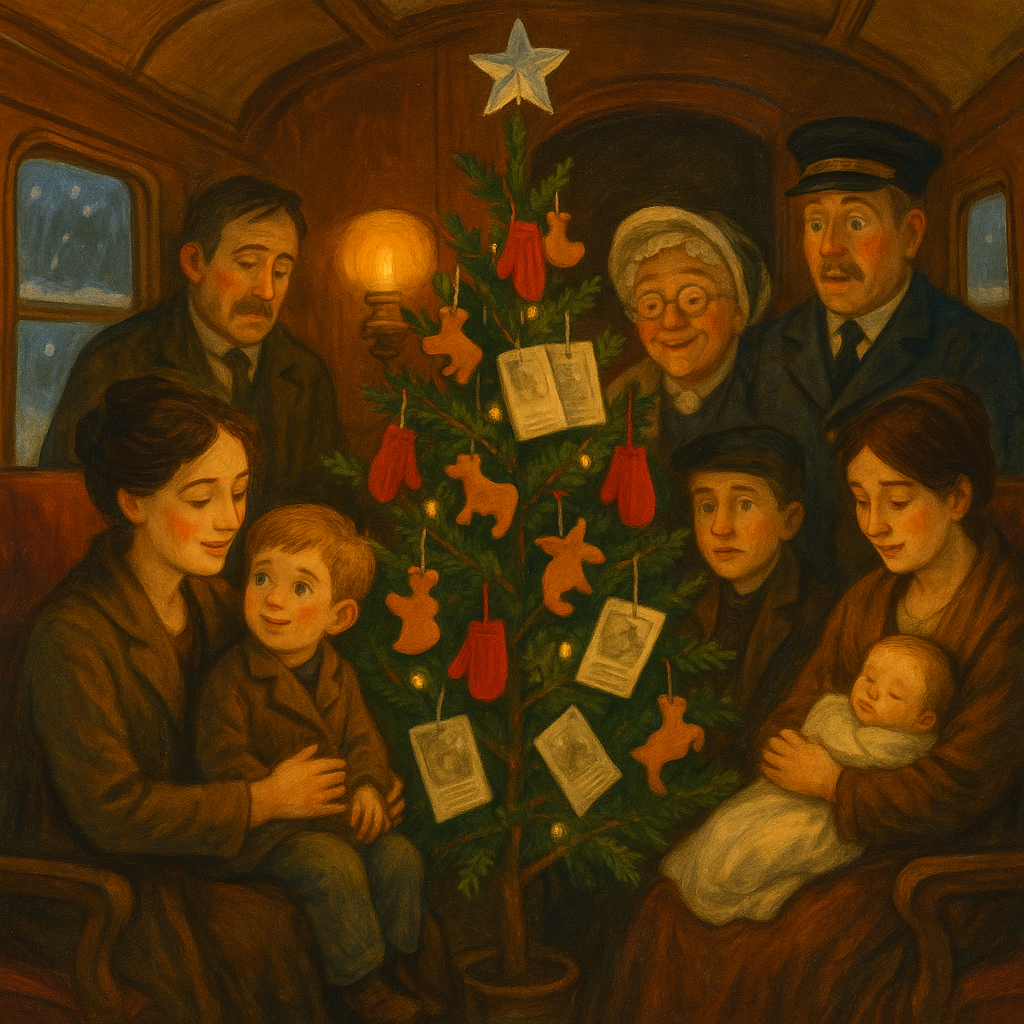
“Well, anyhow, we sha’n’t be starved,” the old lady was saying, pointing to a huge covered basket. “That there basket’s full of fixings I was taking to John’s folks. I expect the children will think it doesn’t seem like Christmas without their leaf-cookies and the gingerbread animals. And they are good, if I do say so — though I never thought, when I was baking them, that they would save our lives.”
“We’ll hope they need not do quite so much for us,” laughed the young woman, whose trunk in the rear car bore the tag “D. M. Marsh.” “But we will not touch the children’s cookies unless we’re starved into it. How glad I am that Aunt Mary made me take this great lunchbox! I hardly made an impression on it at noon.” And she brought out an unopened jar of pressed chicken. “This will be our Christmas turkey!”
“Is there some way of melting that down into soup?” asked the conductor, coming in just then.
“How is the injured man?” inquired the commercial traveler.
“He’s all right — only his arm is broken and he’s knocked out and faint. The doctor was asking for soup or something to brace him up. Chicken broth, now, would be just the thing.”
“Why, we can make broth in a few minutes,” said Miss Marsh — and in a moment she had brought from her trunk a pretty chafing dish and lit it, the old lady nodding approval.
“Left over from a college oyster-spread,” the girl said, laughing. The lamp was adjusted, part of the pressed chicken went into the bright pan, and Jamie stopped crying to taste the broth when an appetizing smell began to drift through the car.
During all of this, the sullen boy had hardly left his dark corner. He didn’t want to talk — it was nobody’s business where he was going, and someone would be sure to ask. But he watched, and thought how quick and pleasant the young woman was. When the broth was sent to Jim, and the doctor returned, the remainder of the old lady’s bread-and-butter and pickles was spread, with various additions from the other passengers’ lunch baskets. Part was reserved for breakfast, and the little group — whose common misfortune had thawed all reserve — supped together merrily if not bountifully.
“And tomorrow is Christmas!” said the traveling man, whose name was Osgood. “I’ve worked like two men to get through and have the day at home with my wife and the babies, and it’s hard to be stalled up this close.”
“And there’s my son John and his Milly and the children,” said the old lady. “I haven’t missed a Christmas with them since he was married. But we’re all alive, and that’s a great mercy.”
“I want a Christmas!” sobbed Jamie, his ready tears bursting forth again. “Mama said I should have one — and grandma’s got a tree — and I want a Christmas!”
The conductor quietly told the sad little story again — the dead mother who had promised the boy a happy day — and Miss Marsh looked steadily out of the car window for a half-minute, her eyes brightening and a resolve forming.
“Jamie,” she said, “you shall have your Christmas. It’s Christmas here just as much as anywhere in the world, and you shall have a real one.”
He looked up at her with joyful trust. “And a tree?”
“Yes, a real tree,” said the girl. The others listened in astonishment. The old lady opened her lips to object, then closed them. The traveling man whistled softly and skeptically. The doctor looked on, amused. Only Jamie and the sullen boy gazed at her with complete confidence.
“When shall I have it?” asked Jamie.
“Tomorrow — Christmas morning. Now go to your papa and go right to sleep, and in the morning — you’ll see!”
With tears undried but face beaming with happiness, Jamie let himself be carried away to his makeshift bed at his father’s side. “And a tree,” he murmured as his eyes closed, “and candles, and—”
“Well?” said Mr. Osgood, with a skeptical smile. But before Miss Marsh could reply, the sullen boy said briefly: “I’ll get it. I saw some small evergreens before it got dark.” He had already buttoned his coat, and seizing the red-handled axe that hung near the stove, he leaped bravely out into the drifts.
“Those little evergreens just a few feet away,” said Miss Marsh eagerly. “He can see them by the light from the windows. And we can make it pretty somehow. Jamie’s such a little lad, and Christmas means so much to him!”
Mr. Osgood nodded. “But what’s going to go on the tree?” asked the practical old lady. “It’s foolishness going to so much trouble for that one child when we’re halfway between life and death! But I declare, I hate to have the day go by and do nothing — and I’ve got a pair of red knit mittens meant for John’s Alexander, and I’m going to give them to that poor motherless lamb. You can hang them on the tree, Miss Marsh.”
“Splendid!” said Miss Marsh. “And I have a red skating cap in my satchel — I believe it will just fit him.”
“Is he too small for a knife?” asked Mr. Osgood. “Let me see — about five, isn’t he? My wife makes six the knife line. I’d better not.” He returned it to his pocket. “Hold on — I’ve some illustrated catalogues that could pass for picture-books, yes, and cards too, our new ones,” and he dove into his cases and brought out a pile of brilliant pictures.
“Will Miss Santa Claus accept this?” asked Dr. Carleton, offering a pocket microscope. Just then the door opened, and the boy came in dragging triumphantly a small evergreen.
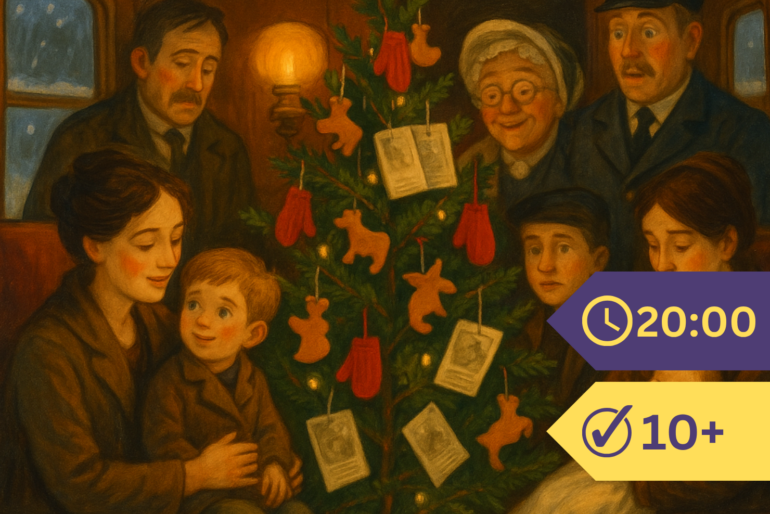
Everyone laughed excitedly, and it did begin to seem like something, as the old lady said. The tree was braced firmly at the end of the aisle, the lumps of ice and snow shaken off, and soft cotton flakes from Dr. Carleton’s surgical stores added for snow. Leaf-cookies and astonishing gingerbread animals dangled from the branches, and Alexander’s red mittens waved in welcome. Even the man of the immovable face helped, with something like a softening of his hard features; and when he fastened a red blank-book and pocket pencil to a branch, there was an outburst of laughing applause.
Meanwhile Dr. Carleton talked quietly with the young mother. He had asked about the baby’s teething and she gave him, almost without realizing it, much of her simple story. Her husband had lost his place in the small town where they had lived. He’d found work in the city, and she was going to meet him. They had no family. She had worked in a factory before she was married. No — the baby hadn’t cut any teeth yet. She hoped he wouldn’t fuss when the teeth came. She didn’t know much about babies.
The doctor listened with sympathy, and a little later, wrapping a bright gold piece in a bit of paper, he marked it “For Baby Burns to cut his teeth on,” and it was added to the tree.
The boy looked on with a dull ache in his throat. He hoped it was not going to be sore. How sick he used to get with bad throats, and how good his mother always was. Mother was filling the children’s stockings at home now. She always managed to have something, somehow. Poor mother — she would have it all alone now. How could he have left her? Why hadn’t he thought of her side of it? I won’t go back, he said to himself. I can’t go back now. I’ll come home rich someday and give her everything she wants. But I won’t sneak back now. Then he didn’t care to think anymore.
“I can make a top,” he whispered to Miss Marsh, “if I have a piece of wood. Shall I?”
“He’d like that best of all,” said Miss Marsh, warmly. Then she added aloud: “Now we must have a star for the top. What can we do?”
“I guess he won’t miss the star,” said the old lady.
But the girl looked from one to another in perplexed appeal.
“Why must there be a star?” asked the boy, shyly.
Miss Marsh hesitated a moment — she didn’t know much about boys, this brotherless college girl — but she said, almost as shyly as he:
“Don’t you think the Christmas star is the most beautiful thing in the world? The Christ Child was born beneath a star; and I think it meant, among other things, that for every new life there is a star set in heaven that will light the way, if once we catch a glimpse of it and know it is there for us.”
The boy listened breathlessly. He couldn’t have said exactly what the girl’s words meant, but the moral courage that had been struggling all day inside him took new strength and slowly began to shape itself into a resolution.
Just then the traveling man, who had been digging in his cases, emerged in triumph waving tin-foil. “Cut out the star from that pasteboard box,” he cried, “and here’s the glory for it. We can’t stop short of perfection in this tree!”
“Well, I’m blessed!” said Conductor Brooks, staring at the sight when he came in a little later. “Where do you folks think you are? At a Sunday-school festival?”
“Never you mind where we are!” said the old lady. Her bonnet was awry and her spectacles on her forehead. “You just help hoist up that star, and then we’re all done.”
Christmas morning, Jamie woke round-eyed and expectant.
“I want my tree,” he said, “and I want my breakfast.” The waiting holiday-makers were just as impatient as he, the breakfast was hurried through, and then they all filed in — Jamie in Conductor Brooks’s arms, his father coming bravely behind, followed by the engineer. Jamie gazed at the tree as if dazed. Then, after the first moment, a smile of radiant, ecstatic joy spread over his round baby face. Not a word or sound — only that beaming, blissful smile. It was irresistible; and with shouts of laughter the tree was stripped of its offerings, and Jamie’s cup of happiness was full.
In the midst of the merriment, Miss Marsh glanced at the boy. He was gazing at the tin-foil star with a curious expression, and she thought of their words the night before. In the breast of her jacket was pinned a badge of her college class — a tiny golden star. She drew it out, and pressing it into one of the leaf-cookies being passed around, handed it to him with a whispered “Merry Christmas.” He saw it, and there was a quick rush of color to his face and tears to his eyes — and that little star tipped the balance of his decision. But the girl never knew.
When the laughter had quieted a little, Jamie turned confidently to Miss Marsh.
“Now the story,” he said.
“What story, laddie?” she asked.
“The Christmas story. Mama said there was a Christmas story, and she saved it up for Christmas day. It’s the nicest story, mama said.”
Everyone was quiet for a moment. Poor Jim turned away. She would have made a good man of him, was the thought in his heart. The girl felt her own heart beat quickly. Could she — before all these strangers? What would they think? No, she couldn’t. She would find a moment to tell it to Jamie alone before the day was over. But the childish eyes gazed expectantly into hers, and with a swift thought of the dead mother, she lifted the little boy gently to her knee and began, her voice trembling a little:
“Long ago, in a beautiful country over the sea, there were shepherds in the fields, keeping watch over their flocks by night…”
The sweet voice grew stronger as the simple words of the wonderful story held the listeners in solemn silence. The little mother’s tears dropped on her baby’s head as she heard of the mother for whom there was no room in the inn, and a vague, trembling prayer went up from her burdened heart. The boy’s eyes shone with new light as he thought of the star set in heaven for the Christ who was a boy, and with a thrill of newly awakened love he placed his own hard-worked mother on her throne in his heart.
There were eloquent sermons preached in churches that Christmas day, and wonderful music sung — but as truly as in any of them, Christ was worshipped around that little tree, whose balsam breath went up like frankincense and myrrh.
A little later, when the relief came and the train pulled at last into the city station, the Christmas party stopped a moment for handshakings and farewells. Twenty-four hours before they would have parted with scarcely a glance at one another. Now they seemed old friends. The busy doctor hurried away first, followed by a long, grateful look from the young mother.
I’ll never forget him, she thought.
The boy took a step toward Miss Marsh. One of her hands was held tight in Jamie’s chubby clasp, the other in the old lady’s. He looked at them for a moment, then turned with a resolute face and walked to the ticket window.
“Give me a ticket on the first train back to Little Falls,” he said.