All good recipe-books give bills of fare for different occasions — bills of fare for grand dinners, bills of fare for little dinners; dinners to cost so much per head; dinners “which can be easily prepared with one servant,” and so on. They give bills of fare for one week; bills of fare for each day in a month, to avoid too great monotony in diet. There are bills of fare for dyspeptics; bills of fare for consumptives; bills of fare for fat people and for thin; and bills of fare for hospitals, asylums, and prisons, as well as for gentlemen’s houses.
But among them all, we never saw the one we give below. It has never been printed in any book; but it has been used in families. We are not drawing on our imagination for its items. We have sat at such dinners; we have helped prepare such dinners; we believe in such dinners; they are within everybody’s means. In fact, the most marvellous thing about this bill of fare is that the dinner does not cost a cent. Ho! all ye that are hungry and thirsty, and would like so cheap a Christmas dinner — listen to this:
BILL OF FARE FOR A CHRISTMAS DINNER
First Course — Gladness.
This must be served hot. No two housekeepers make it alike; no fixed rule can be given for it. It depends, like so many of the best things, chiefly on memory — but, strangely enough, it depends quite as much on proper forgetting as on proper remembering. Worries must be forgotten. Troubles must be forgotten. Yes, even sorrow itself must be denied and shut out. Perhaps this is not quite possible. Ah! we have all seen Christmas days on which sorrow would not leave our hearts nor our houses. But even sorrow can be compelled to look away from its sorrowing, for a festival hour that is so solemnly joyous on Christ’s Birthday. Memory can be filled full of other things to be remembered. No soul is entirely destitute of blessings, absolutely without comfort. Perhaps we have but one. Very well; we can think steadily of that one, if we try. But the probability is that we have more than we can count. No one has yet numbered the blessings, the mercies, the joys of God. We are all richer than we think; and if we once set ourselves to reckoning up the things of which we are glad, we shall be astonished at their number.
Gladness, then, is the first item, the first course on our bill of fare for a Christmas dinner.
Entrées — Love garnished with Smiles.
Gentleness, with sweet-wine sauce of Laughter.
Gracious Speech, cooked with any fine, savory herbs, such as Frolicry, which is always in season, or Pleasant Reminiscence, which no one need be without, as it keeps for years, sealed or unsealed.
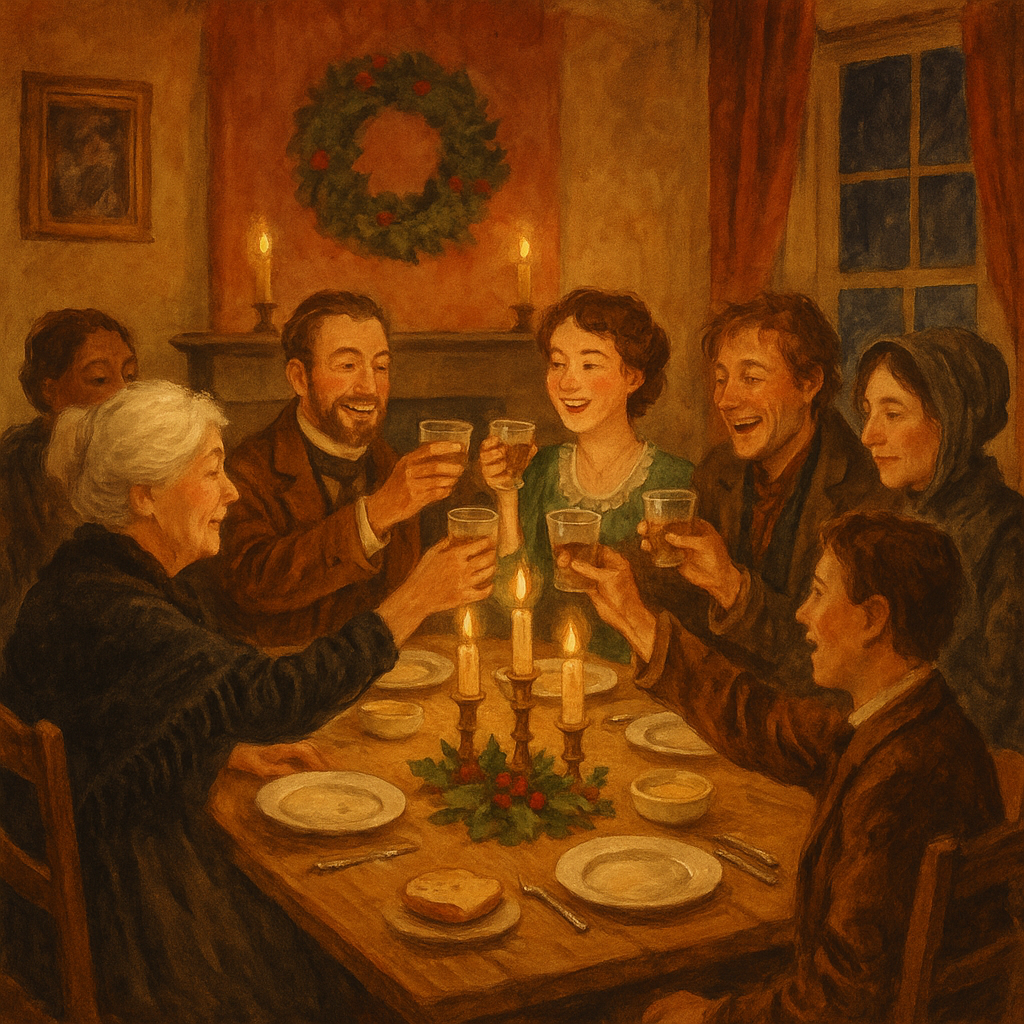
Second Course — Hospitality.
The precise form of this also depends on individual preferences. We are not undertaking here to give exact recipes, only a bill of fare.
In some houses Hospitality is brought on surrounded with Relatives. This is very well. In others, it is dished up with Dignitaries of all sorts — men and women of position and estate for whom the host has special likings or uses. This gives a fine effect to the eye, but cools quickly, and is not in the long run satisfying.
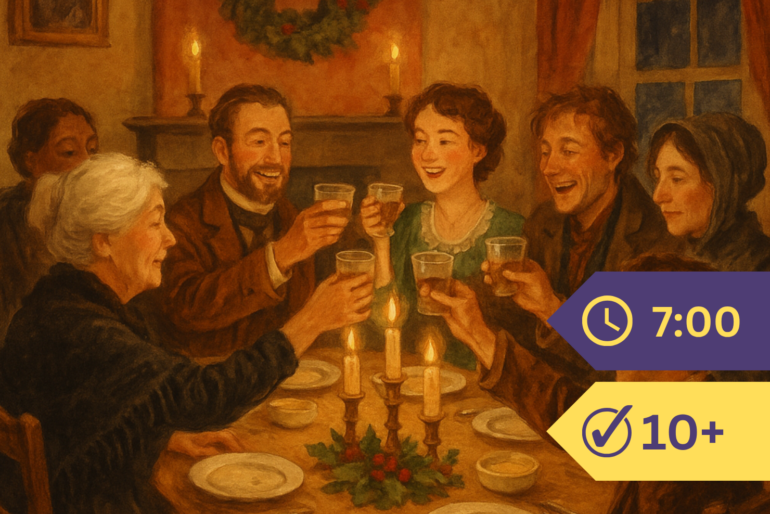
In a third class, best of all, it is served in simple shapes, but with a great variety of Unfortunate Persons — such as lonely people from lodging-houses, poor people of all grades, widows and the childless in their affliction. This is the kind most preferred; in fact, never abandoned by those who have tried it.
For Dessert — Mirth, in glasses.
Gratitude and Faith beaten together and piled up in snowy shapes. These will look light if run overnight in the moulds of Solid Trust and Patience.
A dish of the bonbons Good Cheer and Kindliness with every-day mottoes; Knots and Reasons in the shape of Puzzles and Answers; the whole ornamented with Apples of Gold in Pictures of Silver, of the kind mentioned in the Book of Proverbs.
This is a short and simple bill of fare. There is not a costly thing in it; not a thing which cannot be procured without difficulty.
If meat be desired, it can be added. That is another excellence about our bill of fare. It has nothing in it which makes it incongruous with the richest or the plainest tables. It is not overcrowded by the addition of roast goose and plum pudding; it is not harmed by the addition of herring and potatoes. Nay, it can give flavour and richness to broken bits of stale bread served on a doorstep and eaten by beggars.
We might say much more about this bill of fare. We might, perhaps, confess that it has an element of the supernatural; that its origin is lost in obscurity; that, although, as we said, it has never been printed before, it has been known in all ages — that the martyrs feasted upon it; that generations of the poor, called blessed by Christ, have laid out banquets by it; that exiles and prisoners have lived on it; and the despised and forsaken and rejected in all countries have tasted it. It is also true that when any great king ate well and throve on his dinner, it was by the same magic food. The young and the free and the glad, and all rich men in costly houses — even they have not been well fed without it.
And though we have called it a Bill of Fare for a Christmas Dinner, that is only so that readers’ eyes may be caught by its name, and that they, thinking it a specialty for festival, may learn and understand its secret, and henceforth, laying all their dinners according to its magic order, may “eat unto the Lord.”