The boy’s lantern glowed as he came down the dark mountain path to the little church. Soon other lanterns joined his, and now and then the flickering lights played on the bright dress of a girl or the eager face of a child; but for the most part the shadowy figures gave no hint of who they were, until at last the little crowd gathered into a poorly lighted room, where the flare of an oil lamp showed a motley gathering of country people.
As the boy slouched toward a seat, a girl stopped him. She wore a pink knitted hood, and her cheeks rivaled the color of her head-covering.
“Merry Chris’mus,” she said, and gave him a coquettish glance from her bright eyes as he returned her greeting.
The boy walked by her side a little awkwardly, but unafraid. He was nineteen, and he lived on the hills. It was the time for love, and the girl was his chosen mate. After the festivities they would go up the dark path together, and he would kiss her at the door of her father’s cabin, and that would be their betrothal.
They sat together on the front bench and read from the same hymn book. The boy sang softly. He would not let out his voice in the little room; it was only on the mountain top that the deep tones rang like a bell as he chanted a wild song to his sheep.
The thought of the sheep brought uneasiness. Up there on the mountain his flock lay waiting for him to come and open to them the shelter of their shed; but the temptation had been great, and the smile of the pink-cheeked girl, the music, the lights, the companionship had lured him from the lonely watch under the stars.
Then the girl whispered to him, and he forgot care — until a little later an outer door opened, and a man stepped in, his shoulders white with glistening flakes.
“It’s snowin’,” said the boy.
The girl nodded, but kept her eyes on the stage, where four small girls recited a Christmas poem in unison.
Again the boy’s thoughts flew to the mountain, where the snow was blowing and curling and drifting against a closed door, and where the patient flock, nose to nose and body to body for warmth, bleated for the shepherd who did not come.
At last he moved restlessly. “I’ve got to go,” he said.
“No, you hain’t,” her voice pleaded.
“It’s a fearful storm,” he whispered. “Hear the wind, an’ the sheep are out.”
“They hain’t to hurt,” she whispered back, “an’ you got to go home with me.”
“Your pap’s here,” he said.
“If you don’t stay” — and now she threatened querulously — “if you don’t stay, I’ll go home with Jed.”
The boy looked at her, at her rose-red cheeks, at her blue eyes, at the thin line of her scarlet lips. “But the sheep,” he said, uncertainly.
The new minister was speaking, yearning to move this lethargic people. The boy listened with his face alight. Through the long hours of his childhood he had sat in the sunshine and dreamed of great deeds; with the awakened impulses of youth he had tramped the forests and wondered what life meant to the men who were not of the mountains. And now he knew, for the minister was voicing the doctrine of endeavor. It was not emotion that made the world better, but energy; one must not only dream, but one must do. The great men were those who were faithful in the little things.
“Remember that tonight we make merry,” the minister said finally, “but in the year to come we must work — work for the souls that are within the fold; and as the shepherd cares for his sheep, so must we care for those who are astray.”
“As the shepherd cares for his sheep.” The words struck the boy with the force of a blow. He half rose in his seat, but the girl reached out a restraining hand.
“Stay,” she commanded; but the boy looked at her with unseeing eyes.
“I go to find my sheep,” he said, and left her.
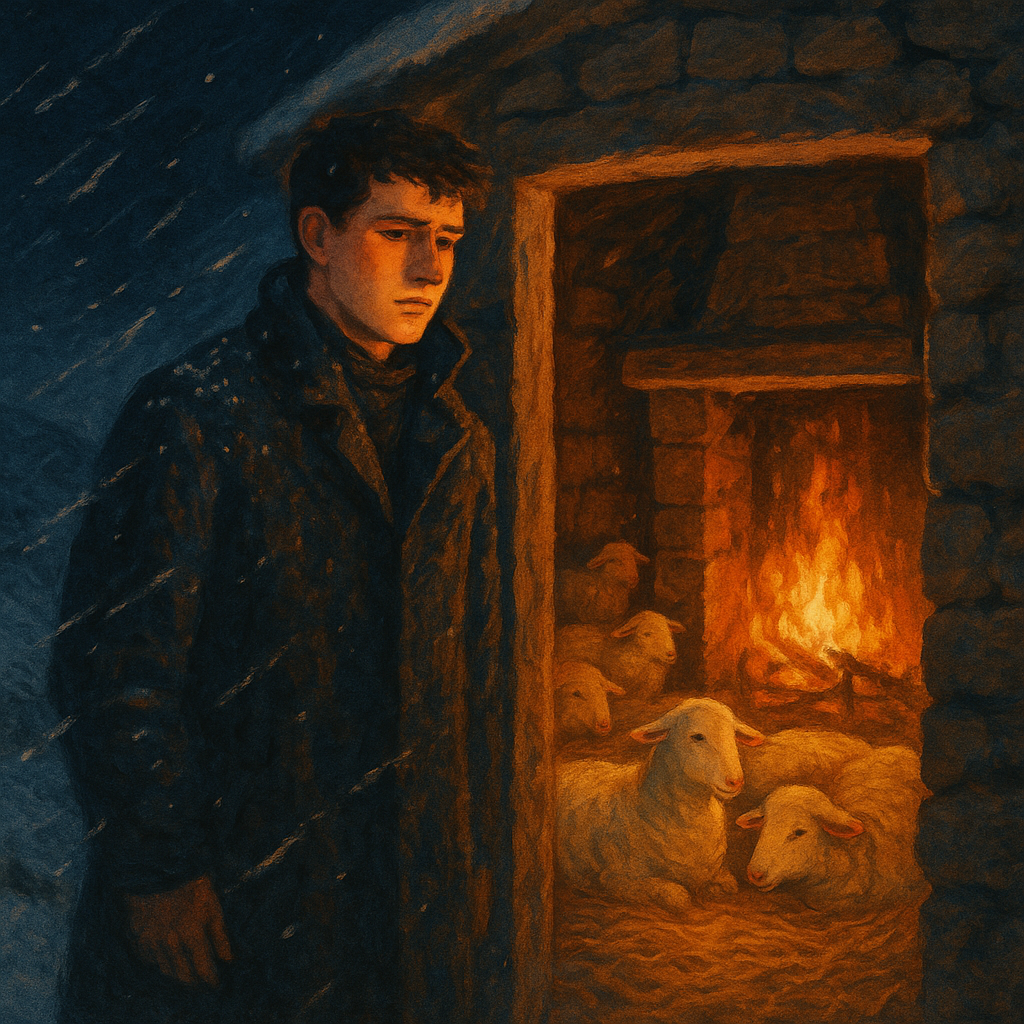
He found them in a close gray bunch against the shed. The wind howled around them, and the snow piled over them, and those nearest the door stumbled in stiffly when the boy unlocked it.
Inside was a rude fireplace, with wood piled beside it. The boy built a great fire, and the flock, retreating before the blaze, lay down on the trodden straw with soft sounds of content. Then he brought in two weak ewes and laid them close to the flames, and watched them anxiously until they revived and staggered back to their fellows.
For a long time after that the boy sat before the fire and thought of the girl. She would go home with his rival, and they would part at the door. His face flushed and his hand clenched as he thought of the parting. Would she—
He rose and went to the door and flung it open. Outside, the stars were blotted out, the wind raged, and the snow whirled. He felt as if between him and the girl there lay the barrier of an unknown world. He had done his duty, and she had not.
He went in and lay down before the fire, his great coat drawn over him.
“Let her go, let her go,” sang the roaring flame. “Let her go, let her go,” raged the wind outside. Then came the soft consolation from within: “You cared for the sheep. You cared for the sheep.”
And so he fell asleep and was comforted — but his cheeks were wet.
In the morning he broke a path down the mountain. The sun shone, the sky was blue, and the world sparkled after the storm. When he reached a certain clearing he stopped and looked out over the glistening snow toward the girl’s house. Suddenly his eye was caught by a flash of pink. Through that white, white world the girl was coming to meet him!
As she came up, he put out both hands and took her smaller ones in his. “I had to go,” he said.
The girl felt a new dignity in his manner. She blushed and trembled; then her lips quivered. “I went home with pap,” she sobbed, her cheek against his coat.
Into his face came all the tenderness of awakened manhood; his rough fingers laid back a little curl that blew about her white temple, and his voice thrilled.
“I’m glad you didn’t go home with Jed,” he said simply, “an’ that you know just how I was—”
She did not know, and would never know, what that night had meant to him; but she knew love, and so he missed nothing, as in the stillness of the perfect Christmas morning she raised her radiant face to his.