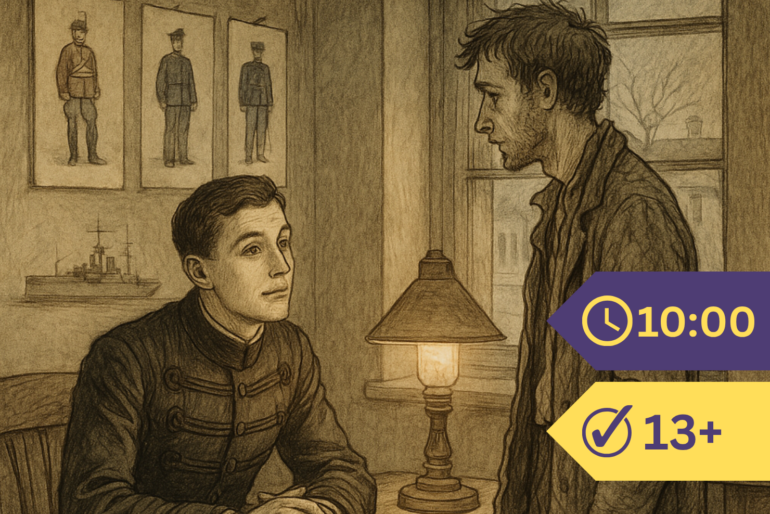
Young Lieutenant Claflin left the Brooklyn Navy-yard early and arrived at the recruiting office at ten o’clock. It was the day before Christmas, and even the Bowery — “the thieves’ highway” — had taken on the emblems and spirit of the season. The young officer smiled grimly as he saw a hard-faced saloon proprietor directing the hanging of wreaths and crosses over his door, telling the assistant barkeeper to make the red holly berries “show up” better.
The cheap lodging-houses had trailed green garlands over their transoms, and even on Mott Street the Chinese residents had hung strings of evergreen over the doors of the joss-house and the gambling den next door. The tramps and drifters, just back from the Island, had an animated, expectant look, as though something was certainly going to happen.
Lieutenant Claflin nodded to Corporal Goddard at the door of the recruiting office, startled that veteran’s rigid posture, and kept him saluting longer than Regulations required by saying “Wish you merry Christmas” as he jumped up the stairs.
The recruiting office was a dull, blank-looking place, the view from the windows uninspiring. He put on his blue jacket with the black braid down the front, lit a cigar, and wrote letters on entirely unofficial matters, forgetting about recruits. He had leave of absence on Christmas, and though the others at the mess had denounced him for abandoning them on that day, they’d forgiven him when he explained he was going home to spend it with his family. The others had homes as far away as San Francisco and as far inland as Milwaukee, and some called the big ship of war home; but Claflin’s people lived up in Connecticut, and he could reach them in a few hours. He was a very lucky man, the others said, and he felt cheerful about it, and forgot the blank office with its Rules and Regulations, colored prints of uniforms, models of old warships, and tin boxes of official documents to be filled out and sent to “the Honorable, the Secretary of the Navy.”
Corporal Goddard on the stoop below shifted from foot to foot and chafed his gloved hands to keep warm. He had no time to write unofficial letters or smoke cigars with his feet on a chair, watching the queer stream of human life flowing along the Bowery. He had to stand straight — which came easily now — and answer questions and urge doubtful minds to join the ranks.
A drunk man gazed at the colored pictures of American infantry, cavalry, and marine uniforms hanging outside the door, placed an unsteady finger on the cavalry picture, and announced he’d chosen to be one of those. Corporal Goddard told him severely to get sober and grow six inches before thinking of such a thing, and frowned him off the stoop.
Two boys from the country asked about the service and went away quickly when they learned the commitment ran three years at minimum. A great many others stopped to admire Corporal Goddard’s bright brass buttons and ruddy complexion, which they innocently attributed to long, sun-baked marches. But no one came to enlist in earnest. At one o’clock Lieutenant Claflin changed his coat and went out for lunch, returning more content than ever and lighting another cigar.
He had just settled himself comfortably when he heard Corporal Goddard’s step on the stairs, followed by a less determined step behind him. He took his feet down from the other chair, pulled his undress jacket straight, and picked up a pen.
Corporal Goddard saluted at the door and introduced the latest applicant for Uncle Sam’s service with a wave of his hand. The applicant was as young as Lieutenant Claflin, and as good-looking; but he was dirty and unshaven, his eyes set back in their sockets, his fingers twitching at his side. Lieutenant Claflin had seen many applicants in this state. He called it the remorseful stage, and he was used to it.
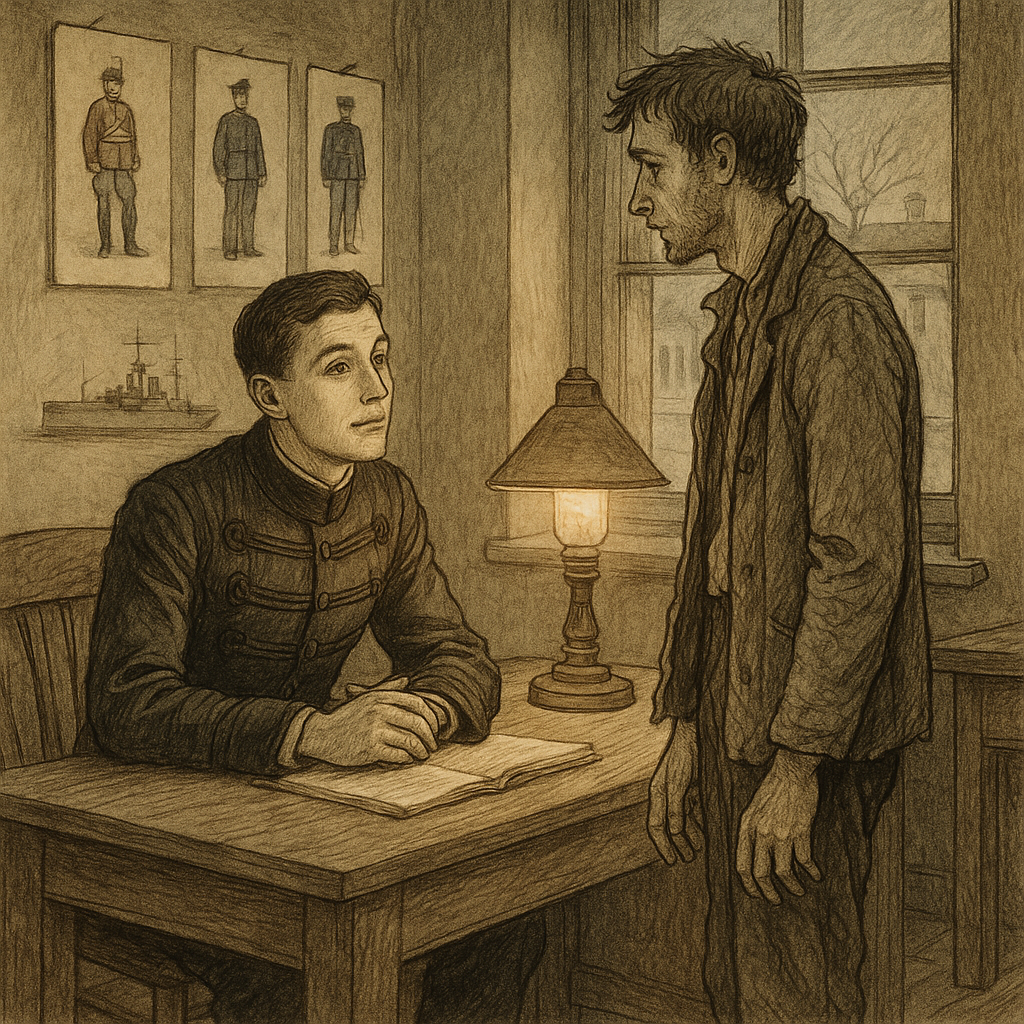
“Name?” said Lieutenant Claflin, pulling a printed sheet toward him.
The applicant hesitated. “Walker — John Walker.”
The lieutenant noticed the hesitation but merely thought, It’s none of my business, and said aloud, “Nationality?” writing United States before the applicant answered.
The man said he was unmarried, twenty-three years old, born in New York City. Even Corporal Goddard knew the last part wasn’t true, but that was none of his business either. He moved the applicant against the wall under the measuring rod and brought it down on his head.
So he measured and weighed him, tested his eyesight with printed letters and bits of colored yarn, while the lieutenant kept tally on the sheet, chewed the end of his pen, and watched the applicant’s face. Many men had passed through this office, but none quite had the air this one did. Lieutenant Claflin felt Corporal Goddard was a little too callous in the way he handled the applicant, too brusque in his questions — though he couldn’t say why Goddard treated them all the same way. He noticed the applicant’s pale face flushing, and that he bit his lips when Corporal Goddard pushed him toward the weighing machine as if moving a barrel of flour.
“You’ll do,” said Lieutenant Claflin, glancing at the sheet. “Your numbers are very good. All you have to do now is sign this, and then it will be over.” But he did not let go of the sheet, as he would have done if he’d truly wanted it over. Neither did the applicant move forward to sign.
“After you sign this,” said the young officer, keeping his eyes down on the paper, “you will have become a servant of the United States. You’ll sit in that other room until the office closes, then be taken over to the Navy-yard and put into a uniform. From that time on, for three years, you will have a number — the same number as the one on your musket. You and the musket will both belong to the government. You will clean and load the musket, and fight with it if God ever gives us the chance; and the government will feed you and keep you in order, and fight alongside you if needful.”
The lieutenant looked up at the corporal and said, “You can go, Goddard.” The corporal turned on his heel and walked downstairs, wondering.
“You may spend those three years,” continued the officer, still without looking at the applicant, “which are the best years of a young man’s life, on the sea, visiting foreign ports. Or you may spend them marching up and down the Brooklyn Navy-yard and cleaning brass-work. There are men who are suited to that — cleaning fittings and standing watch in front of a stone arsenal — and fitted for nothing else. But in every man there is something that tells him he was put here to make the best of himself. Every man has that, even the ones who are only fit to polish brass. But some men try to kill it, in different ways, and usually by rum. They tend to succeed, if they keep at it long enough.
“The government, of which I am a very humble representative, is always glad to get good men. But it seems to me — and I may be wrong, and I’m quite sure I’m speaking contrary to Regulations — that some of her men could serve her better in other ways than swabbing decks. Now, you know yourself best. It may be that you are exactly the sort of man to stand and salute when the officers’ families come aboard to see the ship, and to watch from the fo’c’sle as they walk about the deck. You won’t be allowed to speak to them. You’ll be number 329, and whatever good a home can give a man will be closed off to you, more or less, for three years.
“On the other hand, it may be that there are people who could keep you on shore and help you do something more with yourself than carry a musket. And it may be that if you stayed on shore, you’d drink yourself quietly to death, and break somebody’s heart. I can’t tell. But if I were not a commissioned officer and a creature of Rules and Regulations who can dance and wear a uniform, and a young man generally unfit to pose as an example, I would tell you not to sign this — but to go home, straighten up, and leave whiskey alone.
“Now, what shall we do?” said the young lieutenant, smiling. “Shall we tear this up, or will you sign it?”
The applicant’s lips were trembling now as well as his hands. He rubbed his cuff across his face and managed to smile back.
“I’m much obliged to you,” he said, unsteadily. “That sounds flat, I know — but if you knew all I meant by it. I’ve made a fool of myself in this city, but nothing worse than that. It was either the navy — where they’d keep me straight — or going to ruin on my own. But it won’t be my own way now, thanks to you. I don’t know how you saw it so quickly. But I have a home back in Connecticut, and people who can help me there, and I’ll go back and ask them to let me start again from where I left off.”
“That’s good,” said the young officer warmly. “That’s the way to talk. Tell me where in Connecticut, and I’ll lend you the fare to get there. I’ll expect it back with interest,” he added, laughing.
“Thank you,” said the other. “It’s not so far that I can’t walk — and I don’t think you’d believe in me if I took money.”
“Oh, yes I would,” said the lieutenant. “How much do you need?”
“Thank you — but I’d rather walk. I can get there easily enough by tomorrow. I’ll be a fine Christmas present, won’t I?” he added, grimly.
“You’ll do,” said the young officer. “I rather think you’ll be about the best one they get.” He held out his hand; the other shook it, and walked out with his shoulders as straight as Corporal Goddard’s.
Then he came back and looked into the room shyly. “I say,” he said, hesitating.
The lieutenant reached into his pocket. “You’ve changed your mind?” he asked, eagerly. “Good. How much will you want?”
The other flushed. “No — not that. I just came back to say —” He paused. “Wish you a merry Christmas.”