The “Scavenger” had gone to bed. But, as we knew from experience, she was far from asleep — she was listening to every word of our conversation, storing it away for future use at our expense.
She was only twelve years old, and being the youngest, was doomed to run the family errands. Though she complained bitterly every time she was sent anywhere, in her heart she gloried in any chance to scour the neighbourhood and find out whatever was new or interesting. In her innocent babyhood she had been christened Lillian; but when, as a growing child, she began to depend on old iron, bottles, and the contents of the rag-bag as her chief sources of income, and collected these articles of trade with remarkable energy and no great scruples, we bestowed upon her the more descriptive title of “the Scavenger.”
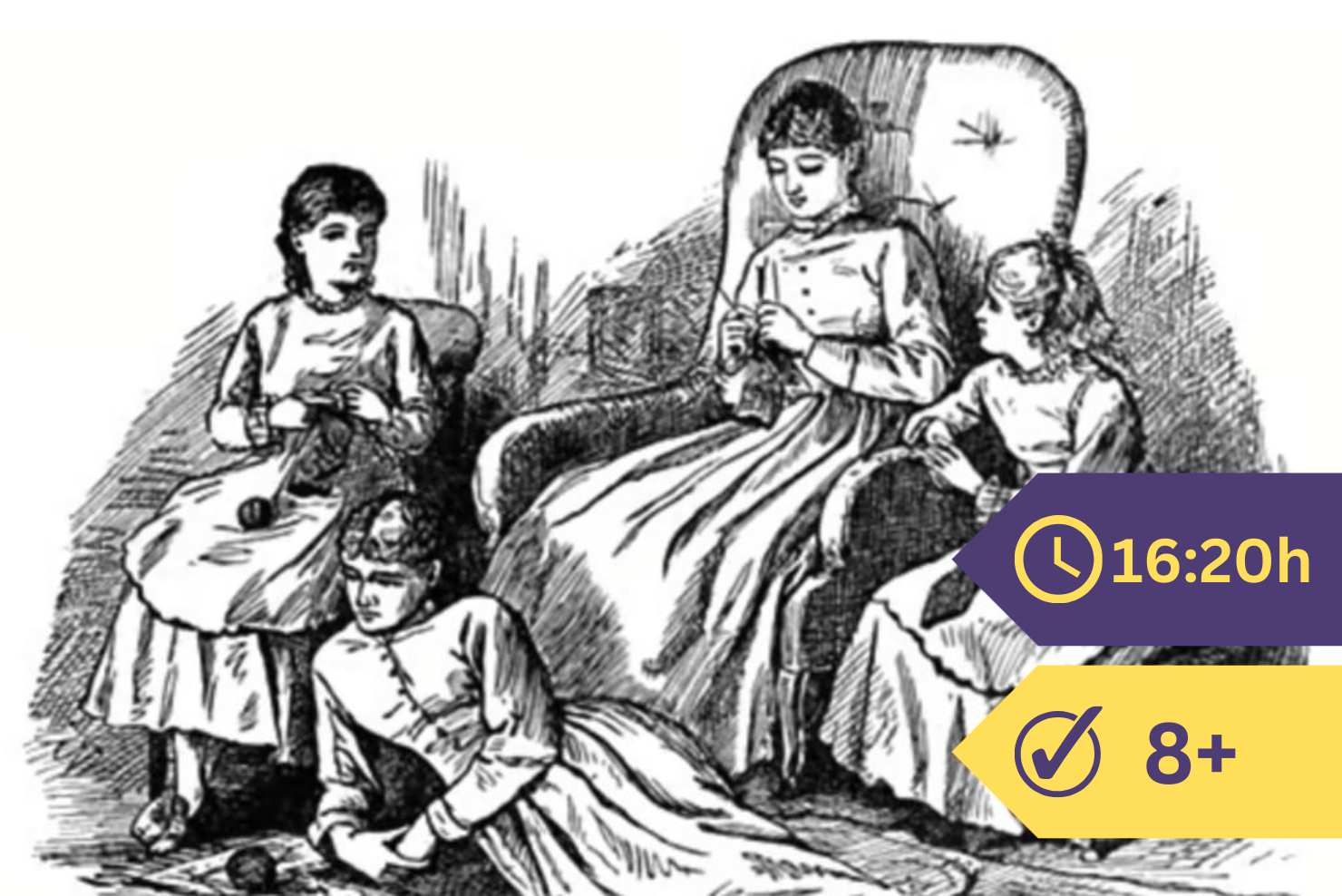
By this time you will have gathered that we were poor. Mother was downstairs sewing, and supposed that we four girls had gone to bed; but three of us sat before the dying fire and bemoaned our poverty.
We were Vivian, Clara, and Nan. I am Nan, the eldest of the sisters. Vivian and I have no nicknames, but Clara is called “Herc,” short for Hercules — an honour bestowed upon her in recognition of her prowess in such feats as lifting the kitchen stove, moving the bookcase, and beating carpets.
“To be poor is hard at any time,” sighed Herc, “but it is doubly hard at Christmas. Here it is the middle of December, and we have not a dollar.”
“My heart aches for mother,” said Vivian. “She is fretting herself ill over the bills.”
“I should like to scalp the butcher,” murmured Herc, in serious meditation.
An odd sound from the bed — a half-strangled sob — caused us to look at each other in surprise.
“What is the matter, darling?” asked Vivian, going over and trying to lift from the Scavenger’s face the bedclothes which were dragged over her features and clutched fiercely from beneath. “Tell your Vivian what troubles you, dear.”
After being coaxed several times, the grief-stricken one raised a corner of the bedclothes and sobbed forth:
“Mother is sick! And all because she has no money. Yesterday I went into her room for some pins, and I found her on her knees by the bedside, crying and praying — praying in the daytime!“
A long-drawn sob betrayed that in this last statement she felt her recital had reached its very height of distress.
“Don’t cry, little girl; don’t cry. Things may grow brighter by and by,” said Vivian soothingly, but her own voice trembled. In fact, sudden tears came to Clara’s eyes and mine as we guessed at the suffering our little mother had so bravely kept from us.
Vivian brushed the damp hair from the child’s forehead and petted her into a calmer frame of mind. When she discovered, after a while, that the much-comforted Scavenger was sobbing merely for her own private enjoyment, revelling in the way the bed shook with each convulsive sob, Vivian came back to her old seat by the fire and asked:
“Is there no way we girls could make a little money and help mother along? Is there nothing we can do?”
“We have not an accomplishment in the world,” I said, a little bitterly.
“Herc might give music lessons!” said a voice from the bed, with a sobbing cackle of dismal mirth.
The sting of this suggestion lay in the fact that Clara, who had less ear for music than anyone alive, was given in moments of dejection to twanking viciously on an old banjo, which she played with so little melody and so much energy as to drive the rest of us to distraction.
Herc broke into a burst of laughter, then sank back immediately into her former state of gloom.
Vivian sighed wearily and fell into a reverie that must have been far sadder than we could guess. Two years before, she had been engaged to be married to a young man who was so affectionate, so boyish, so full of fun, that he soon won mother’s heart as completely as he had won Vivian’s. As for us girls, we simply adored him.
“Brother Bob,” as we soon learned to call him, was summoned to England just three months before the day set for the wedding, to take possession of a fortune left him unexpectedly. And then came the sad, sad news that on the vessel’s return trip he was drowned.
After that, everything went wrong with us. We gave up our Philadelphia home and moved to San Francisco, expecting in some vague way to do better; but we were disappointed, and only by the strictest economy were we able to keep a roof over our heads. Poverty is a skeleton that may be kept decently in its closet until Christmas-time; then it comes forth and rattles its bones under one’s very nose.
The prospect was so dismal that it actually prevented us three tired girls from going to bed. We sat around the grate, staring into the fire, as if trying to wrest a helpful suggestion from the fast-dropping ashes.
This second silence had lasted fully ten minutes when it was again broken by a speech from the bed.
“See here,” said the muffled voice. “I have a splendid idea — but I’m afraid you’ll laugh at me if you don’t like it.”
“Why, Lil, of course we won’t!” said Vivian reproachfully.
Thus encouraged, the flushed and blinking Scavenger struggled into a kneeling position and addressed us with dignity.
“You know our old washerwoman, Biddy Conelly?”
Of course we did, and said so.
“You know the paper, cake, and boot-button shop she keeps?”
“Well?”
“Biddy is laid up with rheumatism, and the shop is shut.”
“Well?“
“Well!” — defiantly, as the crisis grew nearer — “why can’t we keep the shop until Biddy gets better, and make a kind of Christmas place of it, with cornucopias and Christmas-tree things, and have lots of fun, and earn lots of money?”
Silence reigned. Breathless and astounded, we could only look at each other.
Then what a gabble of tongues! What a deluge of fors and againsts! What a torrent of questions and answers! What a flavour of romance — what a contagious excitement and freshness about the whole plan!
“Shopkeepers! Delightful idea! We might be able to pay all the bills and buy mother a new dress!” said Vivian.
“I shall be able to keep my rag-money all for myself, and I’ll buy a bicycle,” said the sanguine originator of the plan.
“Let us go to bed and gain the strength needed to put this scheme before mother in the morning,” concluded I, with wisdom.
Well, we carried our point. Mother at first would not consent; but the gentleman who rented our front parlour conveniently chose that moment to leave without paying his last month’s bill, and we used this deplorable incident to such advantage that mother finally gave in.
Two of us rushed at once to Biddy’s and had an entirely satisfactory interview with her. Not only did she refuse to charge us rent for the shop and stock on hand, but she lent us a little money so that we might lay in goods of a properly holiday nature.
There was much to be done before we could throw open our establishment to an indulgent public. At home, mother and Vivian worked untiringly — mother crocheting and knitting, Vivian dressing dolls and painting little pictures for our show-window. At the store, Lil, Clara, and I were equally busy, and afforded Biddy, who lived in the rooms above, much pleasing excitement.
Clara especially merited praise. Slender and girlish as she was in figure, she performed many manly feats, especially in the way of carpentry; and when it came to cleaning, the rest of us were nowhere beside her.
“Cleanliness is the thief of time,” she panted, “but it’s the only way to be healthy, wealthy, and wise.”
As we intended to be shopkeepers for two weeks only, and as we were such strangers in the city that we had no acquaintances to shock, the day on which we opened our little store found us four of the most expectant, most excited, happiest girls in the world.
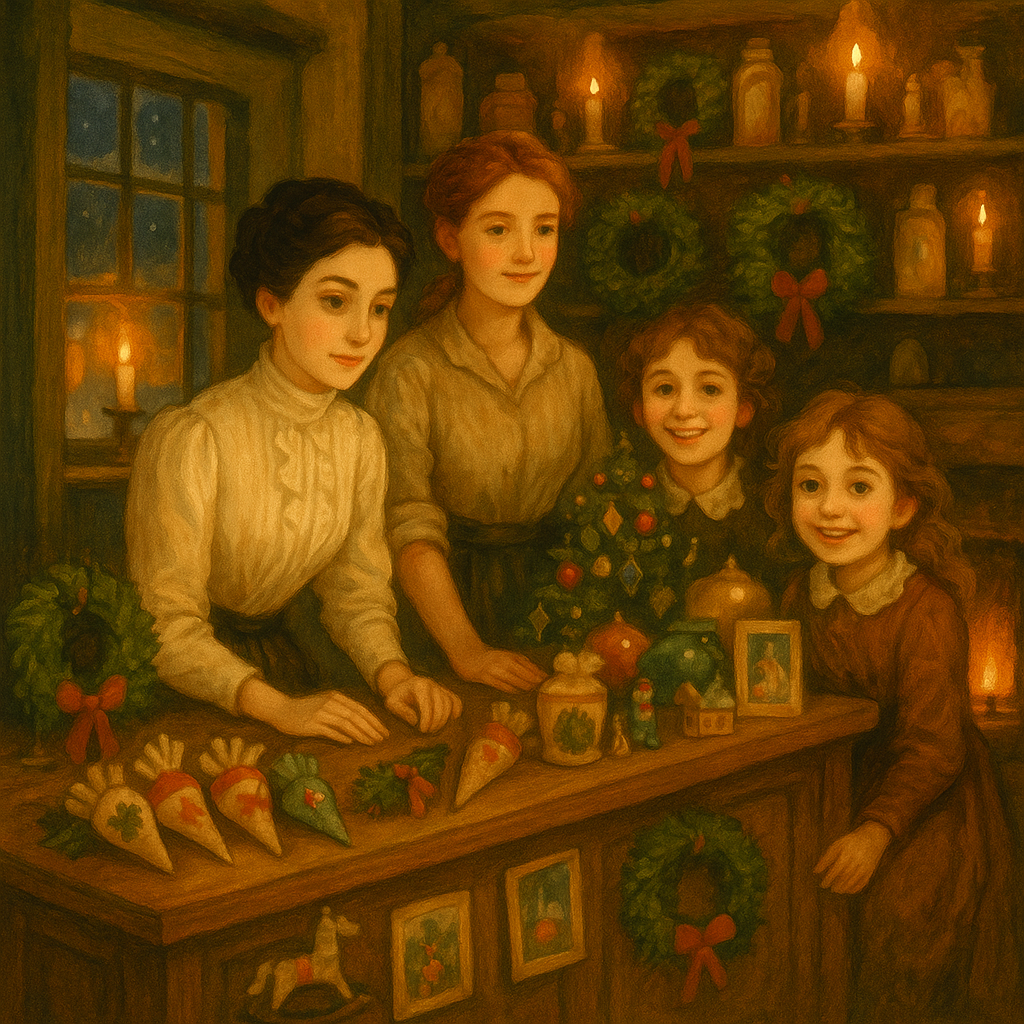
You must hear a short description of our dear shop. It was on Third Street, nearly an hour’s ride from our house. It had only one show-window, and was a bakery, a confectioner’s, and a stationer’s all rolled into one. But our chief pride was in our Christmas goods and tree ornaments. We considered our assortment of dolls and our stock of tin toys unrivalled; and we completed the effect with wreaths and ropes of fragrant evergreen.
At the back, opening out of the store, was a small sitting room; and before its bright fire we sat and chatted whenever we were off duty. We made fun of everything and everybody; we laughed at the poorest jokes; we were in a touch-and-go state of good humour from morning till night. Indeed, we look back upon those days as the merriest of our lives.
Our first customer! The words send a thrill through me even now. We fought so for the honour of being first behind the counter (before the arrival of any buyer, of course) that we finally drew lots for it — and the Scavenger won. She made us retire into the back room and closed the door; then she triumphantly mounted guard alone. The bell tinkled! A child came in! We three in exile pressed our faces to the curtained glass door and breathlessly watched the proceedings. The child pointed to a tin horse; Lil handed it to him; the child nodded; handed it back; said something; Lil wrapped the horse in paper; gave it back to the child; the child took laboriously a coin from his stuffed pocket; laid it on the counter; child went out.
Simultaneously we burst into the shop.
“Let us see it! Show us the money!”
“First blood for me!” shrieked the Scavenger, dashing a ten-cent piece into the till.
Vivian, who was bookkeeper, entered the ten cents amid frenzied rejoicings. Soon after her first sale, Lil shoved her head into the sitting room and observed with a quiet chuckle:
“I say, Vivian — a young man was just straying past, and caught sight of your paintings; and they were so bad they made him ill.”
“They did not,” cried Clara indignantly.
“They did. He gave one look and then reeled — positively reeled — away.”
Vivian was so used to having her pictures ridiculed that she merely smiled and said nothing.
Late in the afternoon, Lillian and I were on duty together. We were very tired, all of us, for we had had an extremely busy day, the stream of customers being almost an unbroken one. Lest anyone jump to the conclusion that we were on the highroad to fortune, I should explain that very few of the purchasers spent more than a dime at a time. Sometimes the worth of a nickel sufficed for their modest needs. Often we suffered the shock of seeing them go out without having bought anything at all.
To Lillian and me fell the glory of serving a customer out of the ordinary. He came at twilight, just before the lights were lit — an elderly-looking, heavily bearded gentleman with a gruff voice. He glanced sharply at both of us, and then said to me in a nervous, rambling way:
“Er — ah — got any paper? Note-paper?”
“Yes, sir; plenty.”
“Give me — er — five dollars’ worth.”
“Five dollars’ worth?” I repeated in amazement.
“Um — yes.”
When the enormous package was at last presented to him, he paid for it promptly, but was not yet satisfied.
“Have you — any, well, er — any nice, first-class gold pens?” he asked again, in his uncertain fashion.
As he was looking directly at them, an answer was unnecessary, so I silently placed the tray of pens before him. He took five, at two dollars each. I tied them up for him, blushing hotly, for I had come to the mortifying conclusion that he was throwing his money into our till from charitable motives only, and did not really need a solitary pen or a single sheet of paper.
“Nice store — very,” he said, gruffly yet affably, catching the Scavenger’s glassy and dismayed stare. “Am setting up a Christmas tree — will want cart-loads of things. Have got — er — lots of children.” Here he described with his gloved hand an immense arc in the air to illustrate the size and number of his children. “All will have to have presents. Must go now. Will drop in again. Good-by.”
The door closed behind him. Lil and I, after an astounded look at each other, rushed into the sitting room to tell the girls.
“A nice sort of customer to have. I wish he would come again,” said Vivian.
“He’s going to — he said so.”
“Was he young or old?” asked Hercules.
“Old,” said I.
“Young!” said Lillian.
“He had a gray beard.”
“Well, the eye part of him was young — real young,” insisted Lil; and the subject was dropped.
When the eventful, delightful day ended, we ran upstairs to bid good night to Mrs. Conelly.
“It’s a fine stroke of luck you’ve been having,” she declared, leaning forward in her chair by the window. “I’ve been sitting here, and I’ve counted one hundred and thirty-nine people who’ve gone in and out of that store.”
“Impossible!” we cried.
“I’ve counted, and I know,” she maintained stolidly. “Sixty-nine went in and sixty-nine came out. One of them didn’t really go in at all, but came up here and began asking questions about you. Not a word did I give him. I only told him where you lived, what your names were, and how you came to be keeping the shop. Then he told me not to mention him to you, and not to tell you whether he was a man or a woman. And I won’t. You can’t drag it out of me.”
“Did he — or she — have a long gray beard?” I asked anxiously.
“Not a hair on his face,” she declared; adding, with a virtuous regard for truth, “barring an eyebrow or so.”
As we could obtain no further information from her, we hurried homeward. It was charmingly dark, and we felt very independent and businesslike at being out at such an unusual hour.
Mother had a hot supper for us, and whether we ate most or talked most, she declared she could not tell.
When our hunger and excitement were both abated, we made the discovery that mother had had a little excitement of her own, and that she was trying to keep it from us. But we pounced upon her like a pack of hyenas:
“Now, mother, what is it? You are a bad hand at keeping a secret. Tell us. Out with it!”
Between laughing and crying she finally told us all — that she had rented the two parlours to a very rich old gentleman, who had not only given a high price for them, but had positively paid three months in advance. She concluded by drawing a great bunch of money — real greenbacks — from her pocket and fluttering them above her head like little flags.
Our youngest expressed her feelings in a fantastic dance.
The next day at the store was a counterpart of the first, except that the reckless buyer did not appear. For three days he kept away, but he made up for it when he did return. Vivian, who had stayed home with mother, missed much of the fun, and had to hear second-hand a tale highly complimentary to herself; for the old gentleman bought all of her paintings, one after another, and stuffed them out of sight into his immense pockets. They only seemed to whet his appetite for more. “I will take — I want — give me that,” he said, pointing abruptly to the most gorgeous doll in our collection.
The poor little doll-loving Scavenger sighed deeply as she beheld her favourite go head-first into one of those capacious pockets, the paper-wrapped legs waving her a sad farewell.
Still not satisfied, our customer demanded in his hearty way, “Now, then, fetch me out Christmas-tree fixings; lots, please.”
At this point, Hercules — who was serving him — blushed a painful red and said with quiet determination: “No, sir; I’d rather not!”
“Bless my soul! What’s the matter with you?” demanded he, bluntly.
Through her desperation, Herc answered honestly: “I don’t think you really want anything you’re buying, sir!”
He broke into a spasm of gruff, good-natured laughter, but insisted with evident sincerity that he needed all he had bought and more, and would have to go elsewhere if she refused to supply him. When she showed him what he asked for, he purchased articles enough to decorate a banyan tree, and departed with the promise that he would “drop in tomorrow.”
The night before Christmas! We had paid all the bills; we had secretly bought mother and one another little presents; and the dear store which had enabled us to do so much was to pass into the hands of Biddy’s cousin, who had come to take charge on our departure.
The delightful nervousness of Christmas Eve was upon us all, and we were all four chattering together in the center of the shop, which we were so soon to leave.
“Well, I just love the old man who bought such loads of things!” exclaimed Lillian. “We wouldn’t have done half so well without him.”
“Goodness!” said Clara. “Speak of an angel and you hear his wings!”
His wings made a great deal of noise, for he burst in with his usual hearty clatter; but instead of dashing to the counter as was his habit, he stood quite still, looking steadily at Vivian, who blushed and trembled under his gaze. And then — the dear old fellow — what did he do but rush at our lovely Vivian and clasp her in his arms! It almost seemed that she had been put into one of those pockets, so completely did she disappear in the overcoat’s embrace.
Before we, an indignant trio, had time to remonstrate, Vivian had torn herself away and was looking at him — not in anger, but in an undefined terror that was not terror at all.
“Vivian! My Vivian!” As his voice rang through the room, our pulses leaped with a strange remembrance, and Vivian — almost unconscious with joy — flung herself of her own free will back into his arms.
Then what a wild, happy set we were! “Brother Bob!” “Dear Bob!” “Not drowned, but come to life again!” We shouted, we laughed, we cried; we all became like raving lunatics in our joy. I found myself crying helplessly over the Scavenger in a corner, while she was shouting “Bob! Bob! Bob!” at intervals, like a joyful little foghorn.
When we were the least bit calmer, Bob sent us into fresh hysterics by pulling his wig and beard out of his pocket. And then we saw the dear remembered face!
“My own, my beloved Vivian!” he cried. The glad tears were running down his face quite as freely as down ours.
Vivian said never a word, but clung to Bob’s arm like one in a dream. How we got into the street we never clearly remembered, but I know we found ourselves dashing homeward at a rousing pace, all talking together. We didn’t want to be heard — we only wanted to talk. Still, we were keenly aware of Bob’s story threading through the noise. He told us how he had lost track of us after he was saved from the lost ship, nobody seeming to know where we had gone. How, after two years of searching, a faint clue had brought him to San Francisco. How he had seen, in our shop-window, Vivian’s painting of our old Pennsylvania home — and had recognised it. How he had learned everything about us from Biddy. And how he had determined to mystify us and haunt the store until he could find Vivian herself behind the counter.
“Here we are at home. Don’t tell us any more,” commanded Lil. “Save it for mother.”
On the doorstep we formed, in excited whispers, an elaborate scheme for mother’s mystification. Bob was to stay outside while we went in and made mother believe we had brought a homeless waif home with us. Then she was to go out and bring him in to the light of her hospitable fireside — and he was to fall upon his knees and reveal himself. Tableau! Bob assented with cheerful readiness, and we, after a violent ring at the bell, waited in breathless expectation.
The door opened; we crowded past mother and tried to push her away from the door, gabbling, “Oh, let us tell you — we knew you wouldn’t be angry — we brought home a poor old tramp with no home and no —”
Here mother gently freed herself, put her dear, pretty head out of doors, and said, placidly: “Come in, Bob.”
We were petrified. She knew.
“Don’t try to deceive your poor old mother, girls,” she said, throwing open the parlour doors —
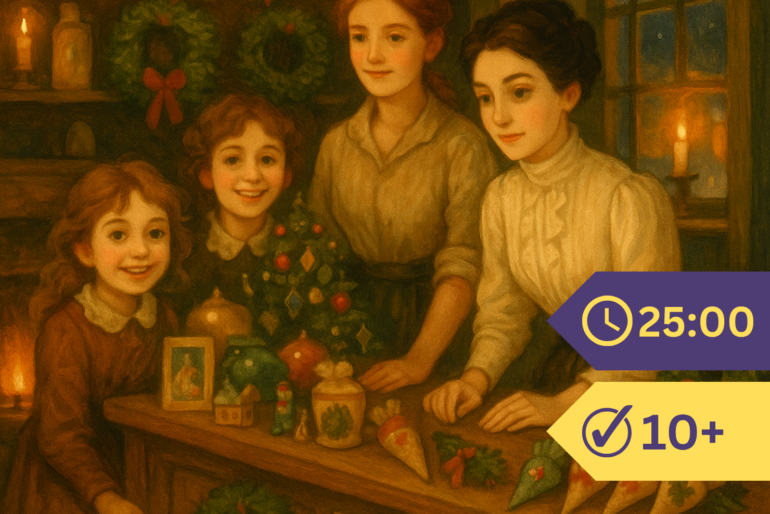
Well, words fail me. At one end of the blazing, brilliantly lit room stood an immense Christmas tree, dazzling with candles, and bearing on its drooping branches — besides myriads of costly gifts — every single article we had sold our “old man.” It was like a child’s dream of a tree. In an armchair by the fire sat Biddy Conelly, beaming happily upon us like a homely old fairy.
“Then Brother Bob is the ‘rich old gentleman’ who rented the rooms — and you knew it!” I cried, as the light suddenly dawned on me.
Through the blissful silence came a still, small voice from Biddy’s direction: “I didn’t know it was the gentleman who had died, but I’m glad I held my tongue about him — where would the surprise have been otherwise?”
But Herc was looking admiringly at mother, and gasped at last: “Mama dear, I didn’t know you could be so underhanded!“