Over a little town in the heart of the Rocky Mountains hung a heavy cloud. A young girl stood at the window of one of the pretty homes, watching the sky with anxious eyes. Her brother stepped up behind her.
“Never mind, Kate,” he said. “We’ll have a good Christmas, even if it does snow.”
Kate frowned. “What good is any more snow? It’s already four feet deep, and all the roads are blocked. We can’t get our Christmas mail. There’s no sugar left in town, only one cow to give milk for the children, not an egg to be had — we can’t even bake a cake!”
Just then white flakes began to float through the air. Kate’s exclamation was a mournful: “There it comes. It’s too bad.”
Near the large stove sat their father. Hearing Kate’s distressed voice, he came to the window. Dr. Ward was a slender man with kind eyes and gray hair. There were many lines across his forehead, but most had been drawn by care and thought, very few by age, and none at all by discontent. As he stood stroking Kate’s hair, it was easy to see that the girl was the pride of his heart.
“Your mother, my dear,” he said quietly, “was always glad when it snowed at Christmas. She always said, ‘A real Christmas should be a white Christmas.'”
Tears rose in Kate’s eyes. Harry turned away his head — he did not want Kate to see how desolate home had felt to him since their mother’s death.
Through the gathering snow two heavy figures came toward the house. Harry opened the door to find two strong men with resolute faces.
“Does Dr. Ward live here?” they asked.
The doctor stepped forward. Despite the storm, the men lifted their caps when they saw him.
“There’s a man badly hurt up at the mines,” said the taller of the two. “Will you come, doctor?”
“Certainly,” said the doctor, without hesitation. “I’ll come at once.”
The man glanced at the two young people. “Doctor — you know the snow is sliding badly? There’s real risk.”
The doctor nodded and reached for his thick coat.
“Oh, Papa!” Kate cried. “Not today — not you! We can’t let you go.” In desperation she turned to the men. “Can’t you find a younger man for a trip like this?”
The man looked troubled. “I’m sorry, miss. We did try. But no other doctor will go. And the man is badly hurt.”
Poor Kate. Her father and brother had hidden their own grief over their mother’s death, doing everything they could to make her life bright. Now she couldn’t believe she could be pushed aside for any other claim. She clung to her father, sobbing.
“Kate,” he said, taking her hands, “my work is to save lives.”
“But, Papa — your life! So useful — save that!”
“My dear, who can say which life is most needed? Besides, your fears are foolish. There is probably no real danger. I shall come back safely — never fear.”
He rested his hand on her head for a moment. Then, satchel in hand, he went to the door. On the threshold he took Harry’s hand. “My boy,” he said, “you are like your mother. I trust Kate to you.” And the door closed.
The three men plowed their way up the street and into the mountain trail that led to the mines. Kate watched the figures grow small in the distance, until the snow hid them from sight. The great hills that shut in the town had never seemed so high, so silent, so unmoved as during the long hours that followed. In vain Harry planned diversions; she sat by the window with an anxious and sorrowful face. Still the storm raged, and as twilight gathered, even Harry could not keep the worry from his voice.
In mountain valleys the dark comes early. It was full night when a heavy knock brought Harry to the door. There stood twelve men, and in their midst, on a sled, a shapeless mass of snow-covered blankets.
“Where’s Father?” Harry gasped, staring at the sled.
“He said to tell you the storm was too bad — he’ll stay up at the mine tonight. We’re taking the hurt man down to the hospital.”
“Noble fellows!” Harry cried, his face alight, as the men set off again. “Those twelve men carried that poor soul down the mountain on a sled, in this storm and darkness, over four feet of snow. They faced death every step of the way.”
Kate stared into the fire and said nothing. Suddenly it was as though a veil had lifted. She saw not only her father risking his life for others — that was no new vision — but those rough, faithful miners, twelve of them, risking their lives to carry one hurt, perhaps dying, man to safety. And she — all day long she had brooded over her own sorrow and anxiety, letting Harry try to cheer her, never once thinking of his troubles.
With a flush of shame she stood up.
“Harry,” she said, “shall we practise a little tonight?”
Harry brought out his flute and the sheet music with an expression of such relief and happiness that Kate’s heart gave another throb of remorse.
The next morning dawned clear and cool. Gradually the sun rose over the mountains, touching the vast snow-covered slopes into a glory of light and color and glittering white. Kate sang as she worked, thinking with quiet determination of the new comfort she would bring into her father’s life from that day forward. Nine o’clock came before the sunlight reached the town in the valley. Harry began watching the mountain trail. But all day long the beauty of the hills glittered before their longing eyes, and no father came down the mountain path. At three o’clock the sun went down, and the tints of sunset glowed on the snowy heights. Kate bravely attempted the pretense of a meal, but by evening Harry found her crying softly to herself.
“Kate,” he said, “don’t worry. Tomorrow morning I’ll go up and find him.”
Harry started early. Kate bravely watched him until he was out of sight.
“We’ll be home for Christmas!” he shouted back, spirits rising at the prospect of something to do.
He climbed to the mines — and found, to his dismay, that his father had started down early the morning before, the superintendent having watched him go.
“I’ll have to go back down and organize a search party from town,” Harry said.
“That’s the best plan,” the manager agreed.
He said nothing about the danger Harry himself would have to pass through. Danger was around them all.
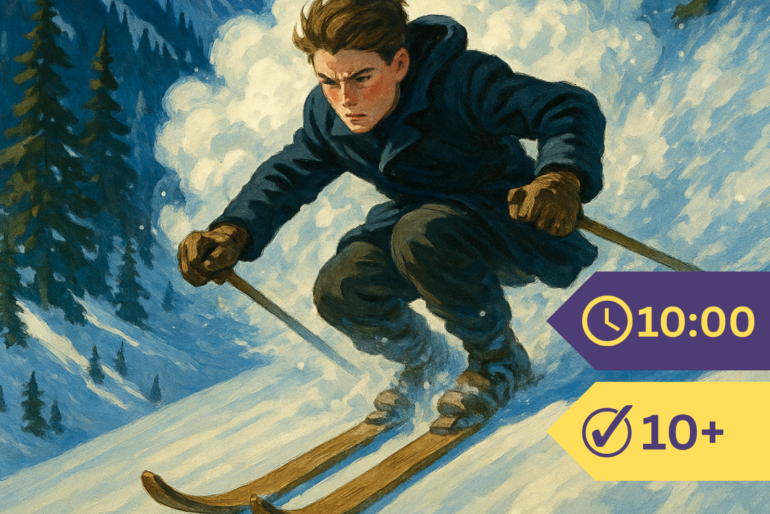
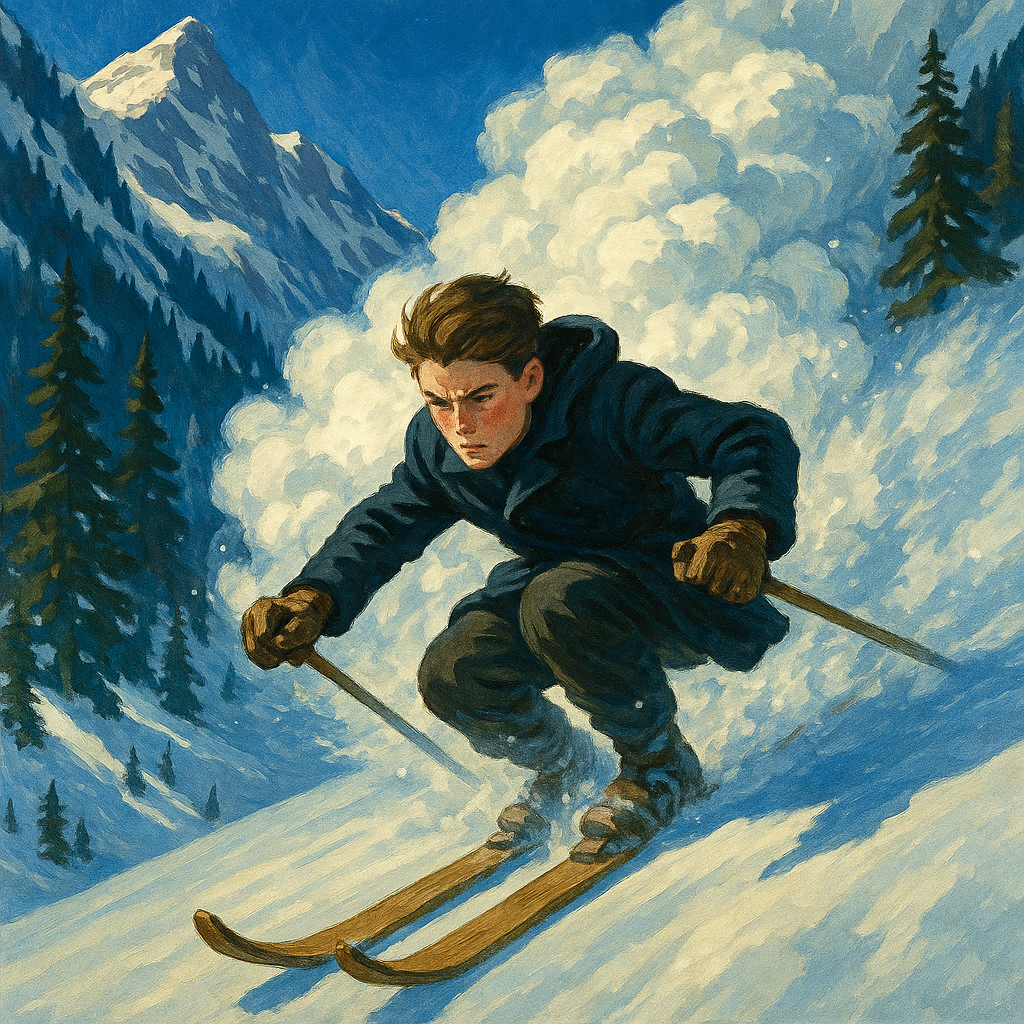
Harry was strong and skilled on the long Norwegian snow-skis he wore that day. His face was sober with worry for his father, but a resolute look came into his eyes as he readied himself for the trip. Just as he shot forward, the thunder of a dynamite blast rolled from the mine above. A shout went up: “Snow-slide!” — and a great mass of snow, shaken loose by the explosion, came crushing past. A corner of the shed was carried away. The men looked at each other. Their escape had been narrow. And the boy who had just shot forward — where was he?
Harry himself needed no warning to understand what that report meant. He had launched himself down the slope, and almost at the same instant the snow was on his heels. There was no chance to turn, no room for thought. His only chance for life was to reach the valley before the avalanche.
Down the shortest, steepest descent he flew, the wind cutting his face, all thought fused into a single burning effort to go faster.
Faster, faster, he skimmed the glittering snow — until he shot like an arrow from a bow out onto the plain below and fell headlong, covered by the icy spray at the very edge of the spent avalanche. The breath seemed pressed from his body. For a long moment he did not move.
Then a shout rang through the air, and he lifted himself to see a band of miners flying down the mountain toward him — men from the mine above, on snow-shoes. They were overjoyed to find the boy alive.
“He beat the snow-slide!” they exclaimed.
Harry, a hero from that hour, was escorted home in triumph.
At the door stood Kate — and behind her, the good doctor, safe and sound. On his way down from the mine the day before, he had been hailed by a man who lived in a small cabin on the mountain-side. The man’s child had broken an arm, and by the time everything was seen to, the short winter day was so far gone that the doctor had no choice but to stay the night.
That Christmas Eve, as Kate and Harry and their father stood watching the stars glow and sparkle in the keen mountain air, Kate slipped her hand into her father’s arm.
“There won’t be much for Christmas tomorrow,” she said. “But any happiness that might have come to me would seem very small now, after having you and Harry given back.”
“My dear,” said her father, “since the Christmas angels first sang ‘Peace on earth, good will toward men,’ the best gift that can come to any of us is an unselfish heart.”