I never had felt so much like Christmas, said Calliope Marsh, as I did that year.
“I wish I knew somebody to have a Christmas tree with,” I said, when the time came around.
“Well, Calliope Marsh,” said Mrs. Postmaster Sykes, looking surprised-on-purpose the way she does, “aren’t there enough poor and neglected folks in this world to please anybody?”
“I didn’t say have a Christmas tree for,” I told her. “I said have one with.”
“I don’t know what you mean by that difference,” she said, “I’m sure.”
“I’m not sure I know either,” I said. “But there is a difference, somewhere. I’d kind of like to have a tree with folks this year.”
“Why don’t you help with your church tree?” Mrs. Sykes asked. “They’re going to spend quite a lot of money on theirs.”
“I hate to box Christmas up in a church,” I said.
“Why, Calliope Marsh!” she said, shocked.
I didn’t want to hurt her feelings — I’m never one of those who likes to throw their ideas in people’s faces and watch them jump back. I tried to talk about something else, but she went right on, trying her best to help me out.
“The ward schools are each going to have a tree this year, I hear,” she said. “Why don’t you go in with your ward and help out there?”
“I hate to divide Christmas off into wards,” I said.
“Well, then, go in with a family. Any of us would be glad to have you. Come to ours — we’re going to have a great big tree for the children. I’ve been stringing popcorn and cutting paper for it whenever I get an odd minute. The Holcombs are having one too, and Mrs. Uppers and Mrs. Merriman and even the Hubbelthwaits and Abigail Arnold, for her little nieces. I never saw a year when everybody was going to celebrate so nicely. Come on with one of us, why don’t you?”
“Well,” I said, “maybe I will. I’ll see.” And I went off down the street. What I wanted to say was, “I hate to box Christmas up in a family” — but I didn’t quite dare. Not yet.
Friendship Village hadn’t ever looked more like Christmas, to my way of thinking, than it did that December. Just the right snow had come — and no more. Just the right cold — and no more. The moon was getting along so that by the night of the twenty-fifth it was going to loom up big and gold and warm over the fields, where it always comes up in winter like it had edged around there to get a wide front yard for its big show, with the whole village having a porch seat.
You know, when you live in a village you always know whether the moon is new or full or where it is and when it’s coming — but when you live in a city you just look up some night and say, “Oh, that’s right, there’s the moon,” and go right on thinking about something else. Here in the village that December everything was getting ready, deliberate, for a full-moon Christmas. The moon and the cold and the snow, all those public things, were doing their best together for our common Christmas. All but us. It seemed like all of us humans were working for it separately.
Tramping along in the snow that night, I thought over what Mrs. Sykes had said, and about all the houses she’d mentioned that were going to have Christmas trees. I could see them all, one tree after another, lighted and streaming from house to house all up and down Daphne Street, just the way they would look.
And then there were the little back streets and the houses down on the flats, where there wouldn’t be any trees nor much of any Christmas. Of course, as Mrs. Sykes had said, the poor and neglected are always with us — yet. But I didn’t want to swoop down on any of them with a bag of fruit and a box of animal crackers and sit and watch them.
That wasn’t what I meant by having a Christmas with somebody.
“There ought to be some place—” I was beginning to think, when right there by the Market Square I came on five or six children kicking around in the snow. It was almost dark, but I could just make them out: Eddie Newhaven, Arthur Mills, Lily Dorron, and two or three more.
“Hello, folks,” I said. “What are you doing? Having a carnival?” Because it’s on the Market Square that carnivals and little circuses and things that belong to everybody are usually celebrated.
Little Arthur Mills spoke up. “No,” he said, “we were just playing we’re selling a load of Christmas trees.”
“Christmas trees! Why, that’s so — this is where they always bring them to sell, isn’t it? A big load for everybody.”
“They’re going to bring an awful big load this time,” said Eddie Newhaven. “Big enough for everybody in town to have one.”
“My,” I said. “What a lot of Christmas trees! Why, if they were set along the curbstone here on Daphne Street, the line of them would reach all the way up and down the town. Wouldn’t that be something?”
Little Lily clapped her hands. “Oh, yes! With popcorn strings going from one to the other!”
“It would be a grand sight,” I said, looking out across the Market Square. There, hanging all gold and quiet, like it didn’t think it amounted to much, right over the big cedar tree in the Square — the old cedar that stood there like something left from some long-ago forest — was the moon, just a crescent horn.
“Once,” said Eddie Newhaven, “when they were selling Christmas trees here, they kept right on after dark. They stood them around and put a little light in each one. It was awful nice. Wouldn’t it be nice if they’d do that all over the Square sometime!”
“It would be a grand sight,” I said again, “but one this town would never have time for—”
I was looking across the Square toward the moon hanging over that cedar tree.
“There’s a pretty good tree there already,” I said, half to myself. “What a grand thing it would be, lit up.” I said it for no real reason, just to keep the talk going with the children. Then something went through me from my head to my feet. “Why not light it?” I said.
The children set up a shout — part because they liked it, part because they thought such a thing could never be. I laughed with them and went on up the street, but all the time something in me kept on going, hurried and urgent, and little pieces of ideas and half-formed plans and long, sharp motions of thought, a little something like light, kept moving through my head.
Down at the next corner I met Ben Cory, who keeps the livery stable and sings bass at nearly everybody’s funeral and other public occasions.
“Ben,” I said, excited, though I hadn’t thought of it until that very minute, “are you getting up any Christmas Eve carols to sing this year?”
He had a new string of sleigh bells over his shoulder, and he gave it a shift so they all jingled.
“Well,” he said, “I did plan to. But I’ve spoken to one or two, and they’re not sure they can. Some have to sing at their churches earlier in the evening and don’t want to be out all night. And most have to be home for family Christmas.”
“There’s no doubt about there being folks glad to listen, is there? Provided you had the singers?”
“Oh, sure,” he said. “People shine up to music considerably on Christmas Eve. It — sort of — well, it—”
“Yes,” I said. “I know. It does, doesn’t it? Well, Ben Cory, you get your carol singers together, and I’ll undertake that nothing much will stand in the way of their being out on Christmas Eve. Is it a bargain?”
His face lit up, all jolly and hearty. “Why, sure it’s a bargain! I’ll get them.” He gave his bells a hunch that made them ring all up and down Daphne Street — that the moon was looking down at, just as if it were public property and not all made up of little private plans.
I don’t know if you’ve ever managed any kind of a revolution.
There are two kinds. One breaks away from something that’s always been. You pick up the broken piece and try to throw it away to make room for something new, and almost everybody will tell you the new piece isn’t any good and that you ought to save the old one and stick it back. But then there’s the other kind — the kind that steps back from what’s always been and looks at it from a little farther off and says: “Let’s move a little way around and pay attention to this thing from a new spot.” Often, if you put it that way, enough people are willing, because they know they can always go back to the same old place afterward if they want.
This last was the kind of revolution I took charge of that week before Christmas.
The very next morning I started out while I still had a glow to drape over the difficulties so I couldn’t see them clearly. I went first to the shopkeepers, since Christmas always seems to hinge and hang on what they say and do. And I went to Eppleby Holcomb first, because I knew he’d see it as I did — and I wanted the support of being agreed with, the way you do.
Eppleby’s store was all decorated with green paper and tassels and turkey-red calico poinsettias, and it looked real nice and festive. The little overhead track that carried bundles had broken down just at the wrong moment, and old Mrs. Wiswell’s felt-soled shoes had gotten stuck halfway, and Eppleby himself was up on top of a counter trying to rescue them while she made tart remarks below. When he’d fished them out and wrapped them up:
“Eppleby,” I said, “would you be willing to shut up shop on Christmas Eve?”
He looked startled. “It’s a pretty good night for trade, you know, Calliope?”
“Well, yes,” I said, “but everybody who is going to give presents to people will give presents to people. And if the stores aren’t open Christmas Eve, folks will buy when the stores are open. Is that sense, or isn’t it?”
He knew it was. And when I told him what I had in my head, he said if the rest would shut, he’d shut, and be glad of it. Abigail Arnold did the same about her home bakery, and the Gekerjecks, and two or three more. But Silas Sykes, who keeps the post-office store, was firm.
“If that isn’t foolish,” he said, “I don’t know what is. You haven’t any more idea of business than so many cats. No, sir. I won’t betray the public by cutting them off from an evening’s shopping.”
It made a nice little sentence to quote, and I quoted it considerably. And the result was, the rest of them — who knew Silas, head and heart — finally said, all right, he could keep open if he wanted to and enjoy himself, and they’d all shut up. I honestly think they kind of appreciated, in a neighborly way, making Silas feel small — when he ought to.
It was a little harder to bring the Sunday-school superintendents around. Of course, when something has been done one way for a long time, you can’t really blame people for feeling that it’s always been the right way. Feelings work like that. Our superintendent, Jerry Bemus, had been superintendent for nearly forty years — ever since the church was built — and some of his thinking had naturally turned to settled stone in places.
Jerry kept a little harness shop next door to the Town Hall, across from the Market Square. When I went in that day he was resting from making harnesses and practicing on his bugle. He could play a bugle call beautifully — you could often hear it going up and down Daphne Street in the morning, and when I was down doing my trading I always liked to hear it. It gave me a nice, old-fashioned feeling, like when Abigail Arnold fries doughnuts in the back of the Home Bakery and you can smell them out in the road.
“Jerry,” I said, “how much is our Sunday-school Christmas tree going to cost us?”
Jerry has a wooden leg, and he can never quite remember not to try crossing it over the other one. He tried that now, and gave it up.
“We figure about twenty-five dollars,” he said, proud.
“And what are you going to do to celebrate?”
“Well,” he said, “have recitations — we’ve got a program of twenty numbers already. And a trimmed tree, and an orange and a bag of nuts and candy for every child.”
“All the other churches are going to do the same,” I said. “Five trees and five programs and five sets of everything. And all of them on Christmas Eve, when you’d think we’d all draw together instead of sitting apart. Can you imagine how it must have looked to those first angels, watching us divide their night into competing sections?”
“Hush, Calliope,” said Jerry Bemus, looking shocked.
“Not a bit of it,” I said. “We’ve been at it so long already, each congregation worshiping in its own corner. Do you honestly think we’ve chosen the best way to spend Christmas Eve with the children — filling them up with sweets and getting them all keyed up?”
We had quite a talk, back and forth, Jerry and me. And all of a sudden, while I was trying my best to make him see what I saw, I noticed his bugle again.
“There’s no real thrill in any of it,” I was saying. “Not half as much,” I said, “as there is in your bugle. When I hear that floating up and down the street, I always feel like it’s announcing something. It seems to me it could announce Christmas to this whole town far better than forty separate little trimmed-up trees. Why, Jerry,” I said suddenly, “listen to what I’ve just thought of—”
Something had come into my head that moment, unexpected, that fitted perfectly with the rest of my plan. And it made Jerry say, before long, that he was willing to go with me to see the other superintendents. And we did — that very day. Isn’t it funny how big things work out through humble means? Purely because the choir leader in one church had resigned over a quarrel with the bass section, leaving them without anyone to train their Christmas music; and purely because another congregation was so short of funds they were borrowing from the foreign mission account for their celebration — we got them to see sense. The other two joined in after that.
The schools were fine from the start, being built, as they are, on the idea that they belong to everybody — nothing dividing one person from another. And I began to feel like life and the world were one great bud, longing to open, if only it could get enough care.
The hardest ones to coax away from a perfectly self-contained way of celebrating were the private families. We all act, I kept thinking those days, like we’re studying the most basic arithmetic. We count up those closest to us and can’t seem to count much higher than ten.
Not all of them were that way, though. On one hand it went something like this, from Mrs. Timothy Toplady and the Holcombs and a lot more:
“Well, it would save us back-aching work — but will the children like it?”
“Like it?” I said. “Try them. Trust them without trying them if you want. I would. Remember — you like being with the children a good deal more often than they like being with you. What children like is to be with each other.”
But the other side had figured it out as the other side of everything always does.
“Calliope,” said Mrs. Postmaster Sykes, “are you out of your mind? Aren’t things all right the way they’ve always been done?”
“Well,” I said, careful, “not all of them. Not every single one.”
“But you can’t go changing things like this. What will become of Christmas?”
“Christmas,” I said, “doesn’t need you or me, Mrs. Sykes, to be its guardians. All Christmas needs is for us to get out of its way and let it express what it means.”
“But the home Christmas,” she said, almost plaintively. “Would you do away with that?”
I turned to her then. I couldn’t help it.
“Whose home?” I said, firmly. “If it’s your home you mean, or any of the thousands like it where Christmas is kept, you know that nothing on earth can take away the Christmas feeling and joy as long as you want it there. But if it’s the homes where no Christmas ever comes — and there are thousands of those too — you surely aren’t arguing to leave them as they are?”
She kept shaking her head. “You can do as you like,” she said, “and so can everybody else. But as for me, I’ll trim my little tree by our own fireside. Jeddie and Nora and father and me.”
“Why can’t you do both?” I said. “I wouldn’t have you give up your fireside for anything. But why can’t you do both?”
Mrs. Sykes didn’t rightly seem to know. But she let me understand that her mind ran comfortably along the groove that had been made for it.
Somehow, the longer I live, the less sense I seem to have. There are things I’ve learned twenty-five times in my life that I still can’t hold onto. And one of them is about not letting excitement get ahead of you.
That night, when I came around the corner onto Daphne Street at half-past seven on Christmas Eve, I thought I might have to stand for a moment in the shadow of the billboard by the arc light, just getting used to the idea of what we were doing. Getting used to it in my throat. But there were things to do between then and eight o’clock, when we’d told everyone to be there. So I ran along and tried to think only about the work. Most always, the work part of anything will steady you.
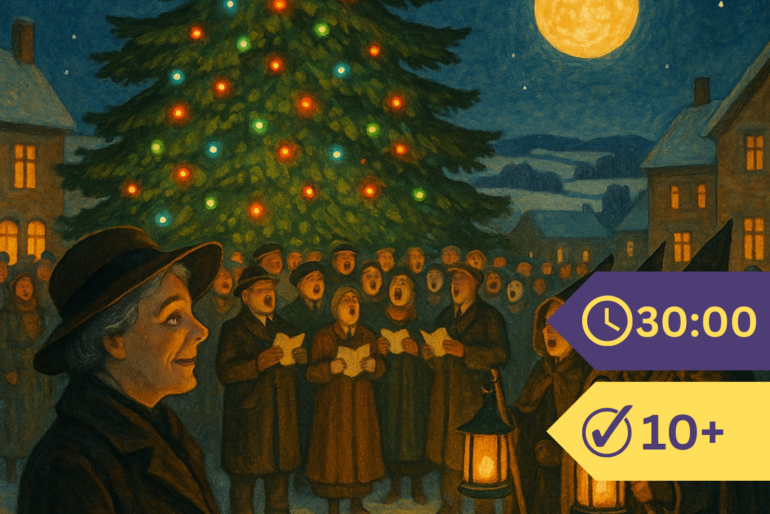
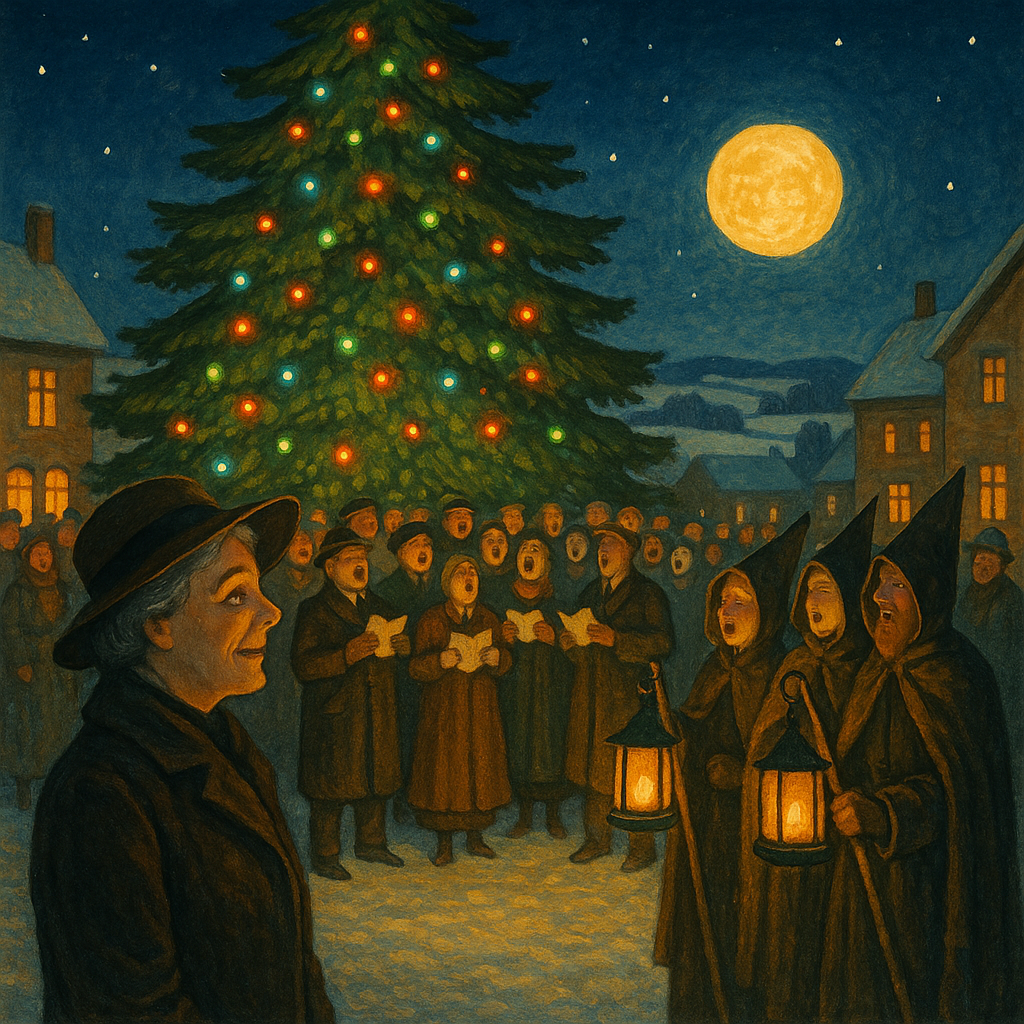
The great old cedar tree, standing at the edge of the Market Square as if it had been left from some long-ago forest on purpose, had been hung all around with festoons of strung popcorn — the kind that no Christmas tree would be a Christmas tree without, because so many hands have sat stringing it late on Christmas week nights, after the children were in bed, and kept it carefully in a box for the next year. We had all that from the churches — Methodist and Presbyterian and Episcopal and Baptist and Catholic popcorn, and you couldn’t tell them apart at all once they were on the tree. The festoons showed ghostly white in the dark, and the people showed ghostly dark, hurrying back and forth doing the last things.
And people were coming. You could hear them all along Daphne Street, tripping over the uneven place that hadn’t been fixed because it was right under the arc light, and coming over the hollow-sounding spot by Graham’s drug store, and coming from the little side streets and the dark back streets and the streets down on the flats. Some of them had Christmas trees waiting at home — the load had been there on the Market Square, just as it had been for years, and we’d never noticed that the Square had any other Christmas purpose. Many had bought trees. But many more had decided not to have any — only to hang up stockings — and to let the great common tree stand for what it stood for, gathering those little private Daphne Street trees up into its living heart.
Over by the bandstand I found the children I’d been looking for — Eddie Newhaven and Arthur Mills and Lily Dorron and Sarah and Mollie and the Cartwrights and Lifty and six or eight more.
“Hello, folks,” I said. “What are you doing down here? Why aren’t you home?”
They answered all together: “For the big tree!”
“Are you now? Whose tree?”
I love to remember the way they answered. It was Eddie Newhaven who said it.
“Why — all of us’s!” he said.
All of us’s. I like to say it over when people get to saying “mine” and “theirs” too hard.
When it was eight o’clock and enough had gathered on the Square, they did the thing that was going to be done — only nobody had known how well they would do it. They touched the button, and from the lowest branch to the very tip-top cone, the big old tree came alight — just as if it had always known what it was about, as if it had come up from the ground long ago for this reason, and we had simply never known until now. Two hundred little colored electric lights, paid for privately, though I had done my best to get the town to pay for them as it ought to for its own tree.
It made a little oh! move through the crowd, it was so big and beautiful, standing there against the stars as if it knew perfectly well that it was one of them. And coming up across the flats, big and gold and low, was the moon, almost full, as if it belonged there too.
“And glory shone around,” I said to myself — and I stood there feeling the glory, outside and in. Not my little celebration, and your little celebration, and their little celebration, private — each costing more than it ought to — but our celebration, paying attention to what Christmas means at its heart.
I was so full of it that I barely saw Ben Cory and his carolers come racing out of the dark. They were all dressed up in pointed hoods and cloaks, carrying long staffs with everyone’s farm lanterns tied to the ends, and they ran out in a line to the tree and took hold of hands and danced around it, singing at the tops of their voices one of those old tunes that — whether you’ve ever heard it before or not — makes something in you that’s older than yourself wake up and remember.
And Jerry Bemus shouted: “Sing it again! Sing it again! I haven’t heard anyone sing that for going on forty years!” And everybody laughed, and they sang it again for him, and more songs that had come out of the old country, a little piece of which was living inside everyone who was there.
Then, just after the carols died down, the thing happened that we’d planned to happen. The choirs of all the churches — who had, I think, never once sung together in their lives, though they had been singing about the same things since they were born choirs — began to sing:
Silent night, holy night.
Down there on the Market Square that had never had anything sung on it before except carnival tunes. All up and down Daphne Street it must have sounded, though there was hardly anyone far away to hear it, most being right there with all of us. They sang it without anyone playing it, and they sang it all the way through.
And then they slipped into other songs — not Christmas carols exactly, but things that came in just as naturally as if they were another name for what Christmas was. “Nearer, My God, to Thee” and “Lead, Kindly Light” and more. And after a bar or two, the voices all around began mumbling and humming, carrying the tunes along in their throats — and then they all just naturally burst out and sang too.
And I don’t know who started it — whether the choirs had planned it, or thought of it then, or whether someone in the crowd struck it up without knowing it himself — but it came from somewhere, strong and clear and real, a song the children had been learning in school and teaching the town for a year or two, sung to a simple, sweeping tune:
The crest and crowning of all good,
Life’s common goal, is brotherhood.
And then everybody sang. Because it’s a piece you cannot sing alone. You simply cannot sing it alone. All over the Market Square they took it up — people who couldn’t sing, and me, who can’t carry a note except when there’s nobody around who would recognize me afterward — we all sang together, there in the dark, with the tree in the midst of us.
We seemed very far from the time when the leader of one choir had left the other choir because of a quarrel over a bass singer. And it was like the way things truly are had spoken for a moment — in the choirs come down from their separate lofts, and in all the singing people. In all of us.
Then up hopped Eppleby Holcomb onto a box in front of the tree and called out:
“Merry Christmas! Merry Christmas — on the first annual outdoor Christmas-tree celebration of Friendship Village!”
When he said that I felt — well, it doesn’t matter how I felt. What I did was turn and make for the edge of the crowd as fast as I could. And just then came what Eppleby’s words had been the signal for. Out on the little flagstaff balcony of the Town Hall, Jerry Bemus stepped with his bugle and blew it shrill and clear — once, twice, three times — sounding over the whole town, a call to say it was Christmas. We couldn’t wait until midnight; we are all in bed long before that in Friendship Village, holiday or not. But the bugle said it was Christmas just the same.
The bugle that used to say it was war.
And at that same moment the big tree went out — quietly, all at once — to be lit again next year, and to stand as a living thing in between.
When I stepped onto Daphne Street, who should I come face to face with but Mrs. Postmaster Sykes.
“The children were bound to come,” she said, before I could say a word, “so I had to bring them.”
“Yes,” I thought to myself. “The children know. They know.”
And I couldn’t even feel sorry when I passed the post-office store and saw Silas sitting in there all alone — the only lit storefront on the street. I knew he’d be on the Market Square the next year.
They went singing through all the streets that night, Ben Cory and his carolers. “Silent night, holy night” came from my front gate when I was nearly asleep. It was like the whole town was being sung to by something that didn’t show. And when the time comes that this something speaks clearly all the time — well, it isn’t a very far-off time, you know.