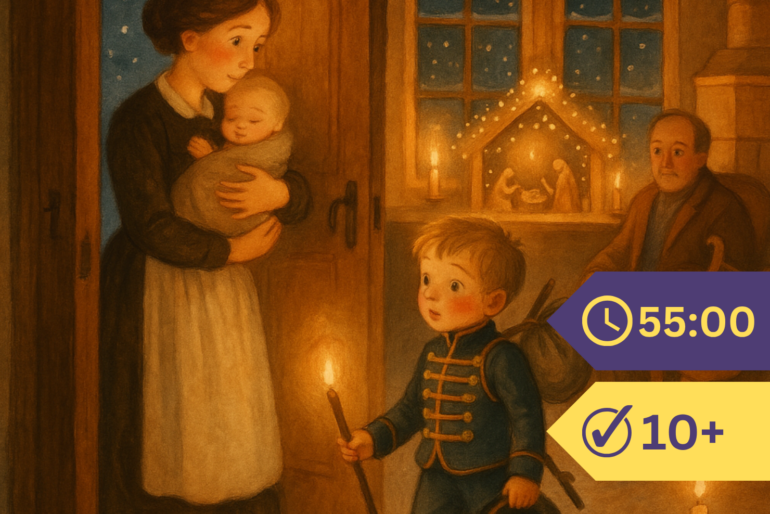
On the hallowed eve before Christmas Day, a small boy named Antony — eight years old, fair-haired, his cheeks crimson with cold — was making his way across snow-clad fields. He was dressed in the fashion of a little soldier, in a neatly-fitting hussar’s jacket, and on his back he carried a bundle containing all his worldly wealth. He walked quickly across the white landscape, looking with joy upon the glittering trees, while the sun went down with a lurid glow and the hoarfrost settled on the branches and twigs, so that they shone like little reddish sparks.
He thought it an easy thing to reach the nearest village. But he had not gone a quarter of an hour before he missed the beaten path and lost himself in the wildest part of the cold, lonely wood. He more than once narrowly escaped falling headlong into a pit or a ravine concealed beneath the white canopy. Night came on. The sky became overcast and all the little stars that had sparkled down along the pine branches were hidden. The snow began to fall heavily.
The poor boy could not discover a trace of the path, and knew not to which side he should turn. He stood still, trembling, and began to cry bitterly. He laid his bundle on the snow, knelt down beside it, took off his hat, and lifted up his little hands to heaven, while he prayed with many tears:
“Oh, thou dear Father in heaven! Do not let me die in this wild wood in the cold, bitter night. I am a poor orphan, and have no father or mother left. I have no one but thee. But thou art the Father of all poor orphans. Oh, do not let me die. Have pity on a poor child. This is the night on which thy Son was born — for his sake hear me, and do not let me die here alone in the wood, on the night when every one else in the world is merry and glad.”
And he laid his little weary head upon his bundle and sobbed.
Suddenly there came from a neighbouring height a sweet sound, like that of a harp, and a beautiful song was heard echoing from the surrounding rocks. He stood up with folded hands to listen. The wind had died away and not a breath now stirred. Inexpressibly sweet were the tones of young voices in the deep stillness of the wood, and now he could distinctly make out the words:
Through each dark care go boldly on, The Lord hath sent his well-lov’d Son To lead thee home to Heaven! Repose thy weakness on His might, Shall not thy God do all things right, When He such gifts hath given?
“The shepherds of Bethlehem must have felt like this,” Antony said to himself, “when they heard the angels singing in the holy night.” He took his bundle, climbed up a mound in the direction from which the sound had come, and after a few paces through the brushwood, a bright stream of light shone out towards him. He stepped out sturdily and soon reached a house which stood alone in the wood. He tapped two or three times at the door — he could hear merry voices within, but nobody answered. The door was only on the latch. Antony went in and groped about in the dark passage until he found the inner door. A bright light from a number of candles shone upon him, and he could have fancied he was gazing into paradise.
In the corner of the room, between the two windows, a beautiful spring landscape was rendered in miniature. A mountain scene, with moss-covered rocks and green pine-woods and picturesque cottages with sheep grazing and shepherds, and a little town on the top of a hill. In the centre of the landscape there was a grotto, and within it appeared the infant Jesus, the Virgin, and Joseph, with the adoring shepherds and angels floating above them all. The whole landscape sparkled with a surprising lustre — it was studded over with innumerable tiny spangles.
The occupants of the house were all assembled round this beautiful scene. On one side sat the father of the family with a harp between his knees; opposite him the mother with her youngest child in her lap; and two lovely children beside their parents, looking reverently upon the cradle. The father and mother sang the song with their clear angel voices, and the two children joined in with their childish tones, while the father accompanied the whole with his harp, and the birds in the trees around joined their melodious voices to the general harmony.
Antony still stood at the open door, the latch in one hand and his hat and stick in the other, fixed upon the beautiful scene and listening to the playing and singing in delighted wonder. The mother noticed through the draught that the door must be open and looked that way.
“Good heaven!” she cried. “How can that child have come through the thick wood this dark night? My poor, poor boy, you have no doubt lost your way?”
“Oh, yes,” said Antony, “I’ve lost myself in the wood.”
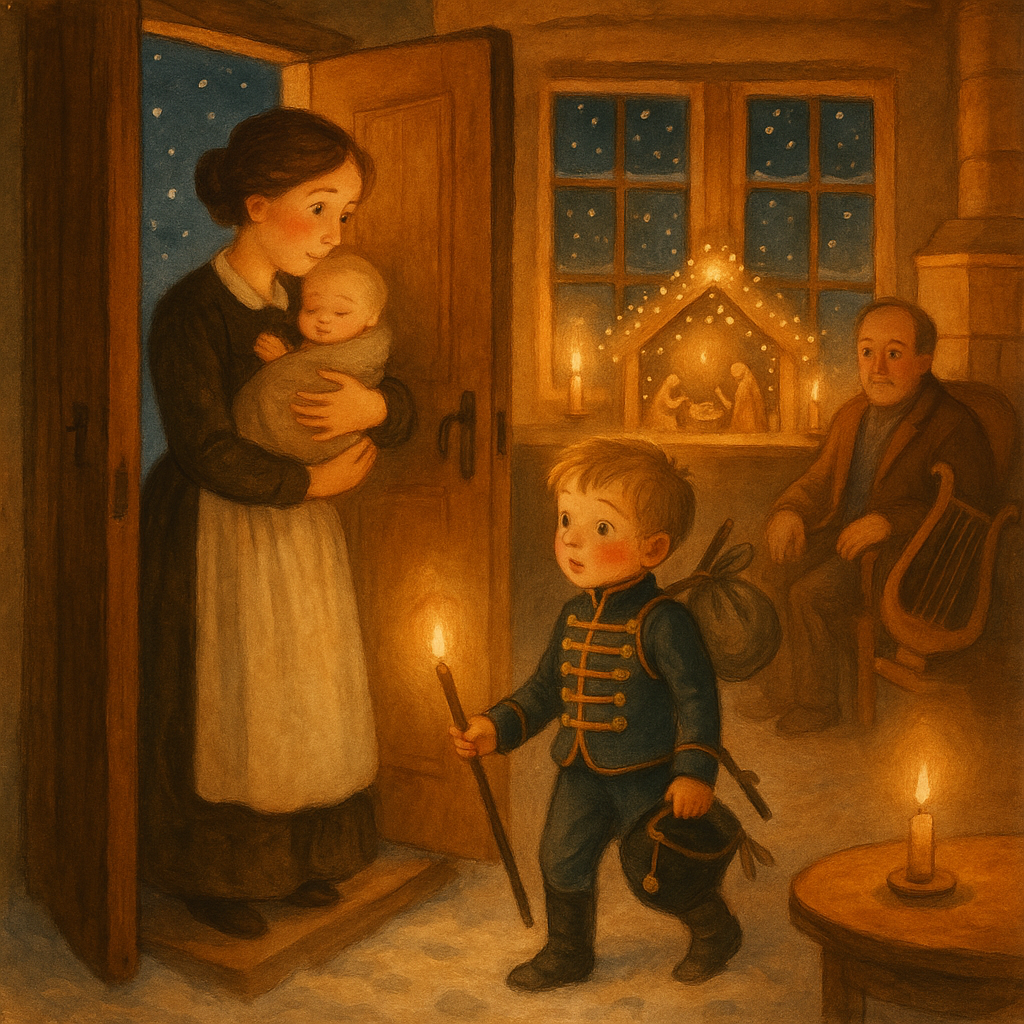
All now looked towards the door. The two children pitied the newcomer heartily, but kept bashfully in the background. The mother went towards him with her little one in her arms and inquired kindly:
“Whence come you, dear little boy? What is your name, and who are your parents?”
“Alas!” said Antony, with tears in his blue eyes. “I have no home at all. My name is Antony Kroner. My father was killed in battle, and my mother died of grief and sorrow last autumn. I am quite strange here, and wander about in the world like a lost sheep.”
He was very cold, and his teeth chattered. “Oh, you poor Antony!” cried the mother. “You can hardly speak for cold — and you must be tired and hungry too. Put your bundle away and sit down.” She gave him warm soup and whatever else was left from supper. The two children, Christian and Katharine, came forward eagerly to take his hat and bundle, and the little guest was called to table. The mother brought him soup and a great piece of Christmas cake and some stewed plums. The children gave him a large share of their Christmas presents — beautiful red-cheeked apples, golden pears, and great brown walnuts. Even little Lizzie let herself be persuaded by her mother to give him the fine rosy-cheeked apple she held in her little fingers, which were almost too small to grasp it. The warm soup revived poor frozen Antony, and he roused himself and became quite merry.
All the while the father had been sitting in his arm-chair by the stove, seeming to consider. The mother came and sat beside him with her youngest child in her arms and asked, “Why are you so silent? What are you thinking of?”
“I am thinking,” he answered, “of the last verse of our song. You have done as we are commanded, in giving the poor boy food and rest. But I think we might do still more for him. You see, this is Christmas Eve — we are celebrating the remembrance of that night when the heavenly child was born who came into the world for our salvation, and for that of all men. And just this evening God sends us a child to whom we may do good. Our Saviour came into the world as a stranger and had not where to lay his head. Should we send this boy away? Tell me your opinion openly, Elizabeth — what ought we to do?”
“To provide for the boy,” answered his wife readily and cheerfully. “‘Inasmuch as ye do it to the least of these, ye do it unto me’ — those are the words of Him who was born this night.”
“You are a dear, good wife,” said the gamekeeper, as he pressed her hand. Then, aloud: “Antony, come here.”
Antony came and stood before him, upright and stiff, like a little soldier before his officer.
“You say your father was a soldier who died for his country. That is very unfortunate for you, though it was honourable in him. But tell us more about your parents. Where were you before the war broke out? How did your father die? How came you to lose yourself in our wood?”
Antony told them everything. How the soldiers had called his father a sergeant and his regiment was quartered at Glatz in Silesia; how his mother had always worked industriously at her needle; how one day his father came home in a hurry and said the war had broken out; how his mother was very much afraid and wept bitterly, but his father took her with him and they travelled far away; how the enemy came and the hussars had to go and meet them, and his mother and he remained behind; how they heard such dreadful firing in the distance, and his mother cried to him at each shot, “Every shot goes like a stab to my heart.”
His father came back safe several times, but one day after a fight a hussar galloped up leading his father’s horse, and said that his father was badly wounded and lying on the battlefield a mile from the village. His mother and he had gone to him as fast as they could. His father was lying beneath a tree, an old soldier kneeling beside him, holding him gently in his arms so that he could rest his head on his comrade’s bosom. His poor father had been shot through the breast and looked as pale as a dying man. He wanted to say something but was unable to speak. He looked at Antony once more with his dying eyes, then at his mother, and then up to heaven. A few minutes afterwards he died.
His mother had almost cried her eyes out. His father was buried in the nearest churchyard. Then she wished to return home, but said she had a very good friend who would doubtless receive them. They had not travelled many days before his good mother fell sick. With difficulty they found shelter in a barn. “This is hard,” said his mother, “but the Virgin Mary was not better housed, and had to sleep in a stable.” His mother grew rapidly worse and prepared for death. Towards midnight he could see by the light of the lantern that she grew paler and paler. She took his hand and said: “My dear Antony, don’t cry. Be always good, have God before your eyes, and do no wrong, and then God will give you another father and another mother.” She blessed him, and died.
The peasants who owned the barn had promised his mother they would take him and provide for him like their own child. They took the little his mother had left — her clothes and a little money. But before three weeks had gone by they sent him away, saying he had eaten three times the value of what his mother had left. So he went, and determined to go to Glatz to his schoolfellows — but the peasants could not tell him which was the way to Silesia. So he had wandered about the country begging, for what else could he do?
The gamekeeper’s wife was much moved and said to her children, with tears in her eyes: “Look, my children, this is what might happen to you. You too might lose your father and mother, and what would you do then? Therefore, pray to God every day to preserve your parents.”
The gamekeeper then examined Antony’s papers — the marriage certificate of his parents, his own baptismal certificate, and a paper authenticating his father’s death, written by a regimental chaplain, with a few words added by the colonel recording the brave and noble conduct of the sergeant and the blameless life of his widow.
“Well,” said the gamekeeper at last. “That is all very good. But now tell me, Antony — how do you like this place?”
“Very well,” answered Antony with a smile. “So well that I feel as if I were at home.”
“Should you like to stay with us?”
“Oh, that I should,” answered Antony. “The lady is just as kind as my mother was, and you are very kind too, and you’ve just such a moustache as my father wore.”
The gamekeeper laughed and stroked his beard. “Well then, boy,” said he, “you can stop with us. I will be your father, and my wife shall be a mother to you. But you must be a good son, and love your brothers and sisters, and do them no wrong. Do you see. Now you are my son, Antony.”
Then Antony burst into tears, gave the gamekeeper his hand, and afterwards kissed his new mother and saluted all the children, even to the youngest. Christian and Katharine were delighted that Antony was to remain with them.
“Now we shall be very merry,” said Christian. “For when we have a game, there will be three to play.”
The gamekeeper who had adopted the poor orphan was very upright and honest — one of the old school, as he expressed himself. He was very pious, wished all men well, and was a man of unimpeachable honour in the service of his duke. He adhered rigidly to the pious customs of his grandparents. In the morning his first duty was always to assemble his wife and children at family prayer, and in the same way each day concluded with evening prayer. He never failed to have grace said before and after meals.
Among these worthy people Antony lived very happily. When the gamekeeper came home in the evening from his rounds, Antony hurried to bring the old grey coat with green facings which he wore indoors, and a pair of slippers. When the mother stood in the kitchen he would run to the garden to fetch herbs and parsley and any vegetable which might be wanted. Many of the good woman’s wishes were fulfilled by him before she had even uttered them.
Antony soon made himself particularly useful to his foster-father. He had to make plans of all the forest entrusted to the gamekeeper’s care, and these he afterwards coloured, writing at the corner of every page the name of the wood in large letters encircled by a garland of oak leaves or pine branches. Sometimes the name of the forest appeared engraved on a rock crowned with pine trees, while beneath rested a stag with branching antlers. During all his playhours Antony was continually drawing or painting landscapes or trees, and whenever he could pick up a strip of blank paper or an envelope, he was sure to draw upon it a bird, a flower, or a branch of a tree. He was never seen idle for a minute. The gamekeeper and his wife loved the good boy as though he had been their own son.
A certain young gentleman, Herr von Schilf by name, was in the habit of visiting the gamekeeper, and happened one day to come into the room. He began to make many sarcastic observations on the Nativity scene and could not imagine of what use the exhibition was.
“What use?” asked the gamekeeper. “Look out of the window, young gentleman — the earth is covered with snow, the branches of the trees crack with the burden that rests upon them. Not a flower is to be seen, excepting the frost-flowers which sparkle on the window-panes. The fruit-trees round my house have neither apples nor pears, and not a green leaf is to be seen. All the branches and twigs are whitened and covered with hoar frost, and long icicles hang from the roof. The poor children are confined to the room like prisoners and can scarcely venture a step beyond the door. Where, then, is the harm if parents prepare for their children a spring landscape within doors in the warm room? I myself have seen the celebrated picture of the Nativity at Dresden during my travels. I can remember that during my childish years this representation was my greatest pleasure and had a good influence on me. So I hope that it may likewise bring joy and blessing to my children.”
The young gentleman found little to say to this. At dinner he sat down without saying grace and began to eat without waiting for it. The gamekeeper, who always spoke right out what he thought, said very gravely: “That’s the way my hogs do — they swallow their acorns without looking up to see whence they come.” The young gentleman declared that saying grace was a thing of very little importance. But the gamekeeper said: “Whatever makes us better men is always important. Gratitude is everything, and forgetfulness of God can never bear good fruit — on the contrary, it is sure to bring misfortune. Pray with us as becomes a Christian and a reasonable being, or you have gone hunting with me for the last time.” The young gentleman got up and said his grace, though he did it more from love of the chase than from any other motive.
One day the gamekeeper sent Antony with a brace of snipes to the neighbouring hunting lodge at Felseck, which belonged to the Duke. On his way Antony passed a waterfall which fell foaming like snow over a rock amidst the dark pine stems. Not far from the cascade sat a strange gentleman in a dark blue blouse, making a sketch of the scene. Antony went up and peeped at the picture over the stranger’s shoulder.
He could not help exclaiming: “Oh, how beautiful — that’s what I call painting.” He begged permission to look more closely and obtained it. “I could almost fancy,” cried the boy as he gazed at the sketch, “that the paper was a glass in which the waterfall and rocks and trees are reflected. How like silver the water gushes out, and how beautifully the white foam shoots forth from among the clefts of the rocks and ripples over the mossy stones! How fresh and lovely is the moss on that stone! It looks as though it could be plucked away. How boldly those fir-trees stand forth!”
The painter was pleased with the unfeigned admiration of the boy and still more so with his appreciation for art. He answered with a smile: “So you are a little painter too, I see.”
“Oh, dear,” answered Antony, “until now I thought myself not a little painter but a rather great one — but now I see that I am not one at all.”
The artist said he would like to see Antony’s paintings and called upon him a few days afterwards. He examined them one by one very closely, smiling two or three times. Though he found many things to criticise in the drawings, he was much pleased with them.
“Really,” said he, “that boy was cut out for an artist. Herr Grünewald, leave him to me. You will see, he will do you credit.”
“With all my heart,” replied the gamekeeper, shaking hands. “I have been considering for some time what the boy is to be. He is now in his fourteenth year and has picked up all that’s to be learnt in the school at Aeschenthal. He’s too delicate and pitiful for a hunter — he takes more after his kind mother than his brave father. So if you think he’ll make a good painter, take him by all means. What premium do you require?”
“Premium?” replied the painter, Herr Riedinger. “I won’t hear of such a thing. You first set me the example of protecting the poor orphan. One good action always draws others after it, as one candle will light up more. That all comes quite naturally.”
So Antony stepped into the carriage and drove away with the artist. His foster-father said: “Do not weep, Antony — it’s only a short distance to the town. We shall often come to see you, and you can visit us on Sundays and holidays.” But the good boy cried heartily.
That worthy man fulfilled his promise to the letter. Antony proved a docile pupil. He frequently accompanied the painter in his visits to the gamekeeper, and they sometimes stayed for several days to make sketches of fine views in the rocky region. The master found occasion each time to praise his pupil. “Between ourselves,” said he to the gamekeeper, “he will turn out an artist to whom I shall not be worthy to hold a candle.”
A few years afterwards, Herr Riedinger came with Antony — now a handsome young man — to spend the Christmas holidays at the cottage. After supper the artist remained sitting with the gamekeeper and his wife long after Antony and the others had gone to rest. The worthy couple had no difficulty perceiving that their guest had something on his mind.
“Antony has learnt as much as I can teach him,” he began at last. “He must now travel — he must see Italy. This will certainly cost no small sum of money — still, it will be well spent. No capital could be better invested. I warrant it will bear good interest and be paid back in time. So far as I am concerned I am willing to further his views to the utmost. I have saved up the money his paintings have realised and shall devote it to his journey — still, it is altogether insufficient. Do you feel disposed to advance the sum which is still wanting? A good work once begun should never be left unfinished.”
The gamekeeper held out his hand. He looked inquiringly at his wife. She nodded, and the gamekeeper shook hands upon it and said: “If the same does not exceed what I possess, I will pay it.”
A calculation was made as to the cost of the journey, and it was unanimously agreed that Antony should commence his journey the following spring.
During the winter the foster-parents made various preparations. The mother and her two daughters worked and knitted most industriously to provide Antony with a sufficient wardrobe. At the commencement of spring Antony came to spend a few days with his parents, and the day of departure came at length.
The mother had prepared a farewell feast and they all dined together for the last time. It was an affectionate and touching scene. The gamekeeper looked at the circle round him. All were sitting in melancholy silence.
“Not so, my sons and daughters,” said he. “Do not be so sad, and you, dear mother, dry that tear. When the sons grow up they must go forth into the world. But, dear Antony, if one or other of your brothers and sisters should ever fall into misery, then remember that we had compassion on you, and do not leave them comfortless. Give me your hand, my Antony. You will not forsake your brothers and sisters, will you, boy?”
“Oh, my dear father,” replied Antony, as he gave his hand to the old man, “I must be the most ungrateful wretch on earth if I were ever to forget your kindness. Believe me, your benefits shall not be forgotten. It shall be my greatest happiness to be able to repay you, my dear mother, or my brothers and sisters.”
“I believe you, Antony,” said the gamekeeper. “But it is time to part. Dear boy, let me give thee a father’s blessing on thy journey.” The gamekeeper rose and lifted his eyes to heaven as Antony bowed his head. There was an air almost of inspiration in the old man’s face and form as he said, solemnly and distinctly: “May God be with thee in all thy wanderings; may he keep thee from evil, and bring thee back whole and undefiled to our arms.”
The brothers and the young people stood round with moist eyes and folded hands, and said “Amen” with their whole hearts.
The gamekeeper folded Antony in his arms and said: “Go your way, and God be with you. Have his fear continually before your eyes. Hold yourself too high to do anything that is evil. The pomps and vanities of this world are not worthy that you should load your conscience to obtain them. Remember that we are not created alone for the short time of our sojourn on earth — there is a hereafter. Fly in particular the company of those men who scoff at the simple faith of our ancestors and laugh at pure and harmless customs. Once more, farewell, and God be with you.”
The mother could only sob forth with tearful eyes: “Antony, look at my eyes, red with weeping — for the sake of the tears I have shed, remain in the fear of God, honest and true. Think of these tears when you are tempted to do evil. Until now you have caused us only joy — never cause us sorrow. Never forget the heartfelt advice of your foster parents, and the last words of your dead mother — and so, farewell.”
The whole family accompanied the youth some distance on his way — almost to the end of the forest. At length they said farewell once more, and Antony went, but they remained motionless. He frequently turned back and waved his hat. The gamekeeper and Christian waved their hats, and the mother and daughters their handkerchiefs, until the object of their solicitude disappeared behind a wooded height, with his staff in his hand and his knapsack on his back.
Christmas Eve had arrived for the third time since Antony’s departure. The gamekeeper came home earlier on this day from the forest with his son Christian. It was bitterly cold. The evening sky shone with a crimson halo through the windows. The round panes already began to freeze and sparkled in the red evening light like jewels. The gamekeeper sat down in his arm-chair beside the great stove and added more wood to the fire.
“Is there no letter from Antony?” he asked.
“None,” replied his wife with a sorrowful countenance.
“It is strange,” resumed the father, shaking his head. “Christmas Eve never failed to bring us a letter from him. He always wrote a very long letter, to which I looked forward as my chief Christmas pleasure. What can the boy be about that he doesn’t write?”
Scarcely were these words spoken when a messenger entered the room, his hair whitened by the frost. He had a letter in his hand and bore on his back a box of pine wood, of a flat shape but sufficiently broad and high that the man was obliged to stoop before he could enter the room.
“There must be a mirror in that box,” said Katharine.
The messenger gave the letter to the gamekeeper and took the box from his shoulders.
“The letter is from Herr Riedinger, the painter,” said the gamekeeper. “How is this? I think that some misfortune must have happened to poor Antony.” He tore the letter open hastily and perused its contents with eager eyes by the light of the stove. “Only think,” he cried joyfully, “Antony has sent us a picture as a Christmas present, all the way from Rome. He has sent it rolled up to Herr Riedinger, requesting him to have it set in a rich gilt frame and to manage so that we should get it without fail by Christmas Eve. Herr Riedinger writes that the picture is a real masterpiece. Antony is a famous boy!”
“Katharine,” he continued, “bring the worthy messenger a glass of wine, while supper is preparing.”
“Now,” said the gamekeeper, “sit round me all of you! In Herr Riedinger’s letter there is one from Antony. I will read it to you.”
Lizzie quickly reappeared with a light in a shining brass candlestick. All eagerly took their seats in a circle, and the father read aloud:
“My dearest parents, brother, and sisters,
Herewith you will receive a Christmas present — a picture which I have painted with great care. It represents the new-born Saviour in the manger. Many artists have assured me that the picture is a very successful one. I wish that it may only give you half the pleasure that the representation of the infant Jesus in the manger gave me when I entered your doors for the first time. Then you would indeed have pleasure in it.
Oh, that I could have brought you the picture myself, and given it to you in person! This is certainly a splendid country. Now that I am writing to you in the month of November, when your winter has doubtless commenced long ago, and your roof and the fir-trees are bending under the weight of the snow, orange and lemon trees with silvery blossoms and golden fruit are blooming around me. Still among all these beauties I long for our rural hearth, beside which I have spent the happiest hours of my life.
I owe it to your kindness that I am now living beneath the mild sky of Italy — that I am an artist, if I may lay claim to the title. That pretty representation of the birth of Christ, imperfect as it may have been, first awoke my desire to be a painter. It is still continually before my eyes, and though I have beheld many a work of art incomparably superior, nothing has ever yielded me so much delight.
Now, at the moment when you are reading this letter and looking at my picture, my heart is among you. I remember with emotion how I arrived half frozen beneath your roof — how my good mother refreshed me with warm food, and how gladly Christian, Katharine, and Lizzie shared their Christmas presents with me. Dear father, once more I thank you and my foster-mother. My warmest love to my brother and sisters. I already look forward to the time when, in a few short years, we shall once more see each other face to face, and I shall be able to tell you how I am, with my whole heart, your grateful and affectionate
“Antony. “Rome, November 15th, 1756.”
“That’s something like a letter,” said the gamekeeper, with tears in his eyes. “Whatever we have spent upon the boy has not been thrown away. I always had a great opinion of him — but he far surpasses my expectations.”
“Oh, no,” cried all with one voice — “the picture — now, directly.”
Christian brought a hammer and a wedge, and opened the case.
“Oh, how beautiful! How lovely!” cried all. “What heavenly forms — what splendid colours!”
The gamekeeper placed the picture upon a side-table between two candles. All eyes were fixed upon the beautiful painting. The mother exclaimed, with clasped hands: “Truly, nothing could be more beautiful! I could almost fancy myself standing beside the Saviour’s cradle. With what a lovely smile the beauteous infant gazes upon us, as though it would welcome us all at its first entrance into the world! With what affection the Virgin, who is kneeling beside the cradle, gazes upon the child she encircles with one arm, while the other rests upon her heart — how she seems to forget the poverty of the stable in her joy over the child. And see with what solemn dignity Joseph stands, raising his eyes and his clasped hands to heaven. Look at the honesty beaming forth from the eyes of the shepherds, who have sunk on their knees in adoration, and the angels soaring above all on their light airy wings. Truly that man must have a heart of stone who could look upon such a picture and not feel a thrill of joy that a Saviour is born.”
The beautiful picture Antony had sent them was the best Christmas present any man could have offered. And they thought in all gratitude of what had once been done for them on this day.
Several years passed in peace and harmony. The gamekeeper’s children had in the meantime grown up. Christian was a sturdy young man, and the two daughters blooming maidens. All were renowned for their unblemished characters. Gradually the father felt the weight of years falling upon him, and the wish arose in his mind to entrust his duties to his son.
But then misfortune came. The old duke died unexpectedly. His heir was still in his minority, a regency was established, and many changes occurred throughout the land. Young Herr von Schilf — that same young gentleman who had once visited the gamekeeper and scoffed at the Nativity scene and neglected to say grace — was now very rich and had great family influence. He became inspector of woods. He came in great pomp to take up his residence at Felseck, which had been placed at his disposal. He was now the superior officer of the old gamekeeper, and plagued the old man incessantly. There was no end of fault-finding; the gamekeeper could do nothing to please him.
One day Von Schilf said to him plainly: “You are no longer fit for service. I shall apply to have a more useful man put in your place.”
“I shall be happy to resign my situation,” replied the old gamekeeper. “I wished to do so already during the old duke’s life-time, so my son is gamekeeper.”
“That’s a good idea,” said Von Schilf, with a sneer. “I’ve a voice in that matter.” The gamekeeper appealed to the order the old duke had made out when his son married. “Bah!” cried Von Schilf. “I understand the value of that. It is only a promise in consideration of future good behaviour. But the youngster won’t do for me — I shall choose a better man.”
The old, grey-headed man with difficulty kept back a tear. “Do not be unjust, your honour. You once imagined I had offended you. For that very reason you should be doubly careful how you injure me.”
“What!” cried Herr von Schilf, his eyes sparkling with rage. “Do you yourself remind me of your insolence? You’re an uncivil, ill-conditioned fellow who never had any love for the higher classes. You’ve allowed your son to marry a girl without a penny, and you’ve thrown away your nice fortune on that beggar’s brat, Antony. Go — I’ll have nothing more to say to you.”
The gamekeeper went his way. “Well,” thought he, “the inspector may say whatever he chooses. My forests are in the very best order, and much as he dislikes me he can say nothing to my prejudice. I will take my chance.” So he did not tell those at home what the inspector had said, for fear he should make them sad without reason.
Soon afterwards, a despatch arrived: the gamekeeper Grünewald was superseded on account of the infirmities of age, and that he was not to appear with a gun, under pain of having it taken from him. The paper said nothing about a pension, and nothing about his son.
The old gamekeeper’s hands trembled as he strove to regain his composure and read the writing to his family. The grandmother and her two daughters turned pale with fright. The young gamekeeper, Christian, grew crimson with anger at the inspector’s treachery. The children began crying too, on seeing their mother’s distress. The old man alone stood quietly among them and said: “Do not forget that we are still in the hands of God, and that no bad man can harm us against his will. You, dear wife, leave off weeping, and give an example of faith to our children. This trial comes from above, and will one day be turned to our benefit. God is our mighty protector, who will not forsake us if the whole world should thrust us away. We will hope in him, and be patient and contented.”
Then another official letter arrived: the cottage must be vacated by Christmas Eve at the latest, so that the new gamekeeper could enter during the holidays. He threatened that if they disobeyed him, he would have them turned out by the bailiffs.
“And are we to leave the house in this dreadful night?” cried the young mother, bursting into tears. “Oh Father in Heaven, have mercy upon these little ones!”
The young gamekeeper stood before her with clenched hands, looking with a despairing eye upon the two children, Frank and Clara, who clung to their mother’s skirts.
“Oh, merciful Providence!” cried the venerable grandmother, wringing her hands. “To be driven in our old age from the roof where I was born, and beneath which my father and my father’s father lived. Oh, it is indeed hard!”
Katharine wept silently. Lizzie stood trembling. The old gamekeeper sat for a long time with his venerable face turned towards heaven. At last he said in a calm, quiet voice:
“Yes, my dear children, it is indeed true that we must quit this house. I do not know any one who could shelter us all together. It will now become necessary for us to separate. I had hoped to enjoy a happy old age among you all. I had hoped that in this house you would once be all assembled together round my death-bed. God has ordered it otherwise, and we must bow in submission to his will. Our hearts are tried when we see these little ones weeping around us — God also feels as a loving father towards all of us. When he sends a heavy dispensation upon us, it is always for some wise end. When things come to the worst they always mend. Our fathers used to say, ‘When times are dearest, help is nearest.’ We have spent many joyous Christmas Eves in this room — let us take this one sorrowful evening as coming from God, meekly and without murmuring.”
“You are right, dear husband!” exclaimed the grandmother. “We will leave all to Providence and be contented even in our great misfortune. I often think how the Virgin must have felt when she not only had to take up her abode in a stable, but was soon afterwards obliged to leave even that shelter and to travel with her divine babe into another land. I know how a mother’s heart must feel, and great must have been her grief. But He who sent his angels to Mary in the stable will send help in his own good time.”
A knock was heard at the door.
The young gamekeeper sprang to his feet with an expressive glance towards the corner where his gun stood and cried: “They shall not dare to turn my grey-headed parents, my dear wife and sisters, and my helpless children, out of doors!”
“Oh, not so, my son,” interrupted the old man. “We will have no resistance, no display of lawless force. God sees us and them. He alone is our strength and our defence.” And as he stood up from his arm-chair, he said quietly: “I wish every one of us could say in the words of the old hymn —
When the Christian, Lord, with a child-like faith, Looketh upward cheerfully, Though the earth pass away like a whirlwind’s breath, Unshaken his trust shall be — Life hath no terror, no sting has death, For his hope hath been in Thee.”
The knocking at the door was repeated, more violently than the first time.
“Go, Christian, and open the door,” said the grandfather.
Christian went. A moment or two afterwards, a handsome fine-looking gentleman, whom they did not know, entered the room. The stranger was wrapped in a green cloak and a fur cap concealed the upper part of his countenance. All thought with a thrill of terror: that’s the new gamekeeper.
The stranger himself seemed startled at the array of red eyes and sorrowful countenances. He took off his cap and stood silent for a moment or two, then exclaimed: “Do none of you know me?”
“Good heavens,” cried Lizzie, “it’s Antony!”
“Antony!” exclaimed Katharine. “Is it possible?”
“In very truth it is,” interposed Christian. “It is Antony. For Heaven’s sake, brother, how came you here? I thought you were in Rome, hundreds of miles away.”
The old gamekeeper rubbed his eyes as though he could not credit what he saw. He approached slowly, then suddenly sprang forward and caught the newcomer in his arms, unable to utter a word but “Oh Antony, my son!”
Thus they stood clasped in a long embrace.
Antony saluted his venerable foster-mother, his brother Christian, and his sisters Katharine and Lizzie with the liveliest joy. The young wife and her children — whom he saw for the first time — also came in for their share of his hearty greeting. In proportion as all had been sorrowful a few minutes before, were they now elated. The unexpected pleasure had chased away all melancholy feelings, as the rising sun scatters the mist of night.
But at length the grandmother began: “Oh Antony, my son, you find us in a sorrowful plight. You must have seen how we were weeping when you entered the room. Let me tell you our grief.”
“I know all,” answered Antony. “But you may make your minds easy. Your affairs stand famously. I have seen the Duke. He greets you kindly, dear father.”
“How!” cried the gamekeeper in amazement. “You come from the Duke! I really think this must all be a happy dream.”
“No,” answered Antony, “it is not a dream, but sober truth. Sit down in your arm-chair, dear father, and I will tell you everything.”
He took off his cloak, and drew a couple of chairs forward. The joyful parents made him sit down between them, and all the rest stood round in a circle, looking at him with eyes of wonder and expectation.
This is what had happened: the Duke had been in Italy not long ago, and among a number of pictures by young artists which were exhibited there, he had remarked one most particularly. He was told it was the work of a young artist from his own country, Antony Kroner by name. The Duke sent for him and was very gracious — he asked the price of the picture and paid much more than had been demanded. He went to see the principal pictures in Rome and often requested Antony to accompany him.
At this juncture, some works of peculiar beauty were offered for sale in Rome, and the Duke commissioned Antony to buy the pictures for him and to see that they were delivered in good condition. Antony executed so flattering a commission with care and good fortune, purchasing the paintings at a price far below the sum allotted to him. He embarked at once with his acquisitions and arrived safely in port with his treasures.
He immediately hired a carriage for the paintings, always keeping them under his own eye. Thus they reached the capital. The Duke had just risen from table and was in his cabinet. He was at once admitted. The Duke was highly pleased — he was not only a lover of pictures but a connoisseur. When he handed Antony the receipts, he found that the sum paid was far below the allowance. He said he could not permit the surplus to be returned, and ordered a room to be prepared for Antony in the palace.
That evening, the idea occurred to Antony to visit old Commissioner Müller — the only man in the city he knew besides the Duke himself. He found the old man much troubled and heard the whole story of the inspector’s persecutions. He wanted to go to the Duke at once, but Commissioner Müller said that would not do. “You must request a private audience tomorrow morning.” Preparations were made so that they should at least obtain a favourable hearing.
On the following morning they were admitted. Antony immediately began to speak about the gamekeeper and spoke with great zeal. “To the point — to the point!” said the Commissioner once or twice, but the Duke only smiled and said: “Let him alone. I like to see the good son’s thankfulness towards his foster parents. We shall soon hear to what all this tends.” Antony then spoke of Herr von Schilf and told why he was so enraged against them, and produced the letters which the gamekeeper had written to Italy — not a single one in which the writer did not express the greatest respect for the late Duke and for the Crown Prince. The Duke not only read the passages Antony showed him but, after graciously asking his permission, perused the entire letters.
“I remember now,” said the Duke, “that you spoke of the worthy man in Italy. A man who writes such a letter and has brought up such a good son cannot be other than honest. Therefore I say — that your highness should give Christian his father’s place.” The Commissioner looked angrily at Antony and exclaimed: “Is that the way to speak to his highness?” But the Duke smiled and said: “It cannot all be done so quickly as you suppose, young man. I must give the Inspector a hearing too.” He beckoned the Commissioner to a window and spoke with him for some time apart. The Commissioner sat down and wrote a letter. The Duke said: “Be assured that all will be well.”
While the Commissioner was writing, the Duke conversed with Antony about his late father’s picture collection, which required to be put in better condition. He asked if Antony would be willing to undertake it. “With the greatest pleasure,” answered Antony, “when the Christmas holidays are over. I saw my worthy foster parents for the first time on Christmas Eve, and on Christmas Eve I must be among them once more — particularly as they are in unfortunate circumstances, and I have such good news to bring them.” “That is perfectly just,” observed the Duke. “I should never wish to interfere with gratitude to parents.”
The Commissioner had written a particular order to the Inspector, to the effect that his highness had learnt to his great displeasure how unworthily the Inspector had treated the worthy gamekeeper Grünewald — that the Inspector was hereby distinctly ordered to refrain from annoying the old gamekeeper and his son in any manner whatever, for that his highness particularly wished to procure rest for the honest man as soon as possible. And their son was certain to have the gamekeeper’s situation.
The old man and his family had wiped the tears from their eyes several times during this narration. Now he got up and embraced Antony once more, took the curtain from the picture of the Nativity, and exclaimed with a look of intense gratitude: “Now let us sing our hymn of praise — ‘Glory be to God in the highest, on earth peace, goodwill towards men.'”
Next morning, very early, before the children had woken from their sound sleep, the grown-up portion of the family were all occupied with the decoration of a Christmas Tree. A fine young fir with thick green branches was placed in the room between the two windows. When Antony’s coach arrived, he opened a great box which contained nearly everything which delights children. He hung little presents to the boughs — fine fruit, many-coloured sweetmeats, pretty baskets of burnt almonds, wreaths of artificial flowers decked with blue and pink ribbons, and all kinds of gay toys. He managed to arrange everything with great taste. He also produced a dozen little tin lamps filled with oil, which he hung carefully to the boughs so that they lit up the tree without setting fire to anything.
When everything was ready, Katharine and Lizzie went to call the children.
“But they must not come in till I have finished lighting the lamps, and until their mother calls them,” said Antony.
When the children heard of the Christmas Tree they were all alert in an instant. It was impossible to dress them quickly enough. At length the mother cried, “Now you may come!” and all hastened into the room and stood fairly dazzled by the lustrous sight. At first they could not utter a word for rapture at the unexpected sight, but gazed in open-mouthed wonder at the tree. The fresh green of the branches, the lights twinkling like stars between them, the crimson apples and golden pears, and the many shining things, all appeared to them like magic. At length they cried out: “Oh, how beautiful! How pretty!” and Frank added: “There’s not a tree in all our forest that is so fine, and that bears fruit in winter. The tree must be like that in Paradise. The child sent us this tree, didn’t he, mother?”
“Not exactly as it stands there,” replied the mother. “But if the Saviour had not been born for us, we should know nothing about Christmas, and you could not have had this pleasure.”
“Then we will love him very much,” cried the children, both together. “And always be obedient,” added Frank, “for you say he loves all children.”
The gamekeeper said: “I like this custom of dressing Christmas Trees. It was very wisely done in our ancestors to make the joyful feast of Christmas a season of joy for children. The childish delight the young ones feel makes them put a value on the Lord’s birthday, and prepares their hearts for a higher joy. From this time forward the little ones in this house shall have a Christmas Tree every year.”
The elder portion of the family now thanked Antony for the pleasure he had prepared them. “It is but a trifle,” replied he, “yet I must beg you to accept a few little Christmas presents.” He unlocked a box which stood in a corner of the room.
“Once on a time,” said he, “you gave me this box, richly filled with clothing, for my journey to Italy. It would be a shame if I were to return it to you quite empty.” For the grandmother he had brought rich silks and furs. “It is the duty of good children,” said he, “to make their parents comfortable in the cold season of the year.” For the three young women he had brought stuff for dresses and silk neckerchiefs from Milan. The young gamekeeper received a fine double-barrelled gun, its stock beautifully inlaid with silver. “You, dear father, require strengthening,” said Antony to the old gamekeeper. “You must go hunting no more, but must have rest in your old age. The hamper there is filled with the best old Rhine wine, and here is a goblet to drink from.”
Antony presented him with a silver cup, richly gilt on the inside. It bore the following inscription: “To my dear father, Frederick Grünewald, as a remembrance of the Christmas Eve in the year 1740 — a present for Christmas Eve 1758, from his grateful son, Antony Kroner.”
The old gamekeeper shook hands with Antony, with tears in his eyes. But Antony insisted on adding a rouleau of gold pieces to his present. “Dear father,” said he, “you have spent great sums upon me. It would not be right if your other children and your grandchildren remained poor through my fault.”
“It is not by any means a present from me,” Antony added. “The Duke treated me with great liberality, and my chief pleasure in receiving his present arose from the reflection that I can at any rate do something towards decreasing an obligation which I can never repay.”
The old grandmother cried, with an affectionate glance: “Oh, Antony, how little we thought, on the Christmas Eve when you first came to our house, that you would one day prepare so joyful a Christmas for us, and save us from ruin through your intercession with the Duke.”
Antony said, solemnly: “This is the finger of God. He directed my footsteps hither on that night, that a blessing might fall on me and on you. To his name give glory. But you must allow me to leave you immediately.”
“Now — and what for?” was the general inquiry.
“To go to Herr Riedinger. I hope to be able to attend church in the town, to pay an unexpected visit to my kind teacher, and to be back here with him by this evening. Then we will pass the remaining days of this year happily in each other’s company.”
In the evening Antony returned with his master, and there never was a happier party on earth than those who sat that night within the walls of the old gamekeeper’s cottage.
What remains to be told of Antony’s story can be communicated in a few words. He asked the hand of the pretty Lizzie in marriage, and readily obtained it. The wedding was the happiest event that had yet occurred in the gamekeeper’s family. Antony bought a house in the neighbouring town, and his reputation as a painter ensured him plenty of practice. He and his wife lived in the greatest unity.
The following spring, the Duke arrived most unexpectedly at Felseck, accompanied by old Commissioner Müller and another man learned in woodcraft. The Inspector was exceedingly surprised and argued little good from his Prince’s condescension.
“You have exceeded my commands,” said the Duke to him. “Misled by your reports, I had determined to cashier the old gamekeeper and to shift his son to a post of less importance — but it was never my will that the whole family should be turned out of house and home in the barbarous manner you contemplated. But now we will go and look at the forest.”
The Inspector’s timber was in a sad state of neglect. “On the reports you sent in, everything seemed right to a hair,” said the Duke. “But the forest looks badly enough — in several places more timber must have stood than has been accounted for. You have deceived me.” It afterwards appeared that the Inspector had been in the habit of furnishing some neighbouring iron foundries with far more wood than found its way into the reports. He had not only squandered his own fortune and run into debt, but had also been guilty of peculation. He was deprived of his office and condemned to pay the deficit, so that poor Herr von Schilf was compelled to live in a very poor way.
The old gamekeeper’s department had been famously managed. The Duke paid him a visit in person, expressed his satisfaction, and spoke to all the family in a very friendly way. Before mounting the horse that a groom was holding before the door, he said to the young man beside him — Christian, now confirmed as gamekeeper — “You are now gamekeeper. See that you manage my property as your father has done.” He turned to the old man with a smile. “Notwithstanding your age you possess health and strength, and I cannot spare you from my service yet. You will understand when I say — farewell, my worthy Inspector.”
And so the family lived on happily in the old cottage among their beloved woods, where the winter trees cracked in the frost and the summer firs shone green, where the children played and the grandchildren came, and where every Christmas Eve the candles were lit upon the tree, the harp was brought out, and the old songs were sung once more.