Majesté, a seltzer-water manufacturer of the Marais, had just enjoyed a little Christmas supper with a few friends from the Place Royale, and now walked home humming to himself. The clock at St. Paul’s struck two.
“How late it is!” the good man thought, hurrying along. But the pavement was slippery, the streets were dark, and this particular corner of old Paris — a neighbourhood that had been laid out before carriages were common — was full of turns, corners, steps, and iron posts set before doorways for the convenience of horsemen, all of them admirably suited to impede a man whose legs were heavy and whose sight was somewhat blurred by the toasts of a Christmas supper.
He reached his destination at last. He stopped before a great doorway, above which gleamed in the moonlight a freshly gilded coat-of-arms — recently retouched armorial bearings he had converted into a trade-mark:
Former Hôtel de Nesmond.
Majesté, Jr., Seltzer-water Manufacturer.
The old Nesmond crest appeared, resplendent, on every siphon from the factory, on every memorandum and letter-head.
The doorway opened directly onto the court — a large, sunny court that flooded the narrow street with light at noon, when the portals stood open. Far back stood a great and ancient structure: blackened walls covered with lacework and embroideries of stone, iron balconies that bellied outward, stone balconies with pilasters, great high windows crowned with pediments, and capitals rearing along the upper storeys like so many little roofs within the roof. Above it all, set into the very slate, the mansard dormer-windows peered out like round boudoir mirrors, daintily framed with garlands. From the court to the first storey rose a great stone stairway, gnawed and worn green by the rains. A thin vine dangled along the wall, lifeless and black as the rope that hung from the pulley in the attic. The whole had an indescribable air of sad grandeur and decay.
This was the ancient Hôtel de Nesmond.
In broad daylight it wore a different face. The words “Office,” “Store,” “Entrance to the work-rooms,” in bright gilt letters, seemed to rejuvenate the old walls and breathe new life into them. Drays from the railroad shook the iron portals as they rumbled through, and clerks stepped out onto the landing to receive the goods. The court was crowded with cases, baskets, straw, wrappers, and pack-cloth — a factory, plainly enough.
But at night, in the deathlike stillness, with the winter moon casting and tangling fantastic shadows through all those roofs, the old Nesmond dwelling resumed its lordly air. The court of honour seemed to expand. The wrought-iron of the balconies looked like fine lace. The old stairway was full of shadows and mysterious recesses, like those of a cathedral — empty niches and half-concealed steps that suggested an altar.
On this particular night M. Majesté was deeply impressed with the grandeur of his dwelling. The echo of his own footsteps startled him as he crossed the great deserted court. The stairway seemed broader than usual, and peculiarly heavy to climb — though that was surely the Christmas supper. At the first landing he stopped to catch his breath, leaning on a window-sill and gazing about him at the lordly old place sleeping so peacefully under its benumbed, snow-hooded roofs. He looked down into the grand, aristocratic court that the moon flooded with a bluish light, and a strange fancy flashed through his mind.
Suppose the Nesmonds should take it into their heads to come back?
Just then there was a violent pull at the door-bell.
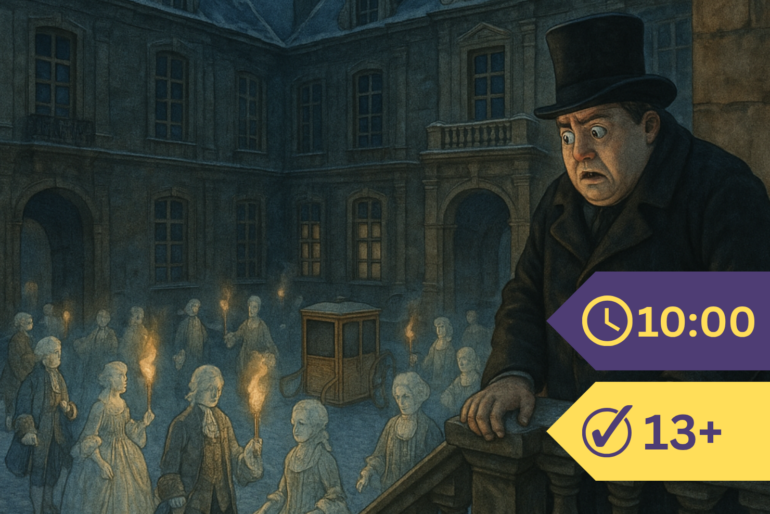
The portal swung open instantly — so brusquely it snuffed out the lamp-post in the court. From the shadow of the doorway came rustling sounds and confused whisperings. There seemed to be a great crowd wrangling and jostling to get in: footmen, a multitude of footmen; coaches with glass panes glimmering in the moonlight; sedan-chairs swaying lightly between two torches whose long flames writhed and twisted in the draught from the doorway.
In a second the court was crowded. But at the foot of the stairway the confusion ceased. People alighted from the coaches, recognised one another, smiled, bowed, and made their way up the stairs, chatting softly as though quite at home. There was much rustling of silks and clanking of swords on the landing, and billows of white hair, heavy and dull with powder. Through the faint sound of their airy tread came a thin, high quiver of voices and little peals of laughter that had somehow lost its vibration.
All these people seemed old — very old. Eyes that had lost their fire. Jewels that had lost their light. Antique brocades shimmering with a subdued iridescence in the torchlight. Above it all, a thin mist of powder rising at every curtsey from the great white-puffed coiffures of these stately heads.
In a moment the place was haunted. Torches glittered from window to window and up and down the curving stairways. The very dormers in the mansard twinkled with joy and life. The whole mansion blazed as though a great burst of sunset had set its windows aglow.
Merciful saints — they will set the house on fire!
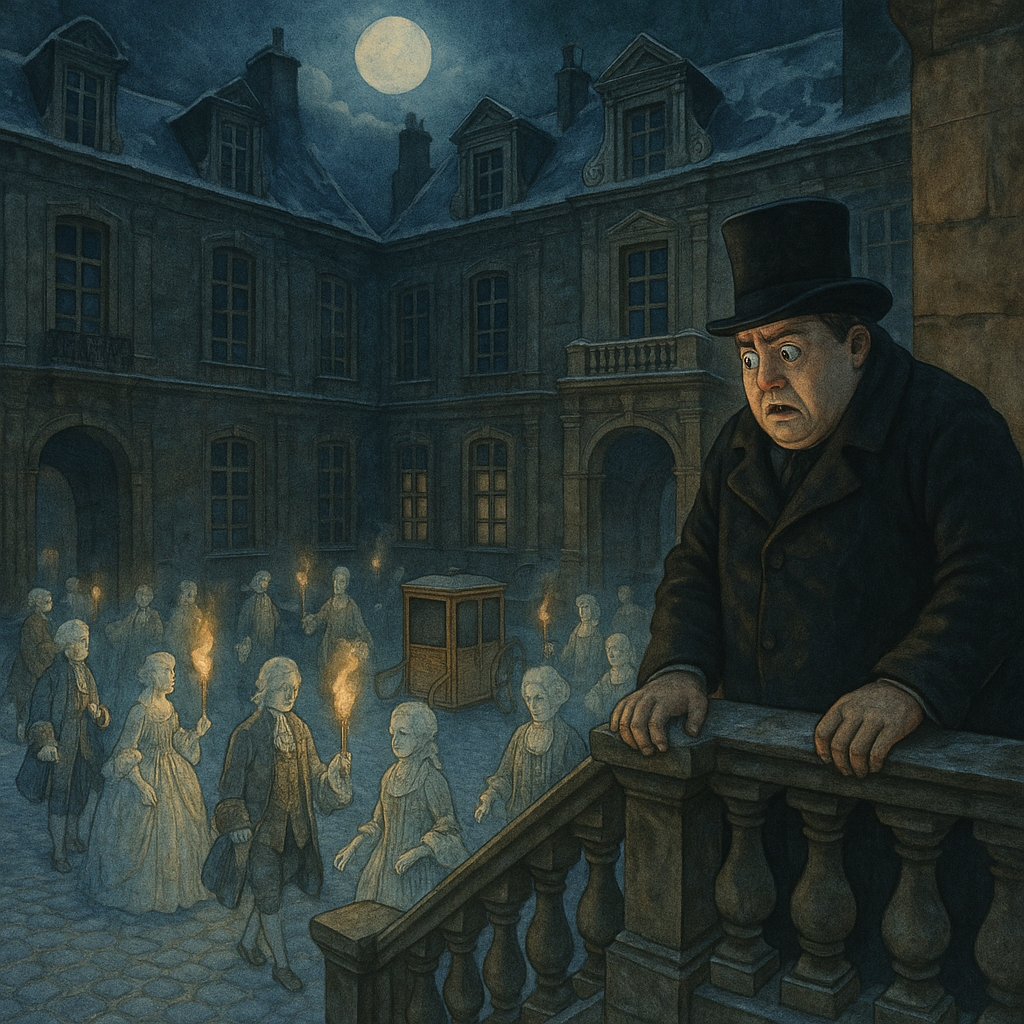
M. Majesté shook the numbness from his legs and hurried down into the court, where the footmen had lit a great bonfire. He went up to them and spoke; but they did not answer. They stood there chatting softly among themselves, and not the faintest breath issued from their lips into the freezing night air.
M. Majesté was somewhat put out. He was reassured, however, when he realised that this great fire — with its long, straight flames — was a most peculiar fire. It emitted no heat. It simply glowed, but did not burn.
The good man set his mind at rest, went back upstairs, and made his way into the store.
These rooms on the first floor must have been grand reception halls in their day. Particles of tarnished gold still clung to the angles. Mythological frescoes circled the ceilings, wound round the mirrors, hovered above the doorways — vague and subdued, like bygone memories. There were no curtains or furniture now, nothing but baskets and great cases filled with leaden-headed siphons, and the withered limb of an old lilac bush rising in black outline outside the window.
M. Majesté entered. He found the rooms crowded and brilliantly lit. He bowed, but nobody seemed to notice him. The women in their satin wraps leaned on their cavaliers’ arms and flirted with ceremonious, mincing graces. They promenaded, chatted, and separated into groups. All these old marquises seemed perfectly at home. One little shade stopped, all of a quiver, before a painted pier-glass; then she glanced smilingly at a Diana carved into the woodwork — lithe and roseate, with a crescent on her brow.
“This is I — think of it! And here I am!”
“Nesmond — come and see your crest!” And they laughed immoderately at the sight of the Nesmond coat-of-arms displayed on the wrappers above the name of Majesté, Jr.
“Ha, ha, ha! Majesté! There are some majesties left in France after all, then!”
There was no end of merriment, of mincing coquetries. Little trills of laughter rose like flute notes in the air. Then someone exclaimed —
“Champagne! Champagne!”
“Nonsense!”
“Yes, indeed — champagne. Come, Countess, what do you say to a little Christmas supper?”
They had mistaken M. Majesté’s seltzer-water for champagne. They naturally found it somewhat flat. But these poor little ghosts had such unsteady heads — the foam somehow excited them and made them feel like dancing. Minuets were immediately organised. Four rare violinists struck out with an old melody by Rameau, full of triplets, quaint and melancholy in its vivacity. And you should have seen the pretty little grandmothers turn slowly and bow gravely in time with the music.
Their very finery seemed freshened and rejuvenated by the sound — the waistcoats of cloth-of-gold, the brocaded coats, the diamond-buckled shoes. The panels themselves seemed to awaken. The old mirror, scratched and dim, which had stood encased in the wall for over two hundred years, recognised them all. It glowed softly upon them, showing each face with a pale vagueness — like a tender regret.
In the midst of all this elegance, M. Majesté felt rather ill at ease. He huddled in a corner and looked on from behind a case of bottles.
But gradually the day dawned. Through the glass doors of the store one could see the court growing light — first the sky, then the tops of the windows, then all one side of the great parlour. Before the advancing day the figures melted and disappeared. The four little violinists alone were belated in a corner; M. Majesté watched them evaporate as the daylight crept upon them.
In the court below he could just make out the vague form of a sedan-chair, a powdered head sprinkled with emeralds, and the last spark of a torch that a lackey had dropped on the pavement — blending now with the sparks from the wheels of a dray, rumbling in noisily through the open portals.