Christmas Eve that year was bleak and cold, and the village seemed frozen into silence. The houses were shut tight, and so were the stables, from which came the muffled sound of animals chewing the cud. Now and then the clack of wooden shoes on the hardened ground echoed through the deserted streets, a door opened and quickly closed again, and silence returned. Thick smoke rose from every chimney into the gray sky, and you could tell that every family was huddled around its hearth while the housewife prepared the Christmas supper. Legs stretched out to the fire, faces bright with the pleasure of tomorrow’s feast, the peasants laughed at the north wind sweeping the roads, the frost that had powdered the forest trees, and the ice that had turned the streams to glass.
My friend Tristan and I had spent the day in the same spirit, in the old house of the Abbatiale, at the corner of the hearth — smoking our pipes and reading poetry. By sundown we had grown restless and decided to venture out.
“The forest must look extraordinary in this frost,” I said to Tristan. “Suppose we take a walk through the wood after supper? Besides, I need to stop by the woodworkers’ camp at Courroy on a small matter.”
So we pulled on our gaiters, stuffed our pipes, wrapped ourselves in cloaks and mufflers, and set off into the wood.
We walked cheerfully along the frozen paths, the ground hard and furrowed with deep icy ruts. On either side, through the thicket, we glimpsed mysterious white depths. The north wind had transformed the overnight mist into a tangle of snowy lace draped over every branch. In the fading light we could still make out the sparkling needles of the junipers, the frosted clouds of clematis, the bluish crystals on the beeches, the silver filigree on the hazel branches. The silence was broken only by the occasional crack of a frozen limb, and every now and then a breath of fine white dust melted cool against our cheeks.
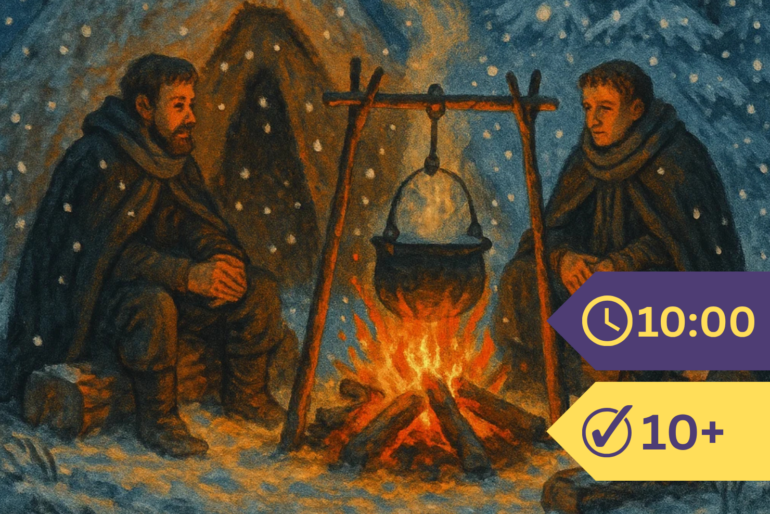
In less than an hour we caught sight of a red, flickering glow through the trees — the woodworkers’ camp, pitched at the forest’s edge above a stream that ran down toward the valley. The settlement was made up of a large cone-shaped hut daubed with earth and a smaller cabin of rough planks carefully chinked with moss. The hut served as dormitory and kitchen; the cabin stored their tools and finished wooden shoes, and stabled the two donkeys they used to carry goods. The woodworkers — masters, apprentices, friends, and children alike — were seated on beech logs around the fire in front of the hut, their shifting silhouettes thrown in sharp black profiles against the flames. Three posts driven into the ground and lashed at the top formed a crane from which an iron pot simmered over the coals. An appetising smell of stewed hare rose with every puff of steam as the lid bobbed up and down. The master, a small, wiry, bristling man, welcomed us with his usual warmth.
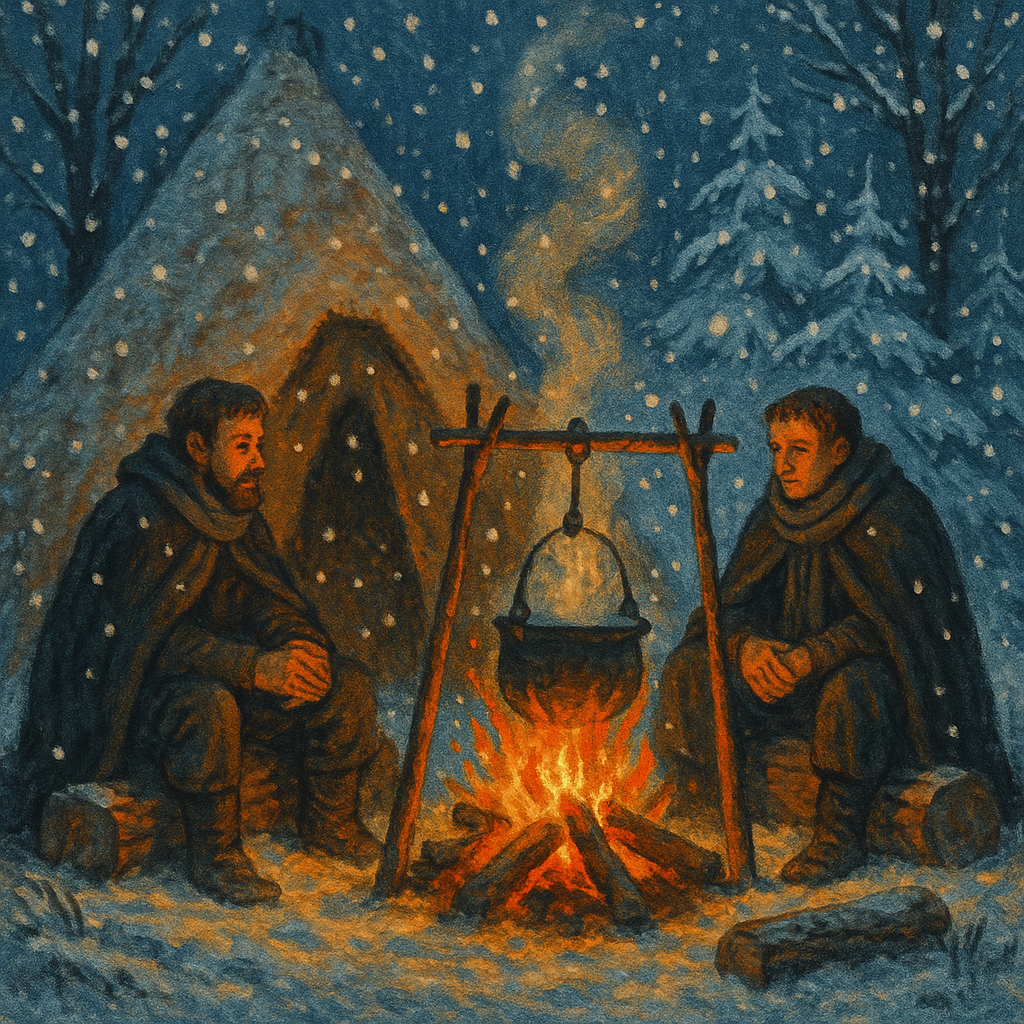
“Sit down and warm yourselves. You find us in the middle of Christmas supper. I’m afraid we won’t sleep too well tonight.” He lowered his voice. “My wife is ill. I’ve made her a bed in the cabin — it’s warmer there, on account of the animals. My boy has gone to town for the doctor, and there’s no time to lose. My little girl is running back and forth between the two.”
We had barely settled ourselves around the fire when the snowflakes began to swirl down through the still air above us. They fell so thick and fast that within a quarter of an hour we had to cover the fire with a hurdle draped in sacking to keep it going.
“By my faith, gentlemen,” said the woodworker, “you won’t be starting back out in this. You’ll have your Christmas supper here with us — and taste of the stew.”
The weather made the choice for us, and we accepted. Besides, the adventure pleased us; a Christmas supper in the heart of the forest was not something we’d planned for. An hour later we were inside the hut, eating hare stew by the light of a stub of candle, washing it down with a rough young wine that scraped the throat pleasantly. The snow fell heavier and heavier, wrapping the forest in a soft white silence. From time to time the woodworker rose and went to the cabin, then came back with a worried look, listening for the sound of hooves from the valley road.
Then, gradually, a few metallic notes rose muffled from below — one bell, then an answering one from the opposite direction, then a third, a fourth, and soon a vague confusion of Christmas chimes was floating over the forest.
Our hosts, still eating, passing the wine-jug hand to hand, tried to pick out each bell by the quality of its sound.
“Those are the bells of Vivey — barely louder than a donkey’s hooves on stone.”
“And that one, Auberive!”
“Yes — and that low droning, like a swarm of beetles? That’s the Grancey chimes.”
By the time the discussion had run its course, Tristan and I had surrendered to warmth and a full stomach. Our eyes grew heavy. Without quite meaning to, we fell asleep on the moss of the hut floor, rocked by the music of the bells.
A piercing cry, followed immediately by joyful voices, brought us bolt upright.
The snow had stopped. The night was turning pale, and through the little skylight we could see a faint brightness above the snow-heavy trees, where a single late star trembled in the sky.
“It’s a boy!” the master shouted, bursting in on us. “Gentlemen, if you’d like to come and see him — I’d be very glad of it. It might bring him luck.”
We followed him across the snow, crunching in the silence, to the cabin, lit by a smoky lamp. On her bed of laths and moss lay the young mother, weak and spent, her head thrown back, her pale face framed by a tumble of dark auburn hair. The midwife, helped by the little girl, was swaddling the newcomer, who wailed thinly. The two donkeys, startled by all the commotion, had turned their quiet gray faces toward the bed; they shook their long ears and looked around them with wide, gentle eyes, breathing out slow puffs of warm vapor that hung in the cold air like smoke. At the foot of the bed stood a young shepherd with a black-and-white she-goat and her newborn kid.
“I’ve brought you the goat, Madame Fleuriot,” he said, in his slow country voice. “You can keep her for the boy as long as you need.”
The goat bleated, the newborn cried, the donkeys breathed their warm breath. There was something ancient and elemental about the scene — something that needed no explanation.
Outside, in the violet light of dawn, while a distant church bell was scattering its first notes through the cold air, one of the young apprentices — dancing in the snow to keep warm — sang out at the top of his lungs the old Christmas carol that seemed, just then, to mean something entirely new:
He is born, the little Child.
Ring out, hautbois! ring out, bagpipes!
He is born, the little Child;
Let us sing the happy news.