Christmas is just as much Christmas at Boon Island lighthouse as it is anywhere else in the world. And why not?
To be sure, the nearest land is ten miles away, and when the winter storms blow, the waves dash clear over the two low rocks out of which the sturdy old tower rises. There are no bright streets lined with toyshops, no gathering of families, no Christmas trees loaded down with presents — nothing to be seen from the lighthouse but the changing water and the ringing rocks, with the whole world hiding somewhere ten miles away.
But there are six children there, and a mother and a father — and if they can’t make a Christmas, then nobody can. Baby Deb alone is material enough to make a Christmas out of, being a very rollicking, jolly sort of four-year-old. But when you add to her Tom and Sue and Ann and Ike and Sam, why, the grim old lighthouse fairly overflows with Christmas every December.
It’s a lonely old one-eyed lighthouse, and it hasn’t got a chimney. But do the children there hang stockings — long, hopeful stockings? Indeed they do. And on Christmas Eve, don’t those stockings hang all temptingly limp and empty under the little shelf? And doesn’t Santa Claus come, very early, mind you? For if you suppose that stout old gentleman doesn’t know how to find a chimney, even when the cold waves are pelting the tower with spray ten miles from land, then you little know what a remarkable way he has about him.
And the Christmas dinners they have — the goose, the brown, melting roast goose! What would the dinner be without that goose? What indeed. For once, they came very near having no goose at all.
It came about this way. Papa Stoughton, the lighthouse keeper, had lost all his savings that December in a bank that failed. A goose is really not a very expensive thing — but if one hasn’t the money, one cannot buy even a cheap one. Papa Stoughton could not afford it, and he said so, right out before the whole family.
The silence that fell over that family then was painful to see. They looked at one another with eyes so wide it’s a mercy they ever got them shut again.
“No goose!” cried Tom at last, who was the oldest.
“No goose!” cried all the others — all except Baby Deb, who at that moment was gently scolding Stulpin, her most troublesome child, for being so dirty. Baby Deb said “goose!” too, but a beat after everyone else, which made them all laugh. No doubt she reckoned that, after all, so long as Baby Deb was there, it would be Christmas, goose or no goose.
When Papa Stoughton explained how things stood, the children understood, and made no complaint. Only Tom sat frowning — and when the others saw the look on his face, they fell to studying him, trying to guess what he was turning over in his mind.
At last Tom said “Ah!” under his breath, and marched mysteriously into the next room, beckoning his brothers and sisters to follow — which they did almost before he’d finished saying it. Baby Deb came too, somewhat awestruck, but ready to lend a little of her wisdom if it should be needed.
“We must have a goose,” said Tom.
“Oh!” gasped his audience, moved to amazement and admiration.
“Ever since I was born,” he went on, “we’ve had a roast goose for Christmas.” He said it as though he’d been born a hundred years ago, and the audience was tremendously impressed. “So,” continued the orator, “we’ll have one now. We’ll have one anyhow. I have a plan.” They shuddered and crept nearer. “We must all contribute.”
“You want a goose, Sue?”
“Yes, indeed!”
“You, Sam?”
“You bet!”
“Me!” said Baby Deb with great firmness — for it was plain to her that this was a question of eating, and she did not wish to be left out.
“Of course you, too, you dear dumpling,” said Tom. “Now then — what shall we each give? I’ll give my new sailboat. That ought to bring something.”
His new sailboat! Why, he’d had it only a week. This was a real sacrifice. Who could hesitate now?
“I’ll give my shells,” said Sue heroically.
“My sea mosses,” sighed Ann.
“You may take my shark’s teeth,” said Ike.
“And my whale’s teeth,” said Sam.
The sacrifice was general. The lighthouse would give up its treasures.
“All right,” said Tom. “Now we’ll tell Father.”
And Father was told. For some reason he turned very suddenly to look out the window — but not before he had wiped his eyes; and Mamma Stoughton wiped her spectacles, and winked hard, and said, “Bless their hearts.” For, you see, these were very simple-hearted folk, and it seemed to them very affecting that the children should give up their treasures to buy a goose.
“And what does Baby Deb contribute?” asked Papa Stoughton, by way of a joke.
“I dess I’s not dot nuffin,” was Baby Deb’s reply, when the matter was put to her, “‘cept ‘oo tate Stulpin.” (Which is to say: I guess I haven’t got anything — except you can take Stulpin.)
Oh, what a laugh there was then! If ever there was a battered and demoralized doll, it was Stulpin. But Baby Deb was hugged and kissed as though she had offered up a lump of gold instead of a bundle of rags.
Papa Stoughton and Tom were to go to the mainland the first clear day and buy the goose. But, alas, a storm came on, and they were forced to wait for it to die down. It did not die down. It grew worse and worse. The wind shrieked and moaned and wrestled with the lonely tower, and the waves hurled themselves at it and washed clear over the island, so that no boat could have lived in such weather.
If a goose is only a goose, then never mind. But if it is a Christmas dinner — ah, then!
Yes, they had good reason to feel dismal at the lighthouse. Six noses were flattened despairingly against the windows fifty times a day — six, for even Baby Deb was affected at last, and though she knew not the least thing about weather, she too would press her little nose to the glass in the most alarming way, as if she thought that pressure was the one effective thing.
It took Baby Deb some time to grasp the importance of having a goose for Christmas, but once she had it, she became a perfect enthusiast on the subject. She explained the whole matter to her dolls, and was particularly earnest with Stulpin, with whom, indeed, she held long and almost painful conversations.
One thing became very certain: there was little prospect of clear weather within a week, and it lacked only three days to Christmas. The others gloomily gave up hope — but not Baby Deb. The truth was, she had a plan; and when one has a plan, one has hope, too.
Mamma Stoughton had lately been having a series of talks with Baby Deb about the important question of prayer, and it had occurred to Baby Deb that the goose was a very good subject for it. The goose was necessary. Why not ask for it, then?
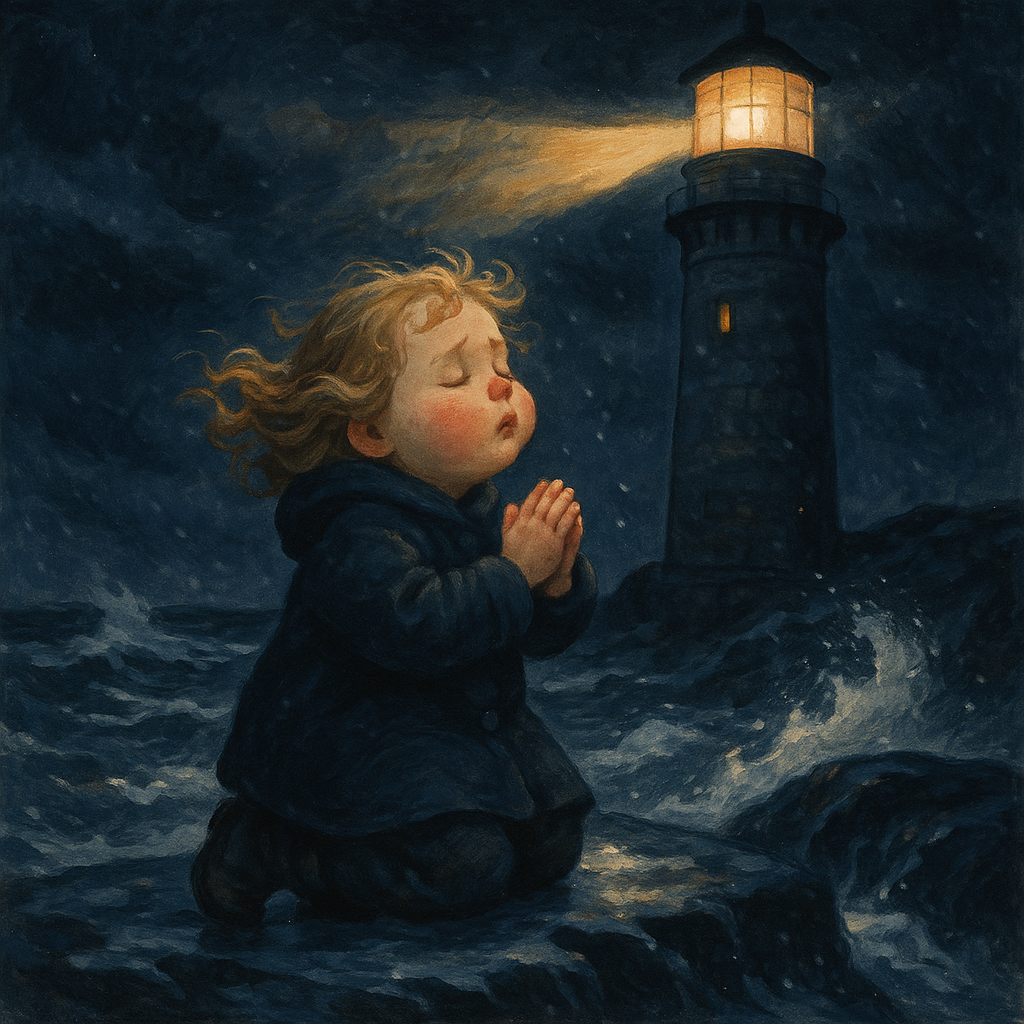
The great difficulty was finding a secret place for her devotions, for the family filled the lighthouse rather full, and Baby Deb understood that prayers ought to be made quietly and in secret. But a place was found. Just in front of the lighthouse lay a broad ledge of rock, usually washed by the waves, but bare at low tide even in bad weather. The other children had been forbidden to go there because it was dangerous — but no one had thought to caution Baby Deb. So there she went, and in her own imperfect way begged hard for the goose.
Christmas Eve came, and still no goose. Baby Deb was puzzled; the others were glum. Still she would not give up. Low tide would be about seven o’clock — she knew, for she had asked — and she would make one last try. She had hopes yet. But as the others knew nothing of her plans, they had no hope at all. To them it was certain there could be no Christmas goose in that house this year.
Seven o’clock came, and Baby Deb crept softly out of the room and down the stairs. She opened the great door just a crack and slipped out into the darkness — really slipped, for it was icy on the rocks, and she sat down very hard. But she was very chubby and did not mind. She crawled cautiously round to the big rock, the keen wind nipping her round cheeks and pelting her with frozen spray. And she knelt down.
“Oh, please, dood Lord, send us a doose! We want a doose awful bad. Won’t you, please, dood Lord?”
Thud — something fell right down beside her.
“Oh — what’s dat?” she exclaimed, putting out her hand. “Why — it’s a doose!” she cried, with a scream of delight, as her fingers closed on a soft, warm, feathery body.
She forgot to say thank you for the goose — but she was thankful, though not very much surprised. She had really expected it.
It was a heavy load for Baby Deb, but she was too excited to notice. She made her way back into the lighthouse and, step by step, patter, patter, up the stairs she went, and burst all breathless into the sitting room, crying in triumph, “It’s tummed! It’s tummed!” — as the great goose tumbled out of her arms onto the floor.
Well — if you think they weren’t surprised, then you know very little about the Stoughton folks. What they all said, nobody knows, for they said it at once. But by and by Papa Stoughton got a chance to be heard.
“Where did you get it, Baby Deb?”
“Why, I p’ayed Dod for it,” answered Deb, in the most matter-of-fact way in the world.
“Prayed God!” exclaimed Papa Stoughton.
“Prayed God!” chorused the whole family.
“Es,” said Baby Deb, convincingly. “Dod’s the dood Lord. I p’ayed to Him. He sonded it to me dess now.”
More questions, and more of Baby Deb’s explanations, brought out the whole story — and those funny folk, the Stoughtons, spent the next ten minutes wiping their eyes and hugging and kissing and making up new pet names for Deb.
Papa Stoughton did remark to Mamma Stoughton that night, as they were going to bed: “A wild goose. Blinded by the bright light, and broke its neck flying against the glass.” Then he was quiet a moment. “And after all — who shall say the good Lord did not send it?”
And not one word of explanation was ever said to Baby Deb; nor did anyone contradict her when she announced, at dinner the next day:
“Dod’s doose is dood.”