Donald MacBride and I were the only Britishers living on one of the North Pacific island lagoons when Christmas of 1880 drew near, and we resolved to celebrate it in a way that would fill our German and American trading rivals throughout the group with envy. MacBride was a bony, red-headed Scotsman with a large heart and a small, jealous wife — Sera, a woman of Palauan heritage who had never been to a civilised country. She ruled him with a rod of iron, much to his financial and moral benefit. She agreed with me that we three ought to show the Americans and the ‘Dutchmen’ how an English Christmas should be celebrated, and concurred that Donald and I should run the show, which — though I was not a married man — was to take place at my house, for the greater space.
Donald, she said, wanted a hakkise; so we bought a nanny-goat from Ludwig Wolfen, the German trader at Molok, and on the evening of the 23rd of December I helped Sera drive and drag the unsuspecting creature home to her husband’s place for the slaughter. I may as well say at once that MacBride’s nanny-goat haggis was a hideous failure, and my boat’s crew — to whom it was handed over, with many strong expressions about MacBride’s beastly provincial taste — said it smelled good, like shark’s liver, but was not nearly so juicy.
Meanwhile, Wolfen — a fat, good-hearted Teuton with a face like a full moon in a fog — called upon me and remarked, in a voice made permanently soft by too many years of lager beer, that he and his neighbour Peter Huysmans would feel very much hurt if we did not invite them to join the festivities. I said that ‘Blazy-head’ (for so we called dear old MacBride) and I would be delighted. Wolfen, who had once spent a Christmas in a public house near the East India Docks during his sailor days, said the correct thing would be to have a Christmas cake. He also suggested we invite Tom Devine and Charley de Buis, the two American traders who lived across the lagoon.
Being aware that trade jealousies had bred a rather notorious bitterness between Wolfen and the Americans, I shook his hand warmly and said I was delighted to see he could forgive and forget. I sent my boat across the lagoon at once with a written invitation, and asked whether Mrs Charley — a Samoan woman skilled in baking — might lend Mesdames MacBride, Wolfen and Huysmans her help in making a Christmas cake large enough to cause the native population to sit up and respect us as men of more than ordinary intelligence and patriotism.
On the evening of the 24th, three whale-boats attended by a flotilla of small native canoes sailed into the little sandy-beached cove where the trading station stood. They were steered by Peter Huysmans, Charles de Buis and Thomas Devine, accompanied by their wives, children, and numerous female relatives, all clad in their holiday best: new mats, their hair heavy with scented coconut oil, scarlet hibiscus flowers behind their ears, and necklaces of sweet-smelling pandanus drupes.
MacBride, Mrs MacBride and I received them the moment they stepped ashore. Ludwig Wolfen — seated in the background on a gin case — struck up ‘The Star-Spangled Banner’ on his accordion, accompanied by several native drums beaten by his wife and her brothers. Then my boatman Bill Grey, a stalwart young Māori man, advanced from the surrounding crowd of islanders and planted a British red ensign on a tall bamboo pole in the sand, calling for three cheers for the Queen of England and three for the President of the United States.
This at once gave offence to Ludwig Wolfen, who demanded to know what was the matter with the Emperor of Germany. Bill took off his coat and asked what he meant by that, and a fierce encounter was only avoided by half a dozen strapping islanders seizing Bill and making him sit in the sand, while the wrathful Ludwig was hustled away by Donald MacBride and Mrs Wolfen and threatened with a hammering if he insulted the gathering further. Ludwig, I regret to say, had begun his Christmas the previous evening.
But we were too merry, and too filled with good comradeship, to let such a trifle disturb the harmony of our first Christmas gathering. Presently Bill Grey, his dark handsome face wreathed in a sunny smile, came up to the sulky and rightly indignant trader with outstretched hand and said he was sorry. Wolfen, good-hearted German that he was, grasped it warmly and said he was sorry too. And then we all trooped up to the house and sat down — only to rise again with our glasses clinking as we drank to our wives and ourselves and the coming Christmas, and to the brown, smiling faces of the people around us who wondered why we had grown merry so suddenly. For sometimes, as they knew, we had quarrelled with one another and bitter words had passed — as it ever is, even in the far South Seas, when questions of trade and money come between good fellowship and old friendship.
Then sweet, dark-eyed Sera took up her guitar and sang us love songs in the old Portuguese tongue of her father. Tom Devine and Charley de Buis and red-faced old Peter Huysmans joined hands and danced around the rough table, while Bill Grey and Ludwig Wolfen stood on top of it and sang — or tried to sing — ‘Home Sweet Home.’ I sat in a chair in the doorway and wondered where we would all be the following year.
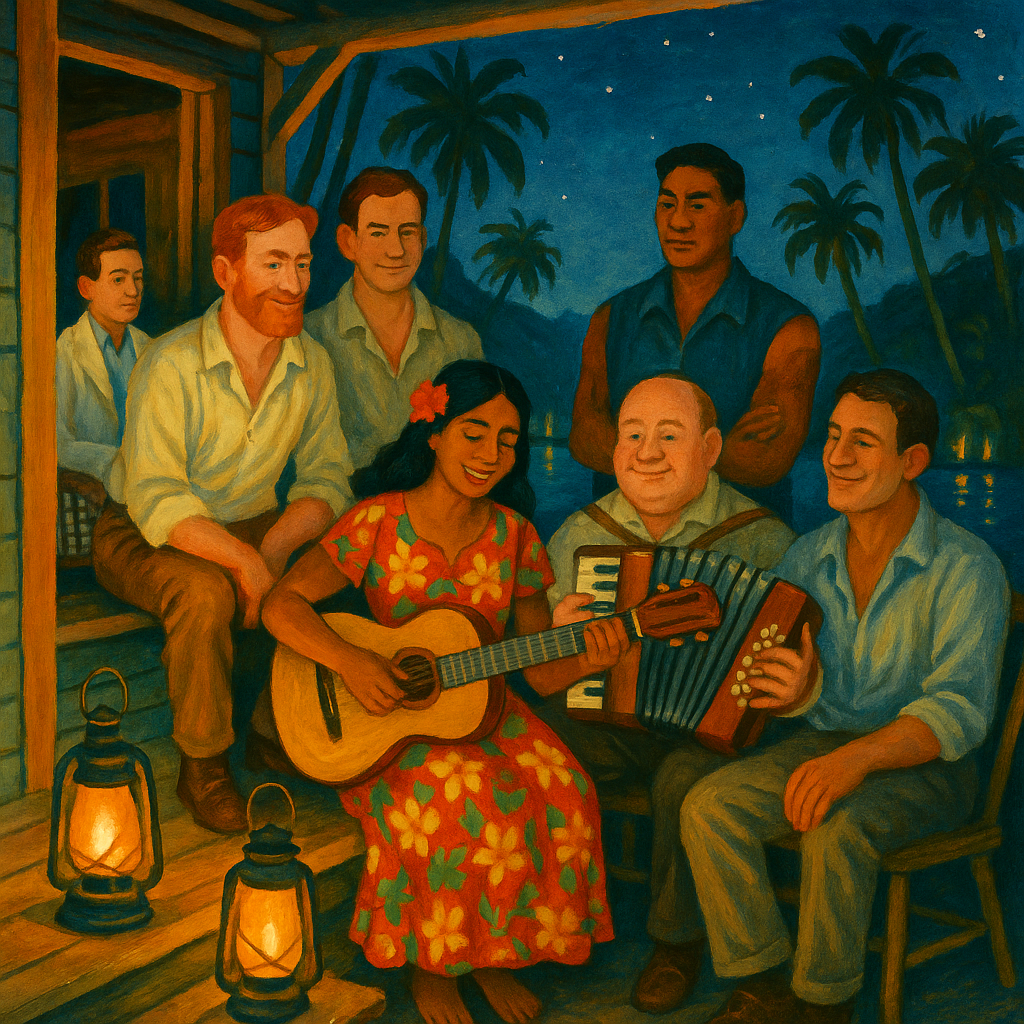
As we sang and danced, and the twang of Sera’s guitar sounded through the silent night, Tom Devine held up his hand, and silence fell.
‘Boys,’ he said, ‘let us drink to the memory of the far-off faces of those dear ones whom we may never see again.’ He paused, then caught sight of Sera bent over her guitar with downcast eyes. ‘And to those who are with us now — our wives, our children, and our friends! Drink, my boys. And the first man who talks business or money tonight or tomorrow gets fired out before he knows where he is — for this is Christmas. Sera MacBride, why the devil don’t you play something and stop me making a fool of myself?’
Sera, with a twist of her lithe body and a merry gleam in her eyes, sang another song. Then long, bony MacBride came over and kissed her on her forehead, whispered something we didn’t hear, and pointed to Charley de Buis, who stood, glass in hand, at the far corner of the room, his thin, sun-tanned face as grave as an English judge.
‘Gentlemen’ — then, aside to me in the doorway: ‘Just fancy us South Sea loafers calling ourselves gentlemen!’ — ‘gentlemen, we are here to have a good time, and I move we quit speechmaking and get the women started on that cake. Tom Devine and I are, as you know, members of two of the First Families of America, and only came to the South Seas to wear out our old clothes —’
‘Shut up,’ said Devine. ‘We don’t want to hear about the First American Families. This is an English Christmas, with full-blooded South Sea trimmings. Off you go, ladies — start on the cake.’
Charley shut up. The women — headed by Sera and Mary Devine — trooped off to the cook-house to beat up eggs for the cake, and left us to ourselves.
When midnight drew near they returned, and Peter Huysmans rose. Twisting his grizzled moustaches, he spoke —
‘My boys, will you let me tell you that the morning is coming when Jesus Christ was born? And will you please, Mary Devine, ask those people outside to stop the drums while I speak? Come here, MacBride, with your red head — and you, Ludwig Wolfen — and you, Tom Devine — and you, Charley de Buis, you wicked devil — and you, Tom Denison, you saucy Australian boy with your fine white dinner suit. Let us join our hands and agree to have no more quarrelling and no more angry words. Why should we quarrel, as our good friend says, over dirty dollars, when there is room enough for us all on this lagoon to make a decent living? And we should try to remember that none of us is going to live for ever, and when we are dead, we are dead a very long time. But now, my friends, I will say no more — for I am dry. So here is to all our good health. And let us promise one another: no more angry words.’
And so we gathered around the big table and, grasping each other’s hands, raised our glasses and drank together without speaking. There was something — we could not say what — behind old Dutch Peter’s little speech that made us think. Presently, when the big gaudy cuckoo clock on the wall struck twelve, even reckless Charley de Buis forgot his standing joke about the painted bird, and we all went outside and sat smoking our pipes on the wide verandah, watching the flickering torchlights of the fishing canoes as they moved slowly across the smooth waters of the sleeping lagoon. Then, almost before we knew it, the swift red sun had turned the long dark line of palms to purple, and then to shining green, and Christmas Day had come.
Tonight, as a chill December wind wails through the leafless elms and chestnuts of this quiet Kentish village, I think of that far-away Christmas Eve, and the rough, honest, sun-browned faces of the men who pressed my hand when Peter spoke of home and Christmas, and Tom Devine spoke of ‘the dear faces we might never see again.’ For only one of them, besides myself, is left. MacBride and his gentle, sweet-voiced Sera went to their deaths a year or two later in the Solomons; Wolfen and his wife and children were lost at sea when the schooner Sadie Foster capsized off the Marshalls; and Devine and Charley de Buis, comrades to the last, sailed away to the Moluccas in a ten-ton boat and were never heard of again — their fate one of the many mysteries of the deep. Peter Huysmans is alive and well, and only a year ago I grasped his now-trembling hand in London, and we spoke of our meeting on Milli Lagoon.
And there again, in a garish, tinsel-lit city bar, we raised our glasses and drank to the memory of those who had gone before.