I.
The last gleam of sun was dying over the fields, and the air had gone sharp and still. The barren countryside seemed to shiver. Chimneys on the neighboring houses sent up puffs of smoke that the icy north wind whirled away, leaving a few snowflakes in exchange. A startled blackbird chirped from her perch on the wall, then called anxiously to her mate from the top of an apple tree. Now and then came the long, melancholy cry of a laborer calling his cattle home, or the scurrying of wooden clogs over the cobblestones in the alley. After that, silence — no other sound to say there was any life in that pale, wintry landscape.
In the broad porch of one of the houses, two boys lay stretched out on a heap of dried rushes, flat on their stomachs, chins on their hands, looking into each other’s eyes. They had spent the afternoon rolling around in the rushes, and to fight off the cold — which they barely felt, poorly dressed as they were — they had only to blow on their fingers from time to time.
One boy lived in the house; the other, next door. It was the first one who suddenly announced:
“I’m going to have fritters tonight. Ha!“
“So am I,” replied the other.
“But I’m having mine with honey.”
“I’ll have something better — sugar!”
“Well, we’re having a meat stew and wheat bread to go with it.”
“My father brought home two fish yesterday — enormous ones!”
“My mother’s down in the town right now getting lard and wheat bread and cake. And this noon my father brought two jars of white wine — the very best kind. And all the eggs we’ve saved this week are for tonight: more than fifteen, big as that!” He shaped a generous circle with his fingers. “We’re spending a whole dollar and thirty-five cents tonight — all of it saved up!”
“What’s that? My father brought four dollars and forty cents up from the harbor, and we’re spending every last bit of it tonight. Here — if I give you a piece of the fish, will you save me a taste of the stew?”
“I couldn’t care less about that. But you haven’t got a brother who’s a student coming home from the seminary this very afternoon.”
“But I’ve got a fine young bull and a cow that gives three quarts of milk. Oh, the amount of milk we’ll have tonight!”
“Milk, you say! Want to see two jars of it right now? I’ll show you something worth seeing.”
The boy sprang up, his friend after him, and together they crept into the kitchen, looking carefully about in case Uncle Jeromo — the master of the house — was anywhere nearby.
Evening was coming on. The boy of the house snatched a burning stick from the hearth and, by much blowing, coaxed up a little flame. By its wavering light they made their way to a smoke-darkened chest beneath an equally smoke-darkened shelf. They raised the lid. There on the bottom, tucked between heaps of flour, bran, and half a cured ham, sat two large jars filled with milk. The boy of the house looked at his friend with an air of triumph. Both of them leaned over. Both stretched out a hand, and each moistened one finger in the milk — each in his own jar. Then, moving as if by a single impulse, they withdrew their arms and stood face to face, sucking their fingers.
“That’s good milk,” said the boy of the house.
“It’s better cream, though,” replied his friend.
“Did you get the cream?”
“What do you think! I got every bit of it on my finger.”
At that moment the first boy remembered with a jolt the terrible fuss his father made whenever cream went missing from the milk — and the evidence such scenes had left on his own ribs. Fearing another thrashing, and wanting to make his own innocence absolutely clear, he flung the burning stick back into the fire, grabbed his friend by the trousers, and called out in the tone of the gravely wronged:
“Father! Father!”
But the guilty party, struck with mortal terror, gave a furious wrench, broke free, and bolted through the yard, licking his fingers as he went.
Uncle Jeromo, who had been repairing a wheel behind the house, came hurrying in at the sound of the shouting. He did not believe the boy’s story about who had stolen the cream, decided the boy himself was the thief, and delivered two resounding blows. The boy shrieked. The father threatened more of the same. In the middle of the cries, Aunt Simona’s voice rang from the doorway.
“Oh, will you look at this! This is how I always find you.”
“Oh, Mama, Mama!” cried the boy, running to cling to her skirts.
“What are you crying for? Who’s been hitting you?”
“Mo-mo-Mama! It was Fa-fa-Father!”
“And he’ll get more,” muttered Jeromo, heading out to the stable. “I’ll teach him to steal the cream.”
“I didn’t take it! It was Tonu — Tonu Zancuda — oh dear!”
“I’m sure it was, poor little thing. That boy is the sneakiest creature alive. Here, have some chestnuts. Stop crying now. Your father is too quick with his hands. Has the student arrived yet?”
“No.”
“God grant a wolf hasn’t eaten him on the road! Where’s your sister?”
“She went to the fountain.”
“That girl! Well, I won’t go after her — no sense going out into the cold at this hour. That Tonu, what a piece of work he is!”
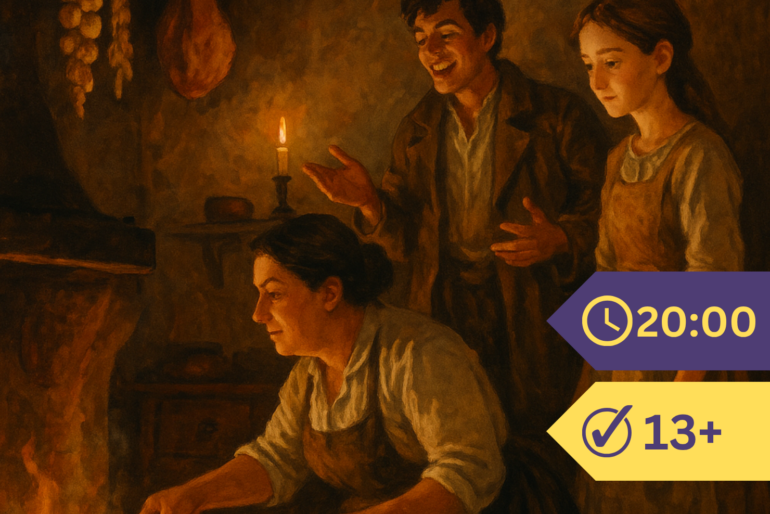
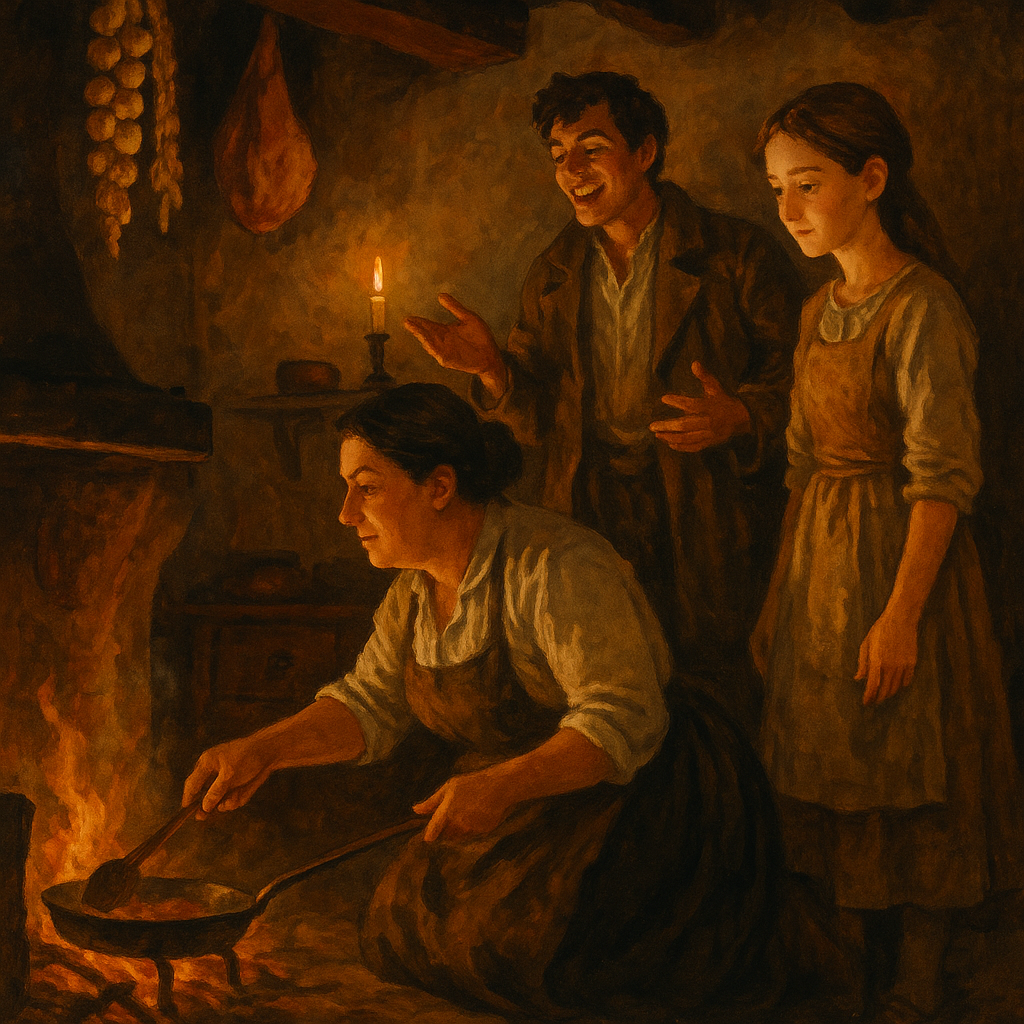
Still muttering, Aunt Simona left her clogs at the closet door, took off the rough woolen skirt she’d thrown over her shoulders, hung it on a plow handle dangling from one of the ceiling beams, and went into the kitchen, the boy close at her heels. She set her basket down by the fire, threw on some dried thistles to bring the flame up, lit a candle, and took from the basket a little lard, a jar of honey, and two cents’ worth of cinnamon. These she arranged on the shelf within easy reach, and set about preparing the Christmas supper. Her daughter arrived shortly to help — carrying the two jars of water from the fountain and insisting she had not stopped to speak to a single soul, not one, and no one had ever found a lie in her mouth!
Uncle Jeromo came in a little later and took his seat by the fire. Country people in this part of Spain are simple in their habits, by necessity and by custom, and they take as much pleasure in watching the Christmas supper being made as in eating it. The sputtering of lard in the frying pan, the cutting of the fritter dough, the cracking and beating of eggs, the bread soaking in them — the sprinkling of sugar over the fritters as they came steaming out of the pan, the pouring of milk or honey on top — all of this, together with the thought that this fine food, and the jar of wine set aside sacredly for the occasion, was about to be lavishly enjoyed by the whole family looking on — all of it filled them with such pleasure that, well, you would only need to look at their faces to understand.
The business of the cream was entirely forgotten. Aunt Simona, crouched on the bare floor with the frying pan handle in one hand and a wooden spoon in the other, felt more important than the Emperor of China, and regarded her task as more delicate and consequential than a peace negotiation between two warring nations. A shame the student hadn’t arrived yet — Christmas Eve in the country had its own special rituals to be properly celebrated. After the pleasure of making and eating the supper came the arrival of the marzantes, about whom the small boy (still a little sniffly from his beating) had already asked several times. He was, truth be told, far more worried about missing the marzantes than about his brother’s delay on the road. The unlucky child had never actually heard them — not at Christmas Eve, nor New Year’s, nor Epiphany — because he always fell asleep before they reached the door. He believed in the marzantes the way he believed in the next world: entirely on the word of others.
II.
You shouldn’t conclude from the fact that Uncle Jeromo had a son at the seminary that he was a rich man in any strict sense. For a laboring man, he was comfortably situated — middling well-off, as he himself would say. But a family chaplaincy came with a small income attached, and Jeromo had gladly sold a piece of his land to fund his eldest son’s education for the priesthood, hoping the boy would eventually be awarded the living.
He’d done it willingly enough, but not without making himself clear: “If you spend that pretty penny I raised from selling my land without becoming a priest, God help you — as far as I’m concerned, I’ll cut you in two.”
The boy’s entrance into the seminary had been nudged along by the Lord of the Manor, a neighbor who had studied a little Latin in his youth and was such a terrible pedant that, purely to have someone on whom to show it off, he had badgered Jeromo day after day until the man agreed that the boy should learn Latin. The great man was so proud of this arrangement that ever since the eldest Jeromo entered the seminary, the student had been dreading his vacations — lying in wait for him, the Lord of the Manor was, armed with Latin phrases that were, the student said, an absolute riddle.
And so the seminarian, terrified of meeting him in some alley or on the bench outside his father’s door, had left the seminary as late as possible, planning to reach the village only after dark. This explained the delay that was making Aunt Simona so anxious.
What she could not have known — what the student himself had no way of suspecting — was that when he stepped into the tavern nearby to spend a few coins quenching his thirst after four leagues on foot, the first person he would meet (after the innkeeper) would be none other than the Lord of the Manor himself. The moment the great man spotted him, he fired off: “Amice, quo modo vales?” — My friend, how do you do? — which robbed the poor student of every drop of thirst he’d had.
“Blast the man,” the student muttered, grabbing his bundle of clothes from the bench and making for the door.
“Unde venis? Quorsum tendis?” — Where are you coming from? Where are you going?
“Now see here. I’ve walked four leagues and I’m in no mood for this. Goodbye.”
“Wait a moment, man! Why are you always so unsociable?”
“Because you’re insufferable, is why. One of these days I’ll set you a Latin puzzle you won’t solve in a year. And if we ever get into theology, we’ll see how you get on.”
“Parce mihi, incipiens sacerdos.” — Spare me, young priest-to-be.
“Watch what you say to me — I can translate, you know. I’m not going to stand for everything.”
“You are a weak creature, without a drop of the virum fortem — the strong man — about you. Don’t go so fast! I meant to walk home with you!”
It was no use. The seminarian quickened his pace, cursing his luck, and did not stop until he was safe inside his father’s kitchen, where he arrived in the worst possible temper.
“Blast that man!” was the only greeting he offered his family.
“What happened?” asked Uncle Jeromo.
“The same old thing. That crackpot — with his everlasting Latin!”
“But what harm does it do you? Haven’t you studied three years now? Why didn’t you answer him?”
“Because I’m not a show-off like him. And he’s studied in a different way — his Latin is full of tricks I don’t know. But I tell you, if he tried me in psychology, he’d have something to worry about. I’m perfectly at home there.”
“But when are you going to say your first mass?” asked Aunt Simona, frowning. The two younger children were staring at the student with wide eyes. “The village is going to ruin — the priest is so old.”
“And doesn’t know a thing, Mother. If you could hear the sermons I give when it’s my turn! We’re learning such a lot.”
III.
As the portrait of Uncle Jeromo’s eldest son is not our main business here, we may skip over the rest of the conversation and return to the Christmas Eve supper itself. The student hauled the stew pot away from the fire so the heat could dry the mud on his trousers. His sister had gathered up his cloak and spare shirts. Then he took charge of the jar of milk, his father of the sugar, and he helped his mother and sister with the toast, keeping them entertained with stories of his exploits and misadventures at the seminary.
When every delicacy was, as Aunt Simona declared, “fit to be eaten by an angel,” and the family had pressed close to the fire for warmth, the next great operation got underway: setting the lazy table.
This table was nothing more than a rectangular board fastened to the kitchen wall by a hinge at one end; the other end was held up against the wall by a leather strap. When the strap was released, the board dropped down like a castle drawbridge, and was propped level by a wooden leg that hung beneath it. Such a table was brought out only for holidays or weddings, so the lowering of it was treated with appropriate ceremony — and produced appropriate chaos.
“Watch it doesn’t fall on you!”
“Help me on this side!”
“Move that bench!”
“Pick up that spoon!”
“Here it comes!”
“It’s twisted!”
“Hold it there!”
“Mind your foot!”
There was scarcely less commotion than if they were launching a ship.
Once the table was set and all the food arranged upon it, the student said grace. We will leave the family to eat in peace — it is an operation that, apart from minor differences in the dishes and the vigor of the chewing, we all perform in much the same way. Besides, our presence might prevent Jeromo from scraping the gravy from the bottom of the stew pot, or his wife from dipping her finger in the honey dish to stir the sugar, or the seminarian from completely emptying his glass of wine.
Let us return an hour later. Everyone is talking more than before, and even old Jeromo has smoothed out his usual wrinkles. The small boy is spread out on a bench, snoring. The seminarian is talking Latin and swearing that if the Lord of the Manor came through the door right now, the man would regret it. And Aunt Simona is humming softly to herself:
Tonight is Christmas Eve,
Tomorrow Christmas holy;
At midnight the Virgin’s child
Is laid in cradle holy.
Her daughter was about to join in when a tremendous noise came from the yard — a chorus of neighing and the clatter of wooden clogs on the cobblestones, as if twenty horses were charging in.
“Robbers!” any city dweller would have cried.
Not at all. These were the marzantes — two dozen young men from the village who go from house to house on Christmas Eve, running and stamping their clogs and imitating horses with their voices.
The family froze and listened.
“Well now, Señor Don Jeromo,” came a voice from the doorway, pitched high in falsetto to disguise its owner, “won’t you show us those shoulders of pork curing on the beam, and some of those rich eggs from the speckled hen we heard cackling in the yard? Come now, do!”
The chorus outside responded with vigorous neighing. This opening speech — called the algarabía, or introduction — went on for a while, the voice begging for a taste of this and a bit of that, until at last it paused and asked:
“Which will you have — shall we sing, or shall we pray?”
“Pray,” said Jeromo.
“Sing, of course!” the seminarian cut in. “I love this sort of thing. Come, sing!” — and he opened the window the merest crack.
This was met outside with another round of neighing, and then the marzantes began to sing — in a slow, doleful, unchanging tone — a very long Christmas ballad, beginning:
In Bethlehem’s manger rough
The Virgin’s child is born,
A babe more rich than gold,
Bright as the sun at morn,
and ending:
To the people of this place
May victory be given;
In this life much grace,
And glory then in heaven.
The last verse had a variant the marzantes used whenever a house gave them nothing, or tried to trick them with food filled with ashes:
For all who live in this house
I wish at this hour
That even their bones
The mange may devour.
The sharp exchanges this second verse tended to provoke — and the livelier ones when the marzantes met a rival group from another village at the tavern, or got into a dispute with someone on the road — were probably the reason the leader disguised his voice and his companions stayed well back in the shadows.
But in Jeromo’s house no one played tricks on anyone, and Aunt Simona passed a little food out to the marzantes. They performed the blessing verse, then went clattering away into the night, neighing with satisfaction.
The family finished the supper, drinking off the last drops of wine. The small boy woke up and asked for the marzantes. When he learned they had come and gone, he filled the kitchen with howls. His father raised a hand, but his mother and the seminarian stepped between them. The fire burned down, the candle flickered, the daughter’s head began to nod, the cat mewed lazily, Jeromo’s pipe fell from his mouth more than once, the seminarian rambled on about the properties of light — and when the sound of the marzantes could be heard, far away now, the family of Uncle Jeromo rose with slow and reluctant steps and went to bed.
Aunt Simona was last. She fretted quietly that they had forgotten prayers, and vowed to make up for it tomorrow. Then she packed away in the familiar chest the remains of the bread, the sugar, and the lard — so that by Easter, if they were careful, there might still be something left to remind the family of Christmas Eve.