It is Christmas Eve in a great city of Bavaria. Along streets white with snow, through fog and the rattle of carriages and the ringing of bells, the crowd hurries joyously toward the open-air roast-meat shops, the holiday stalls and booths. Whole spruce trees move along above the heads of the crowd, carried in people’s arms — a shadow of the Thuringian forests, a touch of wild nature brought into the artificial life of winter. Night is falling. Behind the gardens of the Résidence the last glow of the setting sun burns deep red through the fog. Every lamp that flares up in a window seems to hang upon a Christmas tree.
But this is no ordinary Christmas. It is the year of Grace 1870, and Bavaria is at war. The church bells ring for Christ’s birth and the triumph of Bavarian arms at the same time.
Threading through those festive crowds, hurrying toward the military hospital, is a trader named Cahn — a profiteer who has made himself a fixture at the wards, moving quietly from bed to bed, offering poor prices for the watches and medals and money-orders that the wounded carry sewn into their jackets. At this moment he hurries with a little basket on his arm, a bottle-neck and a sprig of holly peeping out from under a yellow napkin.
He is expected. Two Frenchmen are waiting.
These two Frenchmen are Salvette and Bernadou — infantrymen, two Provençals from the same village, enrolled in the same battalion, wounded by the same shell. Only Salvette is the stronger; already he can rise and make a few steps from his bed to the window. Bernadou will not recover. Between the pale curtains of his hospital cot his face grows thinner and more languid day by day, and when he speaks of home and the return, it is with the sad smile of an invalid who has more resignation in him than hope.
Today, though, he is a little animated. He is thinking of Christmas as it is celebrated back in Provence — like a great bonfire lit in the heart of winter. He remembers the midnight mass, the church glowing with light, the dark village streets filled with people, then the long watch at the table, the three traditional torches, the aioli, the snails, and the ceremony of the Yule log, which the grandfather carries through the house and anoints with steaming wine.
“Ah, my poor Salvette — what a sad Christmas we are going to have this year!” He stares at the ceiling. “If we only had enough to buy a white roll and a bottle of claret! How happy I would be, if I could drink with you over the Yule log just once more — before taps sound for me.”
His eyes brighten as he speaks of wine and white bread.
But how is it to be done? They have nothing left — no money, no watch. To be sure, Salvette still keeps sewn into the lining of his jacket a money-order for forty francs. But that is sacred money — set aside for the day they are free, for the first halt they make at a French inn on the road home. There is no way to touch it.
And yet poor Bernadou is so ill. Who knows if he will ever make that journey?
Without a word to his friend, Salvette rips open his tunic and takes out the order.
When Cahn comes on his morning round, after long whispered negotiations, Salvette presses the money-order into his hand — the paper yellowed and stiff, smelling of powder, stained with blood. From that moment Salvette keeps an air of mystery. He rubs his hands and laughs to himself whenever he looks at Bernadou. As evening comes he stands watch at the window, forehead pressed against the cold panes, until he sees, in the dusk of the deserted courtyard below, Cahn returning out of breath, a small basket on his arm.
At midnight the bells of the city ring out — solemn and mournful over this white ward of suffering. The hospital is silent, lit only by night lamps hung from the ceiling. Great shadows wander across the beds and bare walls, rising and falling with a slow vibration that seems like the oppressed breathing of all the sufferers stretched out there. At moments dreams speak aloud, nightmares groan. From the street rises a vague murmur — steps and voices mingled in the cold resonant air, as if moving under the porch of a cathedral. One feels the mystery of the festival pressing in on the hour of sleep, throwing upon the darkened city the dim glow of lanterns and the warm light of church windows.
“Art thou asleep, Bernadou?”
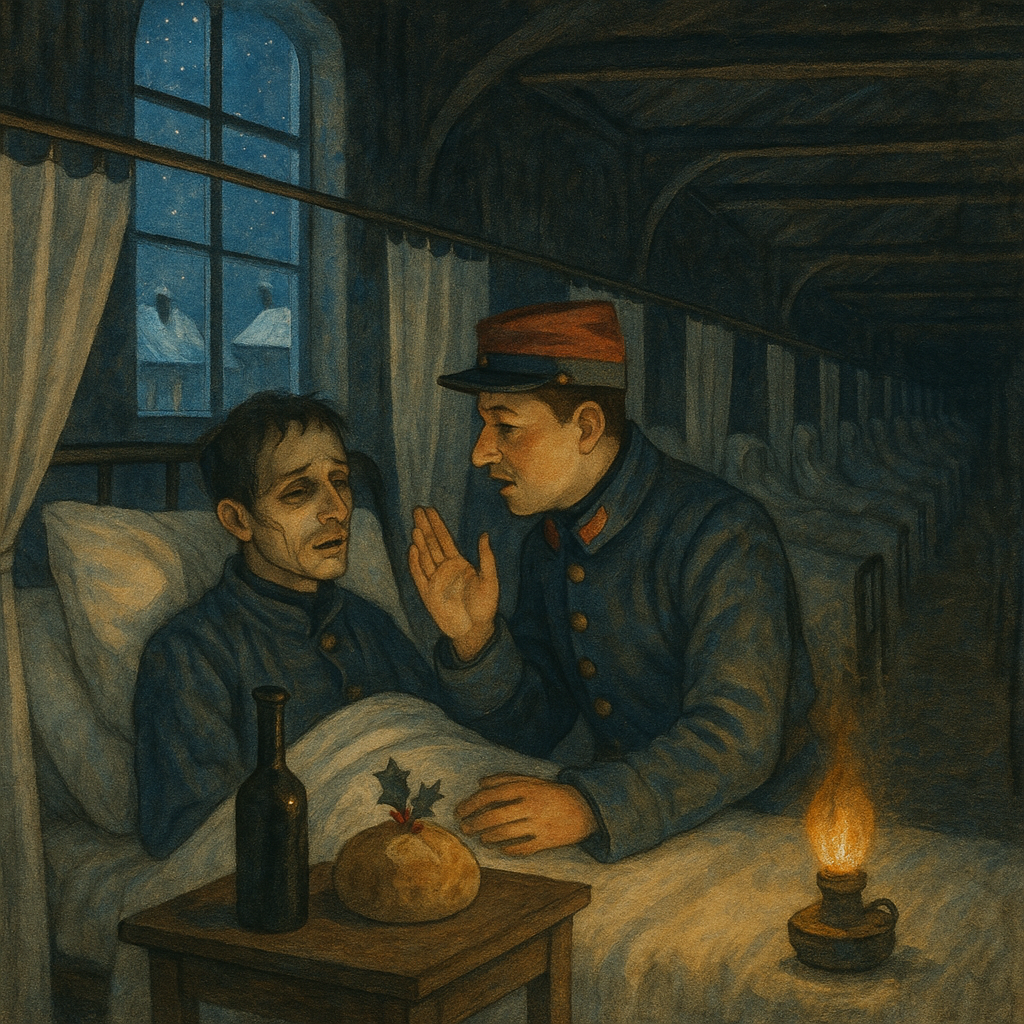
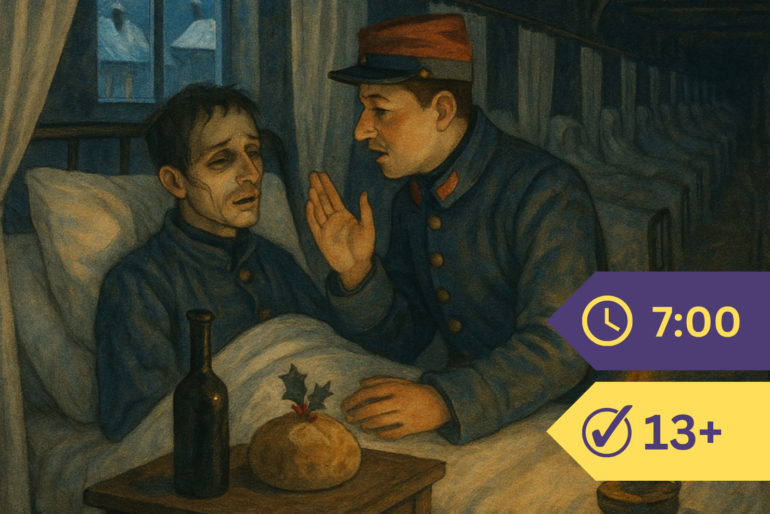
Very gently, on the little table beside his friend’s bed, Salvette has placed a bottle of Lunel wine and a round loaf — a proper Christmas loaf, with a sprig of holly planted upright in it. The sick man opens his eyes, darkly rimmed with fever. In the uncertain light of the night lamps, with moonlight bouncing white off the snowy rooftops and across the ceiling, this improvised Christmas seems to him like a dream.
“Come, comrade — wake up! It shall not be said that two Provençals let Christmas Eve pass without toasting it in a cup of claret.”
Salvette raises him with a mother’s tenderness. He fills the glasses, cuts the bread. They drink, and talk of Provence. Little by little Bernadou rouses, grows tender. The wine, the recalling of old days. With the childlike spirit that comes back to the sick in their weakness, he asks Salvette to sing a Christmas carol of Provence. His comrade asks nothing better.
“Which one do you want? ‘The Host’? ‘The Three Kings’? Or ‘Saint Joseph Said to Me’?”
“No. I love ‘The Shepherds’ best. The one we always sang at home.”
“‘The Shepherds’ it is.”
In a low voice, his head between the curtains, Salvette begins to hum. The carol tells of the shepherds who come to see the Christ child in his stable, who lay their offerings of fresh eggs and cheese in the manger, and are then dismissed in kindly fashion:
“Joseph leur dit: Allons! soyez bien sages,
Tournez-vous-en et faites bon voyage.
Bergers,
Prenez votre congé…”
(Joseph said to them: Come now, be good, / Turn yourselves round and have a safe journey. / Shepherds, / Take your leave…)
As he sings the last couplet, poor Bernadou slips and falls heavily upon his pillow.
His comrade, thinking he has fallen asleep, calls his name, shakes him. But Bernadou does not move. The little sprig of holly lying across the still coverlet seems already the green palm that is laid upon the pillow of the dead.
Salvette understands.
Then, all in tears, a little intoxicated with the feast and with so great a sorrow, he takes up again in full voice — in the silence of the ward — the joyous refrain of Provence:
“Shepherds,
Take your leave!”