At first the two yards were as much alike as the two houses, each house being the exact copy of the other. They were just two of those little red brick dwellings one is always seeing side by side in the outskirts of a city, and looking as if the occupants must be alike too. But these two families were quite different. Mr. Gilton, who lived in one, was a pretty cross sort of man, and was quite well-to-do, as cross people sometimes are. He and his wife lived alone, and they did not have much going out and coming in, either. Mrs. Gilton would have liked more of it, but she had given up thinking about it, for her husband had said so many times that it was women’s tomfoolery to want to have people — people who weren’t anything to you and to whom you were nothing — ringing your doorbell and bothering around in your dining-room. Which of course it was; and she would have believed it, if a woman ever did believe anything a man says a great many times.
In the other house there were five children, and, as Mr. Gilton said, they made too large a family and they ought to have gone somewhere else. Possibly they would have gone had it not been for the fence. When Mr. Gilton put it up and Mr. Bilton told him it was three inches too far onto his land, and Mr. Gilton said he could go to law about it — expressing the idea with some force — Mr. Bilton was foolish enough to take his advice. The decision went against him, and a good deal of his money went with it, for it was a long, teasing lawsuit, and instead of being three inches of made ground it might have been three degrees of the Arctic Circle for all the trouble there was in getting at it. So Mr. Bilton had to stay where he was.
It was then that the yards began to take on those little differences that soon grew very marked. Neither family would plant any vines, because they would certainly have beautified the other side too; and so the fence, in all its primitive boldness, stood out uncompromisingly, and the one or two little trees grew carefully on the farther side of each enclosure, so as not to be mixed up in the trouble at all. Mr. Gilton’s grass was cut smoothly by the man who made the fires, while Mr. Bilton only found a chance to cut his himself once in two weeks.
Then, by and by, Mr. Gilton bought a red garden bench and put it under the tree that was nearest to the fence. No one ever actually went out and sat on it, to be sure, but to the Bilton children it represented the visible flush of prosperity. Particularly was Cora Cordelia wont to peer through the fence and gaze upon that red bench, thinking it a charming place to play house, ignorant of the fact that much of the red paint would have come off on her back. Cora Cordelia was the youngest of the five. All the rest had very simple names — John, Walter, Fanny, and Susan — but when it came to Cora Cordelia, luxuries were getting very scarce in the Bilton family, and Mrs. Bilton felt she must make up for it by being lavish in one direction or another. She had wished to name the earlier girls Cora and Cordelia, but she had yielded to her husband, and called one after his mother and one after herself, and then gave both her favourite names to the youngest of all. Cora Cordelia was a pretty little girl, prettier even than both her names put together.
After the red bench came a mercury garden globe, placed in the middle of the yard to reflect all the glory of its owner, albeit in a somewhat distorted form. This marvel filled the Bilton children with admiration bordering on awe. Cora Cordelia spent hours gazing at it, until called in and reproved by her mother for admiring so much what she could not afford to have. After this, she only admired it covertly.
Small distinctions like these kept the disadvantages of neighbourhood ever present and ever sharp.
Then it was a constant annoyance to have their surnames so much alike. Matters were made more unpleasant by mistakes of the butcher and the grocer — Gilton, 79 Holmes Avenue, was so much like Bilton, 77 Holmes Avenue. Gilton changed his butcher every time his dinner was sent to Bilton’s; and though the mistakes were generally rectified, neither family ever forgot the time the Biltons positively ate the Gilton dinner, under a misapprehension. Mrs. Bilton apologised, and Mrs. Gilton boldly told her husband that she was glad they’d had it and hoped they’d enjoyed it — which only made matters worse. The only joy of the whole dark day was that fearful pleasure snatched by John, Walter, Susan, Fanny, and Cora Cordelia from the undoubted excellence of the roast.
Of course there was an assortment of minor difficulties. The smoke from the Biltons’ kitchen blew in through the windows of the Giltons’ sitting-room when the wind was in one direction, and when it was in the other, many of the clothes from the Giltons’ line blew into the Biltons’ yard, and Fanny, Susan, or Cora Cordelia had to be sent to pick them up and drop them over the fence again, which Mrs. Bilton said was very wearing, as of course it must have been. Things like this were always happening, but matters reached a climax when it came to the dog. It wasn’t a large dog, but it was a tiresome one. It got up early in the morning and barked. Now we all know that early rising is an honourable thing, but it is something that ought to be done quietly, out of regard for those who sleep; and a dog that barks continuously between five and seven in the morning certainly ought to be suppressed, even if it be necessary to use force. Everybody agreed with the Biltons about that — everybody except the Giltons themselves, who, by some freak of nature, didn’t mind it.
When one morning that dog remained quiet and restful, and was found cold and poisoned, and Mr. Gilton was loud in his accusations of the Bilton boys and their father, public opinion wavered for a moment. After that, no member of either family spoke to any member of the other. That was the way matters stood the day before Christmas.
It was snowing hard, and the afternoon grew dark rapidly, and the whirling flakes pursued a blinding career. In spite of that, everybody was out doing the last thing. Mrs. Gilton was not. Of course they would have a big dinner, but even that was all arranged for, although the turkey hadn’t come and her husband was going to stop and see about it on his way home. She shuddered as the possibility of its having gone to the Biltons occurred to her. But she didn’t believe it had — they no longer shared a butcher.
Meanwhile there was so little to do. It was too dark to read or sew, and she sat idly at the window looking out at the passers-by and the driving snow. Everybody else was in a hurry. She wished she too had occasion to dash out for a last purchase, or to light the lamp to finish a last bit of dainty sewing, as she used to do when she was a girl. She seemed to have so few friends now with whom she exchanged Christmas greetings. Was it only for children and youth, this Christmas cheer? Must she necessarily have left it behind her with her girlhood? No — she knew better than that. She felt that there was a deeper significance in Christmastide than children can grasp, and yet it had grown to be so painfully like other days — an occasion for a slightly bigger dinner, that was about all. With an unconscious sigh she looked across to the Bilton house. Plenty of people over there to make merry. Five stockings to hang up. She wished she might have sent something in. To be sure, there was the dog, but that was some time ago. Very likely the dog would have been dead now anyway. She felt herself that this logic was not quite sound, but she wished she could have sent some paper parcels just the same. So strong had this impulse been that she had said to her husband, somewhat timidly, that morning:
“There are a good many of those Bilton children to get presents for.”
“More fools they that get them presents, then,” he had pleasantly replied.
“I don’t suppose he has much to buy them with,” she continued.
“He had enough to buy poison for my dog,” exclaimed her husband, giving his newspaper an angry shake.
“I’d almost like to send them in some cheap little toys.”
“Well, as long as you don’t quite like to, it won’t do any harm,” he said with some heat, putting down his newspaper and looking at her in a manner not to be misunderstood. “But you see that the liking doesn’t get any further.”
“It’s Christmas, you know,” said his plucky wife.
“Oh, no, I don’t know it!” he replied gruffly. “I haven’t fallen over forty children a minute in the street with their ridiculous parcels, and I haven’t had women drop brown-paper bundles all over me when they crowd into the streetcar, and I haven’t found it impossible to get to the shirt-collar counter on account of Christmas novelties! Oh, no, I didn’t know it was Christmas!”
After that there was really not much to be said, for we all know Christmas is dreadfully annoying, and the last thing a man in this sort of temper wants to hear about is peace and good will.
Notwithstanding the fact that Mrs. Gilton envied her neighbours this dark afternoon, their Christmas cheer was not so abundant as it had been in more prosperous times. There was not very much money to be spent this year, and they were obliged to give up something. Mr. and Mrs. Bilton had decided that it should be the Christmas dinner; they would have a simple luncheon and let all the money that could be spared go for the stockings. Each child had its own small sum to invest for the others, and there was still a modest amount for the older members of the family. That it was a modest amount Mrs. Bilton felt strongly as she went from shop to shop. But when she reached home again she was somewhat encouraged; there was such an air of joyous expectation in the house, and her purchases looked larger now that they were away from the glittering counters. Then each of the five children came to her separately and confided in her the nothing less than wonderful results of judicious bargaining, which had enabled them to buy useful and beautiful presents for each of the others out of the sums entrusted to their care, ranging in amount from the two dollars of John to the fifty cents of Cora Cordelia.
She had reason to believe that even Cora Cordelia was making something for her, and though it was difficult to ignore the fact that it appeared to be a knitted washcloth, she had hitherto avoided absolute certainty on the subject. So altogether it was a pretty cheerful afternoon at the Biltons’.
Meanwhile, down in the main street of the city it was a confusing scene. It was darker there than where the streets were more open, and although there were several daring spirits who asserted that the street lamps were lighted, it was not generally believed. The snow was blowing down and up and across, getting more and more unmanageable underfoot every moment. It was cold and windy and blinding and crowded, and a good many other disconcerting things — all of which Mr. Gilton felt the full force of as he stood on the corner where he had just bought his turkey. It was a fine turkey and had been a good bargain, and though he had to carry it home himself, there was nothing humiliating in that. If it had been anybody else he would have been warmed with a glow of satisfaction, but Mr. Gilton was long past glows of satisfaction. It was years since he had permitted himself such things.
“Journal! Five cents!” screamed a newsboy suddenly in his ear.
“Get out!” replied Mr. Gilton, jumping nearly two feet from the shock of the attack. Even the newsboy, hardened to the short words of an unfriendly world, was impressed by the asperity of the suggestion and moved somewhat hastily on.
After this exchange of amenities Mr. Gilton stepped onto the horse-drawn streetcar. It was crowded, of course, as those small cars that run once in half an hour are apt to be, and he had to stand up, and the turkey legs stuck out of the brown paper in a very conspicuous way. The large-hearted public compensated for the car’s lack of comfort with an unusual amount of friendliness — particularly tonight, on account of the season. But nobody said anything to Mr. Gilton. Only when he jerked the bell-cord and stepped off, one stout man with his collar turned up to his ears said, without turning his head:
“I supposed of course he was going to give the turkey to the conductor.”
Everybody laughed in that end of the car except one small old lady in the corner, who was visiting from out of town and was left with the impression that the gentleman who had got off must be a very kind man.
It was darker and blowier and snowier than when he had left the corner, and Mr. Gilton floundered through the unbroken drifts up the little path to the door with increasing grudges in his heart against the difficulties of Christmas. The lock stuck, and he went in slamming the door after him. There was no light in the hall, and he murmured loudly against the inconvenience.
“Confound it,” he said, “why didn’t they light the gas? I’m not one of those confounded Biltons — I can afford to pay for what I use.” And without pausing to take off his hat and coat, he strode to the sitting-room door and flung it open.
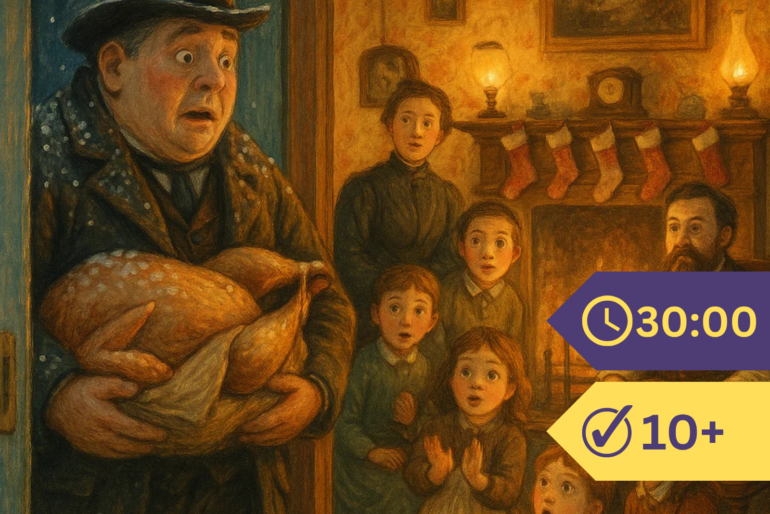
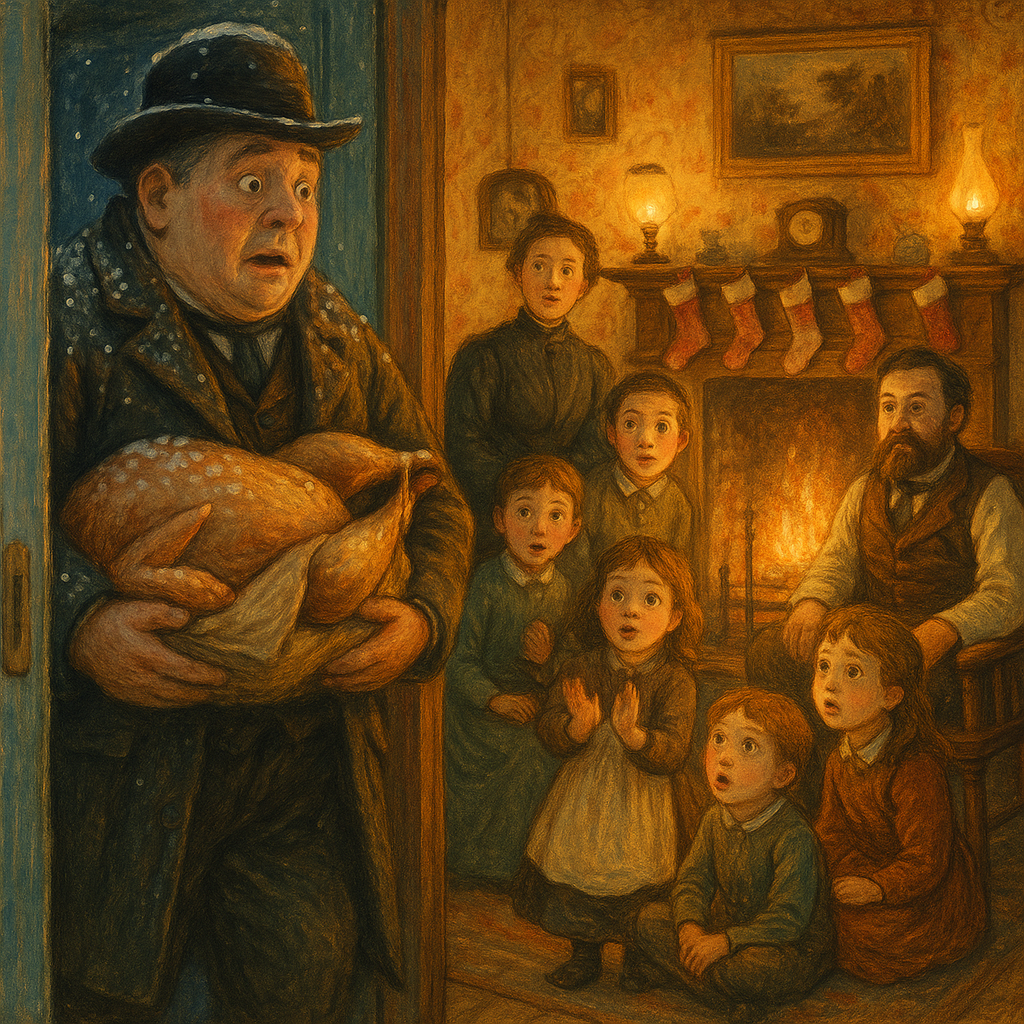
That was an awful moment. The sudden change from the cold and darkness almost blinded him. The sound of many voices, and then the hush of sudden consternation, was in his ears. There was a lamp and there was a fire, and there between them sat Mr. Bilton on one side and Mrs. Bilton on the other, and round about, in various unconventional attitudes, sat four Bilton children. And there in the very midst of them, in his heavy overcoat with snow melting on his hat, his beard, and his shoulders, stood Mr. Gilton. The unexpected scene, the amazed faces gazing into his, rendered him speechless; he wondered vaguely if he were losing his reason. Then, in a flash of enlightenment, he realised what had happened: thanks to the storm outside, he had come into the wrong house.
Naturally his first impulse was towards flight, but as his bewildered gaze slipped about the room it fell upon five stockings hung against the mantelpiece, and stayed there, fascinated. Five foolish, limp, expressionless stockings — it was long since he had seen such an unreasonable spectacle. Then he recollected himself and looked around him. Perhaps even then, if he had made a dash for the door, he might have escaped and matters been none the worse. But in that instant of hesitation, caused by the sudden sight of those five stockings, something dreadful occurred. It must be premised that Cora Cordelia did not know Mr. Gilton very well by sight, being in the first place small and not especially observant, and in the second, filled with an unreasoning fear that caused her to flee whenever she had seen him approach. This is the only excuse for what she did; for while her mother was murmuring faintly, as if in extenuation, “We thought it was John coming in” — Cora Cordelia clasped her hands in delirious delight and cried aloud, “It’s Santa Claus! Oh, it’s Santa Claus!”
Could anything more awful happen to a cross man — a very cross man — than to be taken for Santa Claus?
Mr. Gilton looked at Cora Cordelia and wondered why she had not been slaughtered in her cradle.
“And,” exclaimed Susan Bilton, with sudden communicative fervour, “he has come and brought us a turkey for tomorrow’s dinner!”
No one could appreciate the absurdity of the whole situation better than Mr. Gilton; and yet, strangely enough, together with his annoyance was mingled a touch of the strange feeling that had dawned upon him first when he saw the stockings. By this time — it was really a very short time — Mrs. Bilton had recovered herself and risen, and Mr. Bilton had risen too.
“Hush, children; it is not Santa Claus,” she said. “It is Mr. Gilton. We are glad to see you, Mr. Gilton.” And she held out her hand to him. “Won’t you sit down?” She felt that he had come in the Christmas spirit, and she was anxious to meet him halfway.
“Yes,” said her husband, coming forward and instantly taking his cue from his wife — for he was really a very nice man — “we are very glad.” To be sure, there was a certain stiffness in his manner, for a man cannot always change completely in a moment as a woman can; but Mr. Gilton was too perplexed to notice this. In the incomprehensible way that one’s mind has of clinging to unimportant things in great crises, he was wondering how in the world he was going to sit down with that ridiculous turkey, with its ridiculous legs, in his arms, and not look more absurd than he did now. In this moment of absent-mindedness he had mechanically taken Mrs. Bilton’s hand and shaken it, and after that, of course, there was nothing to do except to shake Mr. Bilton’s. Then he began to know it was all up.
He had not spoken yet, but now he made a frantic effort to save what might be left besides honour. “I came —” he began, “I came to your house —” There he paused, and that unlucky child, with that tendency to be possessed by one idea which is characteristic of small and lively minds, burst in with: “And did the reindeer bring you, and are they outside?”
He almost groaned. Reindeer! If those overworked, struggling carthorses could have heard that! Then Mrs. Bilton, pitying his evident confusion, came to his assistance.
“Don’t mind the children, Mr. Gilton,” she said, her cheeks flushing, and looking very pretty with the excitement of the unusual circumstances. “We are glad you came, however you made your way here. I think we may thank Christmas Eve for it. Now do take off your overcoat and sit down.”
That finished it, of course. He sat down.
In those few moments that strange feeling had grown marvellously stronger. It seemed to be made up of the most diverse elements — a mixture of green wreaths and his own childhood, and his mother, and a top he had not thought of for years, and the wide fireplace at home, and a stable with a child in it, and a picture in a book he used to read, of a great many angels in the sky, one particular one in the middle, and underneath it some words — what were the words? He’d forgotten they had anything to do with Christmas, anyway.
“But you did bring us the turkey, didn’t you?” said Cora Cordelia, helping matters along.
“Cora Cordelia, I’m ashamed of you,” said Mrs. Bilton.
“Yes,” said Mr. Gilton, the words wrung from his lips while beads stood on his forehead. “Yes, I brought you the turkey.”
“Did you really?” exclaimed Mrs. Bilton, who had thought so all along. “That was very kind of you.”
“Will you please take it — take it away?” he said, with that wish to have something over which we associate with the dentist. So Mrs. Bilton took the turkey and thanked him, and gave it to Fanny, who carried it out to the kitchen, and Mr. Gilton gave one last look at its legs as it went through the door, feeling that now he must wake up from this nightmare.
But things only went further and became more incredible and upsetting — only that, strangely enough, that feeling of horror began to wear off, and that singular strain of association with Christmas things grew stronger. He could hardly believe it was no worse, finding himself seated by the littered table, with Mrs. Bilton near and Mr. Bilton over by the fire, listening to first one and then the other, and occasionally letting fall a word himself, his conversational powers seeming to thaw out along with the snow on his greatcoat. These words themselves were a surprise to him. He was quite sure he had started them with a creditable gruffness, but the Christmas air mellowed them in a highly unsatisfactory fashion, so that they fell on his own ears quite otherwise than he had intended. Moreover the general tenor of the conversation was exceedingly perplexing. It was all about how fine it was of him to come this evening, and how they had often regretted the hard feeling, and how things always did get exaggerated. Of course he would not have believed a word of it, if he could have got any grip on the situation — but he couldn’t, and he just went on assenting to it all as if it were true.
There came a time when Mr. Bilton cleared his throat, hesitated a moment, and then said boldly:
“I think I ought to tell you, Mr. Gilton, that I had nothing whatever to do with the death of your dog.” Mr. Gilton felt the ground slipping away from under his very feet. That dog had been his stronghold. “I wouldn’t have poisoned him,” went on Mr. Bilton, “for a hundred dollars. But,” he added, with a queer little smile, “I wasn’t going to tell you so, you know.”
“Of course you weren’t,” exclaimed Mr. Gilton, hurriedly.
“We wouldn’t any of us,” asserted Walter.
“No,” said Susan, Fanny, and Cora Cordelia.
Then it came out that the whole family had rather liked the dog. It was here that John did actually come in, his entrance sounding very much as Mr. Gilton’s had. He nearly fell over when he saw the visitor, but he had time to pull himself together, for Cora Cordelia had snatched that moment for showing Mr. Gilton her gifts for the family, and he was bound hand and foot with helplessness. Then they all came and showed him their gifts. While he examined them, Mr. and Mrs. Bilton carefully averted their eyes and gazed hard at the opposite wall, while Cora Cordelia urged him, in stage whispers, not to let them suspect.
It was pitiable, the state to which he was reduced. Resisting this Christmas enthusiasm was out of the question. To be sure, it came over him once with startling force — as she showed him a toy water-wheel, meant to be turned by sand, which she had purchased for her father at a phenomenally low price because the wheel could not be made to go — that Cora Cordelia was the very child he had stumbled over as she came hurrying out of a toy-shop with a queerly shaped bundle the day before, thus further embittering him against Christmas. Susan had purchased a cup-and-ball for her mother, and as she went out of the room for a moment, insisted upon Mr. Gilton trying it and seeing what fun it was. If Mr. Gilton lives to be a hundred he will never forget the mingled feelings with which he awkwardly tried to get that senseless ball into that idiotic cup.
At last he stood up to go — it was after six o’clock — and they went with him to the door, and wished him a Merry Christmas, and sent a Merry Christmas to Mrs. Gilton, and said good-night several times, and he stumbled on through the snow, this time towards his own door.
It had stopped snowing as suddenly and quietly as it had begun, and the stars had come out. He gazed up at them — something he very rarely did. They seemed a part of Christmas. Just before he turned in at his own gate, he looked back at the Bilton house and shook his fist at it — but the expression on his face was such that the very same newsboy who had accosted him earlier in the evening failed utterly to recognise him and was emboldened to offer him a paper. The boy too was pushing his way home, somewhat dispiritedly, with two papers left.
“I’ll take them both,” said this singular customer. “Here’s a quarter — never mind the change. It’s Christmas Eve, I believe.” And this when he knew perfectly well that a copy of that very same paper was waiting for him on his table. The boy looked at his quarter and looked again at his customer, recognised him with astonishment, made up his mind to buy a couple of hot sausages on the corner, and went on his way feeling that there was a new heaven and a new earth.
Mrs. Gilton was standing at the parlour window, peering out anxiously, as her husband came up the path. She was in the hall as he entered.
“Why, Reuben,” she said, “I was afraid something had happened.”
Goodness gracious! As if something hadn’t happened! He turned away to hang up his overcoat and tried to speak crossly.
“Well,” he said, “I’ve lost my turkey. That’s happened.”
“Never mind,” said Mrs. Gilton quickly. “The other one came later — the first one, you know — so the Biltons didn’t get it this time.”
“They got the second one, though,” said Reuben, hanging up his hat.
“Oh dear, did they!” said Mrs. Gilton. Then she went on: “Well, I don’t care if they did, so there! I daresay they need it for their Christmas dinner.”
“No, they don’t,” said Reuben, turning around and facing her, “because they are going to eat part of ours. They are coming in tomorrow to have dinner with us — every one of them!” he asserted more loudly, on account of the expression on his wife’s face. “Bilton, and his wife, and all the five children, down to Cora Cordelia! So we’ll have to have something for them to eat.”
If Mr. Gilton will never forget the cup-and-ball, Mrs. Gilton will never forget that moment. She went over in her mind whether she could manage him herself tonight, or whether to send Bridget right away for the doctor — and possibly a policeman too — and whether he could be kept for the future in a private house or would have to be confined in an asylum. She was inclining towards the asylum when he, who was going into the sitting-room before her, turned round and laughed an odd little laugh. She began to think then that a private house would do.
The next day they all dined together, which proved that it was not all a Christmas Eve illusion. There is a report in the neighbourhood that the fence between the houses is to be taken down to make room for a tennis court for the Bilton children, but of course this may not be true. It would have to be done in the summer, and if the effect of Christmas could be depended upon to last into the summer, this would be a very different sort of world.