He was born blind, and had been taught the one thing the blind are generally taught — music. For this art he was specially gifted.
His mother died when he was little more than a child. His father, who was first cornetist in a military band, followed her to the grave a few years later. He had a brother in America from whom he had never heard; still, through roundabout channels he knew him to be well-off, married, and the father of two fine children.
To the day of his death the old musician, indignant at his son’s ingratitude, would not allow the name to be spoken in his presence. But the blind boy’s love for his brother never wavered. He could not forget that this elder brother had been the support of his childhood, the defender of his weakness against the other boys, the one who had always spoken to him with kindness. The memory of Santiago’s voice as he burst into his room each morning — “Hey there, Juanito! Get up, man; don’t sleep so!” — rang in the blind boy’s ears with sweeter music than any piano or violin could produce. Could such a warm heart have grown cold? Juan could not believe it. He made excuses. Perhaps the mail was at fault. Perhaps his brother didn’t want to write until he could send a great deal of money. Perhaps he meant to surprise them one fine day, arriving laden with gold at the door of their modest apartment. He never dared share these fancies with his father; but when the old man, working himself into a fury, bitterly denounced the absent one, Juan would find the courage to say quietly: “You must not despair, Father. Santiago is good. My heart tells me we will hear from him one of these days.”
The father died, however, without hearing a word — a priest at one side, the blind boy clinging convulsively to his hand at the other, as though he might detain him in this world by sheer force. When the old man’s body was carried out, Juan seemed to lose his reason. He struggled with the undertaker’s men in a frenzy of grief. Then he was left alone.
What loneliness was his. No father, no mother, no relatives, no friends — and deprived even of sunlight, the friend of all created things. He paced his room for two days like a caged wolf without touching food. The housemaid, with the help of a compassionate neighbor, eventually coaxed him back from this slow self-destruction. He was persuaded to eat. He spent the rest of his days praying and working at his music.
Shortly before his death, Juan’s father had secured him a position as church organist in one of the parishes of Madrid, at seventy cents a day. This was barely enough to run even the most modest household; so within a fortnight Juan sold everything that furnished his little home, dismissed his servant, and took a room in a boarding house for forty cents a day, spending the remaining thirty on everything else. He lived this way for months, leaving his room only for church and returning directly afterward. His grief weighed on him so heavily he rarely spoke. The long hours of the day he spent composing a grand Requiem Mass for his father’s soul, intending to beg the charity of the parish for its performance. He poured every energy of body and spirit into the work.
A ministerial crisis overtook him before it was half finished. I no longer remember which faction came to power — the Radicals, the Conservatives, the Constitutionals — but there was a great change. The news reached Juan late, and to his cost. The new cabinet soon determined that a church organist of Juan’s tendencies was a dangerous citizen. From his perch in the choir loft, at vespers and high Mass, with the full swell of the organ’s pipes, he was apparently expressing opposition of a truly scandalous kind. The new ministers, unwilling — as one of their spokesmen declared in Congress — “to tolerate any form of imposition,” promptly retired Juan from his post and found a more musically reliable substitute: a man, in short, who could be trusted to keep his chords loyal to the institutions.
When officially informed of this, Juan felt nothing beyond surprise. In the depths of his heart he was almost glad: he would have more time for his Mass. The situation revealed itself only when his landlady arrived at the end of the month for money. He had none to give her, naturally, his salary having been withdrawn. He pawned his father’s watch, and resumed his work with perfect serenity, without a thought for the future. The landlady returned at the end of the next month, and he pawned a jewel from the slender paternal legacy — a small diamond ring. Within a few months there was nothing left to pawn. The landlady, moved by something she called generosity, kept him two or three days past his time before turning him out, congratulating herself that she had not claimed his trunk and clothes for the few cents he still owed her.
He found another lodging but could not afford to rent a piano — a bitter blow, for clearly he could not finish his Mass. A shopkeeper he knew owned a piano and permitted him to use it, but Juan soon noticed his visits had become unwelcome, and he stopped going. Not long after, he was turned out of his new lodgings too, and this time they kept his trunk.
Then came the time of misery. Of that particular misery it is hard to form a true idea. Life holds few joys for those who are homeless and poor; but if they are blind and utterly alone, they have surely reached the limit of human suffering. Juan was passed from lodging to lodging, lying in bed while his only shirt was being washed, wandering the streets of Madrid in shoes with holes in them, his trousers worn to fringe at the ankles, his hair long, his beard unshaved. A compassionate fellow-lodger found him a position playing in a café, but he was soon let go — the regulars had no use for his music. He never played popular dances, never a fandango, not even an occasional polka. His fingers drifted over the keys in dreamy ecstasies of Beethoven and Chopin, and the patrons found it difficult to keep time with their spoons.
So out he went again through the byways of the capital. Every now and then some charitable soul stumbled across his misery and helped him quietly, for Juan shuddered at the thought of outright begging. He ate at whatever tavern he could find in the poorest quarter of Madrid — just enough to keep from starving — and for two cents he was allowed to sleep in a filthy den among beggars and petty criminals. Once they stole his trousers while he slept and left him a cotton pair in their place. This was November.
Juan had always clung to the hope of his brother’s return, and now, in the depths of his misery, he nursed it with redoubled faith. He had a letter written and sent to Havana. As he had no address for his brother, the letter bore none. He made every inquiry he could think of, to no effect. He spent long hours on his knees, praying that heaven might send Santiago to his rescue.
His only happy moments were spent in prayer, kneeling in the shadow of a pillar in some quiet corner of a church, breathing the sharp smell of dampness and melting wax, listening to the sputter of candles and the faint murmur of the faithful in the nave. His innocent soul rose above the cruelties of his life and found peace with God and the Holy Mother. From childhood he had been devoted to the Virgin. Having never known his own mother, he turned instinctively to the Mother of God for that tender, sheltering love that only a woman can give a child. He had composed several hymns in her honor, and he never fell asleep without pressing his lips to the small image of Our Lady of Carmen that he wore at his neck.
But at last even heaven seemed to forsake him. Driven from his last shelter, without food, without a coat against the cold, he understood with terror that the hour had come to beg. A great war took place in his soul. Shame and suffering made a desperate stand against necessity. The profound darkness that surrounded him deepened the anguish of the struggle. Hunger won.
He prayed for strength, sobbing, and surrendered. Still wishing to disguise his humiliation, he decided to sing in the streets — at night only. His voice was fine, and he understood music thoroughly. He had no instrument; but he found another unfortunate, perhaps marginally less wretched than himself, who lent him an old broken guitar. He mended it as best he could, and on a frosty December night, his voice raw with grief, he stepped into the street.
His heart beat violently. His knees trembled. When he tried to sing in one of the central thoroughfares, no sound would come. Shame and suffering had tied a knot in his throat. He groped along until he found a wall to lean against, stood there until he was calmer, then began the tenor’s aria from the first act of La Favorita. A blind singer who sang neither ballads nor popular songs drew curiosity, and in a few minutes a crowd had gathered. There was a murmur of surprise and admiration at the art with which he navigated the composition’s difficulties, and many a copper was dropped into the hat that swung from his arm.
But too many had stopped to listen, and the authorities grew uneasy. It is a well-established fact with the police force that people who congregate to hear a blind man sing are always prompted by motives of sedition — it signals hostility to the institutions; in short, an attitude wholly incompatible with the peace of society and the security of the State. A policeman accordingly seized Juan firmly by the arm.
“Here, here! Go straight home now, and don’t let me catch you stopping at any more street corners.”
“I’m doing no harm!”
“You are blocking the thoroughfare. Move on, move on, if you don’t want to spend the night in a cell.”
It is truly encouraging to see how carefully our authorities clear the streets of blind singers; and I believe, in spite of all that has been said to the contrary, that if they could keep them equally clear of thieves and murderers, they would do so with equal pleasure. Juan returned to his den with a heavy heart. He was by nature timid and shrinking, and the thought of having disturbed the peace — of having required the intervention of the executive power — distressed him more than the hunger. He had earned twenty-seven cents. With it he bought food for the next day and paid for the little heap of straw on which he slept.
He went out again the following night. Again the crowds gathered, and again a policeman ordered him to move on. But how was he to move on and still earn anything? He could hardly expect people to follow him down the street. Juan moved on nonetheless — on and on — because he was timid, and the mere thought of breaking a law, of disturbing even for a moment the peace of his native city, was worse to him than starvation.
His earnings dwindled. The requirement to keep moving, combined with the fact that he was no longer a novelty, deprived him each night of a few more coppers. What he brought home could barely keep him alive.
The poor boy saw only one point of light on his horizon: Santiago’s return. Every night as he left his den with the guitar over his shoulder he thought: If Santiago should be in Madrid and hear me sing, he would know me by my voice. This hope — this dream — was the one thing that gave him the strength to go on.
But there came a day when his anguish knew no limit. The night before, he had earned only six coppers. It had been so cold.
It was Christmas Eve.
When morning broke on the world, it found Madrid wrapped in six inches of snow. It snowed steadily all day, which was a matter of little consequence to most people and was even a cause for considerable rejoicing among aesthetes. The poets in particular — those enjoying what is called easy circumstances — spent most of the day watching the flakes through the plate glass of their warm study windows, composing those graceful and ingenious similes that make theatre audiences cry “Bravo!” and readers exclaim, “What a talent that young man has!”
Juan’s breakfast had been a stale crust and a cup of watered coffee. He could not relieve his hunger by contemplating the beauty of the snow — first, because he was blind, and second, because even if he had not been blind, the filthy, patched panes of his den would have given him little view of it. He spent the day huddled in a corner on his straw mattress, drifting through memories of childhood, caressing the old dream of his brother’s return.
At nightfall he grew faint. But necessity drove him into the streets.
His guitar was gone. He had sold it for sixty cents on an earlier day of the same desperation. The snow fell with the same persistence. His legs trembled as they had on his first night of singing — but now from hunger rather than shame. He groped his way through the streets as best he could, with great clumps of mud and slush above his ankles. The silence around him told him the streets were nearly empty. Carriages moved past without a sound. Once he nearly walked in front of one.
In one of the central thoroughfares he began to sing the first thing that came to him. His voice was weak and hoarse. Nobody stopped.
“Let us try another street,” he thought.
He made his way down the Avenue of San Jerónimo, walking awkwardly through the snow, a white coating settling on his shoulders, cold water squeezing from his shoes with every step. The cold had penetrated into his bones. Hunger had become a sharp, physical pain. For a moment the cold and the pain brought on such faintness that he thought he was about to die, and he lifted his heart to the Virgin of Carmen and cried out in his anguish: “Mother, have pity!”
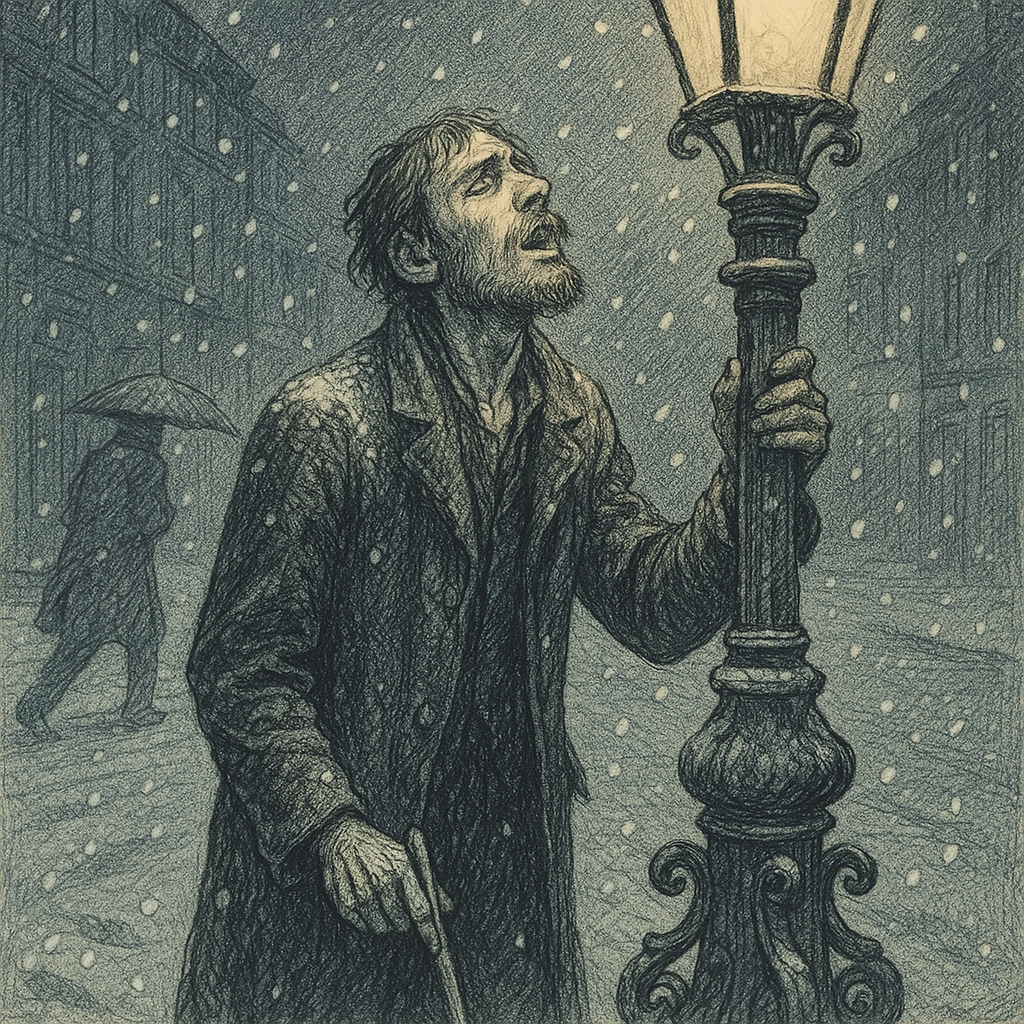
After saying those words he felt calmer, and dragged himself to the Plaza de las Cortes. He grasped a lamp-post for support and, under the impression of the Virgin’s protection, sang Gounod’s Ave Maria.
Still nobody stopped.
The people of Madrid were at the theatre, at the cafés, or at home, dandling their children on their knees in the warmth of the hearth — in the warmth of their love. The snow continued to fall steadily, copiously, with the apparent intention of providing material for the local column of the morning papers, where it would be described in a thousand delicate phrases. The occasional passers-by hurried past muffled to the ears, umbrellas low. The lamp-posts had put on their white nightcaps, from beneath which escaped thin rays of dismal light. Silence was broken only by the distant rumble of carriages and the light fall of snowflakes that rustled faintly, like the continuous whisper of silk.
Juan’s voice alone vibrated in the stillness, imploring the mother of the unprotected; and his song was less a hymn than a cry of anguish — a moan of sadness and resignation that fell cold and dreary, like snow upon the heart.
His cry was in vain. In vain he repeated the sweet name of Mary, fitting it to every melody he knew. Heaven seemed far away and unable to hear him. The neighbors of the square were near at hand but did not choose to listen. No one came down to bring him inside. No window opened to drop him a copper. The passers-by, pursued as it were by the swift footsteps of pneumonia, could not dare to stop.
At last Juan’s voice died in his throat. He could sing no more. His legs trembled under him; his hands lost their feeling. He took a few steps and then sank onto the pavement at the foot of the iron railing surrounding the square. He sat with his elbows on his knees and buried his face in his hands.
He felt vaguely that this was the last moment of his life, and he prayed again, imploring the divine mercy.
After a few minutes he became aware of a hand shaking his arm, and knew there was a man standing before him. He raised his head, assuming it was the familiar story about moving on.
“Are you an officer?” he asked timidly.
“No. I’m no officer. What’s the matter with you? Get up.”
“I don’t think I can, sir.”
“Are you very cold?”
“Yes, sir. But it isn’t only that — I haven’t had anything to eat today.”
“I’ll help you, then. Come — up with you.”
The man took him by both arms and lifted him to his feet. He seemed very strong.
“Now lean on me, and let’s find a cab.”
“But where are you taking me?”
“Nowhere you wouldn’t want to go. Are you afraid?”
“No. I feel in my heart that you will help me.”
“Come along, then. Let’s get something hot into you quickly.”
“God will reward you, sir. The Virgin will reward you. I thought I was going to die there against that railing.”
“Don’t talk of dying, man. Right now the question is finding a cab. If we can only move fast enough — what’s the matter? Are you stumbling?”
“Yes, sir. I think I struck a lamp-post. You see — as I am blind—”
“Are you blind?” the stranger asked, and his voice had changed.
“Yes, sir.”
“Since when?”
“I was born blind.”
Juan felt his companion’s arm tremble against his own. They walked on in silence. Suddenly the man stopped and asked in a voice husky with feeling:
“What is your name?”
“Juan.”
“Juan what?”
“Juan Martínez.”
“And your father was Manuel Martínez — musician of the third artillery band?”
“Yes, sir.”
The blind boy felt two powerful arms seize him and press him close, and heard a trembling voice cry:
“My God — how horrible, and how happy! I am a criminal, Juan. I am your brother Santiago!”
And the two brothers stood sobbing in the middle of the street. The snow fell lightly on them both.
Then Santiago tore himself away and began to shout, breaking off every few words:
“A cab! A cab! Isn’t there a cab anywhere? Curse my luck — come, Juanillo, try — make an effort, my boy, we’re not so far. Where in heaven’s name are all the cabs? Not one has passed. Ah — there — no, the beast is going the wrong way. Here’s another. This one is mine. Hello, driver! Five dollars if you take us flying to Number 13 Castellana!”
And lifting his brother in his arms as though he were a child, he put him in the cab and jumped in after him.
As they glided swiftly and noiselessly over the snow, Santiago — his arms still around Juan — explained something of his life. He had been in Costa Rica, not Havana, and had built a modest fortune. For years he had been deep in the countryside, beyond the reach of any mail service, cut off from Europe. He had written several letters to their father and managed to get them onto English trading ships, but had never received a reply. Planning to return to Spain soon, he had put off making further inquiries. He had now been in Madrid four months. The parish records told him his father was dead; but what he could learn of Juan was vague and contradictory. Some thought he had died. Others said he could be found wandering the streets with a guitar. Every search had come to nothing — until, fortunately, Providence had thrown them together.
Santiago laughed and wept by turns, showing himself to be the same warm, impulsive, joyful soul Juan had adored in childhood.
The cab stopped. A servant opened the door, and Juan was carried inside. When the door closed behind him, he breathed an air of warmth and comfort — that particular softness that seems to breathe from a wealthy house. His feet sank into carpet. Two servants took his dripping clothes and brought him clean linen and a warm dressing gown. Before a crackling wood fire he was given a bowl of hot broth, then something more substantial, administered slowly and with care. Then a bottle of old wine came up from the cellar.
Santiago was too restless to sit. He moved about, gave orders, interrupted himself every minute to ask:
“How do you feel now, Juan? Warm enough? Perhaps you don’t care for the wine?”
When the meal was over, the two brothers sat quietly together before the fire. Santiago asked a servant whether the señora and the children had gone to bed. Learning that they had, he turned to Juan with a gleam in his eye.
“Can you play the piano?”
“Yes.”
“Come into the parlor, then. Let’s give them a surprise.”
He led Juan into the adjoining room, sat him at the piano, raised the lid for the fullest resonance, threw open the doors, and went through all the elaborate pantomime of a man preparing a grand surprise — tiptoeing, whispering, speaking in falsetto — so much absurd theater that Juan found himself laughing, recognizing how little his brother had changed.
“Now, Juanillo — play something loud. Something startling. With everything you’ve got.”
Juan struck up a military march. A tremor ran through the silent house, like a music box winding to life. The notes poured out, rushing, jostling one another, yet never losing their triumphant rhythm.
“Louder, Juanillo! Louder!”
And the blind boy struck with all his spirit and might.
“I can see my wife peeping from behind the curtains. Keep playing, Juanillo. She’s in her nightgown — ha! I’m pretending not to see her. She must think I’ve gone mad. Keep going!”
Juan obeyed, though he thought the joke had gone on long enough. He wanted to know his sister-in-law, to embrace his nephews.
“Now I can see Manolita — hello! Paquito is up too! Didn’t I say we’d surprise them? But they’ll catch cold. Stop a moment, Juanito!”
And the jubilant clamor was silenced.
“Come, Adela — Manolita — Paquito — put something on and come see your uncle Juan. This is Juanillo, the one I’ve talked about so often. I found him in the street tonight, nearly frozen to death. Come, all of you, quickly.”
The whole family hurried in and wrapped their arms around the blind boy. His sister-in-law’s voice was soft and musical. To Juan it sounded like the voice of the Virgin. He sensed that she was weeping quietly at the thought of all he had suffered. She called for a foot-warmer to be brought. She wrapped his legs in a blanket and placed a soft cushion behind his head. The children gathered around his chair, touching his hands, as they all listened with tears to the account of his years of misery.
Santiago pressed his hands to his own forehead. The children stroked Juan’s hands and said:
“You’ll never be hungry again, will you, uncle? Or go out without a coat and an umbrella? I don’t want you to. Neither does Manolita. Nor Mama. Nor Papa.”
“I’ll wager you won’t give him your bed, Paquito,” said Santiago, hiding tears behind a show of teasing.
“My bed’s too small for him, Papa! But he can have the guest room. It’s a great bed, uncle — a big, big bed!”
“I don’t think I want to go to bed just yet,” said Juan. “Not just now. I am so comfortable here.”
“That pain is gone now, isn’t it, uncle?” whispered Manolita, kissing and stroking his hand.
“Yes, dear — God bless you. Nothing hurts now. I am happy. Very happy. Only I feel so sleepy. So sleepy I can hardly keep my eyes open.”
“Never mind us. Sleep if you need to,” said Santiago.
“Yes, uncle, sleep,” repeated the children.
And Juan fell asleep — but he woke in another world.
The next morning, at dawn, two policemen stumbled across a corpse in the snow. The doctor from the charity hospital pronounced it a case of death from exposure.
As one of the officers turned him over, face upward —
“Look, Jiménez,” he said. “He seems to be laughing.”