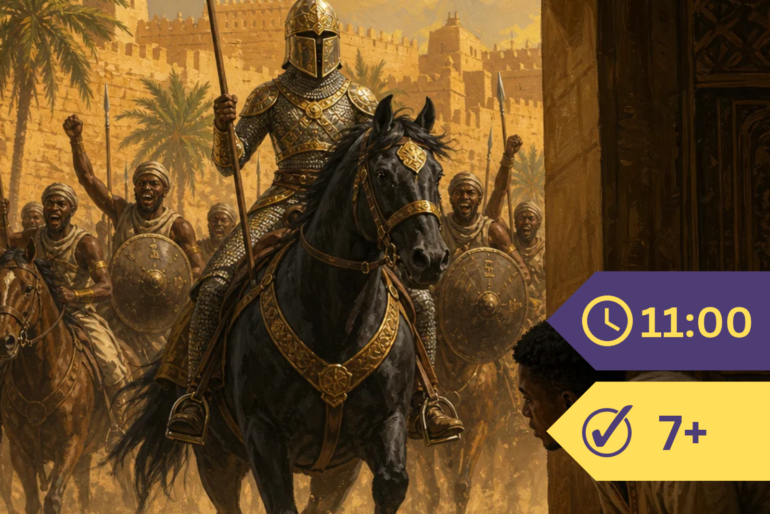
In a great country far to the south, where the Nile flows, there lived a king who had one son, Samba.
From the time Samba could walk, he was afraid of everything, and the older he got, the worse it became. At first his father’s friends laughed it off. “It’s odd to see a boy of our people dive into a hut when an elephant trumpets, and tremble when a lion cub half his size wanders by,” they said. “But he’s only a baby. He’ll be as brave as the rest when he’s older.”
“Yes, he’s only a baby,” the king said, overhearing. “It will be all right soon.” But he sighed as he said it, and the men looked at him and said nothing.
The years passed. Samba grew into a tall, strong young man, good-natured and pleasant, and everybody liked him. If he was rarely seen in any dangerous place on the king’s hunting trips, nobody said much, because he was too popular. “Once the king names him his heir at the great feast, he’ll stop being a child,” people murmured, as they had before. On the day of the ceremony their hearts were light. “It’s Samba, whose chin rises above other men’s heads, who will protect us from the raiders!” they cried.
A few weeks later, the villagers woke to find their herds had been driven off in the night, and their herdsmen had been taken captive. This was Samba’s moment to show his new courage and ride at the head of the warriors. But Samba was nowhere to be found, and the avengers rode out without him.
He returned many days later, head held high, with a story about tracking a lion to its den and killing it at the risk of his life. If he had told it earlier, people would have believed it. Now it was too late.
“Samba the Coward!” a voice shouted from the crowd. The name stuck. Even the children shouted it, and his father did not defend him. At last he couldn’t bear it. He decided to leave for some faraway land that had been at peace as long as anyone could remember. Early next morning he crept to the king’s stables, chose the quietest horse, and rode north.
He never forgot the terrors of that journey. He barely slept for fear of beasts behind every rock and bush, and by day a distant lion’s roar made him jump so hard he nearly fell off. A dozen times he almost turned back, and it wasn’t the mocking laughter at home that stopped him, but the fear of being dragged into their wars. So he kept going, and was deeply thankful when the walls of a city, bigger than any he’d imagined, rose up before him.
He drew himself up tall and rode proudly through the gate and past the palace. The princess was sitting on the terrace roof, as she often did, watching the street. “What a fine figure,” she thought, as Samba steered his big black horse skilfully through the crowd. She sent a servant to ask who he was.
“He’s the son of a king, and the heir to a country by the Great River,” the servant reported. The princess went straight to her father and said that if she couldn’t marry the stranger, she would never marry anyone.
Like many fathers, the king could refuse her nothing. She had already turned down so many suitors that he was worried no one would ever be good enough. After a talk with Samba, whose cheerful, easy manner charmed him, he agreed. Three days later the wedding was celebrated in splendour.
The princess was proud of her tall, handsome husband. For a while she was happy to spend her days with him under the palm trees, listening to his stories and the customs of his homeland. But after a time that wasn’t enough. She wanted other people to be proud of him too, and one day she said, “I almost wish raiders from the north would try to steal our herds. I would love to see you ride out at the head of our men and chase them home. How happy I’d be to hear the city ring with your deeds!”
She looked at him lovingly as she spoke, but to her surprise his face darkened.
“Never speak to me about raiders or war again,” he said sharply. “I left my own land to get away from them. At the first word of an attack, I’d leave you forever.”
“How funny you are!” she laughed. “Someone your size, scared of raiders! But you mustn’t say such things to anybody but me, or they might think you mean it.”
Not long afterwards, while the city was having a feast outside the walls, a band of raiders who had been hiding for days drove off all the sheep and goats grazing on a hillside. When the loss was discovered, hours later, the king ordered the war drum to be beaten. The warriors gathered in the great square, shaking with anger, and there were loud cries for revenge and for Samba, the king’s son-in-law, to lead them. But however loudly they shouted, Samba did not come.
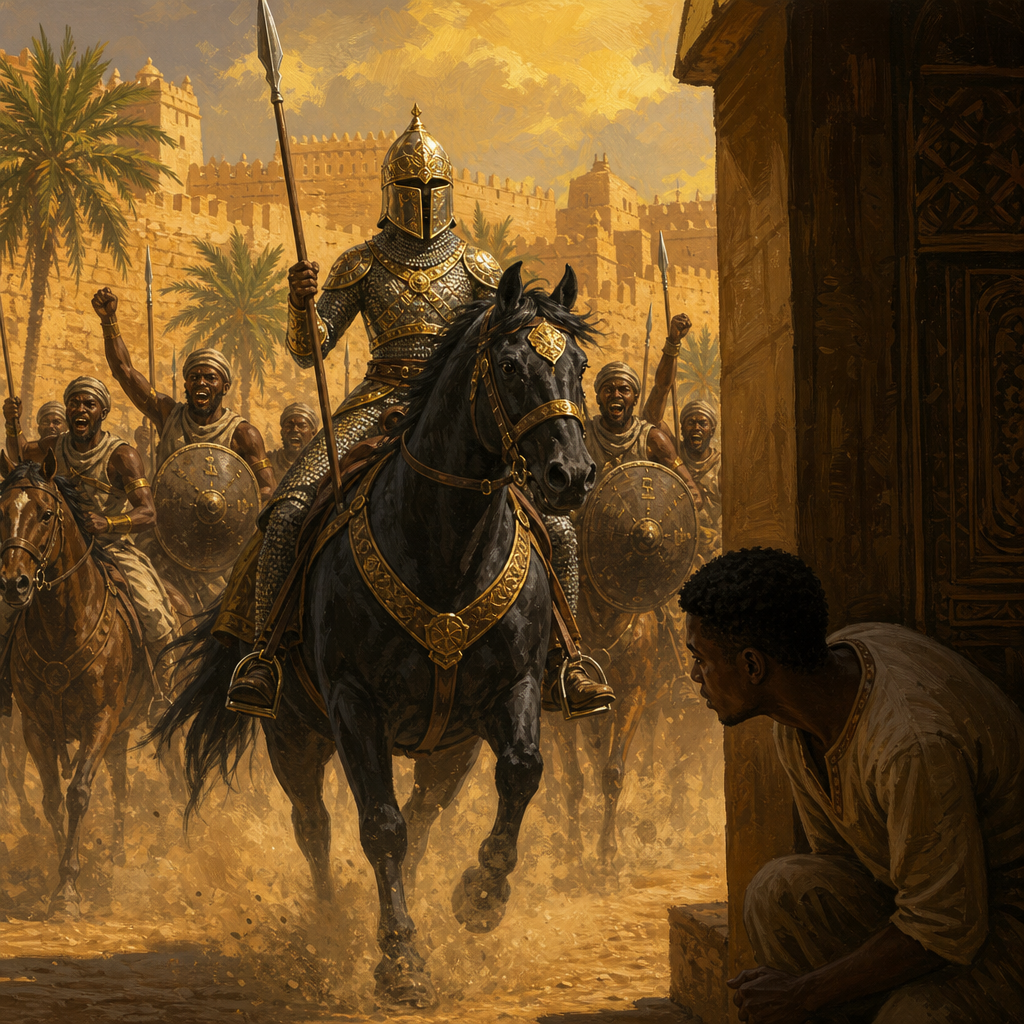
Where was he? In a cool, dark cellar of the palace, crouching between big clay jars of grain. His wife found him there and tried with all her strength to make him ashamed, but nothing worked. Even the thought of what his shame would cost him later was nothing compared with the danger in front of him.
“Take off your coat of mail,” she said at last, in a voice so stern that no one would have known it was hers. “Give it to me, and your helmet, your sword and your spear.” Samba, glancing fearfully left and right, took off the gold-inlaid armour, piece by piece. His wife put it on with steady hands, never looking at him as he slunk back to his corner. When she’d fastened the last buckle and lowered the visor, she went out, mounted Samba’s horse and gave the signal to follow.
The princess was shorter than her husband, but she was tall for a woman, and the horse was bigger than the others. When the men saw the gold-inlaid armour, they didn’t doubt for a moment that Samba had taken his place, and cheered loudly. She bowed, kept her visor down, spurred her horse and galloped at the head of the troop. The raiders hadn’t expected anyone to come so quickly, and were scattered almost before they could form a line. The little band of horsemen returned to the city, singing Samba’s praises.
The moment they reached the palace, the princess flung her reins to a groom and slipped up a side stair to her own rooms. There was Samba, lying on a pile of mats, who looked up uneasily, unsure how she would treat him. He needn’t have worried. She unfastened the armour as fast as she could and told him to put it on at once. Samba obeyed without a word. Then she led him out onto the flat roof, where a crowd below was cheering.
“Samba, the king’s son-in-law! Samba, bravest of the brave! Where is he? Let him show himself!”
When Samba appeared, the shouting grew louder. “Look how modest he is! He leaves the glory to others!” Samba only smiled and waved.
Out of all that crowd, one person was not cheering. It was the princess’s youngest brother, a sharp-eyed boy, who had noticed things during the fight that reminded him of his sister, not her husband. He told the other princes, in secret, what he suspected, and they laughed and told him to take his dreams somewhere else.
“We’ll see who’s right,” said the boy. “Next time we fight, I’ll put a mark on our commander.”
Despite their defeat, a few days later the raiders sent a new party to steal cattle. The princess dressed in her husband’s armour again and rode out at the head of the column. This time the fight was fiercer, and in the thick of it her youngest brother came near and scratched his sister’s leg. She hardly noticed at the moment, but when the raiders were beaten and she came back, she grew faint and could barely climb the stairs to her room.
“I’m hurt,” she told Samba, sinking onto the mats. “It’s nothing, don’t worry. You only have to give yourself a little scratch in the same spot, and nobody will guess it was me fighting, not you.”
“What?” Samba’s eyes bulged. “You think I’d agree to something so painful and pointless? I might as well have fought myself!”
“I should have known better,” said the princess in a faraway voice. As soon as Samba turned his back, quick as thought, she pricked his bare leg with a spear tip.
He yelped and staggered, more from shock than pain. But before he could speak, she was gone, looking for the palace healer. “My husband is wounded,” she told him, loud enough for several people to hear. “Come at once. He’s faint.” All day the crowd pressed at the palace gate, asking after their brave champion.
“You see?” said the king’s older sons, who visited the room where Samba lay groaning. “We were right, O wise little brother. He did fight.” The boy only shook his head.
Two days later the raiders came a third time. The herds had been moved to a safer place, but they were stolen just the same. “The people will never expect us back so soon after we were beaten,” the raiders told each other.
When the war drum sounded, the princess found her husband. “Samba,” she said, “my leg is worse than I thought. I can hardly walk, and I can’t mount my horse without help. Today you’ll have to go in my place.”
“What nonsense,” he said. “I never heard of such a thing. I could be hurt, or even killed! You have three brothers. The king can send one of them.”
“They’re too young. The men wouldn’t follow them. But if you won’t go, at least help me with my horse.” And Samba, who was always ready to do anything that didn’t involve danger, agreed.
When the horse was ready, she said, “Ride it to the meeting place outside the gate and I’ll join you by a shorter route and take over.” Samba, who liked riding in peacetime, mounted. As soon as he was in the saddle, his wife brought her whip down sharply on the horse’s flank. It leapt forward, through the streets and straight through the ranks of warriors waiting for him. The whole army surged after him. Samba tried to stop, but he might as well have tried to halt the wind, and in no time they were fighting hand to hand.
And then something happened. Samba the coward, the skulker, the terrified, found himself pushed so hard with no way to escape that something woke inside him, and he fought with all his might. And when a man of his size and strength starts fighting, he generally fights well.
That day the victory belonged to Samba. He came back carrying the raider chief’s sword, and the old king hugged him. “My son,” he said, “how can I ever thank you for this?”
Samba, who was good and honest when fear wasn’t ruling him, answered plainly: “Father, don’t thank me. Thank your daughter. She is the one who turned the coward I was into a brave man.”