When holiday week’s almost over,
And broken are some of the toys,
When Christmas-tree needles are dropping,
And drums will not give out a noise,
When someone has said, “It’s a nuisance;
This tree must be carried away,”
And we stand around and look gloomy,
And beg for it “just one more day,”
There’s one thing that keeps up our spirits:
The best of the week’s merry nights
Is just at the last, when we children
May blow out the Christmas-tree lights.
The little tots, Doris and Douglas,
They blow out the ones lowest down.
Their faces get redder and redder;
Their foreheads are all in a frown.
Then Alice, the next high by measure,
Puts out all the candles half low;
And then I, the eldest and tallest,
I blow, and I blow, and I BLOW!
But even I can’t reach the top ones,
So father lifts up Baby Grace;
Her dear little mouth is a circle,
All wrinkled her sweet little face.
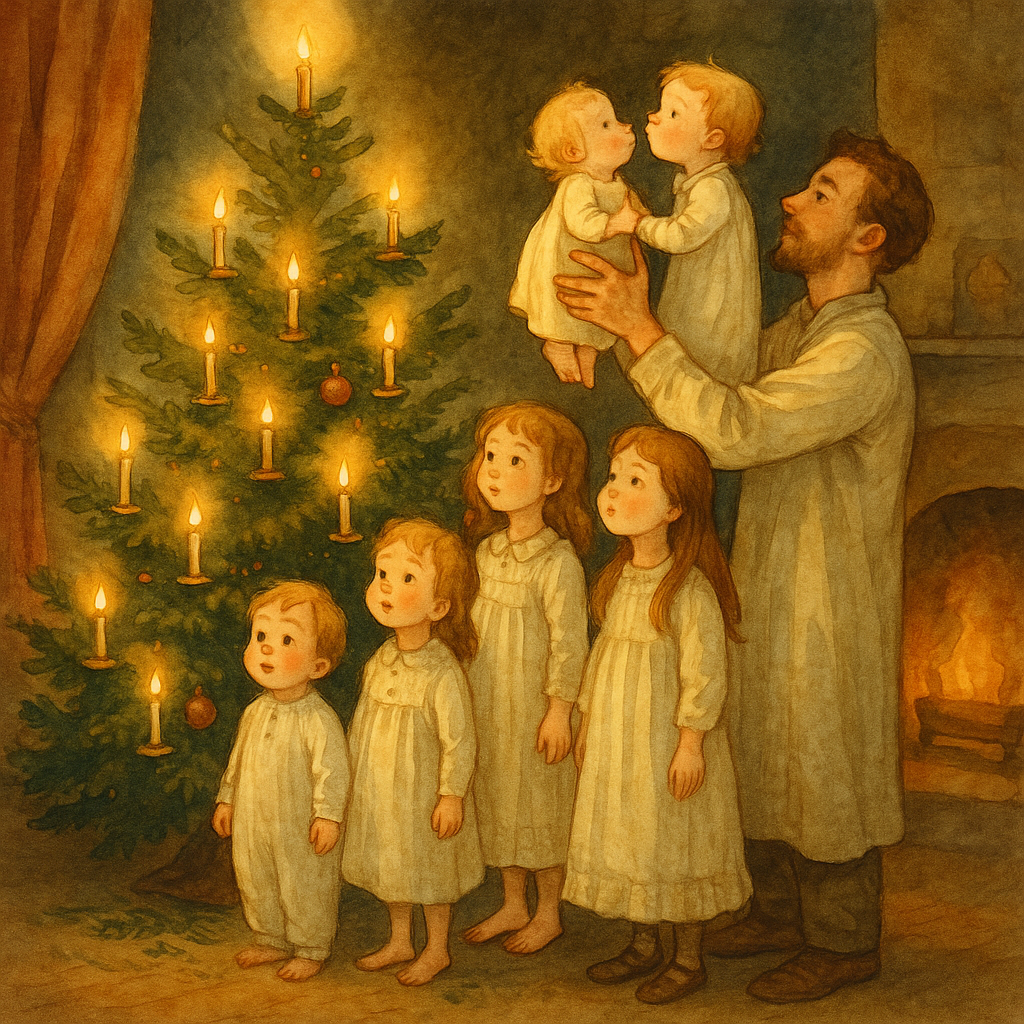
She blows out the tiptopmost candles;
We clap and hurrah when she’s done;
And that is the end of the Christmas,
The very — last — bit — of — the — fun!
✦ ✦ ✦ ✦ ✦
But all through the year it’s a pleasure
To think of our holiday nights —
The best coming last, when we children
May blow out the Christmas-tree lights.