Phantasus

Summary


"Phantasus" by Arno Holz conjures a tiny, fantastical Christmas world where a gingerbread house twinkles on a sugar-candy mountain, a Christmas tree glows in a green heaven, and a round tinfoil sea mirrors angels and lights. Children gather to stare at the poem's peculiar narrator — the dwarf Turlitipu, whose belly is made of gum-dragon, whose legs are matchsticks, and whose eyes are raisins. The poem blurs the magical and the edible in one luminous, strange vision.

Read Online

On a mountain of sugar-candy,
under a blossoming almond-tree,
twinkles my gingerbread house.
Its little windows are of gold-foil, out of its chimney steams wadding.

In the green heaven, above me, beams the Christmas tree.

In my round sea of tinfoil
are mirrored all her angels, all her lights!

The little children stand about
and stare at me.

I am the dwarf Turlitipu.
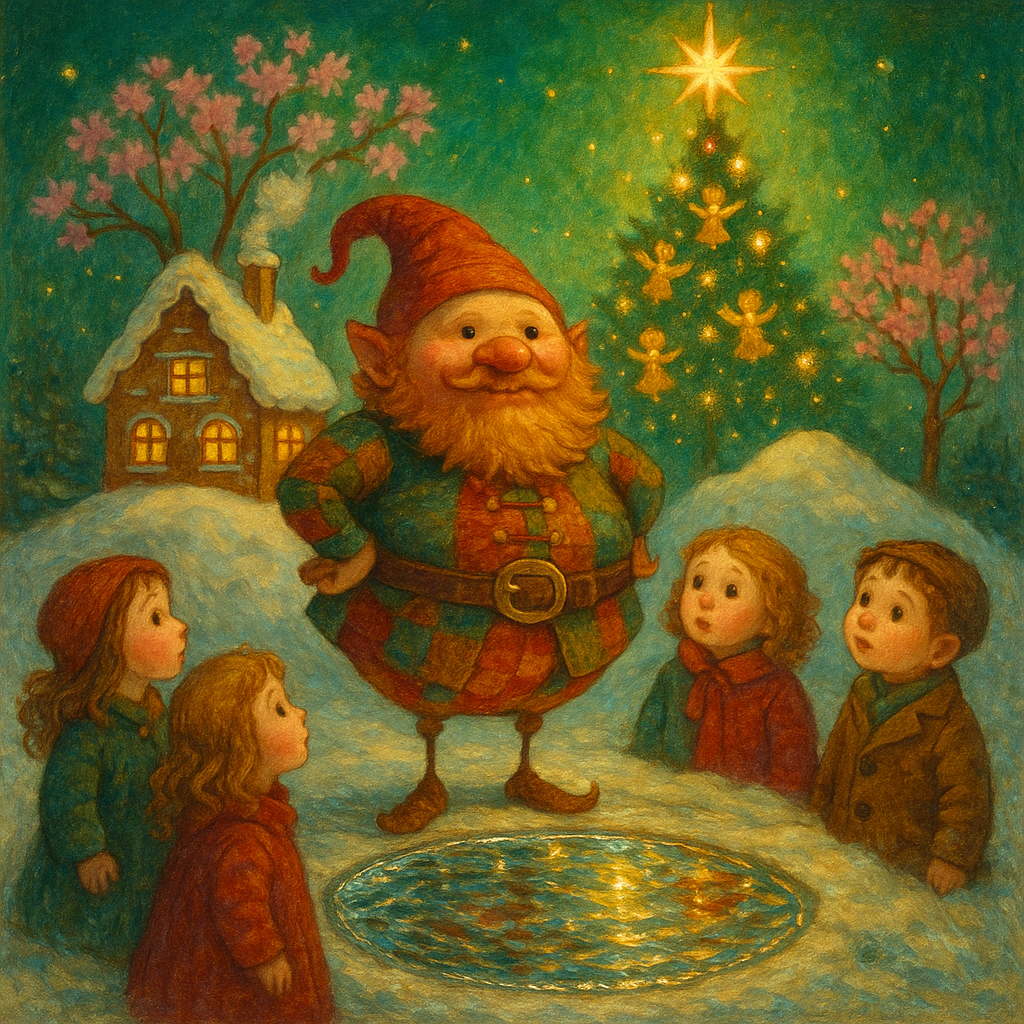
Der Zwerg Turlitipu steht vor seinem Lebkuchenhaus in der Zuckerwelt des Gedichts „Phantasus"

My fat belly is made of gumdragon,
my thin pin-legs are matches,
my clever little eyes
raisins!

Credits

Arno Holz was a pioneering German poet and dramatist of the late 19th century, widely regarded as a leading figure of German Naturalism. "Phantasus" is the title work of his celebrated 1898 poetry collection, in which he experimented boldly with free verse and central-axis typography to create an intimate, dreamlike voice unlike anything in German poetry before it.