King Arthur’s Waes-Hael

Summary


"King Arthur's Waes-Hael" weaves the ancient Anglo-Saxon wassail toast into a devotional Christmas ceremony, where the drinking bowl — shaped like a woman's breast — becomes a sacred vessel linking knightly revelry to the mystery of the nursing Christ child. Each stanza calls "Waes-hael" (be whole) and "Drink-hael" while urging reverence rather than abandon, drawing celebrants into a hushed, almost liturgical meditation on Bethlehem's infant and the divine warmth of a mother's embrace.

Listen to audio


Read Online

               I.
Waes-hael for knight and dame!
   O! merry be their dole;
Drink-hael! in Jesu’s name
   We fill the tawny bowl;
But cover down the curving crest,
Mould of the orient lady’s breast.
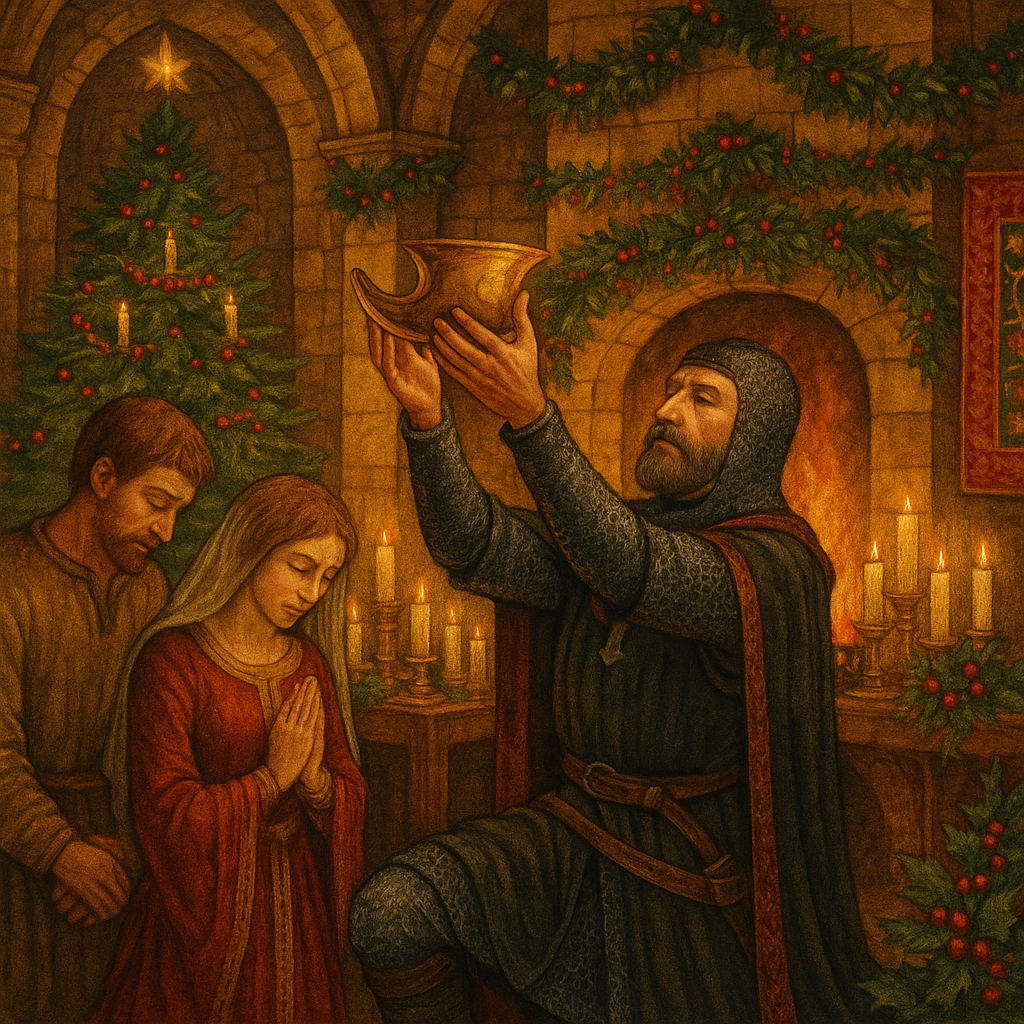
A knight kneels holding a ceremonial wassail bowl in a candlelit medieval hall, illustrating King Arthur's Waes-Hael.

               II.
Waes-hael! yet lift no lid:
   Drain ye the reeds for wine!
Drink-hael! the milk was hid
   That soothed that Babe divine;
Hushed, as this hollow channel flows,
He drew the balsam from the rose.

               III.
Waes-hael! thus glowed the breast
   Where a God yearned to cling;
Drink-hael! so Jesu pressed
   Life from its mystic spring;
Then hush, and bend in reverent sign,
And breathe the thrilling reeds for wine.

               IV.
Waes-hael! in shadowy scene,
   Lo! Christmas children we;
Drink-hael! behold we lean
   At a far Mother’s knee;
To dream, that thus her bosom smiled,
And learn the lip of Bethlehem’s Child.


Credits

Robert Stephen Hawker was a 19th-century English poet and eccentric Anglican vicar of Morwenstow, Cornwall, celebrated for reviving Arthurian and Celtic themes in Victorian verse. He is widely credited with initiating the modern Harvest Festival tradition, and this poem reflects his lifelong fascination with merging medieval ritual — here the wassail cup — with Christian mysticism.