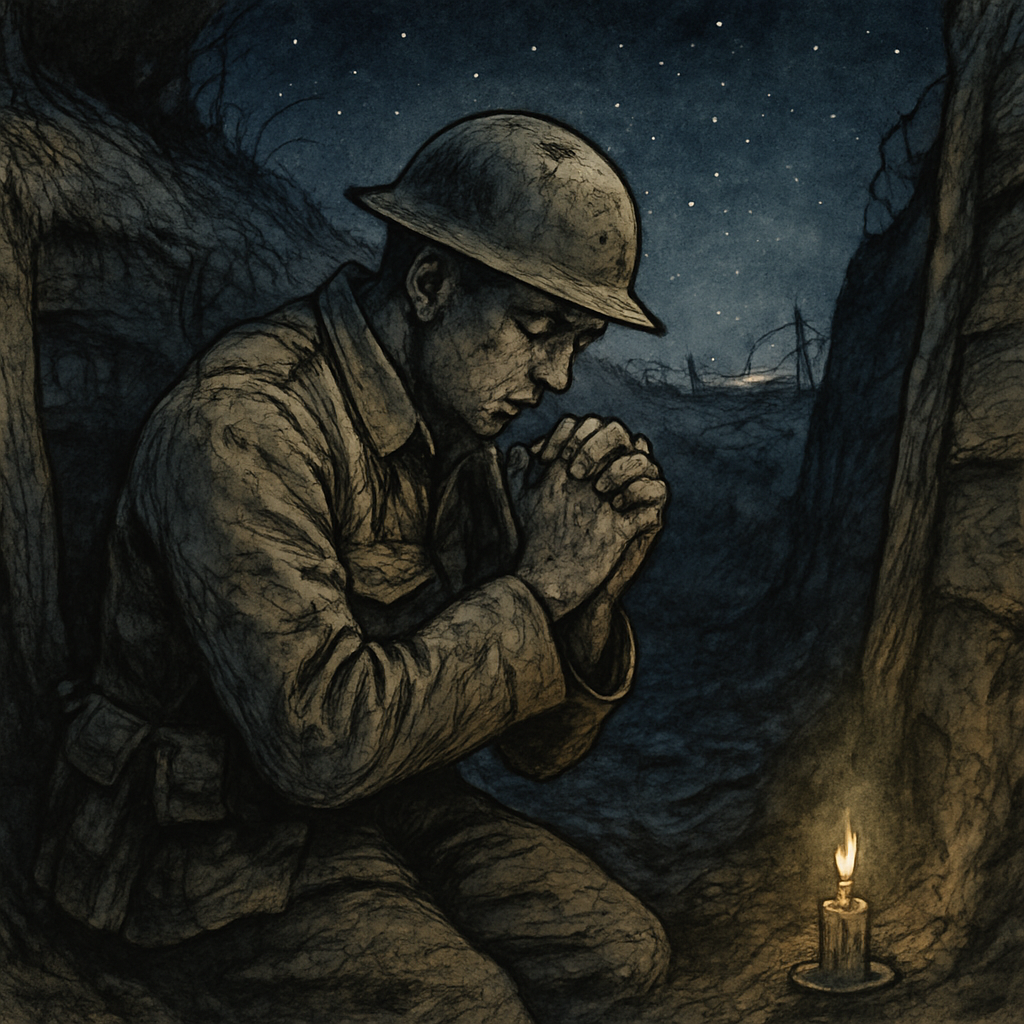
Now the muttering gun-fire dies,
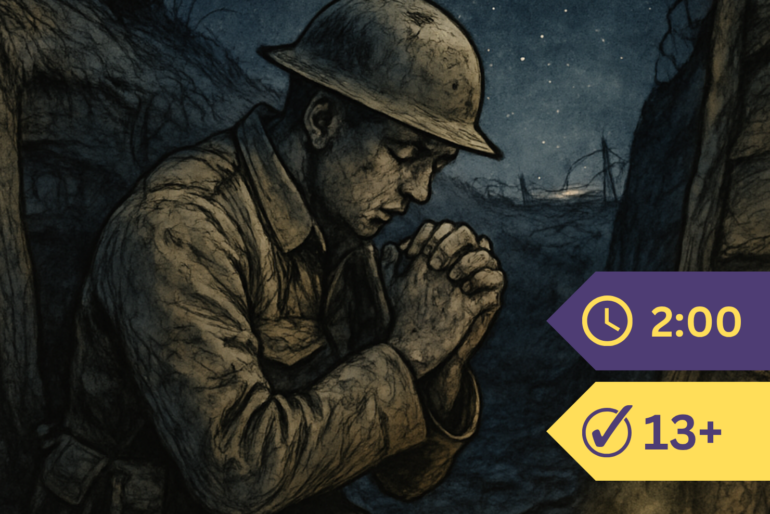
Now the night has cloaked the slain,
Now the stars patrol the skies,
Hear our sleepless prayer again!
They who work their country’s will,
Fight and die for Britain still,
Soldiers, but not haters, know
Thou wouldst pity friend and foe.
Therefore hear,
Both for foe and friend, our prayer.
Thou whose wounded Hands do reach
Over every land and sea,
Thoughts too deep for human speech
Rise from all our souls to Thee;
Deeper than the wrath that burns
Round our hosts when day returns;
Deeper than the peace that fills
All these trenched and waiting hills.
Hear, O hear!
Both for foe and friend, our prayer.
Pity deeper than the grave
Sees, beyond the death we wield,
Faces of the young and brave
Hurled against us in the field.
Cannon-fodder! They must come,
We must slay them, and be dumb,
Slaughter, while we pity, these
Most implacable enemies.
Master, hear,
Both for foe and friend, our prayer.
They are blind, as we are blind,
Urged by duties past reply.
Ours is but the task assigned;
Theirs to strike us ere they die.
Who can see his country fall?
Who but answers at her call?
Who has power to pause and think
When she reels upon the brink?
Hear, O hear,
Both for foe and friend, our prayer.
Shield them from that bitterest lie
Laughed by fools who quote their mirth,
When the wings of death go by
And their brother shrieks on earth.
Though they clamp their hearts with steel,
Conquering every fear they feel,
There are dreams they dare not tell.
Shield, O shield, their eyes from hell.
Father, hear,
Both for foe and friend, our prayer.
Where the naked bodies burn,
Where the wounded toss at home,
Weep and bleed and laugh in turn,
Yes, the masking jest may come.
Let him jest who daily dies.
But O hide his haunted eyes.
Pain alone he might control.
Shield, O shield his wounded soul.
Master, hear,
Both for foe and friend, our prayer.
Peace? We steel us to the end.
Hope betrayed us, long ago.
Duty binds both foe and friend.
It is ours to break the foe.
Then, O God! that we might break
This red Moloch for Thy sake;
Know that Truth indeed prevails,
And that Justice holds the scales.
Father, hear,
Both for foe and friend, our prayer.
England, could this awful hour,
Dawning on thy long renown,
Mark the purpose of thy power,
Crown thee with that mightier crown!
Broadening to that purpose climb
All the blood-red wars of Time. . . .
Set the struggling peoples free,
Crown with Law their Liberty!
England, hear,
Both for foe and friend, our prayer!