I Wandered Lonely as a Cloud

Summary


"I Wandered Lonely as a Cloud" opens with a solitary speaker drifting aimlessly across valleys and hills until he stumbles upon a vast, shimmering field of golden daffodils beside a lake. The flowers toss and dance in the breeze like stars stretching across the Milky Way — ten thousand at a glance. Yet the poem's true revelation comes later: when the speaker lies still in a pensive or empty mood, the daffodils flash back into his mind, filling his heart with unexpected, quiet pleasure.

Read Online

I wandered lonely as a cloud
That floats on high o’er vales and hills,
When all at once I saw a crowd,
A host, of golden daffodils;
Beside the lake, beneath the trees,
Fluttering and dancing in the breeze.

Continuous as the stars that shine
And twinkle on the milky way,
They stretched in never-ending line
Along the margin of a bay:
Ten thousand saw I at a glance,
Tossing their heads in sprightly dance.
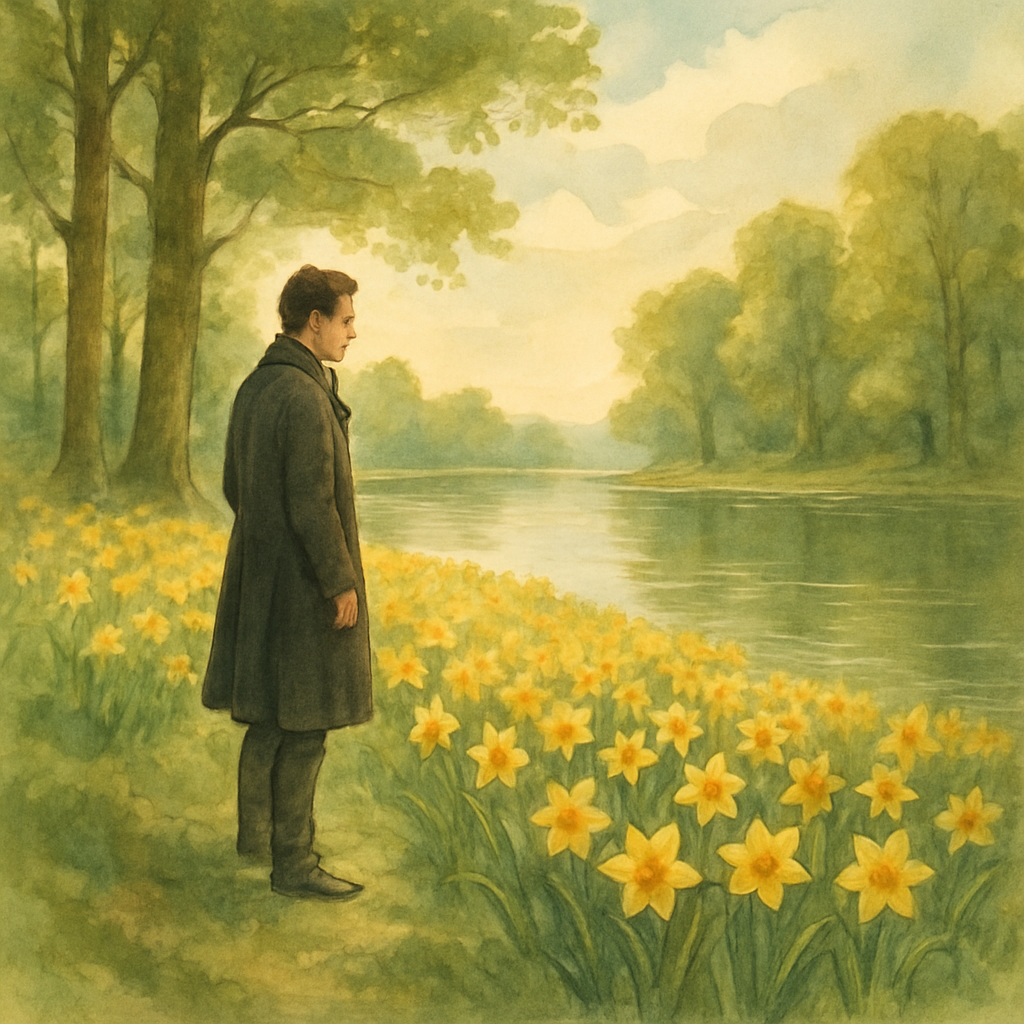
A lone wanderer gazing at a field of golden daffodils beside a lake, illustrating Wordsworth's poem.

The waves beside them danced; but they
Out-did the sparkling waves in glee:
A poet could not but be gay,
In such a jocund company:
I gazed—and gazed—but little thought
What wealth the show to me had brought:

For oft, when on my couch I lie
In vacant or in pensive mood,
They flash upon that inward eye
Which is the bliss of solitude;
And then my heart with pleasure fills,
And dances with the daffodils.

Add Ririro as a Preferred Source on Google


Credits

William Wordsworth was an English Romantic poet whose work helped launch the Romantic Age in English literature, co-authoring *Lyrical Ballads* with Samuel Taylor Coleridge in 1798. "I Wandered Lonely as a Cloud," written in 1804 and published in 1807, was inspired by a walk Wordsworth took with his sister Dorothy near Ullswater in the Lake District, an encounter she recorded in her journal.