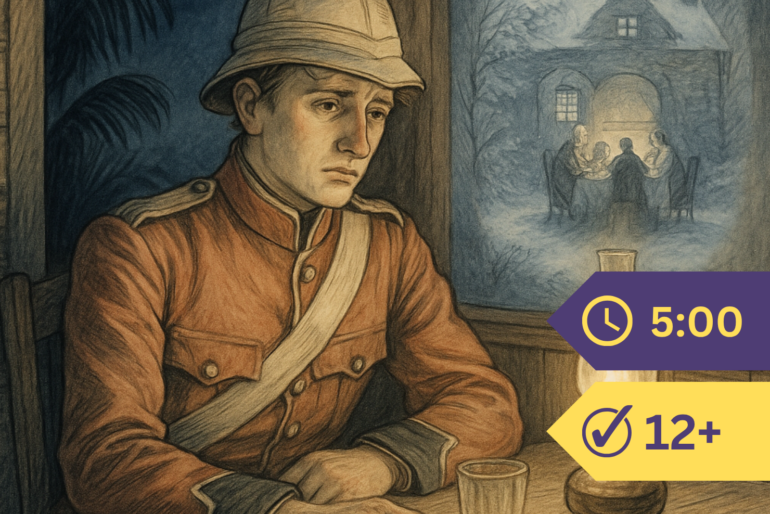
TO-MORROW, alas! I am booked to go
And dine with our Colonel and Mrs. C.O.
I hate to depart from my usual way;
And to-morrow, by Jove, will be Christmas Day!
One feels, now one hasn’t a regular Mess,
It’s a bore to go out, and a nuisance to dress;
And a feed at the Commandant’s bungalow
Is a dreary attempt at Christmas, you know:
The punkah, instead of the Christmas fire!
The Colonel, instead of the dear old Squire!
The lizard, and withering noonday glow,
Instead of the robin, and frost and snow!
I know, after all, that my lot isn’t bad,
But somehow or other it makes me sad,
At a season like this, when the thoughts will roam,
To think what they’re doing just now at home!
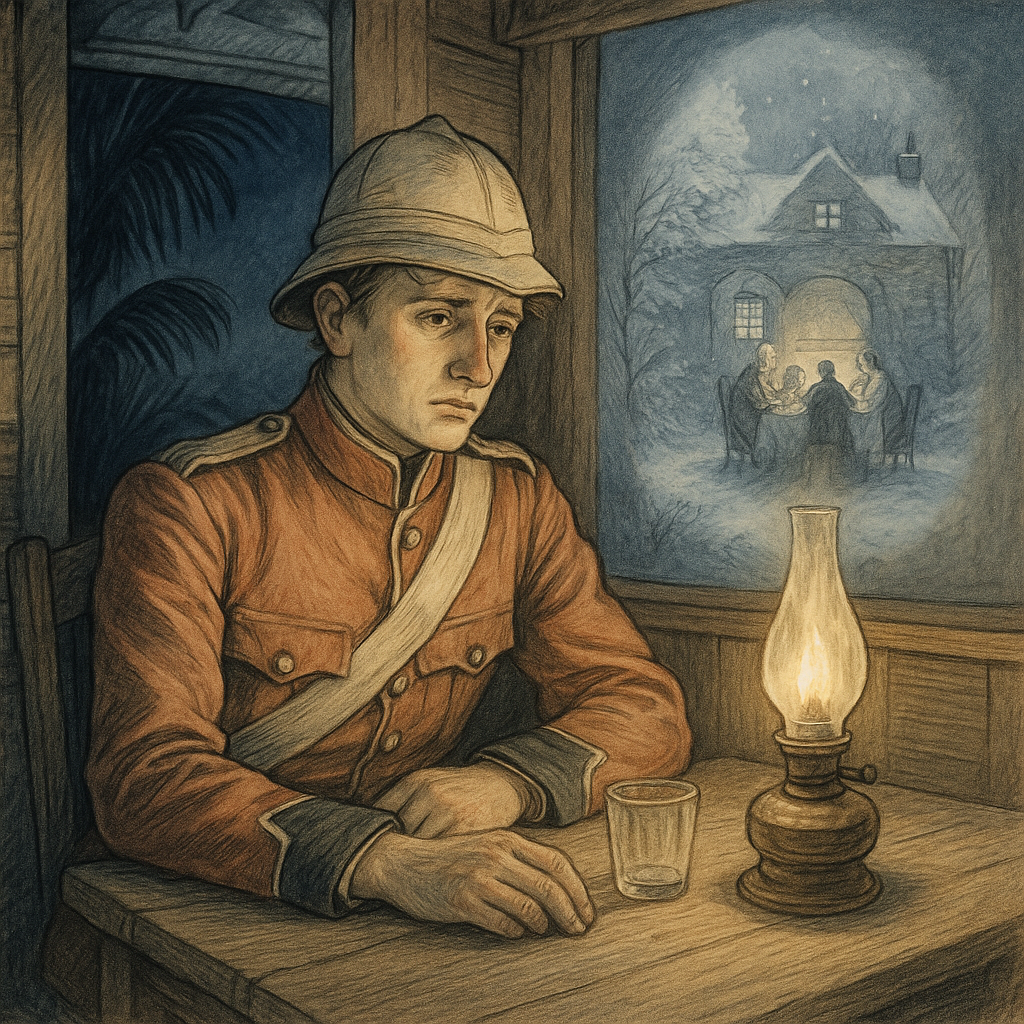
I fancy I see them, the Squire and all,
In the breakfast-room in the dear old Hall.
There’s snow on the drive and the grove of birch,
And they’re ringing the chimes in the village church.
Yes, yonder he sits in his wonted place,
With a smile on his fresh benignant face;
And the Mother, she’s there at the other end,
And Harry, and Jack, and Jane, and a friend.
I wonder whether they’re altered much?—
The Dad’s crisp hair had a silvery touch
When I said good-bye, and he bore up so;
And that—why, it’s nearly ten years ago!
The Mother, too, she was tall and erect;
But she’s stooping a little now, I expect,
And her hair, in its rich and glossy bands,
Has been fingered perhaps by Time’s rough hands;
But it cannot alter her look so kind,—
It robs, but it leaves the heart behind;
And I see her beam happily round, in the way
That she always beamed upon Christmas Day.
There’s Harry, who taught me fine escapades,—
He’s got his Majority now in the Guards;
And they say that he’s leading a steady life,
And thinking of looking about for a wife.
There’s Jack,—why, I left him a rollicking lad,
And now he’s a mate on an ironclad.
And Jane—a mere baby in frock and curl—
If her photograph’s true, is a beautiful girl.
They’re sitting all round the family spread:
There’s a pasty of game, and a big boar’s head;
There’s holly on window and picture-frame,
And the fire burns up with a crackling flame.
Then the quiet old rector looks in on his way,
And bids them a blithesome Christmas Day;
And together they walk through the grove of birch,
Over the stile, to the village church.
At the graveyard gate the churchwardens stand,
With “A merry Christmas!” and hat in hand,—
The grocer, the smithie, and Farmer Ball,—
And the Squire has a kindly word for all.
Then, when the shadows of night descend,
The Hall is lighted from end to end;
There’s a bonfire huge on the lawn outside,
And within, the Mother is in her pride,
For she loves this night the best of the year,
And loads her board with the Christmas cheer,—
The mincemeat pies, and the loin of beef,
And the grand plum-pudding with holly-leaf.
There’s happiness, too, in the old Squire’s face,
As he rises and says the Christmas grace.
He chuckles, and laughs, and cracks his joke,
And the party’s a party of merry folk.
Then he fills a bumper up to the brim;
He toasts them all, and they all toast him.
“A merry Christmas and happy New Year
To every one who is near and dear!”
But I fancy the Mother’s eyes are wet
When the old man says, “There is one toast yet—
Him absent—the youngster who’s far away,—
God give him a merry Christmas Day!”
Ah me! I know that my lot’s not bad,
But the reverie somehow makes me sad;
And this is a time when the thoughts will roam,
Wherever we are, to the scenes of home.