Once upon a time there was a king who had only one child, a daughter. He had longed for a son, or at least a grandson, to come after him. But a prophet told him that his own daughter’s son would one day kill him.
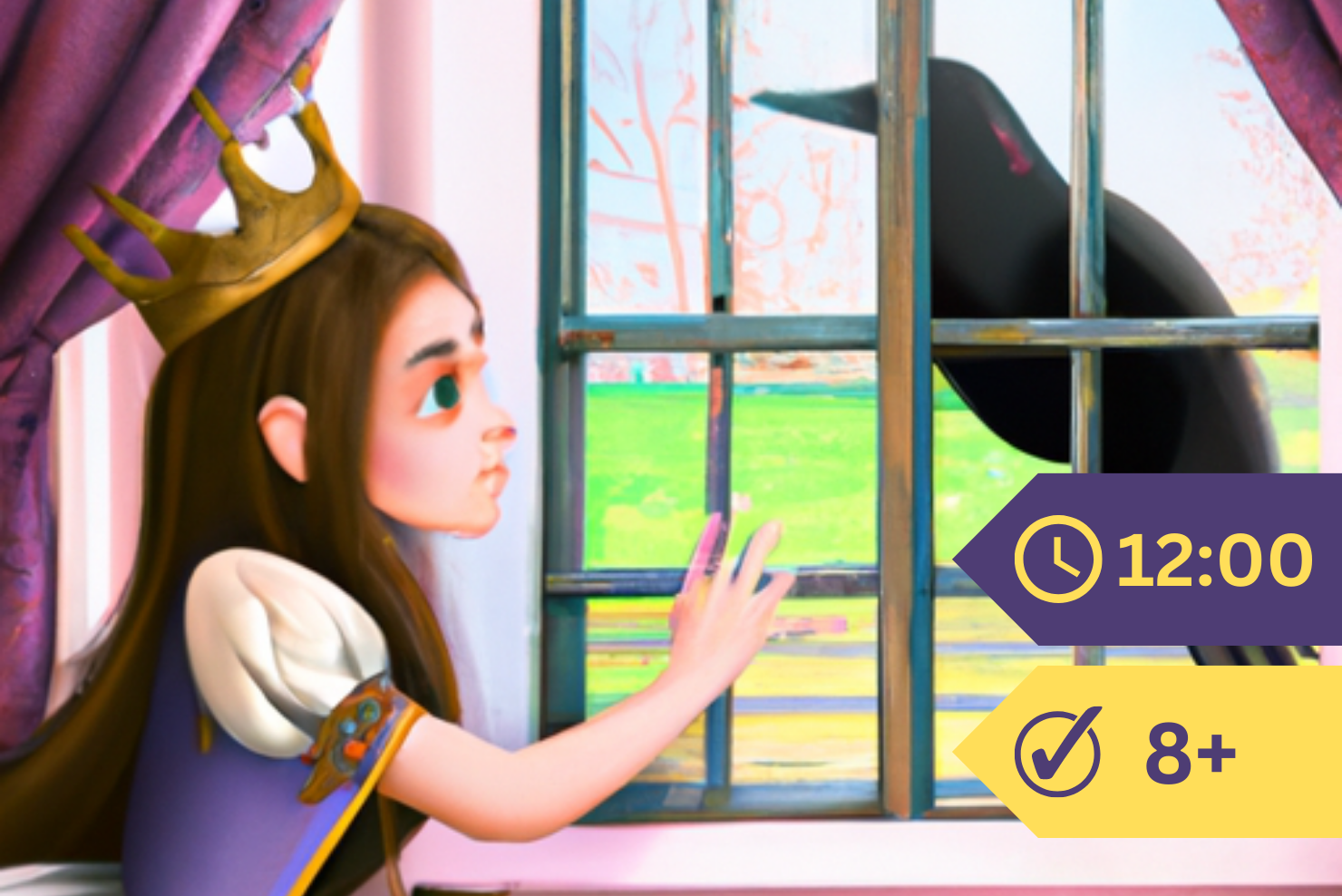
The news terrified him. He decided his daughter would never marry, for he thought it better to have no grandson at all than to be killed by one. He called his workmen and had them dig a deep, round hole in the earth. In it they built a prison of brass, and when it was finished he locked his daughter inside. No man ever saw her, and she never saw the fields or the sea. She saw only the sky and the sun, through a wide open window in the roof of the brass house.
So the Princess sat day after day, watching the clouds float across the sky and wondering whether she would ever get out. Then one day it seemed to her that the sky opened, and a great shower of shining gold fell through the window and lay glittering on her floor.
Not long after, the Princess had a baby, a little boy. When the King heard of it he was angry and afraid, for the child who would be his death had been born. Yet he was a coward, and he hadn’t quite the heart to kill them outright. Instead he had the Princess and her baby shut in a huge brass-bound chest and thrown into the sea, so that they might drown, or starve, or perhaps drift to some country far out of his way.
All that day and night the chest floated on the waves. The baby wasn’t afraid of the wind or the water, for he didn’t know they could hurt him, and he slept soundly. His mother sang over him:
“Child, my child, how sound you sleep!
Though your mother’s care is deep,
You can lie with heart at rest
In the narrow brass-bound chest;
In the starless night and drear
You can sleep, and never hear
Billows breaking, and the cry
Of the night-wind wandering by;
In soft purple mantle sleeping
With your little face on mine,
Hearing not your mother weeping
And the breaking of the brine.”
At daybreak the waves drove the chest ashore on an island. It lay there until a man of that country came by, saw it, and dragged it up the beach. When he broke it open, there inside were a beautiful lady and a little boy. He took them home and was very kind to them, and he raised the boy until he was a young man.
By then the King of that country had fallen in love with the boy’s mother and wanted to marry her. He knew she would never leave her son, so he thought of a plan to get rid of the boy. A great Queen in a nearby land was about to be married, he announced, and all his subjects must bring him wedding presents for her. He gave a feast and invited everyone. Some guests brought gold cups, some brought necklaces of gold and amber, and some brought splendid horses. The boy brought nothing, for his mother had nothing to give him. The guests began to laugh at him, and the King said, “If you have nothing else to give, you might at least go and fetch the Terrible Head.”
The boy was proud, and he spoke without thinking. “Then I swear I will bring the Terrible Head, if a living man can bring it. But of what head you speak, I know not.”
They told him that far away lived three dreadful sisters, monstrous women with golden wings, claws of brass, and serpents growing on their heads instead of hair. They were so awful to look at that anyone who saw them turned at once to stone. Two of the sisters could never be killed. The youngest, whose face was beautiful, could be, and it was her head the boy had promised to bring. It was no easy adventure.
He may have been sorry then that he had sworn, but he meant to keep his oath. He left the feast, where everyone sat drinking and making merry, and walked alone beside the sea in the dusk, to the very place where the chest had washed ashore. He sat down on a rock and looked out at the water, wondering how to begin.
Then someone touched his shoulder. He turned and saw a young man who looked like a king’s son, and beside him a tall, beautiful lady whose blue eyes shone like stars. They were taller than mortal people. The young man carried a staff topped with golden wings and wound with two golden serpents, and he wore wings on his cap and on his shoes. He asked the boy why he looked so unhappy, and the boy told him about his oath and how he had no idea where to start.
The lady said it was a hasty and foolish oath, “but it might be kept, if a brave man had sworn it.” The boy answered that he wasn’t afraid, if only he knew the way.
To kill the dreadful woman and cut off her head, the lady told him, he would need three things. The first was a Cap of Darkness, which would make him invisible when he wore it. The second was a Sword of Sharpness, which would cut through iron in a single stroke. The third was the Shoes of Swiftness, so he could fly through the air.
The boy said he didn’t know where to find such things, and without them he could only try and fail. Then the young man took off his own shoes and said, “You shall use these until you have taken the Terrible Head, and then you must give them back to me. With them you’ll fly as fast as a bird, or a thought, over the land and the waves, wherever the shoes know the way. But some roads they don’t know, roads beyond the edge of the world, and those you must find for yourself. First, go to the Three Gray Sisters, who live far off in the north. They are so cold that the three of them share one eye and one tooth. Creep up close, and when one passes the eye to another, seize it. Don’t give it back until they tell you the way to the Three Fairies of the Garden. The Fairies will give you the Cap of Darkness and the Sword of Sharpness, and show you how to fly beyond this world to the land of the Terrible Head.”
“Go at once,” the lady added, “and don’t go home to say good-bye to your mother. These things must be done quickly, and the Shoes of Swiftness know the way to the Gray Sisters.”
The boy thanked her and fastened on the shoes. He turned to say good-bye, but the young man and the lady had vanished, and he never knew how. He leaped into the air to try the shoes, and they carried him faster than the wind. He flew over the warm blue sea, over the sunny southern lands, and over northern peoples who drank mare’s milk and lived in great wagons, wandering after their flocks. He crossed wide rivers where wild birds rose and fled before him, then plains, then the cold North Sea, then fields of snow and hills of ice. At last he reached the place where the world ends, where all the water is frozen and there are no people, no animals and no green grass.
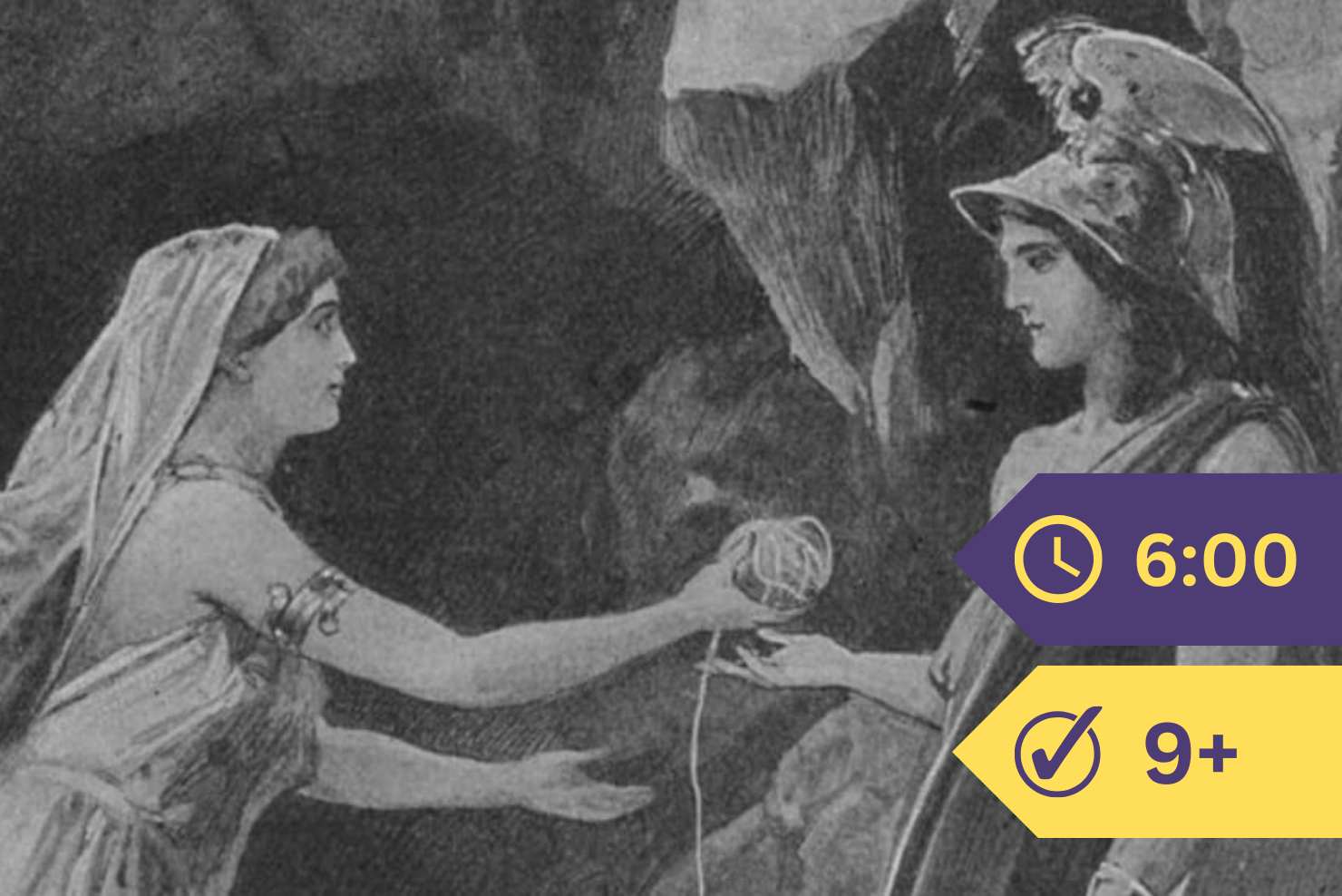
There, in a blue cave of ice, he found the Three Gray Sisters, the oldest of living things. Their hair was white as snow and their skin an icy blue. They mumbled and nodded as if in a dream, and their frozen breath hung around them like a cloud. The cave opening was narrow, and it was hard to get in without brushing against one of them. But floating on the Shoes of Swiftness, the boy slipped inside and waited until one sister said to the one who held the eye:
“Sister, what do you see? Do you see old times coming back?”
“No, sister.”
“Then give me the eye, for perhaps I can see farther than you.”
The first sister passed the eye along, but as the second groped for it, the boy snatched it neatly out of her hand.
“Where is the eye, sister?” said the second.
“You have taken it yourself, sister,” said the first.
“Have you lost the eye, sister? Have you lost the eye?” cried the third. “Shall we never find it again, and see old times coming back?”
The boy slipped out of the cave into the open air, and he laughed aloud.
When the Gray Women heard that laugh they began to weep, for they knew a stranger had robbed them and they could do nothing about it. Their tears froze as they fell from the hollows where their eyes should have been, and rattled on the icy floor. They begged him to give back the eye, and he couldn’t help feeling sorry for them, they looked so pitiful. But he said he would never give it back until they told him the way to the Fairies of the Garden.
They wrung their hands, for they guessed what he was up to and why he had come. The Dreadful Women were their kin, and it was hard for them to help him. But at last they told him to fly south, always keeping the land on his left and the sea on his right, until he reached the Island of the Fairies of the Garden. He gave them back their eye, and they went back to watching for the old times to return.
The boy flew south between land and sea until he saw a beautiful island crowned with flowering trees. He landed there and found the Three Fairies of the Garden. They looked like three lovely young women, one dressed in green, one in white and one in red. They were dancing and singing around an apple tree hung with golden apples, and this was their song:
THE SONG OF THE WESTERN FAIRIES
Round and round the apples of gold,
Round and round dance we;
Thus do we dance from the days of old
About the enchanted tree;
Round, and round, and round we go,
While the spring is green, or the stream shall flow,
Or the wind shall stir the sea!
There is none may taste of the golden fruit
Till the golden new time come
Many a tree shall spring from shoot,
Many a blossom be withered at root,
Many a song be dumb;
Broken and still shall be many a lute
Or ever the new times come!
Round and round the tree of gold,
Round and round dance we,
So doth the great world spin from of old,
Summer and winter, and fire and cold,
Song that is sung, and tale that is told,
Even as we dance, that fold and unfold
Round the stem of the fairy tree!
These grave, dancing fairies were nothing like the Gray Women. They were glad to see the boy and treated him kindly. When he told them he had been sent to find the Sword of Sharpness and the Cap of Darkness, they gave him both, along with a wallet and a shield. They belted the diamond-bladed sword around his waist and set the cap on his head, and then not even they could see him, fairies though they were. He took the cap off again, and each of them kissed him and wished him good fortune. Then they went back to their endless dance around the golden tree, for it is their task to guard it until the new times come, or the world ends.
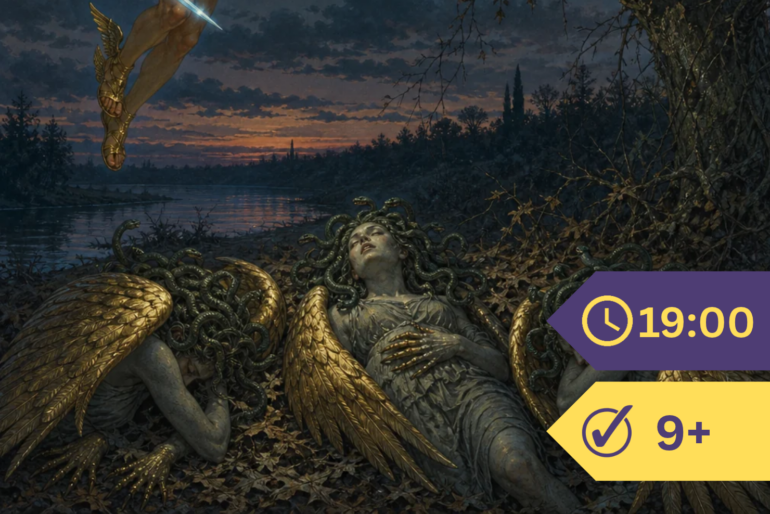
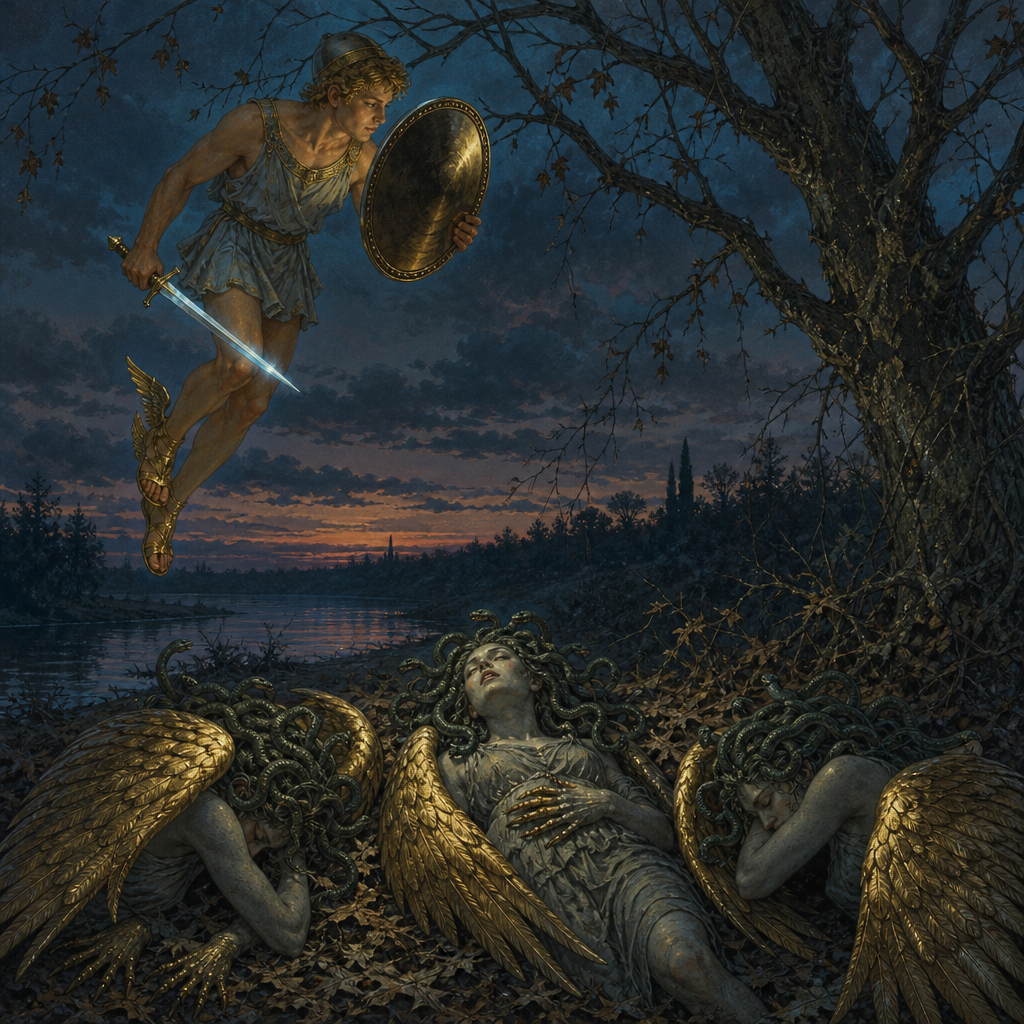
The boy put on the cap, hung the wallet at his side and the shining shield on his back, and flew out beyond the great river that coils like a serpent around the whole world. On its bank he found the three Terrible Women fast asleep under a poplar tree, with dead leaves lying all around them. Their golden wings were folded and their brass claws crossed. Two of them slept with their hideous heads tucked under their wings like birds, and the serpents in their hair writhed out from beneath the golden feathers. The youngest slept between her sisters, lying on her back with her beautiful, sad face turned to the sky. Though she slept, her eyes were wide open. Had the boy seen her, he would have been turned to stone by the terror and the pity of it, she was so awful.
But he had a plan to kill her without looking at her face. As soon as he spotted the three from far off, he took the shield from his shoulder and held it up like a mirror, so that he saw only their reflections and never the Terrible Head itself. He crept closer, watching the mirror, until he judged he was within a sword’s stroke of the youngest. Then he drew the Sword of Sharpness and struck once, and the Terrible Head was cut from her shoulders. The blood leaped out and struck him like a blow. He thrust the head into his wallet and flew away without once looking behind him.
The two Dreadful Sisters woke and rose into the air like great birds. They couldn’t see him through the Cap of Darkness, but they chased him up the wind, tracking him by scent through the clouds like hounds hunting in a wood. They came so close he could hear the clatter of their golden wings and their shrieks to each other: “Here, here!” “No, there! This way he went!” But the Shoes of Swiftness were too fast for them. At last their cries and the rattle of their wings faded away as he crossed the great river that runs around the world.
When the horrible creatures were far behind, the boy flew east, trying to find his own country. Looking down, he saw a strange sight: a beautiful girl chained to a stake at the high-water mark of the sea. She was so frightened and so tired that only the iron chain around her waist kept her from falling, and she hung there as if dead. He felt sorry for her and flew down to stand beside her. When he spoke, she raised her head and looked around, but his voice only seemed to frighten her. Then he remembered he was still wearing the Cap of Darkness, and she could hear him but not see him. He took it off, and there he stood before her, the handsomest young man she had ever seen, with short curly yellow hair, blue eyes and a laughing face. And he thought her the most beautiful girl in the world.
With one stroke of the Sword of Sharpness he cut her chain. Then he asked her what she was doing there and why people had treated her so cruelly. She told him she was the daughter of the king of that country, and that she had been tied there to be eaten by a monstrous beast from the sea. The beast came every day and devoured a girl, and today the lot had fallen on her.
Even as she spoke, the long, fierce head of a sea creature rose from the waves and snapped at her. But the beast was too greedy and too hasty, and it missed. Before it could rise and bite again, the boy whipped the Terrible Head out of his wallet and held it up. When the beast lunged a second time, its eyes fell on the head, and in an instant it turned to stone. The stone beast lies on that coast to this day.
The boy and the girl went to her father’s palace, where everyone was weeping for her, and they could hardly believe their eyes when she walked in alive and well. The King and Queen made much of the boy, and they could hardly contain their joy when he asked to marry their daughter. The wedding was splendid, and after some time at court the pair sailed home to his own country in a ship. He couldn’t carry his bride through the air, so he took the Shoes of Swiftness, the Cap of Darkness and the Sword of Sharpness to a lonely place in the hills and left them there. They were found by the man and woman who had met him beside the sea and helped him start his journey.
When the boy and his bride landed at the harbor of his native country, the first person he met in the street of the town was his own mother, running for her life. The wicked King was chasing her with a sword in his hand, for he had finally understood that she would never marry him. She had disliked him before, and she liked him far less now that her son had vanished so suddenly. She didn’t know where the boy had gone, and she feared the King had secretly killed him. Now she ran straight into her son’s arms. He had time only to kiss her and step in front of her before the King struck at him. The boy caught the blow on his shield and cried:
“I swore to bring you the Terrible Head, and see how I keep my oath!”
He drew the head from his wallet, and the moment the King’s eyes fell on it, he turned to stone, just as he stood, with his sword raised.
The people rejoiced, for the wicked King would rule them no longer. They asked the boy to be their king, but he said no, he must take his mother home to her father’s house. So they chose as their king the man who had been so kind to his mother when she was first cast ashore in the great chest.
Soon after, the boy, his mother and his wife set sail for his mother’s own country, from which she had been so unkindly driven. On the way they stopped at the court of a king who was holding games and giving prizes to the best runners, boxers and quoit-throwers. The boy joined in. He threw the quoit farther than anyone had ever thrown one, and it fell into the crowd and struck a man, who died. That man was the boy’s grandfather, the King who had locked his daughter in the brass house. He had fled his own kingdom for fear his grandson would find him and kill him after all. So his own cowardice and a stroke of chance destroyed him, and the prophecy came true.
The boy, his wife and his mother returned to the kingdom that was theirs by right, and they lived long and happily after all their troubles.