Once upon a time a young man made ready for a voyage. His name was Norss. His shoulders were broad, his cheeks were ruddy, his hair was fair and long, and good-nature shone from his blue eyes and lurked about the corners of his mouth.
“Where are you going?” asked his neighbor Jans, the forge-master.
“I am going sailing for a wife,” said Norss.
“For a wife, indeed!” cried Jans. “And why go you to seek her in foreign lands? Are not our maidens good enough and fair enough, that you must search for a wife elsewhere? For shame, Norss!”
But Norss said: “A spirit came to me in my dreams last night and said, ‘Launch the boat and set sail tomorrow. Have no fear; for I will guide you to the bride that awaits you.’ Then, standing there, all white and beautiful, the spirit held forth a symbol — such as I had never before seen — in the figure of a cross, and said: ‘By this symbol shall she be known to you.'”
“If this be so, you must go,” said Jans. “But are you well provisioned? Come to my cabin, and let me give you venison and bear’s meat.”
Norss shook his head. “The spirit will provide,” said he. “I have no fear, and I shall take no care, trusting in the spirit.”
So Norss pushed his boat down the beach into the sea, leaped aboard, and unfurled the sail to the wind. Jans stood wondering on the shore and watched the boat speed out of sight.
On and on sailed Norss, so many days and so many leagues that he thought he must have compassed the earth. In all that time he knew no hunger nor thirst — no cares or dangers beset him, just as the spirit had promised. By day the dolphins and the other creatures of the sea gamboled about his boat; by night a beautiful Star seemed to direct his course; and when he slept and dreamed, he saw ever the spirit, clad in white, holding forth the symbol in the shape of a cross.
At last he came to a strange country — so different from his own that he could scarcely trust his senses. Instead of rugged mountains, he saw a gentle landscape of velvety green; the trees were not pines and firs, but cypresses, cedars, and palms; instead of the cold, crisp air of his native land, he breathed the perfumed breezes of the Orient; and the wind that filled his sail was heavy and warm with the fragrance of cinnamon and spices. The waters were calm and blue — very different from the white and angry waves of Norss’s native fjord.
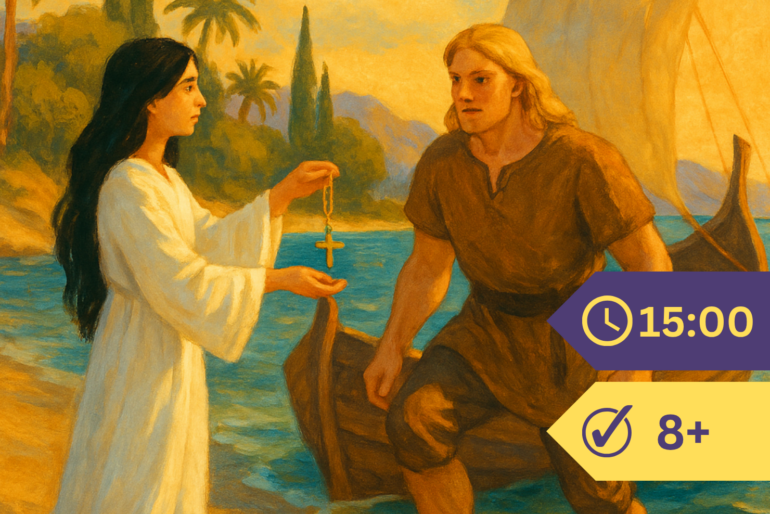
As if guided by an unseen hand, the boat moved straight toward the shore of this beautiful land; and before its prow touched shallower water, Norss saw a maiden standing on the beach, shading her eyes with one hand and gazing intently at him. She was the most beautiful maiden he had ever looked upon. As Norss was fair, so this maiden was dark; her black hair fell loosely about her shoulders in charming contrast with the white garments in which her slender, graceful form was clothed. Around her neck she wore a golden chain, and from it hung a small symbol he did not immediately recognize.
“Have you come sailing out of the North into the East?” asked the maiden.
“Yes,” said Norss.
“And you are Norss?” she asked.
“I am Norss; and I come seeking my bride,” he answered.
“I am she,” said the maiden. “My name is Faia. An angel came to me in my dreams last night and said: ‘Stand upon the beach today, and Norss shall come out of the North to bear you home as his bride.’ So I came here, and found you sailing to our shore.”
Remembering then the spirit’s words, Norss said: “What symbol have you, Faia, that I may know you have truly spoken?”
“No symbol have I but this,” said Faia, holding out the pendant on the golden chain. Norss looked upon it, and there it was — the symbol of his dreams: a tiny wooden cross.
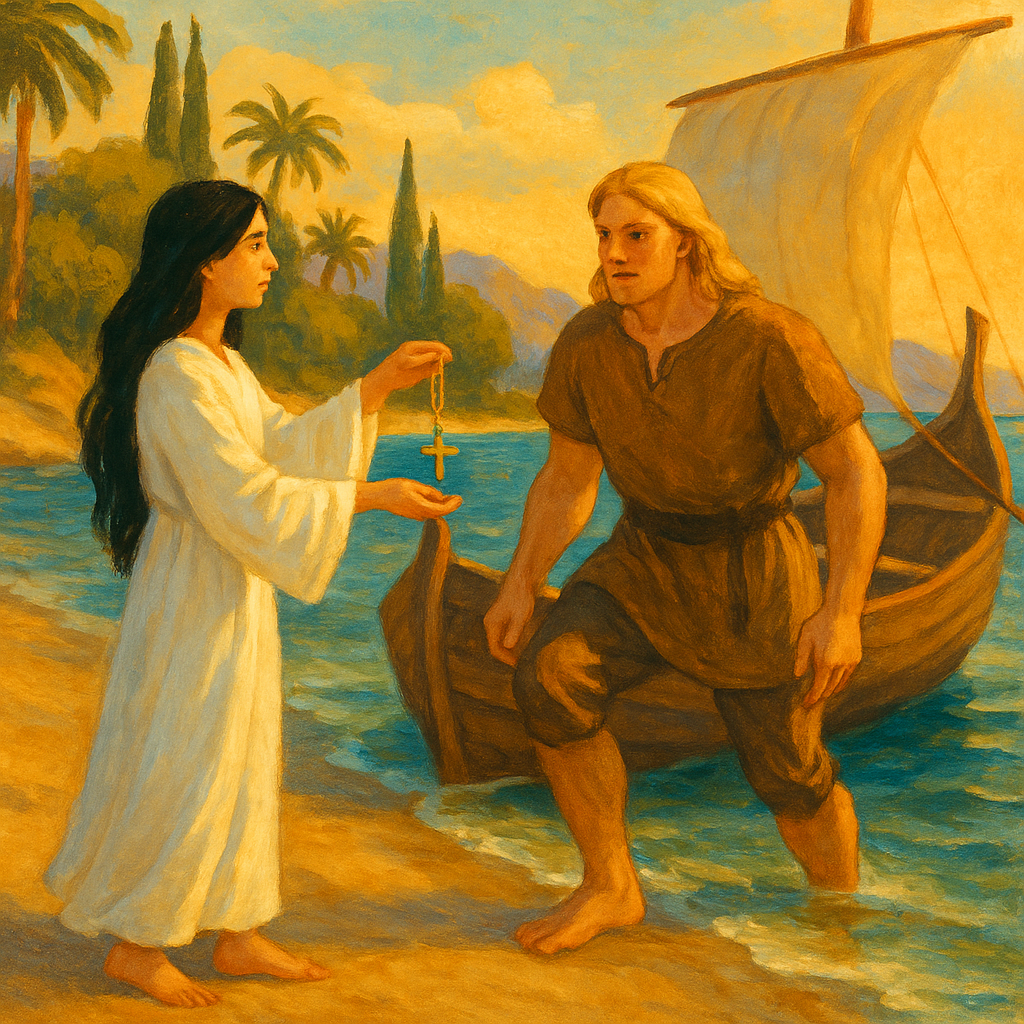
Then Norss clasped Faia in his arms and kissed her, and together they entered the boat and sailed away into the North. In all their voyage, no care or danger beset them, for it came to pass exactly as they had been told in their dreams. By day the dolphins and the other creatures of the sea gamboled about them; by night the winds and waves sang them to sleep. And, strangely enough, the Star that had led Norss eastward now shone bright and beautiful in the northern sky.
When Norss and his bride reached home, Jans the forge-master and all the neighbors made great joy, and everyone agreed that Faia was the most beautiful maiden in all the land. So merry was Jans that he built a huge fire in his forge, and the flames filled the whole northern sky with rays of light that danced up, up, up toward the Star, singing glad songs all the while. So Norss and Faia were wed, and they went to live in the cabin in the fir grove.
To these two was born in good time a son, whom they named Claus. On the night he was born, wondrous things came to pass. To the cabin in the fir grove came all the quaint, strange spirits — the fairies, the elves, the trolls, the pixies, the goblins, the kobolds, the moss-people, the gnomes, the dwarfs, the water-sprites, the brownies, the nixies — all came to the cabin in the fir grove and capered about and sang the strange, beautiful songs of the Mist-Land. And the flames of old Jans’s forge leaped higher than ever into the northern sky, carrying the joyous tidings to the Star; and that happy night was full of music.
Even in infancy Claus did marvellous things. With his baby hands he wove willow twigs into pretty figures. As he grew older, he fashioned with the knife old Jans had made for him many curious toys — carts, horses, dogs, lambs, houses, trees, cats, and birds, all of wood and very like to nature. His mother taught him how to make dolls too — dolls of every kind, condition, temper, and color; proud dolls, humble dolls, boy dolls, lady dolls, wax dolls, rubber dolls, paper dolls, worsted dolls, rag dolls — dolls of every description without end. So Claus became just as popular with the little girls as with the little boys of his village, for he was so generous that he gave away all his pretty things as fast as he made them.
Claus seemed to know by instinct every language. As he grew older he would ramble off into the woods and talk with the trees, the rocks, and the beasts of the greenwood, or sit on the cliffs overlooking the fjord and listen to the stories that the waves loved to tell him. He knew the haunts of the elves and the stille-volk too, and many a pretty tale he learned from those little people. When night came, old Jans told him the legends of the North, and his mother sang to him the lullabies she had heard as a child herself in the far-distant East. And every night his mother held out to him the symbol in the shape of the cross, and asked him to kiss it before he went to sleep.
So Claus grew to manhood, increasing each day in knowledge and wisdom. His works increased too, and his generosity dispensed everywhere the beautiful things his fancy conceived and his skill created. Jans, being now a very old man with no son of his own, gave Claus his forge and workshop and taught him the secret arts he had learned from cunning masters in his youth. Right joyous was Claus; and many, many times the northern sky glowed with the flames that danced singing from the forge while he molded his pretty toys. Every color of the rainbow were those flames, for they reflected the bright colors of the beautiful things strewn round that wonderful workshop. So little children everywhere loved Claus because he gave them pretty toys, and their parents loved him because he made their little ones so happy.
But now Norss and Faia were come to old age. After long years of love and happiness, they knew that death could not be far away. And one day Faia said to Norss: “Neither you nor I fear death, dear love; but if we could choose, would we not choose to live on forever in our son Claus, who has been such a joy to us?”
“Ay,” said Norss, “but how is that possible?”
“We shall see,” said Faia.
That night Norss dreamed that a spirit came to him and said: “Norss, you shall surely live forever in your son Claus, if you will but acknowledge the symbol.”
When morning came, Norss told his dream to Faia, and Faia said: “I had the same dream — an angel appeared to me and spoke those very words.”
“But what of the symbol?” cried Norss.
“I have it here, about my neck,” said Faia.
She drew from beneath her shawl the little wooden cross on its golden chain. As she stood there holding it out to Norss, he thought of the time when he had first seen her on that far-distant shore, standing in the sunlight — her eyes shaded with one hand, the cross held in the other — and he felt as if no time had passed at all.
“Faia!” he cried. “It is the same — the same you wore when I found you in the East!”
“It is the same,” said Faia, “yet see how my kisses and my prayers have worn it smooth; for many, many times in these years, dear Norss, I have pressed it to my lips and breathed your name upon it. See now — see what beautiful light its shadow makes upon your face!”
The sunbeams, streaming through the window at that moment, cast the shadow of the cross on old Norss’s brow. He felt a glorious warmth move through him, his heart leaped with joy, and he stretched out his arms and folded Faia close, and kissed the symbol and acknowledged it. Then likewise did Faia; and suddenly the place was filled with a wondrous brightness and strange music, and never again were Norss and Faia seen by mortal eyes.
Until late that night Claus toiled at his forge, for it was a busy season and he had many beautiful things to make for the little children all around. The colored flames leaped singing from the forge so that the northern sky seemed lit by a thousand rainbows — but above all that bright glory beamed the Star, serene and beautiful.
Coming late to the cabin in the fir grove, Claus found no sign of his father or his mother. “Father — Mother!” he cried, but received no answer. Just then the Star cast its golden light through the latticed window, and that strange, soft radiance fell and rested upon the wooden cross lying on the floor. Claus stooped and picked it up, and kissing it gently, he said: “Dear talisman, be my inspiration evermore — and wherever your blessed influence is felt, there let my works be known henceforth forever!”
No sooner had he spoken than he felt the gift of immortality come upon him; and in that same moment there came a knowledge that his parents’ prayer had been answered, and that Norss and Faia would live in him through all time.
And there, in that place and that hour, came all the people of Mist-Land and Dream-Land to declare their allegiance to him: the elves, the fairies, the pixies — all came to Claus, prepared to do his bidding. Joyously they capered about him, and merrily they sang.
“Now haste ye all,” cried Claus — “haste to your homes and bring me the best you have! Search deep in the earth for the finest gold and choicest jewels; fetch from the bottom of the sea the treasures hidden there — the rainbow-colored shells, the smooth bright pebbles, and the strange ocean flowers; go to your secret lakes and bring me pearls! Speed, speed, all of you! For we have many beautiful things to make for the little ones of the earth we love!”
To the kobolds and the brownies he said: “Fly to every house on earth where the cross is known; stay unseen in the corners, and watch and listen to the children through the day. Keep a careful account of good and bad, and every night bring me the names of each, so that I may know them.”
The kobolds and the brownies laughed gleefully and sped away on noiseless wings; and so too did all the other fairies and elves.
To Claus came also the beasts of the forest and the birds of the air, pledging him their service. The Four Winds danced up and begged to serve him too. And the Snow King came stealing along in his feathery chariot.
“I shall speed over all the world and tell them you are coming!” he cried. “In town and country, on mountain-tops and in valleys — wherever the cross is raised — I will herald your approach, and strew you a pathway of white. Oho!” And singing softly, the Snow King stole upon his way.
But of all the beasts that begged to serve him, Claus loved the reindeer best. “You shall travel with me,” he told them, “for I will bear my treasures not only to the children of the North, but to the children of every land where the Star points me and love is found.” The reindeer neighed joyously and stamped their hooves, as if they longed to start at once.
Oh, many, many times has Claus whirled away from his far northern home in his sledge drawn by the reindeer, bearing thousands upon thousands of beautiful gifts — all of his own making — to the children of every land. He loves them all alike, and they all alike love him. So truly do they love him that they call him Santa Claus; and I am sure he must be a saint — for he has lived these many hundreds of years, and we, who know he was born of Faith and Love, believe that he will live forever.