Mr. and Mrs. Nutcracker were as respectable a pair of squirrels as ever wore gray brushes over their backs. They lived in Nutcracker Lodge, a hole in a sturdy old chestnut tree that leaned out over a shady dell. They had raised many families of young Nutcrackers there, and every one of them was a model of good behaviour in the forest.
But in time they had a son named Featherhead, who was as different from the rest of the family as if he had dropped out of the moon into their nest. He was handsome enough, and lively, but he was also sulky, contrary, and unreasonable. He found fault with everything his respectable papa and mama did. Instead of helping lay up nuts and learning the lessons a young squirrel ought to learn, he sneered at all the good old ways of Nutcracker Lodge and said they were behind the times. He was always on hand at mealtimes, though, and set his teeth to work on the nuts his mother had gathered, always choosing the best ones for himself. And he seasoned every nibble with grumbling.
Papa Nutcracker often lost his patience and said something sharp. Mamma Nutcracker would shed tears and beg her darling boy to be a little more reasonable.
While his parents, brothers, and sisters raced cheerfully up and down the branches, storing food for the winter, Featherhead sat apart, sulking and scolding.
“Nobody understands me,” he grumbled. “Nobody treats me as I deserve. I was born for something far more important than gathering chestnuts and hickory nuts. I am an unusual squirrel.”
“Depend upon it, my dear,” Mrs. Nutcracker whispered to her husband, “that boy is a genius.”
“Fiddlestick on his genius!” said old Mr. Nutcracker. “What does he do?”
“Oh, nothing, of course. But they say that’s one of the marks of genius. Remarkable people never come down to common life, you know.”
“He eats enough for any two,” said Mr. Nutcracker, “and he never helps gather nuts.”
“But, my dear, Parson Too-Whit has talked with him, and he says the boy has very fine feelings, so far above the common crowd.”
“Fine feelings, indeed!” snapped Mr. Nutcracker. “When a fellow eats every nut his mother gives him and then grumbles at her, I don’t think much of his feelings. Why doesn’t he do something? I’m going to tell my fine young gentleman that if he doesn’t behave himself, I’ll tumble him out of the nest head over heels and see whether hunger can bring his fine airs down a bit.”
“Oh, my dear,” sobbed Mrs. Nutcracker, throwing both paws around her husband’s neck, “do be patient with our darling boy.”
Now, the Nutcrackers belonged to the fine old family of the Grays, but they were on good terms with every branch of the squirrel tribe. They were especially friendly with the Chipmunks of Chipmunk Hollow. Young Tip Chipmunk, the eldest son, was a perfect contrast to Master Featherhead. Tip was cheerful and quick, and always on the lookout for food. Mr. and Mrs. Chipmunk had very little to worry about. They could sit at the door of their hole and chat with the neighbours, quite sure that Tip would see to everything and have plenty laid up for winter.
“What a commonplace fellow that Tip Chipmunk is,” sneered Featherhead one day. “I shall take care not to associate with him.”
“My dear, you are too hard on poor Tip,” said Mrs. Nutcracker. “He’s a very good son.”
“Oh, I don’t doubt he’s good enough,” said Featherhead. “But he’s so common. He hasn’t an idea in his head beyond his nuts and Chipmunk Hollow. And he has no manners! Mother, I hope you won’t invite the Chipmunks to Thanksgiving dinner. Those family dinners are such a bore.”
“But, my dear, your father thinks a great deal of the Chipmunks. They’re our relatives, you know.”
“So are the High-Flyers, and if we could get them to come, there’d be some sense to it. But of course a flying squirrel would never set foot in our house if a common chipmunk were there. It isn’t to be expected.”
“Confound the puppy,” said old Mr. Nutcracker. “I wish good, hardworking sons like Tip Chipmunk weren’t so uncommon.”
But in the end Featherhead had his way, and the Chipmunks were not invited to Nutcracker Lodge for Thanksgiving. They weren’t offended, though. Tip called early that morning to wish everyone a happy holiday and left a few choice beechnuts at the door.
“He can’t even see he isn’t wanted here,” sneered Featherhead.
At last old Mr. Nutcracker declared it was time for Featherhead to choose some work.
“What are you going to do, my boy? We’re doing a fine trade in hickory nuts, and if you’d like to join us…”
“Thank you,” said Featherhead, “but the hickory trade is far too slow for me. I wasn’t made to grub and dig that way. I have my own plans.”
To be plain, Featherhead had made friends with the Rats of Rat Hollow, a crowd whose honesty was doubtful. Old Longtooth Rat dealt in shady bargains, and for a long time he had had his eye on Featherhead as just the sort of silly fellow for a job that was, quite simply, stealing.
Near Nutcracker Lodge stood a big barn, full of corn and grain and many bushels of hazelnuts, chestnuts, and walnuts. Longtooth told Featherhead to gnaw a passage into the loft and set himself up there as a “trader,” handing out nuts and grain whenever Longtooth wanted them. What he did not tell Featherhead was that the farmer was about to buy a Scottish terrier to keep the rats out of the grain.
“How foolish those drudging fellows like Tip Chipmunk are,” Featherhead told himself. “There he goes, picking up a nut here and a grain there, while I step into a fortune all at once.”
“I hope you’re honest in your dealings, my son,” said old Mr. Nutcracker.
Featherhead flicked his tail saucily over his shoulder and laughed. “Certainly, sir, if honesty means getting what you can while it’s going, then I mean to be honest.”
Soon Featherhead seemed to be doing very well. He had a splendid hole in the middle of a heap of chestnuts and appeared to be rolling in wealth. He lavished gifts on his mother and sisters. He carried his tail high and proud over his back. He was even gracious to Tip Chipmunk.
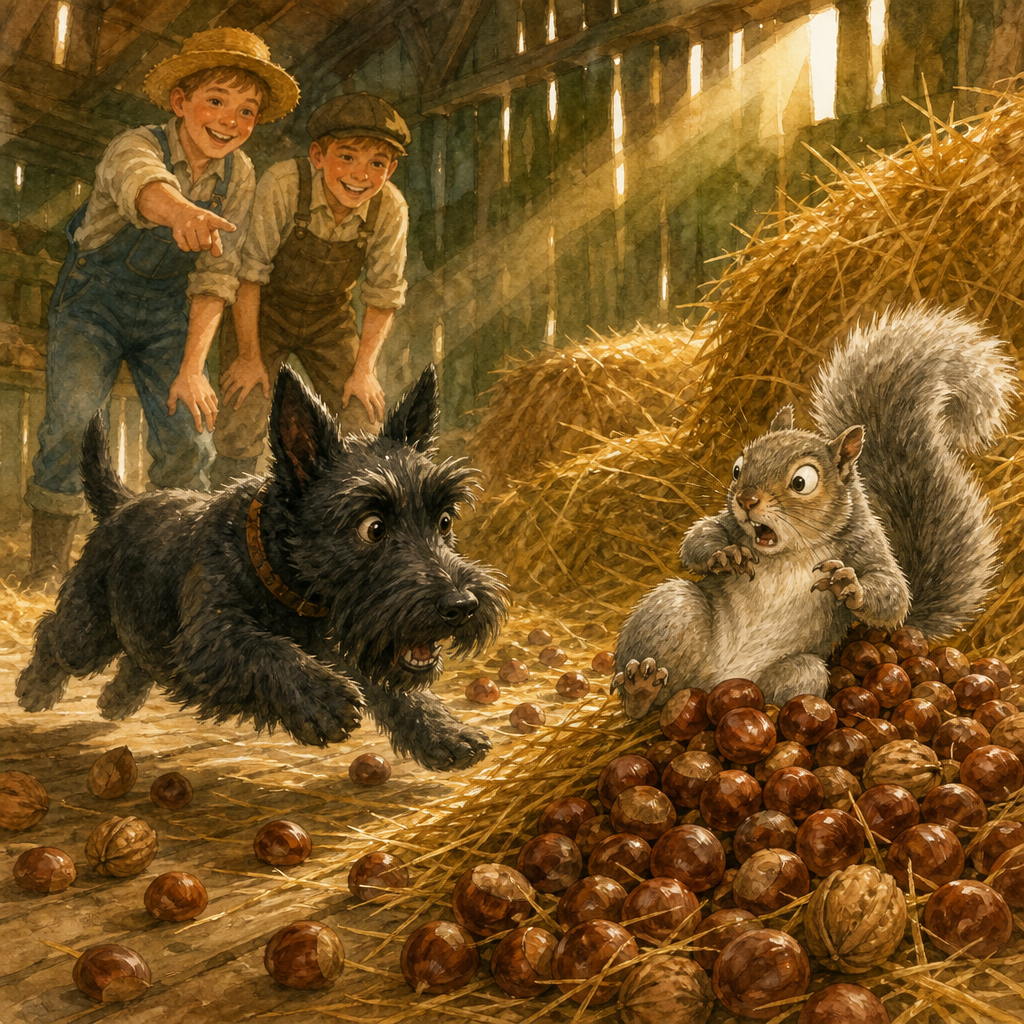
But one day, as Featherhead lounged in his hole, two boys came up with the friskiest, wiriest Scottish terrier you ever saw. The dog’s eyes blazed like torches. Featherhead’s heart sank to his toes when he heard the boys say, “Now we’ll see if we can catch the rascal who’s been eating our grain.”
He tried to slip out through the hole he had gnawed to get in, but it was blocked.
“Oh, you’re in there, are you, Mister?” cried one of the boys. “Well, you won’t get out. Now for a chase!”
And poor Featherhead ran in terror up and down through the bundles of hay, with the terrier barking at his heels and the boys shouting and cheering. At last he squeezed out through a crack, but he left half of his fine tail behind him, because Master Wasp, the terrier, snapped at it just as he was squeezing through. Alas! All the fur was stripped away, and what was left was as bare as a rat’s tail.
Poor Featherhead limped away, bruised and beaten, with the dog and boys still after him. They would have caught him, too, if Tip Chipmunk’s door hadn’t stood open to take him in. Tip took the very best care of him. But the glory of Featherhead’s tail was gone forever.
From that day on, though, he was a sadder and a wiser squirrel than he had ever been before.