I don’t know whether you know her. Perhaps you do. Anyway, you probably know someone like her. This particular little girl used to think she knew absolutely everything, and she was only eight years old.
When her daddy told her something, she’d say, “I know that.” When Mamma pointed out something new in a shop window, she’d say, “Oh, I’ve seen that before.” She simply would not admit there was anything she didn’t know. It was impossible to surprise her. If you bought her an umbrella for her birthday and asked afterwards whether she liked it, she’d say, “Well, I thought I was going to get an umbrella, anyway.”
Naturally, nobody enjoyed taking her anywhere. When visitors wanted to give the children a treat, they would whisper to her daddy, “I think we’ll just take the boys this time.” They were far too polite to say why, but Daddy knew exactly what the matter was.
One day there was great excitement in the house. Daddy announced that he was taking the little girl to London, just the two of them. She was delighted. Imagine being the only one chosen!
On the train, Daddy did his best to make the journey fun. He put away his newspaper and pointed out everything a little girl might like to see.
“I know that,” she said. “I’ve seen that before.”
After a while, Daddy got a little tired of it and changed the subject.
“Suppose,” he said, “you were to lose me in London. What would you do?”
“Oh, go home,” said the girl, not worried in the least.
“But how?”
“I’d just walk to the station and get on the train.”
“And how would you know the way?”
“Well… er… that’s easy. I know that.”
An hour later they were standing in Trafalgar Square, looking up at Lord Nelson on top of his tall column, cold and lonely against the sky. Crowds hurried past, but the girl hardly noticed. She was busy with the enormous bronze lions and the man on the pillar. She didn’t like to admit it was all new to her, but at last she turned to ask Daddy about it.
“Why,” she asked, “is that man with one arm standing up on that pole?”
She waited. She looked around. There was no Daddy.
“Daddy?”
No answer.
“Dad-deeeeeeee!”
Still nothing. Daddy had gone, and she was alone.
Suddenly she remembered what she’d told him on the train. She looked at the hundreds of people streaming past, at the huge buildings, at the buses and cars rushing down the streets, and the truth sank in: she had no idea how to get home. There were so many buses. How would she know which to take? She didn’t even know the name of the station to ask for.
She began to cry. For a little while nobody noticed, because everyone was in such a hurry. Then a big policeman crossed the road, bent down, and asked her kindly what was wrong.
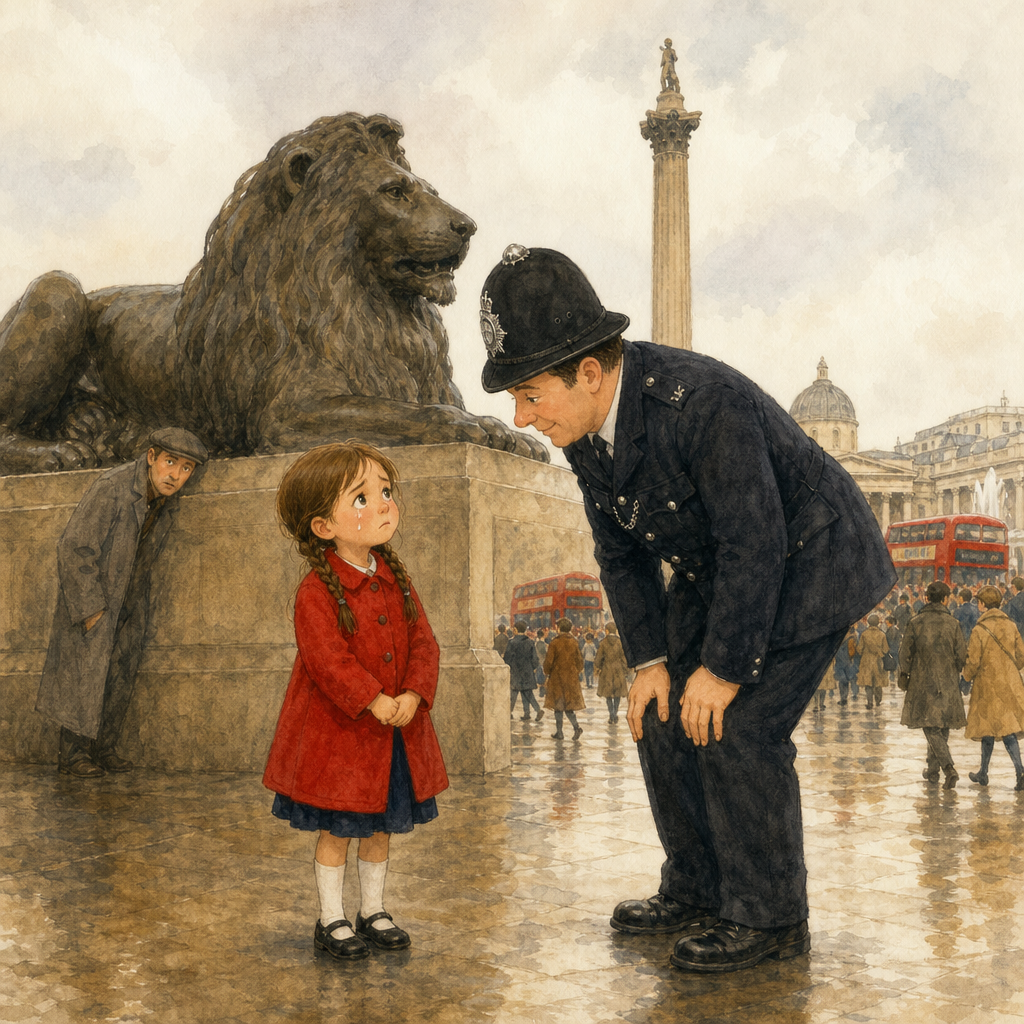
“I’m lost,” she whimpered.
“Lost? Who were you with?”
“My daddy. And he’s gone.”
“Gone where?”
“I don’t know. Boo-hoo-hoo!”
“Where do you live?”
“I don’t know. Boo-hoo-hoo!”
“Well, then, you’d better come along with me.”
“No! I don’t want to go to the police station!”
“I can’t leave you here, I’m afraid. But don’t worry, we’ll find your daddy.”
So the big policeman and the little girl set off together, her sobs growing quieter as she trotted along beside him. They hadn’t gone far when a familiar voice called out from behind them:
“Girlie!”
She forgot the policeman and all her troubles, spun around, and jumped into her daddy’s arms. (Flagged addition: Daddy had been keeping watch from behind the lion’s plinth the whole time.)
“Oh, I’m so glad you came!” she said. “I thought I was lost!”
They had a big hug, right there in Trafalgar Square.
“You see, girlie,” said Daddy afterwards, “I only wanted to find out whether you really did know the way home.”
And ever after, whenever the little girl was tempted to say “I know that,” she thought of the big policeman and Trafalgar Square, and didn’t say it.