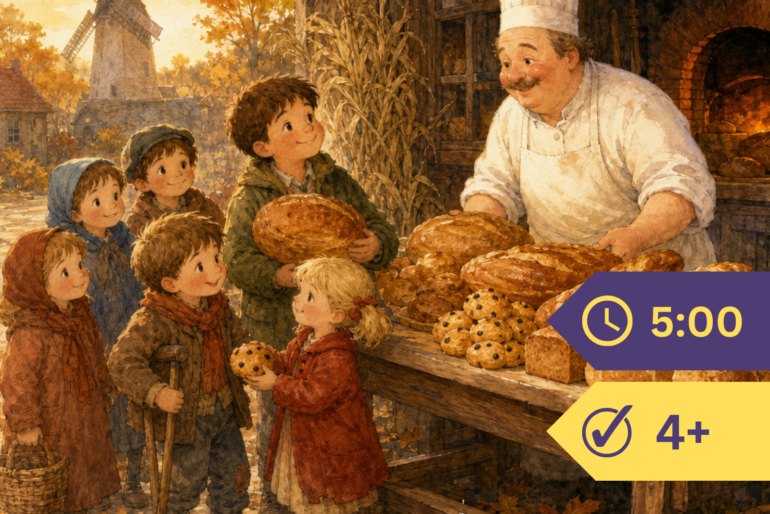
All the children were glad when the Little Baker came to town and hung a sign above his funny little brown shop:
“Thanksgiving Loaves to Sell.”
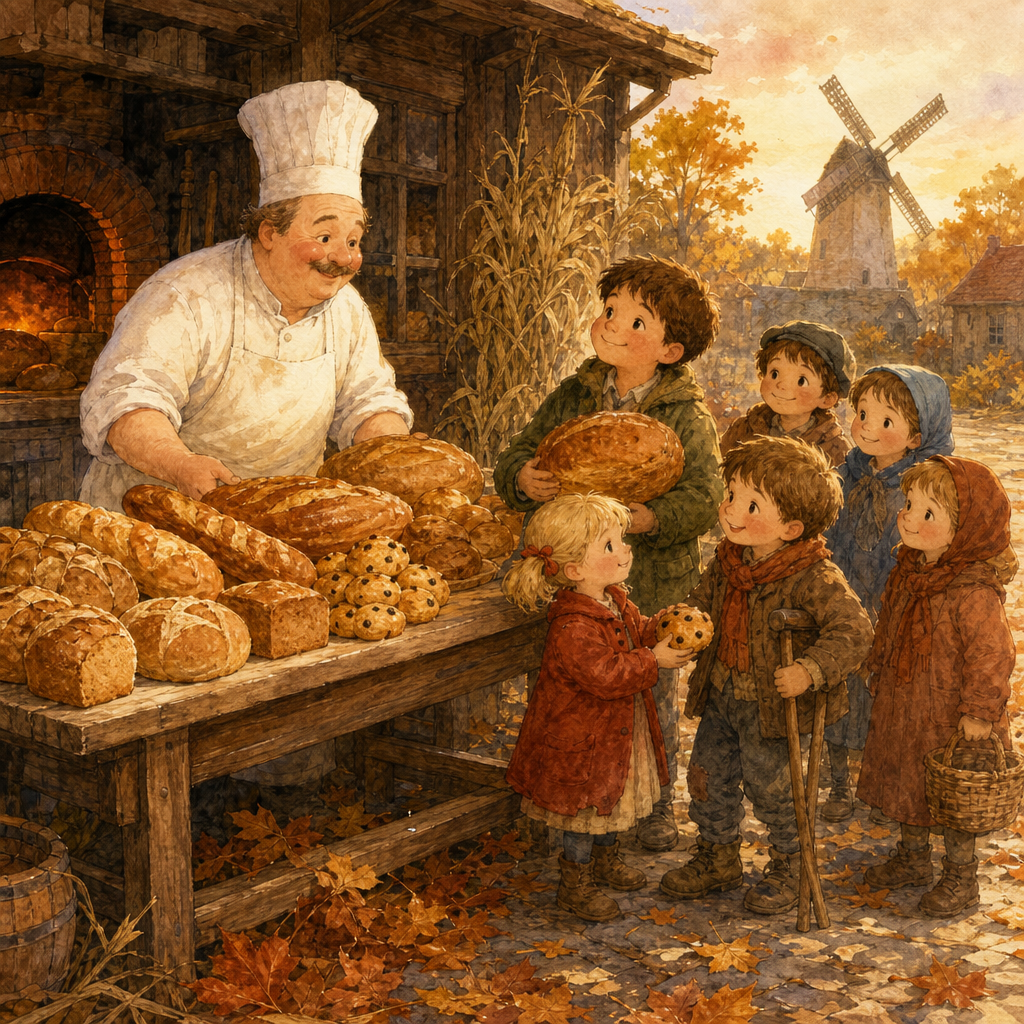
Each child ran to tell the next, until the streets rang with running feet and the clear November air was full of laughter. A crowd of small children gathered as near as they dared. The boldest crept so close they could feel the heat of the big brick oven and see the rows of gleaming baking pans.
The Little Baker never said a word. He washed his hands at the windmill’s water spout and shook them dry in the crisp air. Then he unfolded a long, spotless table in front of his door and began to shape the loaves, while the children edged closer and closer.
He shaped big, long loaves and tiny round ones. He made wee loaves studded with currants, square loaves with curious markings, fat loaves, flat loaves, and loaves in shapes the children had never seen. And as he worked, he sang softly:
“Buy my loaves of brown and white, Shaped for every child’s delight. Who forgets another’s need Eats unthankful, eats in greed; But the child who breaks his bread With another, Love has fed.”
Soon the children began to whisper.
“I’m buying the very biggest loaf,” said the Biggest Boy. “My mother lets me buy whatever I want. I’ll eat it all myself, and that’s fair, because I’m paying for it.”
“Oh,” said the Tiniest Little Girl. “That would be greedy. You could never finish a loaf that big.”
“If I pay for it, it’s mine,” the Biggest Boy said grandly. “Nobody has to share what’s his own.”
“Oh,” said the Tiniest Little Girl again, more softly this time. She slipped away from him, her eyes gone round.
“I have a penny,” she told the Boy with the Limp. “You and I could share one of those wee loaves. They have currants in them, so we won’t mind that it’s small.”
His face had turned wistful when the Biggest Boy talked about the great loaf. “Yes, let’s,” he said. “But you must take the bigger piece.”
Then the Baker raked the bright coals from the great oven into an iron basket and slid in the loaves, every one, while the children crowded closer with eager faces. When the last loaf was in, he shut the oven door with a clang so loud and merry that they all burst out laughing. He stood in his doorway, smiling, and sang again:
“Clang, clang, my oven floor, My loaves will bake as oft before, And you may play where shines the sun Until each loaf is brown and done.”
Away ran the children, singing the Baker’s song back to him as they went. Behind them, the raked-out coals popped and threw long red lights across the brown wall. Some children played hide-and-seek among the stacked cornstalks. Some ran through heaps of russet and gold leaves, just to hear them rustle. And some, too eager to play, hurried home for pennies.
At last the Baker called:
“The loaves are ready, white and brown, For every little child in town. Come buy Thanksgiving loaves and eat, But only Love can make them sweet.”
The children came flying like a cloud of leaves in the wind. At the shop they paused, whispering and giggling, while the Baker laid the loaves out on his spotless table.
“This one’s mine,” said the Biggest Boy. He slapped down a silver coin, snatched the great loaf, and ran off to eat it alone.
Then came the Impatient Boy, shouting, “Give me my loaf! Can’t you see my coin is silver? Don’t keep me waiting!”
The Baker said nothing. He didn’t smile, he didn’t frown, he didn’t hurry. He handed over the loaf and watched the boy dash away to eat it by himself.
Others came next, crowding and pushing with their money, the strongest and rudest at the front. Each snatched a loaf and ran off without a word of thanks. Some very little children looked on wistfully, unable to get near. All the while, the Baker calmly kept laying out his beautiful loaves.
When the crowd thinned, a Gentle Lad came up. He spent every penny he had to buy loaves for all the little ones, until no one was left without. The Tiniest Little Girl walked off hand in hand with the Boy with the Limp, to share their wee loaf, both of them smiling. And everyone who broke one of those smallest loaves found it larger than it had seemed.
But the Biggest Boy had begun to frown.
“This loaf is sour,” he said angrily.
“But it’s your own loaf,” said the Baker. “You chose it yourself, and you chose to eat it alone. Don’t blame the loaf when the choosing was yours.”
Then the children who had grabbed their loaves and run came creeping back. “We came for good bread,” they cried, “but ours are heavy as stones. Look at that boy with all those children. His bread is light! Give us light, sweet bread too!”
The Baker smiled a strange smile. “You chose in haste,” he said, “the way people choose when they’ve no thought of sharing. I can’t change your loaves, and I can’t choose for you. Had you forgotten, when you were buying, that these are Thanksgiving loaves? I will come again. Then you can choose more wisely.”
The children went away thoughtfully.
But the little ones and the Gentle Lad sat eating with joyful laughter. Every tiny loaf was broken into many pieces and passed around, and to them the bread tasted as fine as cake and as sweet as honey.
Then the Baker fetched cold water and put out the fire. He folded his table, took down the boards of his little shop, packed everything into his wagon, and drove away humming a quaint tune. Soft winds rustled the corn and tossed the branches together with a chuckle like music. And where the brown leaves lay deepest, in a little mound, the Tiniest Little Girl and the Boy with the Limp sat eating their sweet currant loaf together.