A hunter, gentle and kind, grew weary of the treachery and cruelty of the people he had known. He left them, and with his wife and three children he traveled until they found a spot beside a clear stream and built their lodge. They lived there peacefully and happily for many years, leaving it only to hunt, for the animals provided their food and clothing. At last the strong man fell ill, and before long he knew he would die.
He gathered his family and spoke his last words. “My wife, my companion all these days, you will follow me before many moons to the island of the blest. But you, my children, whose lives have just begun, will face the wickedness, unkindness and ingratitude I fled. I’ll go in peace if you promise to love each other always, and never to forsake your youngest brother.”
“Never!” they said, holding out their hands. And the hunter died content.
Barely eight moons later, as he’d said, the mother followed him. But before she left, she reminded the two older children of their promise never to leave the youngest, for he was small and weak. While the snow lay thick, they looked after him and kept him warm. But when the ground turned green again, the young man’s heart stirred, and he longed to see the village where his father had spent his youth.
He opened his heart to his sister. “Brother,” she said, “I understand your longing for other people. But remember what Father said. Shall we think only of our own pleasure and forget the little one?”
He didn’t answer. He took his bow and arrows and walked out of the lodge. The snows fell and melted, and he never came back. At last the girl’s heart grew cold and hard, and the little boy became a burden in her eyes. One day she said to him, “There’s food here for many days. Stay inside the lodge. I’m going to find our brother, and when I do, I’ll come back.”
After hard traveling, she reached the village where her brother lived. When she saw that he had a wife and was happy, and when a young man began to court her, she too forgot the child alone in the forest and thought only of her own happiness.
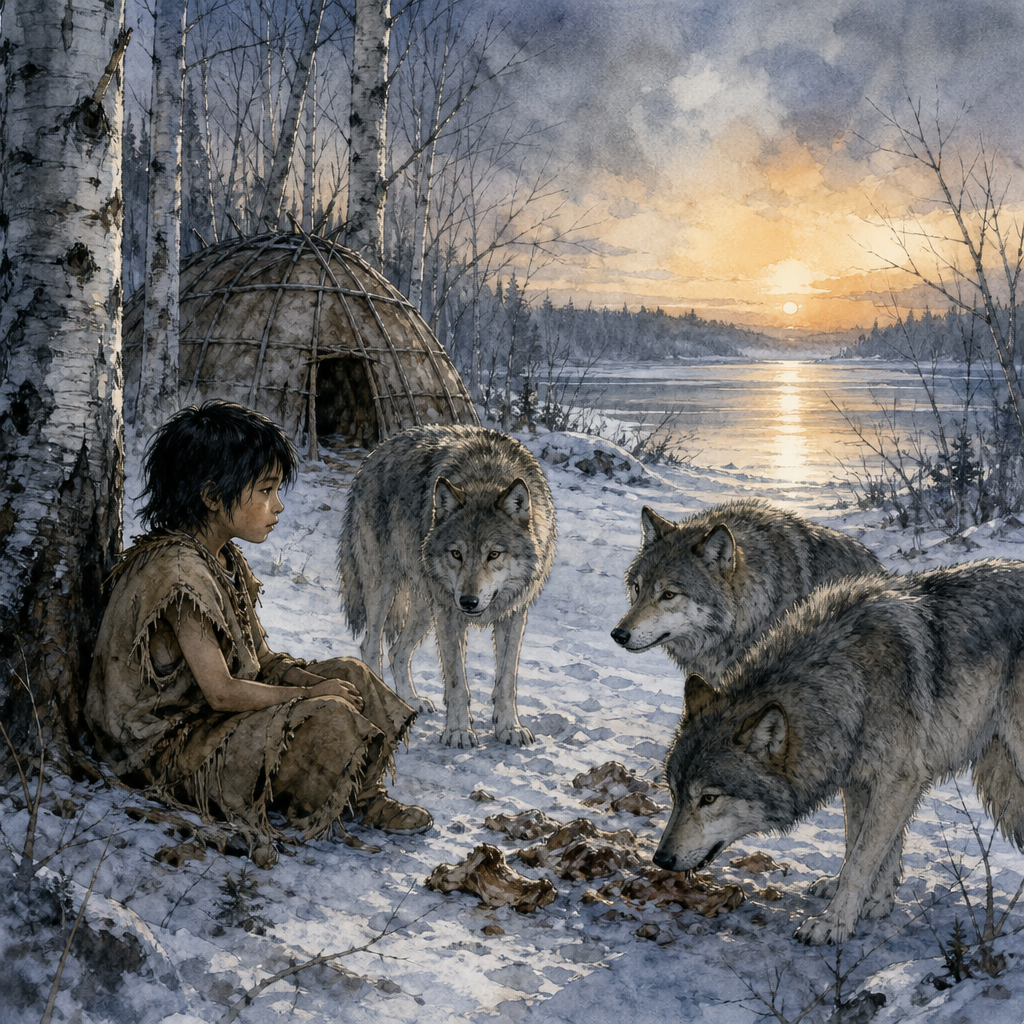
As soon as the boy had eaten all the food she’d left, he went into the woods and gathered berries and dug roots. While the sun shone, he was content and ate his fill. But when the snows came and the wind howled, he was hungry and cold. He hid in trees at night and crept out only to eat the scraps the wolves had left behind. Having no other friends, he began to sit near them while they ate, and they came to know him and shared their food. Without them, he would have died in the snow.
At last the snows melted, and the ice on the great lake broke up. When the wolves went down to the shore, the boy followed them. One day his big brother was fishing in his canoe near the shore, and he heard a child’s voice singing:
“My brother, my brother! I am becoming a wolf, I am becoming a wolf!”
And when the song ended, the child howled like a wolf. The elder brother’s heart sank. He paddled quickly toward him, calling, “Brother, little brother, come to me!” But the boy, now half a wolf, only sang again. The louder the older brother called, the faster the boy ran after his brothers the wolves, and the heavier his skin grew, until with a long howl he vanished into the depths of the forest.
The elder brother went back to the village with shame and anguish. He and his sister mourned the little boy and the broken promise for the rest of their lives.