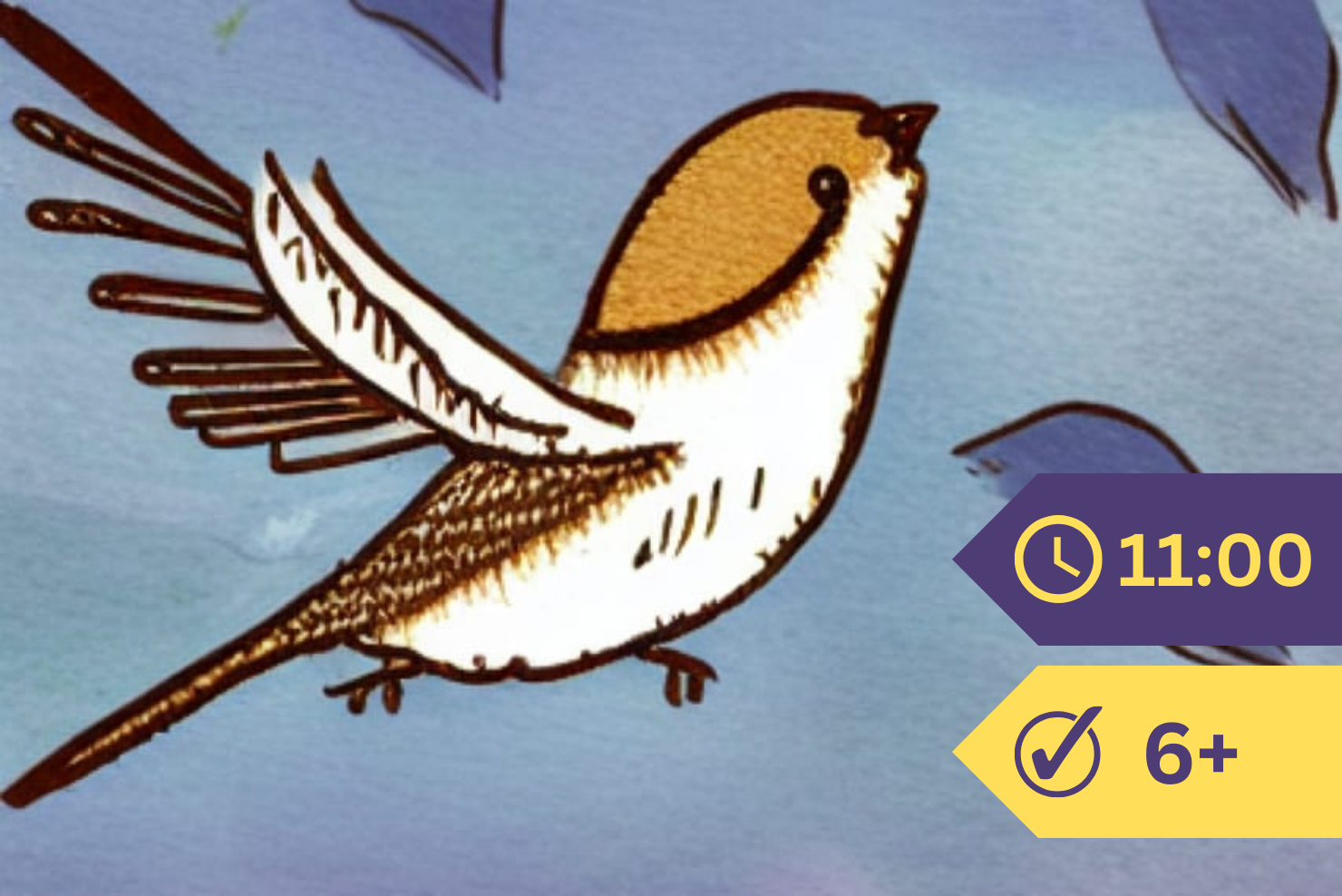
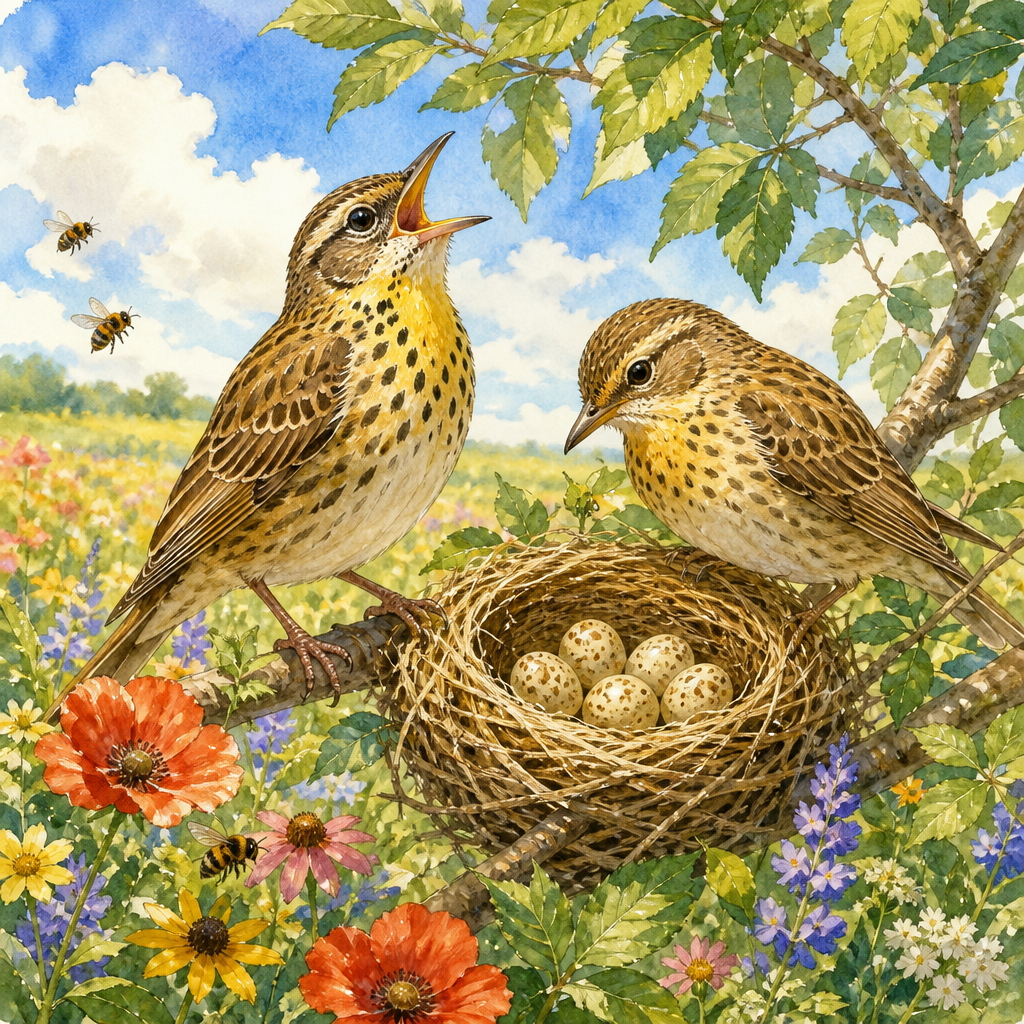
A pair of birds came to our fields that had never built a nest or seen a winter. How beautiful everything was! The fields were full of flowers, the grass was growing tall, and the bees were humming everywhere.
One of the birds began to sing, and the other said, “Who told you to sing?”
“The flowers told me,” he answered, “and the bees, and the wind and the leaves, and the blue sky. And you told me to sing.”
“When did I ever tell you to sing?”
“Every time you brought in tender grass for the nest. Every time your soft wings fluttered off again to find hair and feathers to line it.”
“But what are you singing about?” asked his mate.
“I’m singing about everything and nothing,” he said. “I sing because I’m so happy.”
By and by there were five little speckled eggs in the nest. “Is there anything in all the world as pretty as my eggs?” said the mother-bird. Then the two of them looked down at the people passing by and felt sorry for them, because they were not birds.
A week or two later, the father-bird came home to find his mate bursting with news. “Oh, what do you think has happened?”
“What?”
“One of my eggs has been peeping and moving!”
Soon another egg stirred under her feathers, and then another, and another, until five little birds had hatched. The father-bird sang louder than ever. The mother-bird wanted to sing too, but she had no time, so she turned her song into work. The babies were so hungry that both parents were kept busy feeding them. Off each one flew, and the moment the little ones heard wings fluttering in the leaves, five yellow mouths flew open wide, so wide that nothing could be seen but five yellow mouths!
“Can anybody be happier?” said the father-bird. “We’ll live in this tree always. There’s no sorrow here. It’s a tree that always bears joy.”
Before long the little birds were big enough to fly. How proud their parents were to see them leave the nest and sit huddled on the branches! What a to-do there was, the two old birds chattering and coaxing to get the young ones going on their own. In no time at all the young birds had learned to use their wings. They flew away and away, found their own food, built their own nests, and sang their own songs of joy.
Then the old birds sat silent and looked at each other, until the mother-bird said, “Why don’t you sing?”
“I can’t sing,” he answered. “I can only think and think.”
“What are you thinking about?”
“How everything changes. The leaves are falling from this tree, and soon there’ll be no roof over our heads. The flowers are going. There was frost last night. Almost all the other birds have flown. Something is calling me, and I feel as if I’d like to fly far away.”
“Let’s fly away together,” she said.
So they rose silently and climbed high into the air. They looked to the north, and far away they saw the snow coming. They looked to the south, and there they saw flowers and green leaves. All day they flew, and all night they flew, until they found a land where there is no winter, where flowers always blossom and birds always sing.