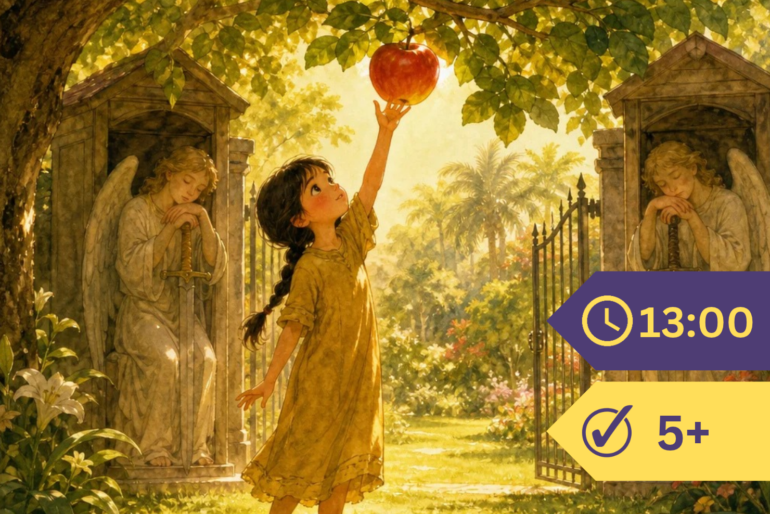
Marian’s mummy read her the Bible, so she knew all about Adam and Eve. But she never knew that Eve had a little daughter until Uncle Joe told her this story.
After her mummy and daddy, Marian loved Uncle Joe better than anyone in the world. He lived in a little house tucked into a dimple on the side of Fairbarrow Down, and a man called Mr Parker lived with him and helped keep the place tidy. Uncle Joe had been a soldier in a lot of faraway places, and when children asked him what he had fought for, he’d say, “Lost causes.” Between wars he had done a dozen other things, such as trying to find out what caused diseases, and whether plants from one place could be made to grow in another. Mr Parker had been a soldier too, a soldier of misfortune, he said. He had saved Uncle Joe’s life three times, and Uncle Joe had saved his twice.
Uncle Joe’s face was yellowish brown, from so much sun and fever. Mr Parker’s was red. He called himself a lone, lorn orphan, though he was much fatter than Uncle Joe, and every so often he would announce that it was rough weather in the Baltic, and nobody ever knew why.
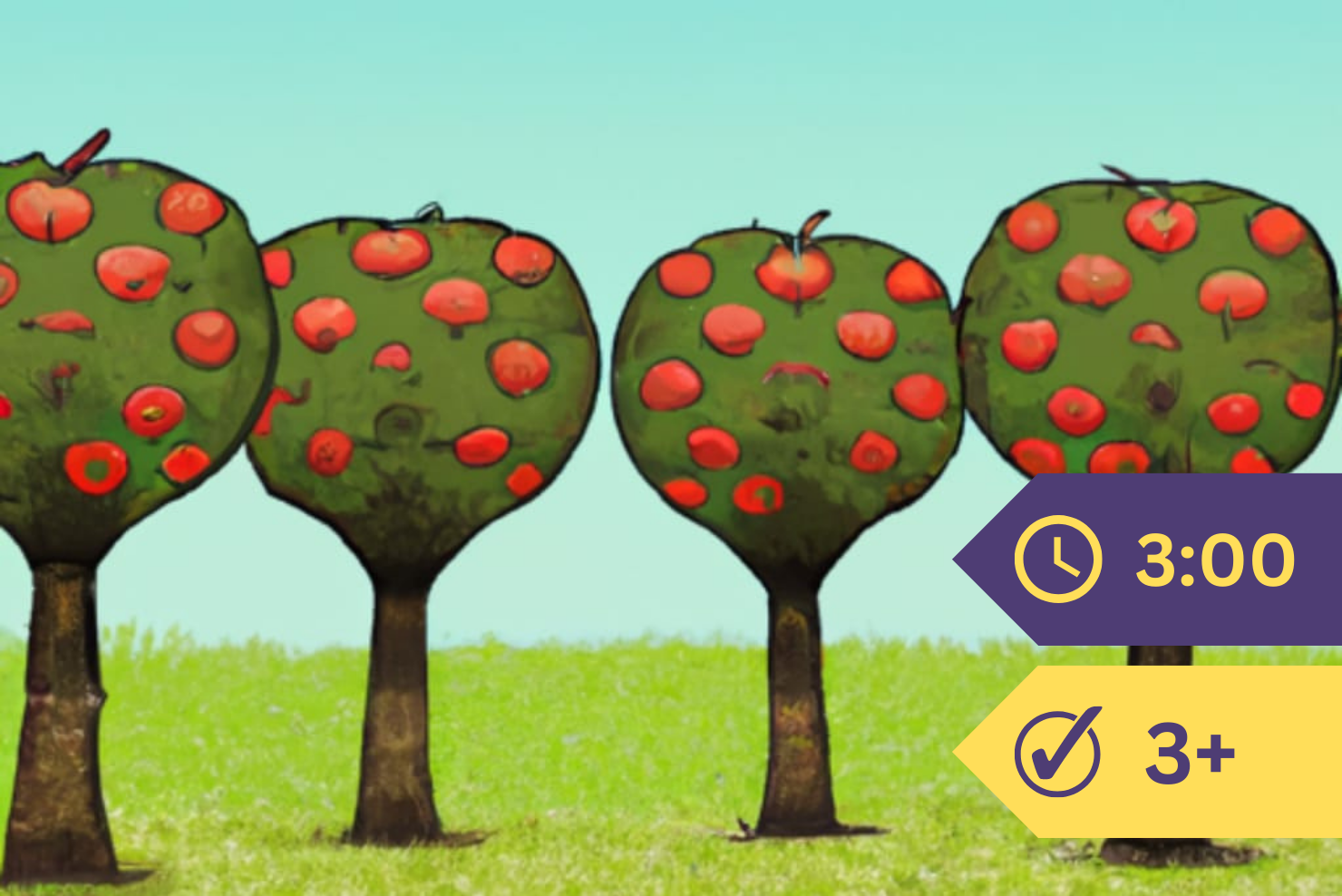
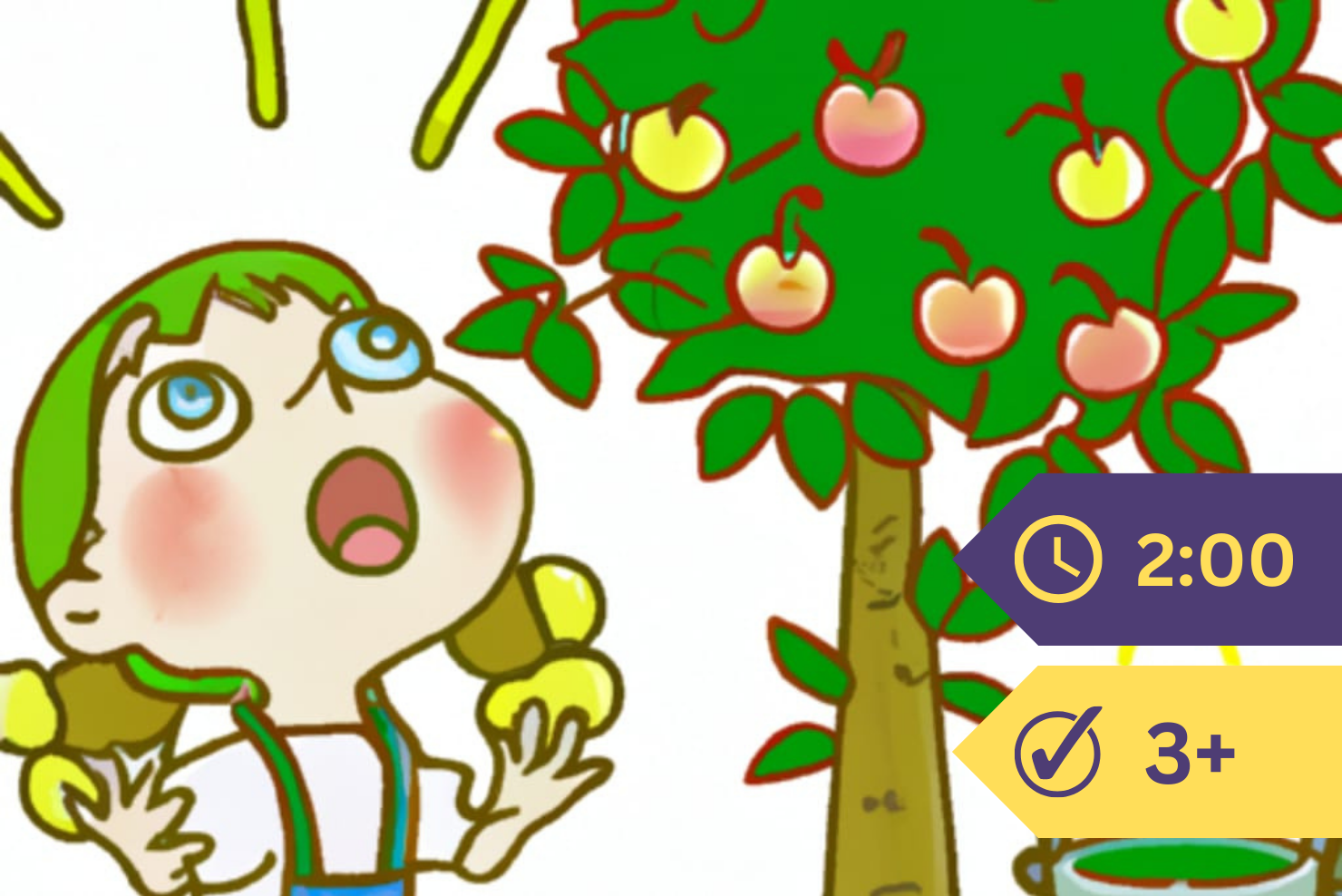
One spring afternoon Uncle Joe told Marian this story while they sat under one of his apple trees. The petals were beginning to fall, leaving tiny, weeny, baby apples behind. The only really ripe apples in the garden were the two in Marian’s cheeks.
“Those aren’t real apples,” said Marian.
“Well, it depends,” said Uncle Joe, “what you mean by real.”
“There’s more kinds of apples than a few,” said Mr Parker, who had come out to mow the lawn. “There’s eating apples and cooking apples and pineapples and crab-apples. There’s oak-apples and Adam’s apples and the apples what you see in little girls’ cheeks.”
“Kissing apples,” said Uncle Joe. “They’re one of the most important kinds.” He began to fill his pipe. “And now I think of it, one of the oldest. As old as Eve’s little girl.”
And he began to tell her about her.
“I’m not sure what her name was. Gretchen or Olga, Séraphine or Marie-Louise. I rather think it was Bella. You remember what happened in the Garden of Eden, and how Adam and Eve had to leave it, not because the good Lord God wanted to turn them out, but because He knew they could never be happy there any more. Every hour they stayed they’d have grown more miserable, and if they’d come back it would have broken their hearts. So He put two angels at the gate.
“He had wanted them to be a sort of grown-up babies in the loveliest nursery ever imagined, so that He could come and play with them whenever He was tired of running the universe. But once they’d heard about growing up and choosing for themselves, they could never be babies again, and it would have been cruel to keep them in the nursery.
“Of course they didn’t see it that way. They thought it very hard, and often grumbled. When they had learned to write, they sent Him cross letters and said unkind things about Him in books. Mostly that was because they had to work and look after themselves. But that was the only way, He saw, that they could ever be happy again. ‘They weren’t content just to be My playthings,’ He thought, ‘so now they must learn to be My comrades. In the end that may be best for everybody, though it’ll be a long, long time before they’ve learned how.’ And He sighed as He looked at the empty nursery and the animals they used to play with, just as mothers and fathers sigh now when their babies grow up and have to go to school.
“Just outside the Garden was a big town full of houses and factories and chimneys, and men and women working all day. Where had they come from? Well, the world is a big place, and there had been people in it a long time, outside the Garden, building and farming. Adam and Eve’s children, later on, married their children, so that everybody in the world now is half Garden and half world.”
“Even clergymen?” asked Marian.
“Even clergymen. And policemen and postmen.”
“And lone, lorn orphans,” said Mr Parker, “and the man what comes to mend the bath.”
“But I’m jumping ahead,” said Uncle Joe. “When Adam and Eve left the Garden, they didn’t know what children were, and their hearts were full of bitterness against the good Lord God. That was one reason He thought it would be good for them to have a little girl of their own. In time, He thought, they might begin to guess something of what He felt towards them.
“So about a year after they left, little Bella was born, and they thought she was the loveliest baby since the world began. They lived in a dark street on the edge of the town, in one room on the top floor at the back. Adam had a job at a boot-and-shoe factory, but he was only a beginner and his wages were small. Eve took in washing and darned socks, but she always kept their home tidy and fresh flowers on the mantelpiece. Every day she put crumbs on the window-sill, and soon she had made friends with the birds that came to eat them. Sometimes a bird would fly from the Garden, and feed from her hand, and tell her the news. Adam and Eve knew the birds’ language from living with them so long, but they never managed to teach it to their children, and since they died nobody has learned it.
“Soon after Bella came a rise in wages, and soon after that, another baby, and then more, and though they rented another room or two they were always poor and often hungry. But gradually they thought less often of the Garden. Sometimes they even wondered whether they’d go back if the good Lord God gave them the chance. Despite the poverty and the noise and the smells, they had learned what it meant to have children, and to bend over their cots and kiss them good night.
“When Bella was eight, she was a plump little girl with dark eyes and an impudent mouth. She wore her hair in a long pigtail, and her nose was ever so slightly turned up. Her parents thought she was beautiful. Everybody else thought her quite ordinary. She spent most of her time in the streets, though she was always on time for meals. She had lots of friends, mostly boys, but every so often she’d get tired of them all, and then she would go exploring and usually end up hurting herself. Eve was too busy to keep track of her. The one thing she had strictly forbidden was for Bella to go anywhere near the Garden of Eden. It was the rule that nobody should, with angels at the gate and swords of flame, and Eve thought it would be far worse for one of her children to break it than anybody else.
“So she had always told Bella never to go even as far as the street that led to the fields outside the Garden. And if Bella hadn’t been bored on this particular day, a week after her birthday, and if it hadn’t been so hot and dusty and everybody so cross, and if she hadn’t been as curious as her mother used to be, and if she hadn’t just happened to be walking up that street, and if the fields at the end hadn’t looked so cool, and if her friend Bobby Gee hadn’t dared her to do it, well, there’s no knowing, but perhaps she wouldn’t have ended up looking through those dreadful gates.
“Only a strip of grass lay between her and the Garden. In the afternoon heat the leaves of the trees hung heavy and still. The lawns looked like wax. And where were the angels? Bella held her breath. There was nobody. Only the sentry-boxes.
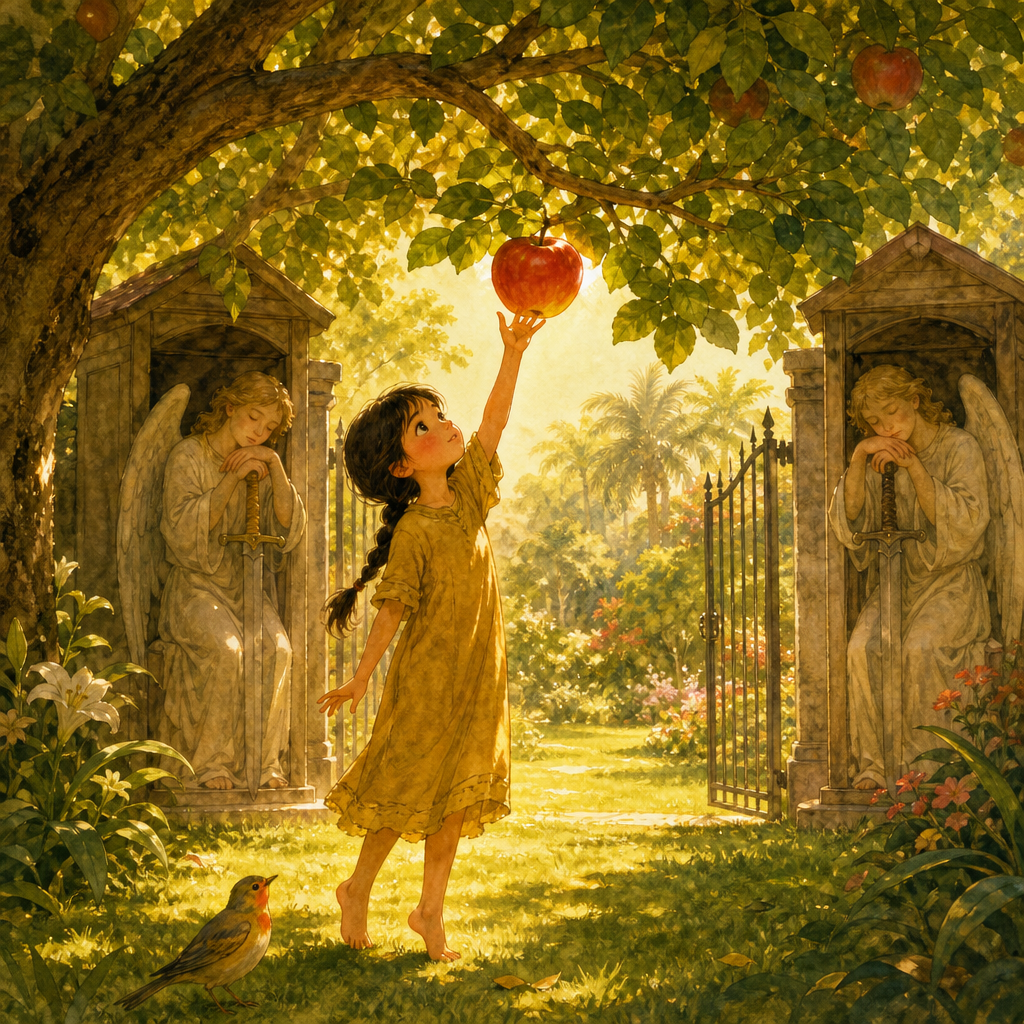
“She crept forward. Her bare feet made no sound. The bars of the gate shivered in the heat. She stopped and listened, and, very faint, like the sea hundreds of miles away, came a sound that rose and fell. Then another. They came from the sentry-boxes. The angels were fast asleep. Bella bit her lip. She could feel her heart jumping like a mouse in a cage. The scents of the Garden came to meet her.
“What made her eyes grow round was a bending tree just inside the gate, with such apples as she had never seen. From the lowest bough hung the biggest and most beautiful of all. Her mouth began to water. As she pressed against the bars, the gate began to move. Slowly it swung open, and still the angels slept. What an apple it would be to eat! A bright bird hopped across the grass and looked up at her. She glanced over her shoulder. Nobody. She thought about the rules, and what her mother had said, and then she remembered Bobby Gee.
“She stepped into the Garden and tiptoed up to the tree. The apple was so ripe it was nearly ready to fall, and it hung just level with her nose. It smelled like honey, and when she touched it it was cool as marble. She touched it again and took hold of it, and somehow it came off the tree. She lifted it to her lips, and it felt like a kiss. And then a Voice behind her said:
“‘Well?’
“She whirled round. It was the good Lord God.
“‘What are you doing?’
“She hid the apple behind her back, but His eyes shone through her like light through a window. She hung her head.
“‘Are you Eve’s little girl?’
“Bella nodded. She couldn’t say a word.
“‘I thought you must be.’ He put His finger under her chin. There came a sound like a great wind. The two angels had heard His voice, and they had drawn their swords and leaped into the Garden. In another moment, Bella thought, they would have killed her. But the good Lord God held up His hand. They stood on either side of Him, leaning on their swords, looking rather downcast. Bella held out her hand. He took the apple from her.
“‘What excuse have you for stealing My apples?’
“Bella thought for a moment. She thought of one.
“‘Please, sir, mother did it. She told me so.’
“‘But you knew the rules.’
“She hung her head again. She knew them quite well.
“‘And rules must be obeyed.’
“Bella began to tremble. The angels stood like statues. Then the good Lord God spoke again.
“‘Look at Me.’
“Bella lifted her eyes and saw the World without End. He gave her back the apple.
“‘You may keep it,’ He said, ‘on condition that you give half to Bobby Gee.’
“‘Thank you, sir.’
“‘But that’s not all.’ He bent and touched her cheeks. ‘I hereby ordain that now and for ever every little girl and every little boy shall wear apples in their cheeks, in remembrance of what you have done. They shall be known as the brand of Eden, the brand of Eden for little thieves, and their parents must see to it, on pain of My displeasure, that they never be allowed to fade away.’
“Then He bent lower and gave her a kiss, and the tall angels led her outside the gate. And that’s why the apples in little girls’ cheeks are almost the oldest kind in the world.”
Uncle Joe lit his pipe. From where they sat they could see the countryside for miles, and the town below looked small, with the spire of St Peter’s Church like a toy. Far beyond it, past the level cornfields, the sun was sinking into the evening mist. It grew rosier and rosier until it looked like an apple itself. Mr Parker winked at Marian.
“Rough weather,” he said, “in the Baltic.”
Then he spat on his hands and rubbed them together. “Well, I must be getting along with this here lawn-mowing.”
A tiny verse retelling the legend, left in the author’s words.
Eden had an apple-tree,
Eve a little daughter,
Tried to do as mother did,
But the Good Lord caught her.
“Wherefore ’tis ordained,”
He said, “Here and in all places,
Children shall henceforward wear
Apples in their faces.”