San Giuliano was the only son of his parents, who lived in the hill town of Albano. In his youth he was wild enough to give them worry, but what worried them far more was this: an astrologer had foretold that when he grew up, he would kill both his father and his mother.
“It isn’t our lives we’re most anxious about,” they said to each other. “Lives are not such a great matter. But we must put him out of reach of committing so terrible a crime.” So they gave him a horse and his share of money, and told him to ride out into the world and make a home elsewhere.
And so he went, and thirty years passed. Thirty years is a long time. Many things are forgotten in thirty years — even an astrologer’s warning. But one thing a mother never forgets, and that is her child. Even after all that time, Giuliano’s mother longed for him as though he had only left yesterday.
One afternoon they were walking in the woods near Albano when they saw a little boy climb into a tree and take a bird’s nest. After the boy had gone, the parent birds came back, calling and fluttering about the empty branches in anguish.
“Look,” said Giuliano’s mother. “Even these little birds grieve for the loss of their young — and we have been content to live apart from our only son.”
“We have not been content,” said his father. “Let us go and find him.”
They put on pilgrims’ cloaks and set out on foot. Over mountains and plains they walked, until they came at last to a city — a place called Galizia, as they understood it — and there, footsore and weary, they were greeted by a gentle lady who saw them and said at once: “Where do you come from, poor pilgrims? What a long journey you must have had.”
They told her they were from the hill town of Albano, and that they were searching for a son named Giuliano.
“Giuliano!” she cried. “That is my husband’s name. He is out hunting just now, but come in with me and rest.” She brought them in, washed their feet, fed them, and gave them her own bed to sleep in.
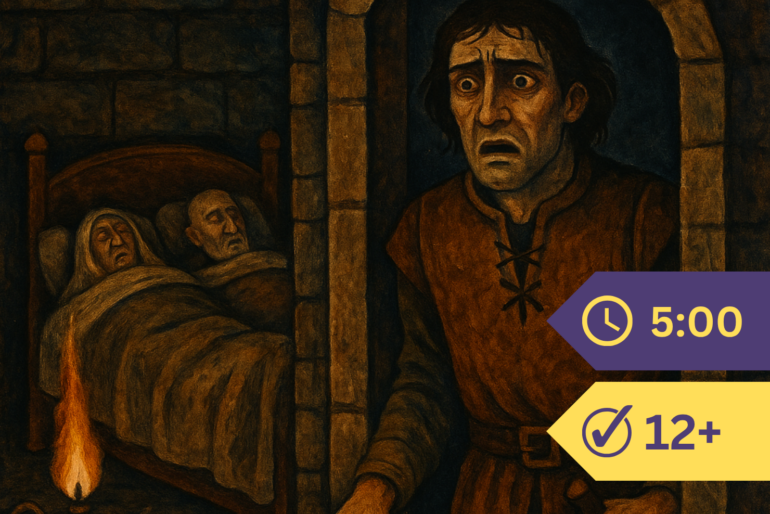
But while she was showing this kindness, the Devil came to Giuliano out in the fields and poured jealous thoughts into his mind — whispers and insinuations about his wife, growing darker as the day grew late. By the time Giuliano rode home, his blood was up. He came into the house and went straight to the bedroom, and seeing two figures in the bed, drove his hunting knife into them before he had taken a breath.
He killed them both. He had killed his own father and mother, without knowing them.
When he came out of the room, his wife was there, coming to welcome him home.
“You — here?” he said. “Then who are those in the bed that I have killed?”
“Killed?” she said. “They were a pilgrim couple — an old man and woman who came searching for their son, a man named Giuliano. I gave them our bed to sleep in, for love of your name.”
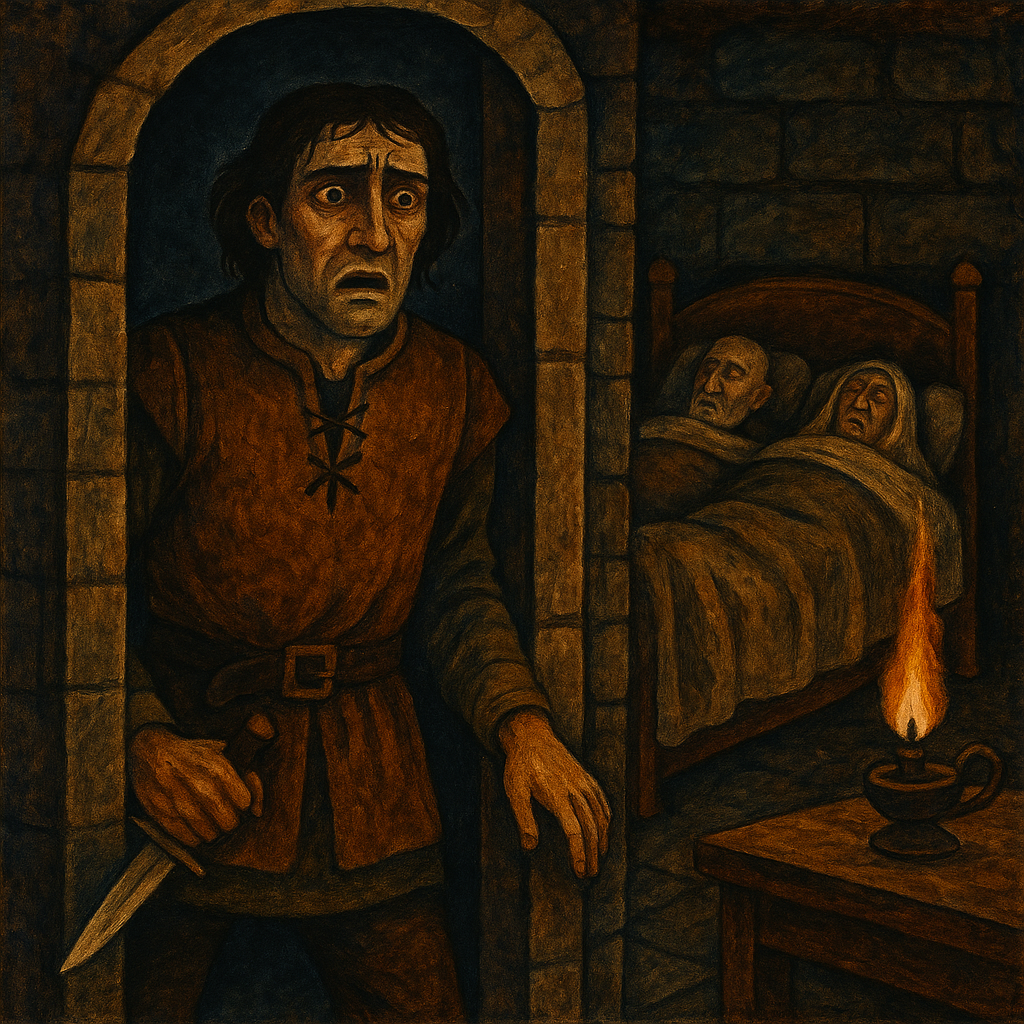
Then Giuliano understood what he had done, and the knowledge struck him like a blow. He stood as if dead, and for a long time could not speak. At last his wife came to him.
“We will do penance together,” she said. “We will lay aside ease and comfort, and give ourselves to the poor.”
He took her hands. “It is well spoken,” he said.
Near where they lived there was a swift river with no bridge, and many pilgrims had drowned trying to cross, or gone miles out of their way. Giuliano said: “We will build a bridge.” And many pilgrims came to the city with no roof over them at night, so he said: “We will build a hospice, and tend every pilgrim who comes, until God forgives me.”
They set out for Rome to find craftsmen. But on the road, a band of workmen met them, cheerful and eager. “We’ll do it! We’ve built many bridges before,” they cried. So Giuliano brought them back, and in only two days the bridge was standing.
“This cannot be right,” said Giuliano’s wife, who was holy enough to sense what others could not. “There is something wrong here.” She trusted her husband’s good sense enough to make a test. “Take a round hard cheese,” she said, “and roll it along the bridge, and let the dog run after it. If they cross safely, well enough.”
Giuliano did as she said. The cheese rolled out onto the bridge — and when dog and cheese reached the middle, the whole thing collapsed into the river. The Devil had built it, and it would not hold a Christian crossing.
“God has not forgiven me yet,” said Giuliano. “Now let us build the hospice.”
This time, when the same band of eager workers appeared on the road, Giuliano and his wife walked past them without a word, and went all the way to Rome to hire honest craftsmen. The hospice was built, and every pilgrim who came was welcomed, fed, and sheltered.
At last the house was full — every bed taken, every corner occupied — when one more old man appeared at the door.
“Friend,” said Giuliano’s wife, “it breaks my heart to say it, but there is not a bed left, nor so much as an empty corner.”
“If you cannot receive me,” said the old man, “it is because you have already done so much charity on my account. Take this, then.” He held out his pilgrim’s staff and went on his way.
But it was Jesus Christ himself who had come in the shape of that old man. And when Giuliano took the staff, three flowers blossomed on it, and he understood.
“See,” he said. “God has forgiven me.”