Once upon a time the forest was in a great commotion. Early in the evening the wise old cedars had shaken their heads ominously and predicted strange things. They had lived in the forest many, many years, but never had they seen such marvellous sights as were to be seen now in the sky, and upon the hills, and in the distant village.
“Please tell us what you see,” pleaded a little vine. “We who are not as tall as you can see none of these wonderful things. Describe them to us, that we may enjoy them with you.”
“I am filled with such amazement,” said one of the cedars, “that I can hardly speak. The whole sky seems to be aflame, and the stars appear to be dancing among the clouds; angels walk down from heaven to the earth, and enter the village or talk with the shepherds upon the hills.”
The vine listened in silent astonishment. Such things had never happened before. It trembled with excitement. Its nearest neighbour was a tiny tree, so small it was scarcely ever noticed; yet it was a very beautiful little tree, and the vines and ferns and mosses and other humble residents of the forest loved it dearly.
“How I should like to see the angels!” sighed the little tree. “And how I should like to see the stars dancing among the clouds! It must be very beautiful.”
As the vine and the little tree talked of these things, the cedars watched with growing interest the wonderful scenes beyond the forest’s edge. Presently they thought they heard music — and they were not mistaken, for soon the whole air was full of the sweetest harmonies ever heard upon earth.
“What beautiful music!” cried the little tree. “I wonder where it comes from.”
“The angels are singing,” said a cedar, “for none but angels could make such sweet music.”
“But the stars are singing too,” said another cedar. “Yes, and the shepherds on the hills join in the song — and what a strangely glorious song it is!”
The trees listened to the singing, but they did not understand its meaning. It seemed to be an anthem, and it was of a Child who had been born; but beyond that they could not follow. The strange and glorious song continued all through the night; and all that night the angels walked to and fro, and the shepherd-folk talked with the angels, and the stars danced and carolled in high heaven. It was nearly morning when the cedars cried out: “They are coming to the forest! The angels are coming to the forest!”
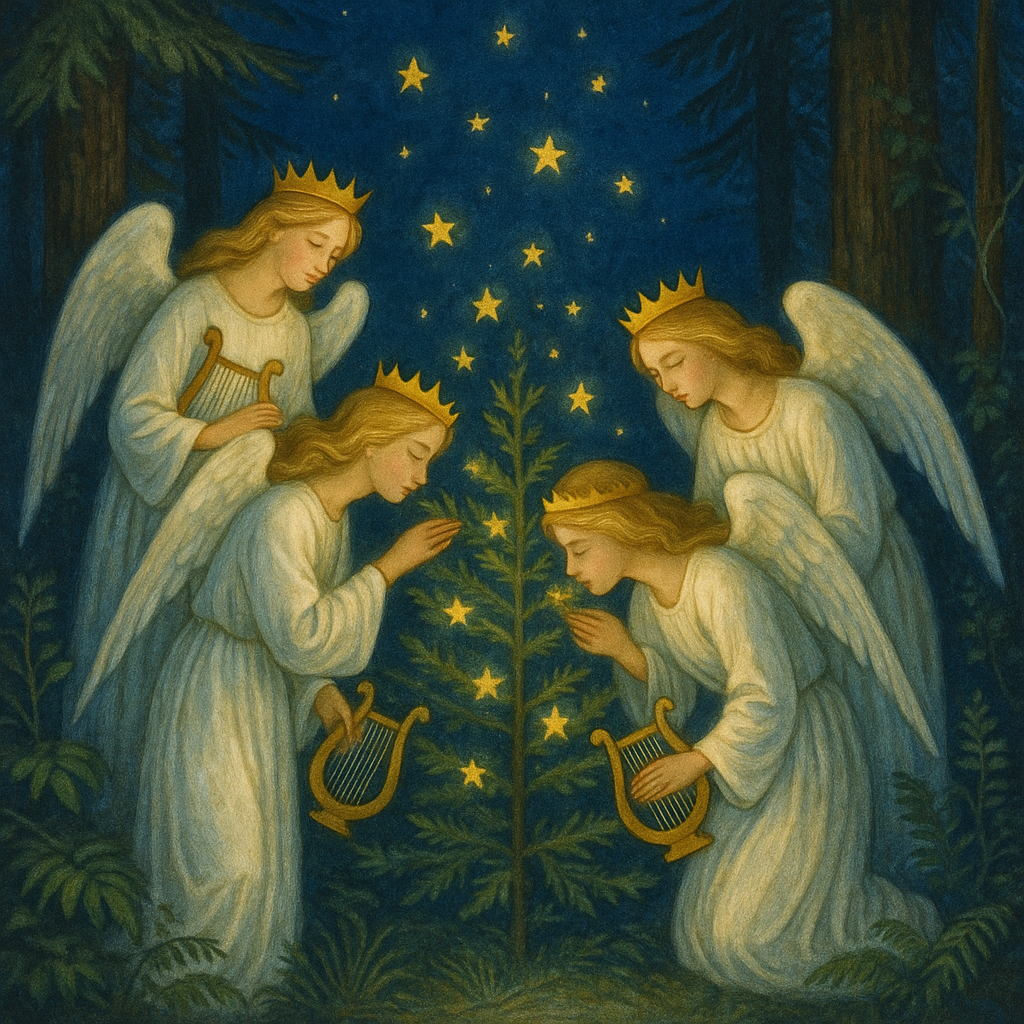
And surely enough, this was true. The vine and the little tree were very frightened and begged their older, stronger neighbours to protect them from harm. But the cedars were too busy with their own fears to heed the faint pleadings of the humble vine and the little tree. The angels came into the forest, singing the same glorious anthem about the Child, and the stars sang with them, until every part of the woods rang with echoes of that wondrous song. There was nothing in the appearance of that angel host to inspire fear: they were clad all in white, with crowns upon their fair heads and golden harps in their hands; love, hope, charity, compassion, and joy beamed from their beautiful faces, and their presence seemed to fill the forest with a divine peace.
The angels came through the forest to where the little tree stood, and gathering around it, they touched it with their hands and kissed its little branches and sang more sweetly than before. And their song was of the Child, the Child, the Child who had been born. Then the stars came down from the skies and danced and hung upon the branches of the tree, and they too sang that song — the song of the Child. And all the other trees and the vines and the ferns and the mosses beheld it in wonder, and could not understand why all these things were being done, or why such honour should be shown to the little tree.
When morning came the angels left the forest — all but one, who remained behind and lingered near the little tree. A cedar asked: “Why do you stay with us, holy angel?” And the angel answered: “I stay to guard this little tree, for it is sacred, and no harm shall come to it.”
The little tree felt quite relieved by this assurance, and held up its head more confidently than ever before. And how it thrived and grew and gained in strength and beauty! The cedars said they had never seen the like. The sun seemed to lavish its choicest rays upon the little tree, heaven dropped its sweetest dew upon it, and whenever the winds came to the forest they forgot their rough ways and lingered to kiss the little tree and sing it their prettiest songs. No danger ever threatened it; for the angel never slept — through the day and through the night the angel watched the little tree and kept it from all harm. From time to time the trees spoke with the angel, but of course they understood little of what he said, for he spoke always of the Child who was to become the Master; and always when he spoke thus, he caressed the little tree and stroked its branches and leaves, and moistened them with his tears. It was all very strange, and none in the forest could understand.
So the years passed, the angel watching his blooming charge. Sometimes beasts strayed toward the little tree and threatened to strip its tender foliage; sometimes a woodman came with his axe, intent on hewing down the straight and shapely thing; sometimes the hot, consuming breath of drought swept from the south and sought to blight the forest and all its greenery. The angel kept them from the little tree. Serene and beautiful it grew, until at last it was no longer a little tree, but the pride and glory of the forest.
One day the tree heard someone coming through the forest. Until that day the angel had always hastened to its side when men approached; but now the angel strode away and stood beneath the cedars.
“Dear angel,” cried the tree, “can you not hear the footsteps of someone approaching? Why do you leave me?”
“Have no fear,” said the angel. “He who comes is the Master.”
The Master came to the tree and beheld it. He placed His hands upon its smooth trunk and branches, and the tree was thrilled with a strange and glorious delight. Then He stooped and kissed the tree, and turned and went away.
Many times after that the Master came to the forest, and when He came it was always to where the tree stood. Many times He rested beneath it and enjoyed the shade of its foliage and listened to the music of the wind rustling through the leaves. Many times He slept there, and the tree watched over Him, and the forest was still, and all its voices were hushed. And the angel hovered near like a faithful sentinel.
From time to time men came with the Master to the forest and sat with Him in the shade of the tree and spoke of things the tree could never quite understand — only it heard that the talk was of love and charity and gentleness, and it saw that the Master was beloved and honoured by all who came. It heard them speak of His goodness and humility — how He had healed the sick and raised the dead and given blessings beyond counting wherever He walked. And the tree loved the Master for His beauty and His goodness; when He came to the forest the tree was full of joy, and when He came not, it was sad. The other trees of the forest joined in its happiness and its sorrow, for they too loved the Master. And the angel always hovered near.
The Master came one night alone into the forest, and His face was pale with anguish and wet with tears, and He fell upon His knees and prayed. The tree heard Him, and all the forest was still, as if standing in the presence of death. And when morning came, the angel had gone.
Then there was a great confusion in the forest. There was a sound of rough voices and a clashing of swords and staves. Strange men appeared, uttering loud oaths and cruel threats, and the tree was filled with terror. It called aloud for the angel, but the angel did not come.
“They have come to destroy the tree,” cried the vine, “the pride and glory of the forest!”
The forest was deeply troubled, but it was in vain. The strange men plied their axes with cruel force, and the tree was hewn to the ground. Its beautiful branches were cut away and cast aside, and its soft, thick foliage was scattered to the mercy of the winds.
“They are killing me!” cried the tree. “Why is the angel not here to protect me?”
But no one heard the piteous cry — none but the other trees of the forest; and they wept, and the little vine wept too.
Then the cruel men dragged the stripped and felled tree from the forest, and the forest saw that beautiful thing no more.
But the night wind that swept down from the City of the Great King to ruffle the waters of distant Galilee lingered a moment in the forest to say that it had seen, that day, a cross raised up on Calvary — the tree on which was stretched the body of the dying Master.