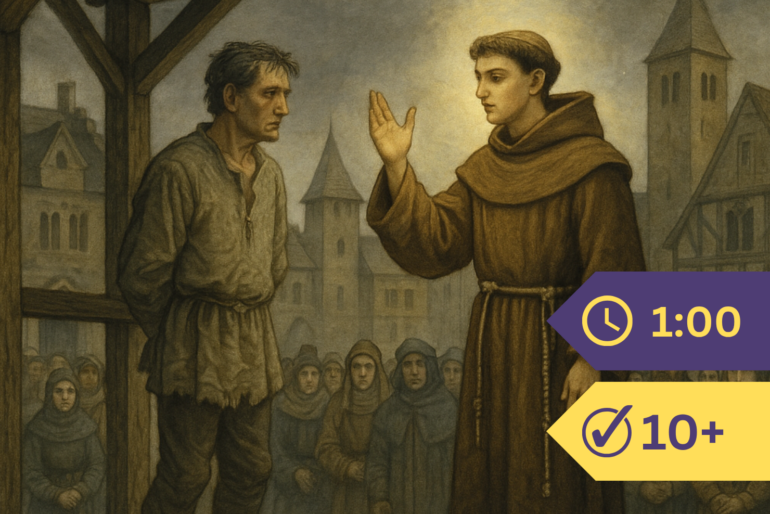
St. Anthony’s father was accused of murder. The facts seemed to be against him, and the court condemned him to be executed.
St. Anthony was in the middle of a sermon when his father was led to the scaffold. He paused for a moment. “Allow me to stop for a breath,” he told the congregation, and he was still — and then went on again.
But in that minute’s pause, though no one in the church had lost sight of him, he had gone to the scaffold.
“What are you doing to that man?” he asked the executioner.
“He has committed murder and is to die for it.”
“He has murdered no one. Bring me the dead man.”
No one knew who was speaking, but something in the voice made them obey without question.
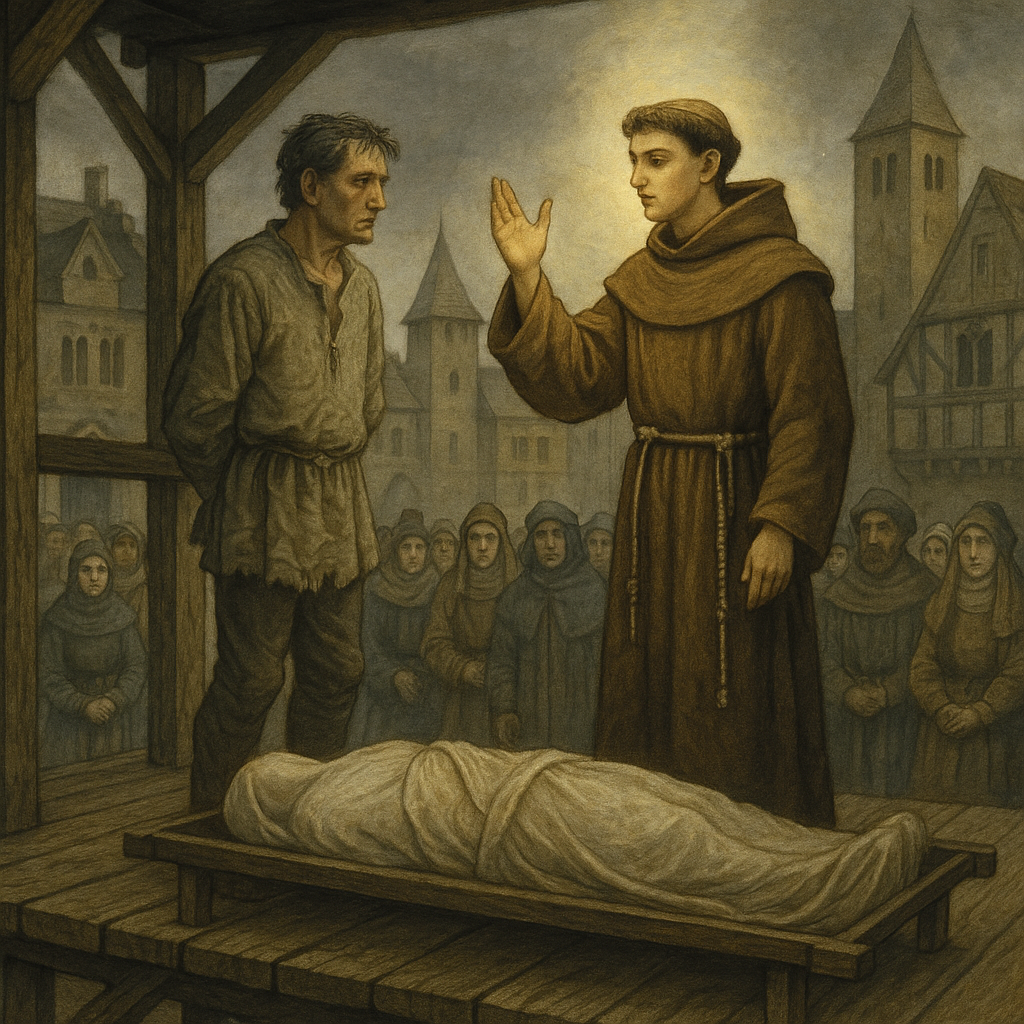
When the body was brought, St. Anthony said to it: “Is this the man who killed you?”
The dead man opened his eyes. He looked at the condemned man.
“No,” he said. “That’s not the man at all.”
“And you yourself,” said St. Anthony, “where are you?”
“I should be in Paradise,” said the dead man, “but there is an act of excommunication against me, and so I am in Purgatory.” Then St. Anthony bent his ear close and heard the man’s confession, and when it was done he released him from the bond, and the man went straight to Paradise.
St. Anthony’s father was declared innocent and set free.
And all that time, no one in the church had noticed St. Anthony leave the pulpit.