St. Anthony was a handsome young man, as anyone can see in his pictures. As he went about preaching, a young woman fell into an admiration of him that was more than admiration — her name was Castitre, and she placed herself in his path whenever she could find out which way he was going.
At first St. Anthony kept his eyes on the ground and ignored her. Then he rebuked her, but she only followed the more. And then he had a thought — a saint’s thought, full of honesty. It is not she who deserves rebuke. It is I, who have become an occasion of sin to her. God grant that her fault be not counted against her for loving me.
The next time she stepped out in front of him, it was in a deserted stretch of the Campagna.
“Brother Antonio,” she said, “come with me down that path — no one will see us there.”
What surprised her was this: instead of the cold manner he had always used, St. Anthony greeted her with a smile. And something in that smile filled her with a joy she had never felt before — quite different from what she had expected. He seemed willing to walk with her, and she led the way.
But as she went, everything around her changed. The path she knew was gone. The countryside looked different. And yet — how could it be different? She led on.
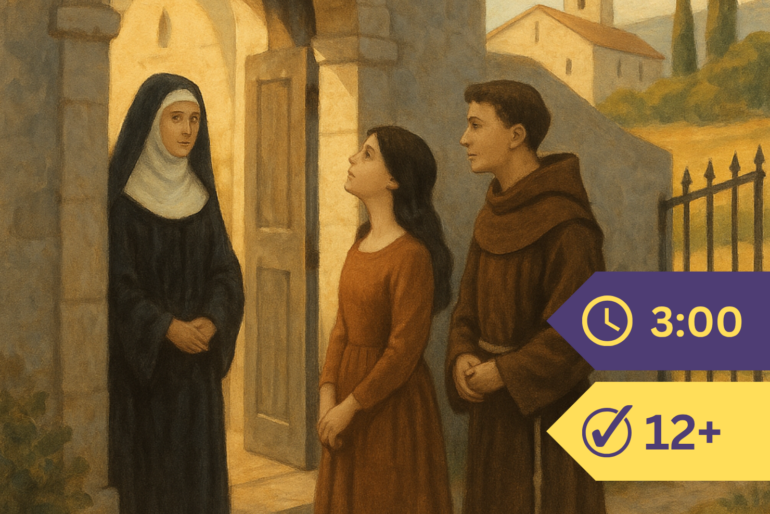
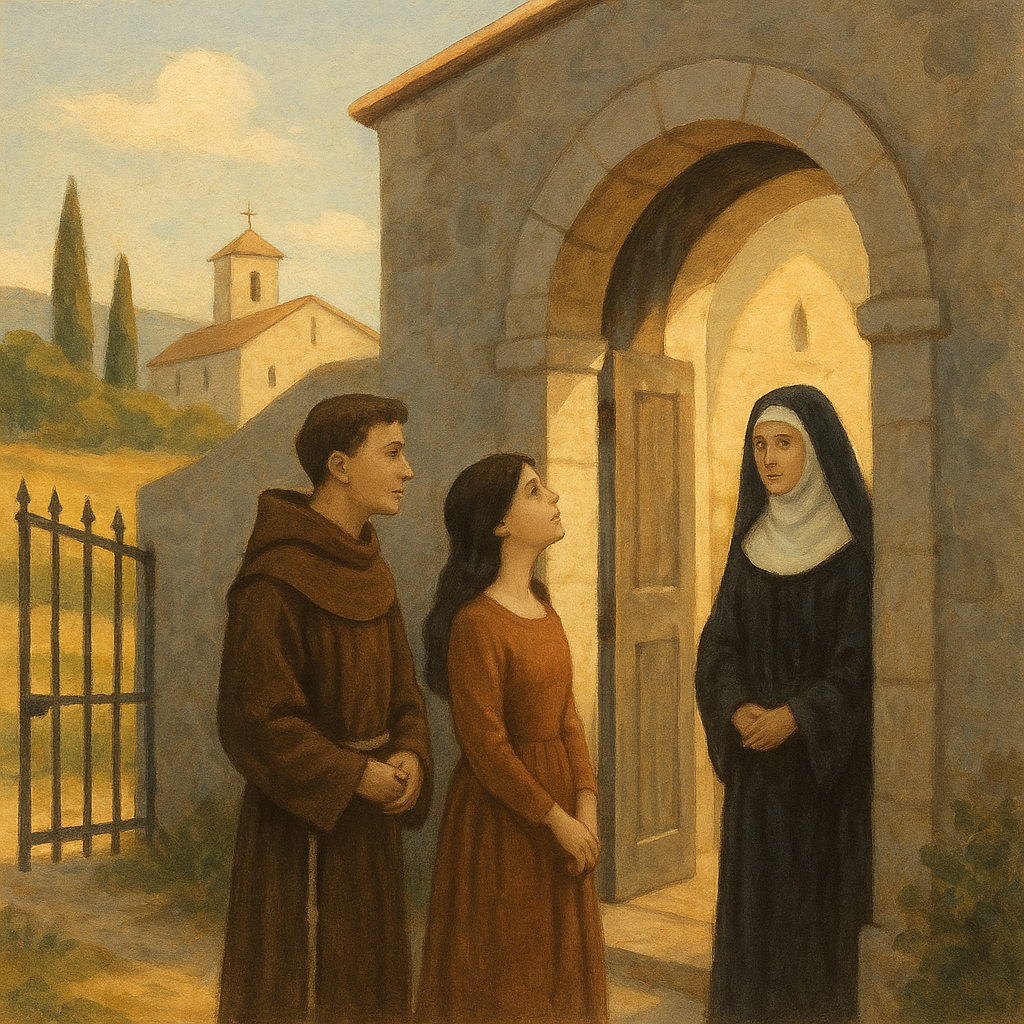
At last, instead of the rocky hollow she had been making for, there rose before her a grey building with high walls and gates. St. Anthony stepped forward. A nun opened the door, and he asked for the abbess.
“I have brought you a young woman,” he said to her, “and I ask you to give her your particular care.” The abbess promised, and St. Anthony went away — but not before drawing the young woman aside and giving her this one prayer to carry with her: I have sinned. Have mercy on me.
Then he went back to his brothers and asked them all to pray through the night, and to tell him in the morning what they had seen.
The first morning, they had all seen a little spark of light in the darkness.
“Not enough, brothers,” said St. Anthony. “Pray again tonight.”
The second morning: a pale streak of light moving upward.
“Not yet. One more night.”
The third morning, they all told him they had seen a great blaze of light, and in the midst of it a bed, and on the bed a young woman white as a lily, and four shining angels carrying her up to heaven.
“It is well,” said St. Anthony. “Your prayers have given a soul to the choir of heaven.”
He went afterward to the convent, and the abbess told him that the young woman had spent three days repeating only I have sinned, have mercy on me — and had then given up her soul to God, in simplicity and peace.