Nun Beatrice was, on the whole, a good sister — full of fine intentions and generous feelings — but she had a weakness for the world, and a certain vanity she never quite conquered. She held the post of portress at the convent, the one who kept the keys and managed what passed in and out through the convent gate.
One quiet afternoon she made her decision. She had hidden away a set of ordinary clothes from among the things given to the poor, and now she put them on, laid the convent keys on the kneeling-desk in the parlor beneath the picture of Our Lady, and whispered, “Keep the keys for me, and let no harm come to this house or my sisters.” Then she slipped out and went back into the world.
If she had looked up at the picture as she said those words, she might have seen something change in the painted face — a glance of reproach, gentle and sad. But she was too full of her own excitement to notice.
The moment she was gone, Our Lady stepped down from the canvas.
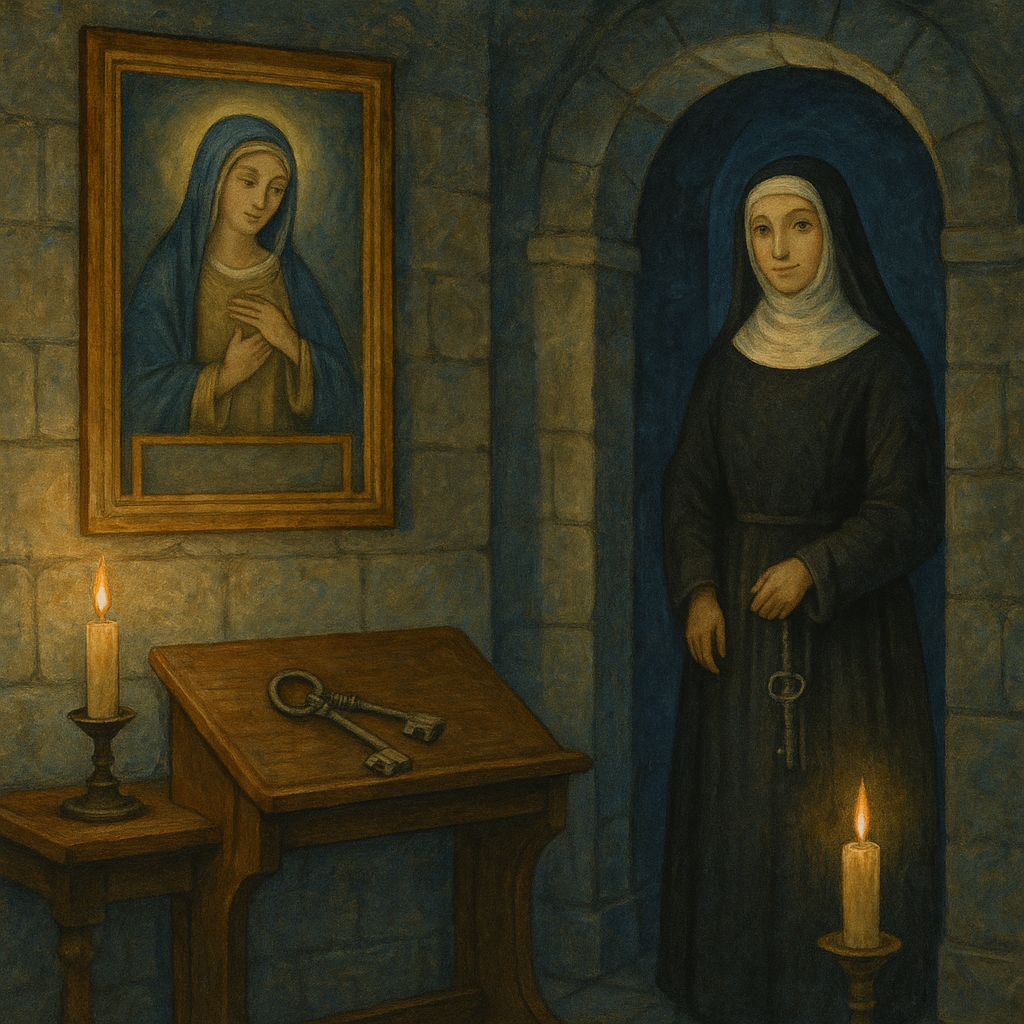
She put on the habit Beatrice had left behind, tied the keys to her belt, and took up the work of portress. She wore Beatrice’s face, so that no one knew the difference — except that the sisters all remarked, privately, how Beatrice seemed to have become humble, and modest, and unusually kind.
After a while, the community decided it was a waste of talent to leave so virtuous a nun at the gate, and they made her Mistress of Novices. In that office she was so gentle and so wise that every young sister placed in her care became, in time, a saint.
Beatrice, meanwhile, was living in the world again. She was often unhappy. She wanted to go back, but could not find the courage to confess what she had done. She kept putting it off.
One day, the convent’s agent passed through the neighborhood. Beatrice recognized him at once, though he didn’t know her in her ordinary clothes. She fell into conversation with him, and at last, keeping her voice casual, asked after one of the nuns she said she used to know — Suora Beatrice.
“Sister Beatrice?” said the agent. “She is the example of the whole house. Everyone in the convent could almost believe she is a saint.”
Beatrice could hardly keep the astonishment off her face. She had expected him to speak of her disappearance. “Are you sure it’s the same one?” she said. “The one I knew was very far from a saint.”
“There has only ever been one Sister Beatrice,” he said. “She was portress for a time, and now she is Mistress of Novices.”
As soon as he had gone far enough, Beatrice went straight to the convent and asked to see Sister Beatrice. And in a few minutes the Mistress of Novices came into the parlor.
The moment Beatrice saw her, an awe she could not explain came over her. Without knowing why, she dropped to her knees.
“It is well that you have come back, child,” said Our Lady. “Put on your habit again. Go in and do penance, and keep up the name I have made for you.”
Then she returned to the canvas, and Beatrice put on her habit, and went back to her life. She worked so hard from that day to live up to what Our Lady had made of her name that within a few months she had truly become what the convent had always believed she was.