Now, the man who told me this story was Paddy Phats — and you ought to know that there was no man in the three kingdoms who set a higher price on truth than Paddy Phats. He was a small, stout fellow, exceedingly civil and good-natured, full of fun and drollery, and a perfect miser in everything relating to truth. He insisted that truth was a commodity far too valuable for general use, and that any man who possessed it ought by all means to keep it to himself. Whenever anyone had related an anecdote that set credulity at defiance, Paddy felt it as a personal compliment — it was, he would say, one of Paddy Phats’s stories.
By this parsimonious use of truth, Paddy became so notorious that not a single soul of his acquaintance ever dreamt of expecting it from him. He was, for reasons of his own, also known by no other name than “Duck-foot.” He farmed a little, kept a small garden, went to no sheep, but managed somehow — without anything like ostentation — to keep himself tidy, and to treat himself to a quiet bit of mutton now and then.
It was on a Christmas Eve, as we sat about the fire, that someone finally asked Paddy to tell us about the race between Black-and-all-Black and the Padereen Mare.
He gave no reply at first, took a long whiff of his pipe, and then gravely commenced the legend — something in the following manner:
“There was once a race-horse,” said Paddy, “and some said it was on account of his colour that he was called Black-and-all-Black, while others said it was owing to a worse cause than that. However it came about, be that as it may — the raven’s wing was never smoother or blacker than his skin. You’d see the whole country round you the same as in a looking-glass, and that, I suppose, was what made the people say he had quicksilver in his veins. This Black-and-all-Black was the admiration of every one who ever saw him. It was said he was swifter than the wind, and that he could run on a dead level as fast as the crow could fly. At all events, one thing was very well known: no horse ever had a chance with him in racing, and indeed, when you come to understand everything, you won’t wonder at that.”
“Why so, Paddy?” said we. “What was so wonderful about it?”
Paddy gave the speaker a look of calm and withering contempt, puffed away the smoke from his pipe, and gravely went on:
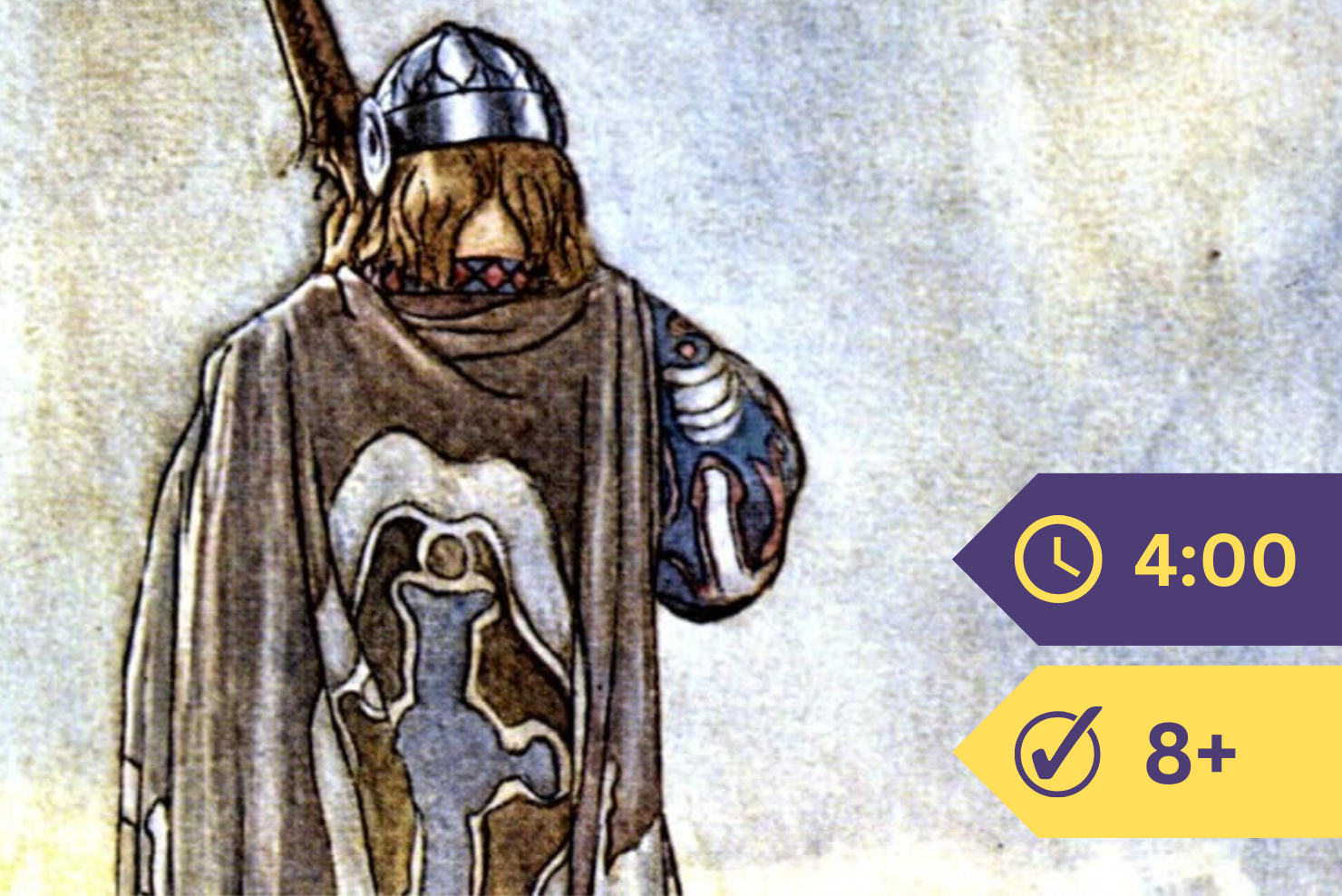
“You see, there was an old squire in the neighbourhood — a member of the Hellfire Club, Lord guard us! — and that same squire was so roguish and wicked that no one ever made a bargain with him that wasn’t taken in. Despite all his cheating, however, he was always poor; for, indeed, it’s no lie to say that he went along upon the true Irish principle of living upon three times his income. This squire, whose name was Gunpowder George, drank, and swore, and gambled, kept hunters and hounds, and other cattle that shall be nameless. The general opinion was that he had a crust of sin upon his soul a foot thick.
“At any rate, one morning he found himself hard pressed for money — fairly run aground — and it took it into his head to sell himself to the Devil, Lord save and guard us from the dirty beast! The bargain was struck accordingly; George signed the agreement with three drops of his own blood, and everything went on well enough until the young boy began to make inquiries into his character. When he found it was a regular bite, and that George had taken him in as well as he did every one else that had dealings with him, the ould fellow was nettled, you may be sure, to find himself outdone. He thought he’d appeal to George’s generosity to let him out of the bargain.
“‘What temptation came over me,’ says he to himself, ‘to buy such a precious piece of goods at such a price, an article that I was sure of in any case at the long run.’
“Accordingly he went to George, and began to argue as fair as he could. ‘George,’ says he, ‘I’ll go down on my two knees to you if you’ll only let me out of this bargain.’
“‘Are you there?’ said George, laughing.
“‘Truth I am,’ says the other, ‘and it’s a shamed face I carry in regard to this unfortunate transaction between us. Nobody will place dependence in me for the future when it’s known that I am honester than Gunpowder George. My name and character’s gone for ever,’ says he.
“‘So you are there?’ said George again, still laughing.
“‘I am,’ said the other; ‘and a sorry figure I cut here.’
“‘And the greater rogue’s there,’ says George, ‘and it’s a proud man I am to think that I have outdone you.’
“George had a gun in his hand as he spoke, and just at that moment a beautiful white pigeon flew near where he was standing. He raised the gun to his shoulder, covered the bird, and was about to fire, when he checked himself. ‘Pass on, poor bird,’ says he; ‘for once in my life I’ll spare the innocent.’
“Satan got black in the face when he heard the words, for you see there was mercy and kindness to the harmless and inoffensive in them.
“‘George,’ says he, changing his mind, ‘let the bargain stay as it is; it must stand good. I’ll perform my part of it; and I’ll take care that you shall perform yours.’
“George laid his forefinger along his nose, gave him a grin, and desired him to go about his business.
“Now it so happened that at the time I’m speaking of, there was living in the same parish with Gunpowder George a certain gentleman named Father M’Sod, who owned such a racer that never had been beaten any more than Black-and-all-Black. This mare had no name at the time; but whenever she ran, she defeated all those horses that ran against her little chance. She did not appear until some time after Black-and-all-Black had the country to himself, and she was looked upon now as the only animal that had any chance against him. All the kingdom was loud for a trial of speed between them; and as Gunpowder George met Father M’Sod one day, he challenged the white mare to a trial with Black-and-all-Black. They were both going in the same direction, that is, towards Father M’Sod’s house, when George asked his reverence if he might go in to get a sight of his famous mare. The priest nodded towards the stable, and told the other he might go in if he liked.
“George accordingly went in, but there was never a thing could he see there but a white pigeon sitting upon the top of the rack.
“‘Father M’Sod,’ says he, on joining his reverence in the house, ‘this wonderful mare isn’t in the stable.’
“The priest said nothing, only asked him to take a glass of wine. George agreed to this; but when he handed it to his lips, the squire himself was surprised to see that the priest, you see, was in the habit of making the sign of the blessed cross over everything he either ate or drank or gave to another. So, after signing it over the glass of wine that he handed to the squire, you may judge of his surprise when he saw that if his neighbour was to get a million of money he couldn’t bring it to his lips. The squire was surprised.
“‘Unfortunate sinner,’ said the priest, looking at him, ‘I see now how it is. If God hasn’t said it, you’re likely to travel downwards yet. No doubt of it, you’ll go to your destination by way of a slope, and you may take my word for it, it won’t be an uphill one. You’ll find very little good weather in the country you’ll go to; and for that reason, I’d advise you to leave your greatcoat and flannels behind you, and to start as light and airy as possible. However, it’s too bad that you should leave my house without tasting something, at any rate.’ He pushed a bottle towards him. ‘Help yourself.’
“The other then helped himself to a glass or two of wine, but had no difficulty in doing it now, for the sign of the cross had not gone over it, and then came out with his challenge.
“‘Come, Father M’Sod,’ said he, ‘will you run your mare against Black-and-all-Black? I’ll give you twenty to one in hundreds.’
“‘Is Black-and-all-Black your own property?’ asked the priest.
“‘No,’ says the squire, ‘but he’ll be on the ground at the forthcoming races, and I’ll back him against all odds. I’d bet my soul on him.’
“‘Very well,’ said the priest, ‘I’ll take that bet.’
“‘What do you mean?’ asked the squire.
“‘I mean,’ replied the other, ‘that if you wager your soul upon him, I’ll take up the wager.’
“The squire gave a hearty-like laugh, but still anyone might perceive that there was something hollow and dismal in it in spite of all he could do.
“‘What do you mean?’ said he; ‘I don’t understand you.’
“‘I mane,’ says the priest, ‘that if you will wager your soul that Black-and-all-Black will win, I’ll take up the wager against the white mare beats him.’
“‘But,’ said the other, ‘I’m not free to make the wager, in regard that my soul is my own. I’m sold to another gentleman.’
“‘I’m afraid it was a bad bargain on both sides,’ said Father M’Sod; ‘but, as the sun is now shining very brightly, if you’ll walk out to the stable-yard, I’ll tell you whether the bargain is a sure one or not.’
“They accordingly went out; and after taking a turn or two up and down the yard, the priest says to him, ‘Unfortunate man! Where’s your shadow?’
“‘That’s more than I can tell,’ says the other; ‘but I know I haven’t had a shadow for some time past. It’s nothing now but pure substance. My own opinion is, that it went out to take exercise on me, and give me the slip.’
“This, you see,” continued Paddy, “was the way the priest managed to find out whether he had sold himself to the Devil or not, for it’s very well known that anyone who signs such a bargain is obligated to give his shadow to the purchaser, by way of security.
“‘Come,’ he went on, ‘I’ll bet five thousand pounds against all you’re worth in the world, if you have the spirit.’
“To make a long story short, the wager was drawn up on paper, signed by each, and witnessed by Father White, who had just returned from a sick call.
“‘I suppose your mare has been out taking her gallop,’ said the squire; ‘and as it’s likely she has returned, I’ll have a peep into the stable again before I go.’
“‘Do so,’ said the priest, ‘and I myself will go with you.’
“On entering the stable, sure enough, there she was — a milk-white beauty that the world could not surpass. Not like Black-and-all-Black, her eye was mild and clear; there was a smell from her, too, like that of roses; her skin shone like ivory. And what was most wonderful, when the squire looked into it, he thought he saw one of the most beautiful countries that ever was seen or dreamt of by man. The people, he thought, were walking about in some happy land, where there appeared to be neither care nor sorrow, but where all were filled with pleasure and delight. It was covered with lovely groves and meadows, beautiful rivers ran through it, and multitudes of happy beings walked along their green banks. Altogether, the sight wrung his heart when he compared it with the terrible place that was preparing for himself. On rubbing his eyes, however, it all vanished, and he saw nothing but the beautiful milk-white mare, as she stood gently and quietly before him. He then looked up to the top of the rack, after the white pigeon, but whatever had become of it, he saw that it was no longer there.
“In the meantime, the races were coming on; and it had gone abroad like wildfire over the whole country that the Padereen Mare was to run against Black-and-all-Black. Nothing could perfectly describe the state of excitement that spread upon the subject. The very children cut long wattles for hobby-horses, and ran races against each other in the names of the two celebrated animals I am talking of.
“At last the day came. Such crowds — such thousands upon thousands as flocked to the race-course — were never seen at a race-course before or since. Two or three races went off, but nobody troubled their heads about them. ‘Where’s Black-and-all-Black? Where’s the Padereen Mare?’ was the cry in every one’s mouth.
“This race was to come off at two o’clock; and exactly as the hour arrived, the two animals made their appearance — although, and this is truth, there wasn’t a soul there could tell where either of them came from. Nothing could be more beautiful than the appearance and condition of both. The black fellow shone to that degree that you could scarcely think he was substance at all. You imagined you could see through him. On the other hand, the mare was every bit as beautiful, but she was calmer and gentler; and yet not without a sly cast of eye, that told you she had a kick in her, if provoked.
“When the second bell rang, the two jockeys went down to the scales to be weighed; Gunpowder George accompanied Black-and-all-Black and his jockey, whilst Father M’Sod attended the mare and hers. The black jockey was exactly the weight — not a scruple either more or less; but it so happened that the other was about three ounces light.
“‘This won’t do,’ said the squire; ‘three ounces is a great deal in a race like this. I have myself a pair of horses so equal in speed and bottom, that the weight of the key of the stable is enough to make either of them beat the other.’
“Father M’Sod put his hand in his pocket, and pulling out his beads, hung them about his jockey’s neck, and lo and behold you, they just made him the exact weight! The race was to be a four-mile one, the best of three heats. The squire had bet all he was worth in the world upon his favourite; beyond that estate, and what he wished to keep for a rainy day. At length the two animals came to the start — got the word — and off they flew like the wind. By all accounts Black-and-all-Black’s feet scarcely touched the ground. There he went, coal black, far ahead of the mare; and it was thought at first that he would double her wide ease.
“The first heat was his beyond all question. Now, you might think that the black horse spoke to his rider —
“‘Am I doing it purty?’ said the horse to his rider.
“‘Why, Paddy,’ said one of his audience, ‘do you mean to say that the horse spoke?’
“‘To be sure, I mean to say it,’ replied Paddy; ‘isn’t it well known the song tells you that?’
“‘Am I doing it purty?’ asked the horse.
“‘Beautiful,’ said the jockey, ‘and better than that; you’re going it all to pieces. The fire’s in you, my blackbird. It’ll be a double distance against her at the least.’
“‘Something’s wrong, for all that,’ replied the horse; ‘I feel the wind going out of me, and you’re getting heavier and heavier at every stride I make.’
“‘Be gad, you’re beginning to fight it shy, sure enough,’ replied the jockey. ‘Move on! By the powders o’ war, she’s creeping up!’
“‘More power,’ said his jockey, as he pushed him on.
“The black racer, however, showed great bottom; he increased his speed, came in a good way first, and the Padereen Mare barely saved her distance.
“The course was now in an uproar. All the backers of Black-and-all-Black were on the high horse with delight. There was no end to the wagers they made and the odds they offered. The squire betted his last estate, his last acre, the coat on his back, the shoes to his feet, and the hat on his head.
“‘Come,’ said he, patting the horse on the neck; ‘if you don’t win this, you leave me a ruined man, with neither soul nor body that I can call my own. Put your right foot foremost, my boy, and tell them you’ll see them when you come back, but not till then.’
“The friends of the Padereen Mare, on the other hand, were not a bit cast down. They saw that, although the horse ran away from her at the beginning, she gained upon him at the close, and at any rate saved her distance. Father M’Sod had crowds coming to consult him as to what they should do. His reverence gave them a knowing wink, and only said ‘Na boclish. Take all the bets you get.’ This gave them courage, and the betting was a miracle to see.
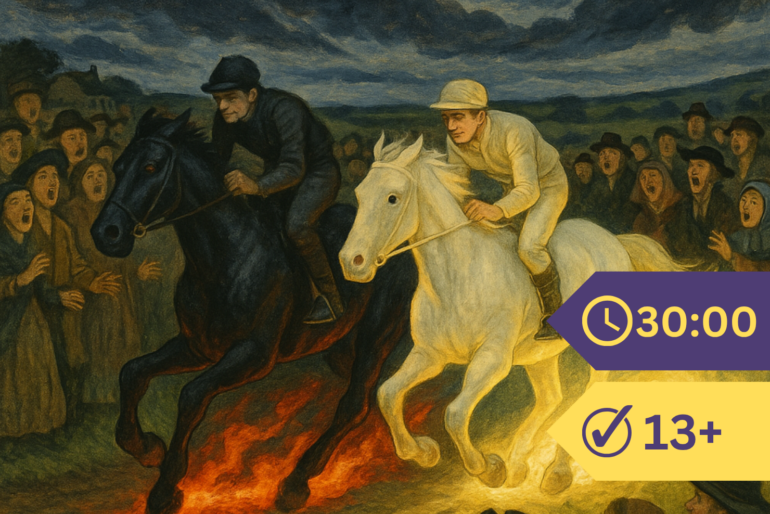
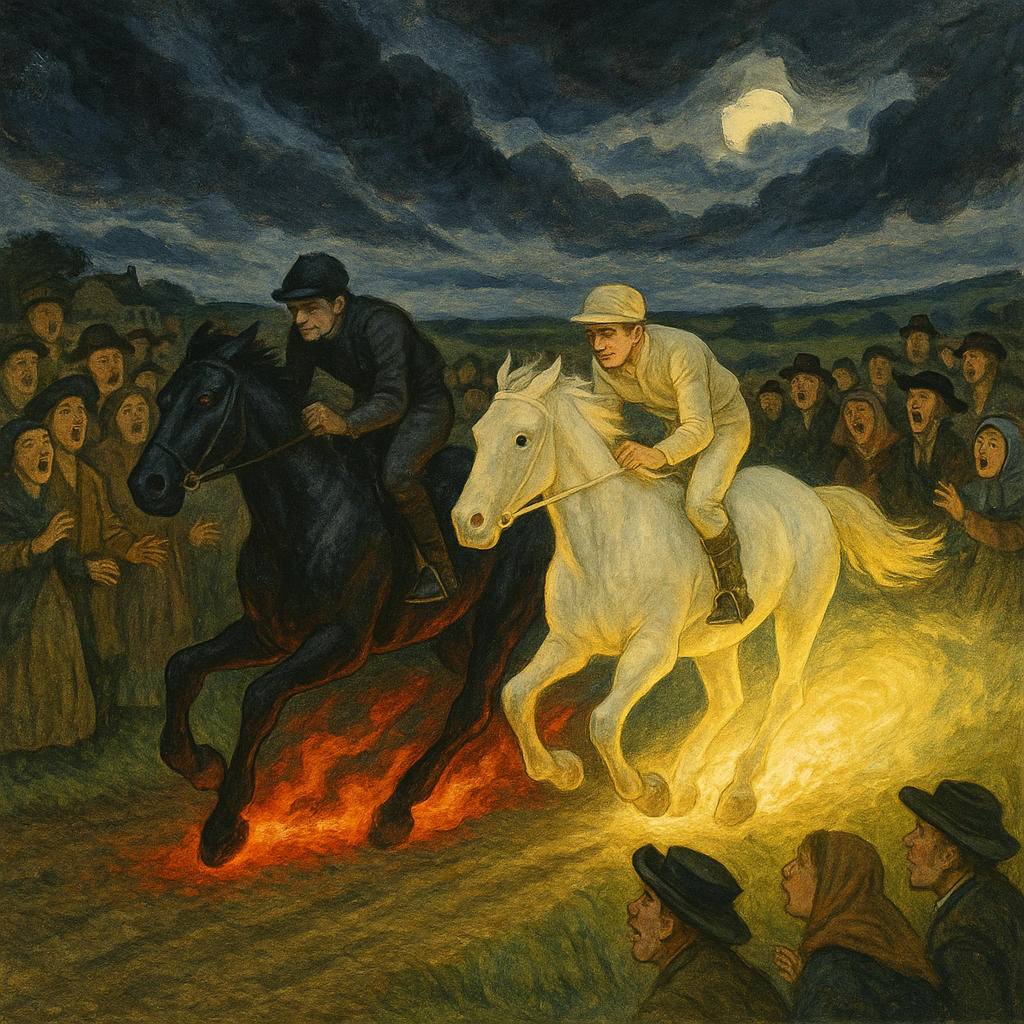
“Well, they started for the second heat, and off went Black-and-all-Black as if he had wings; and off went the beautiful Padereen Mare neck for neck beside him. There was no running away from her now. It wasn’t run she did, but fly. As for the horse, he outdid all his former doings; but go as he would, there was the darlin’ at his side. The day was dark — oh, this is truth! — and what do you think was seen? Why, then, I’ll tell you. As the horse flew along, your eye could hardly keep up with him, and the people were amazed, astonished, and frightened to see that he left a train of deep red fire behind him, whilst the mare, on the other hand, left behind her a beautiful line of light. Oh, you needn’t shake your heads; it’s gospel I’m laying down to you.
“At all events, the Devil did his best — did wonders; however, there was that against him that he couldn’t outdo. On their way back to the winning-post, the mare — to the admiration of all — shot before him with the speed of a cannon-ball, leaving him hard set to save his distance; but save it he did, and between ourselves, it was as much as he could do.
“And now maybe the course didn’t become mad in earnest. That bout was over, and so far they were even — the mare beating him about the same distance he beat her at first. This was the first time that ever Black-and-all-Black was overcome; and the beautiful mare was kissed and hugged by men, women, and children, whilst the others showed very long faces and began to tremble for their money.
“Well and good. The third heat began, and off they went; but if their speed was great before, it was wonderful now. Nothing like it was ever seen or dreamt of. Padereen, the darlin’ of the world, shot before him and gained on him at every stride. At long last, as they were on their return, she set out at a new pace; and before he knew where he was, she passed the winning-post, leaving him two distances behind — so that she beat him by a double distance, and won this great and extraordinary race.
“But what was most amazing was this: the fire that came from Black-and-all-Black in the last heat had used to flame out terribly at times, but by degrees it became less and less, and darker and darker, until at last it disappeared altogether and ended only in smoke, that smelled very strongly of brimstone; whilst the light that the Padereen Mare left behind her grew larger and larger, and brighter and brighter, until, when she came home to the winning-post, she was surrounded by a brightness so great that the people were hardly able to see her.
“Now, when those who had backed Black-and-all-Black found that their great favourite was beaten, they rushed in crowds to avenge themselves on the horse that had so completely undone them. They might as well spare themselves the trouble, however; for, go where they might, search where they might, there was no Black-and-all-Black to be found. It seemed as if the earth had swallowed both him and his rider. And, by the same token, it was the very same case with the Padereen Mare. When her friends, who had won such oceans of money by her, strove to get near her, to pat and hug and kiss her as a friend, she too couldn’t be seen, any more than her jockey. While they were looking for her, a white pigeon rose from the crowd and flew away in the direction of the priest’s house.
“Well and good — although it was anything but that for the squire — he rode homewards a ruined man, body and soul. That very night, at midnight, on a Christmas Eve — the Devil, Lord be about us! — was to come for him; and how to act, or what to do, he knew not, no more than the man in the moon.
“‘There is no hope for me,’ says he; ‘I see nothing but destruction before me. I may as well despair at once. What an unfortunate doom is mine! I led a life of pleasure, and yet it wasn’t pleasure; for what pleasure can any man have that violates the commandments of God, and is an enemy to his kind? Many a happy heart I might have made by my riches; but, instead of that, what did I do but scatter misery, and shame, and sorrow around me.’
“Just as he had spoken the last words, a white pigeon flew towards him and lit upon his right shoulder.
“‘Don’t despair,’ said the pigeon, ‘but repent. I know that Satan is to come for you at midnight. On your way home, you must pass the priest’s door; call on him, and let him be with you when Satan comes, and you have a chance yet. But if every one should desert you, I won’t, provided you repent. You kept back your hand from the defenceless and the innocent, and that’s a proof that your heart is not all evil.’ After saying this, it flew away and left him to pursue his journey.
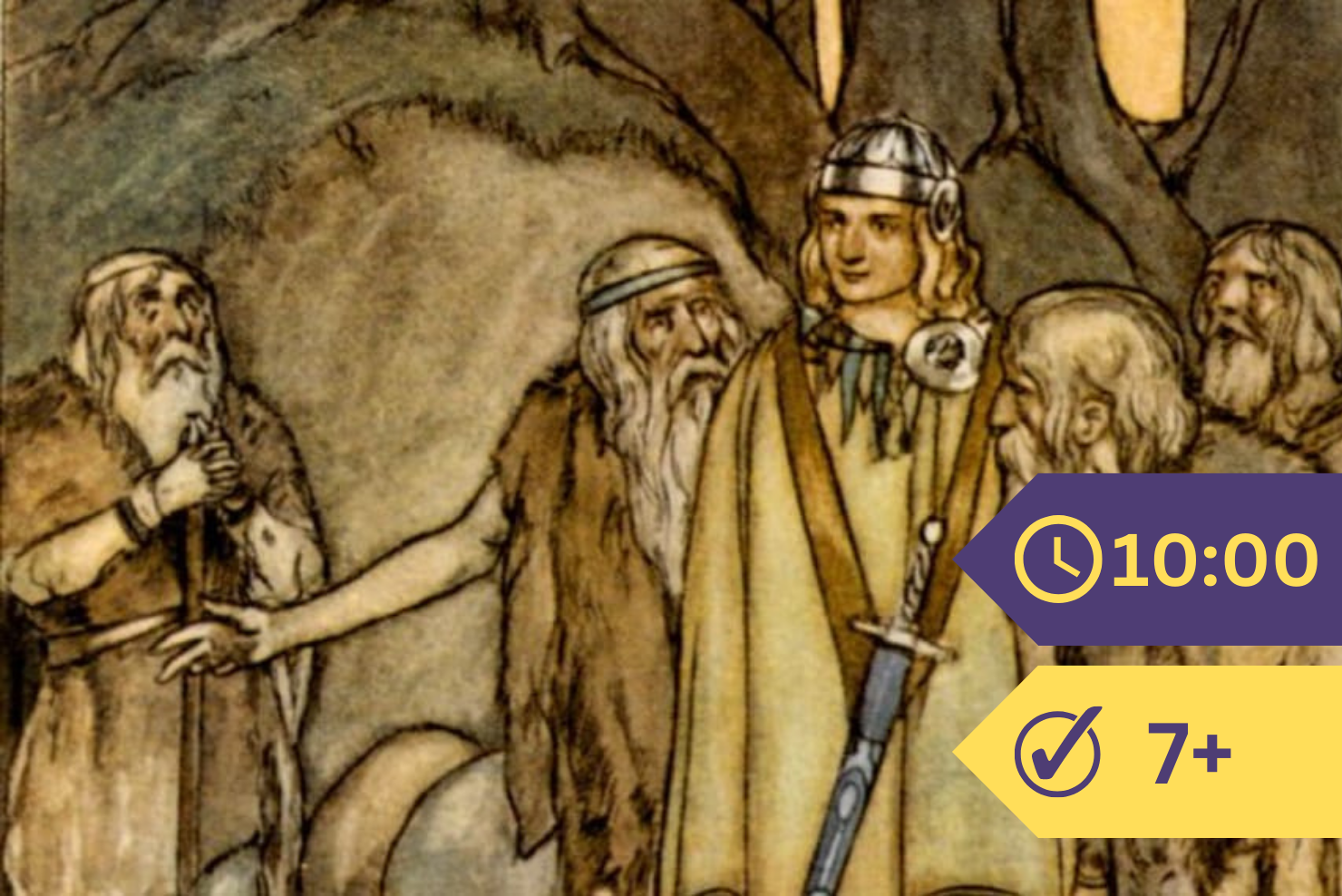
“Well, he did so; he called upon the priest; and in order to have two strings to his bow, he called also on the parson. He told them both his circumstances, and mentioned especially the visitor he was to have at midnight, and the cause of the visit. The parson was the man he called on first; and, having mentioned his business together with his intention of calling on the priest also, that worthy gentleman — who was drinking his wine after dinner — said, ‘I have always been maintaining a warfare against Satan and his works; but my stronghold against him is the pulpit. To meet him face to face would be — ahem! — to give him unequal terms. I could not think, my friend, of doing that — he is in every way unworthy of it. Besides, I have another still more serious objection: you are calling in the aid of that priest. Now, I tell you that, in attempting to save your soul by connecting myself with an idolater, I would run a great risk of losing my own. Besides, I should miss my pulpit cushion; for you don’t know, my friend, how the energetic thumping of a pulpit cushion carries fear and dismay into the spirit of Satan; it makes him, so to speak, put his fingers into his ears. No, my friend — I fear the coming to personal encounter with him — I am not, I trust, a cowardly soldier; but I could not, for a moment, think of doing anything in common with an idolater.’
“‘Well, now,’ said the squire, very much downhearted, ‘I must see what the priest will do. If he deserts me, I’m a gone man!’
“He found his reverence mixing a comfortable tumbler of punch; and, after refusing to either eat or drink — for he was warmly pressed to do both — he began to tell him the whole story. The priest stopped him and said, ‘You needn’t go on. I know it all. You sold yourself to the Devil. It’s a common case. He has a market here that’s well attended. Sure, there’s not a wealthy profligate in the country that abuses his wealth, and the gifts that God has given him; that oppresses and casts out the shelterless poor to the open elements of heaven, and leaves them there to starve and die — there’s not one, I say, who has not made the same bargain, and is as clearly the Devil’s property as you are. Yet, at the same time, I’d as soon not meet him face to face, in regard to an antipathy I have against him; but let me at him from the altar, and if I don’t give him pepper, I’m not drinking this.’
“He raised his glass. ‘Here’s to you! And I hope you’ll settle your bets before you go.’
“The squire thought he’d try him a little farther; for the truth was, he saw that, however well disposed both clergymen were to abuse the Devil at a distance, neither of them relished coming to close grips with him.
“‘I’ll tell him,’ said he, ‘that Dr. Slumberwell will be there, and may be, it will give him courage. If it’s any satisfaction to you to know that you will have support,’ said he, ‘I can tell you that Dr. Slumberwell will be there to assist you.’
“‘What, sir,’ replied his reverence, ‘do you expect that I’d associate myself with a heretic?’
“‘Wouldn’t you join a heretic in striving to save my soul?’ asked the poor squire, who feared that, between two stools, he was likely to come to the ground.
“‘No, sir,’ said he; ‘in doing so I’d run a risk of losing my own. Why, then, do you ask me to do what’s unreasonable? I’ll pray for you, I’ll convert you, I’ll make a good Catholic of you — only, for Heaven’s sake, don’t ask me to meet the Devil in the dark.’
“‘God bless me,’ thought the squire, ‘these two men would burn one another in the name of God, and yet they are both of the same religion.’
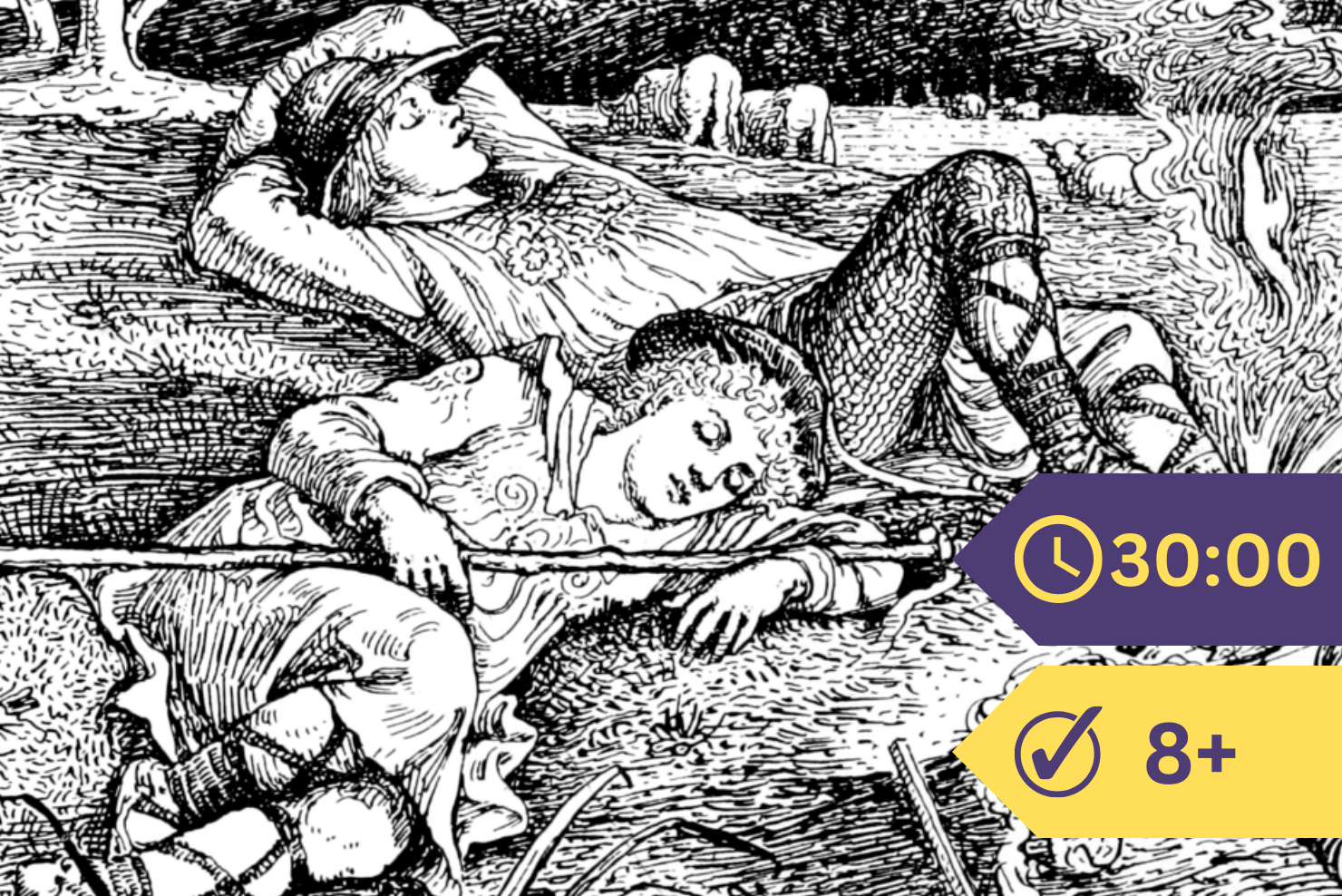
“The squire was so completely overcome with all he had gone through that day that he forgot everything that had happened to him for the remainder of it. He went to bed, I dare say, to take an hour or two’s rest, to strengthen himself for his journey.
“When he awoke, he saw the white dove sitting on a chest of drawers at the foot of his bed.
“‘Did I not see you this evening?’ said he.
“‘You did,’ said the dove.
“‘May I ask who and what you are?’ said the other.
“‘You may,’ replied the dove. ‘My name is Mercy. I was a favourite with your Protestant clergyman until wealth and luxury hardened his heart and left no place for me in it. I have also abandoned the priest, who now thinks more of the aggrandisement of his Church than he does of the salvation of his flock. I am sadly in want of a place of rest; but, as I said to you before, so I repeat to you again — do not despair, but repent.’ Then it vanished.
“Now, however, came the dreaded hour. A hollow blast of wind moaned through the whole house; the windows shook in their frames; an awful noise, like the sound of heavy carriage-wheels, was heard coming to the door, where it stopped. Then came a solemn knock; the door was opened — the footstep was heard mounting the stairs — approaching the bedroom door — the handle was seized — it was turned — and in walked the Devil, to claim his bargain! He grinned with such delight that it would make your blood run cold, and was in the very act of stooping to take away the squire, body and bones, when the unfortunate man gave a shout and a start — awoke — and on looking about him, perceived that it was all only a dream. A heavy fit of the nightmare that he had been labouring under for hours.
“This was upon Christmas Eve, as I said.”
“Well, Paddy, and what became of the squire?”
Paddy gave the company a long look, took a final puff of his pipe, and then replied:
“The squire repented, and became one of the best, the most pious, and the most charitable men that ever was in the country. Only that, to the day of his death, he could never bear the sight of a parson that thought more of himself than his religion, or of a priest that thought more of his religion than his flock. Every Christmas he gave a comfortable dinner to a number of poor people; and I hope that every one who hears me, and can afford it, will imitate his example, and show mercy and kindness to those that are friendless and without food.”