Beyond Bethlehem, which is a big village, walled and moated, lies a hilly country — wild and remote, covered with dense woods of firs, pines, larches, beeches, and similar trees. At times the people of Bethlehem go in bands to cut down these trees and burn them to charcoal, which they pack on mules and sell in the valley. Sometimes they lash whole trunks together — the kind that would serve for beams, rafters, and masts — and float them down the many swift rivers.
On these mountains, in the thickest part of the forest, a certain woodcutter decided to build a house where he could live with his family, store his timber, and care for his animals. For this purpose he made use of certain pillars and pieces of masonry that stood among the trees — the remains of a heathen temple, long fallen into ruin. He cleared the wood around the site, leaving only stumps and low bushes. Close by, in a ravine between high fir trees, ran a river of greenish water, exceedingly cold and swift. It ran full to its banks even in midsummer, fed by the melting snows, and all around, up hill and down dale, stretched the woods of firs, larches, pines, and other noble trees, giving off a clean and virtuous fragrance.
The man thought to enjoy his house, and came with his family, his servants, and his horses and mules and oxen. But scarcely were they settled when an earthquake split the place, tearing wall from wall and pillar from pillar, and a voice was heard crying in the air: “Ecce domus domini dei” — “Behold the house of the Lord God” — whereupon they fled in astonishment and terror, and did not stop until they reached the town.
And no one of that man’s family ventured back to that house or that wood — save one called Hilarion, a poor lad and a servant, but of upright heart and faith. He offered to return alone and live there, cutting down trees and burning charcoal for his master. So he went. He was but a poor lad, clothed in a leather tunic and a coarse serge hood, and he took with him an ox and an ass to carry the charcoal down to Bethlehem.
The first night Hilarion slept in the ruined house, he heard voices — like those of children, boys and girls together — singing in the air. But he closed his eyes, said a Paternoster, turned over, and slept. Another night he heard voices that made him tremble; but being clean of heart, he said two Aves and went to sleep. And a third night he heard the voices again, and they were passing sweet, and with them came a fragrance as of crushed herbs and flowers — frankincense and orris root. Hilarion feared the voices might be those of heathen gods, but he said his prayers and slept.
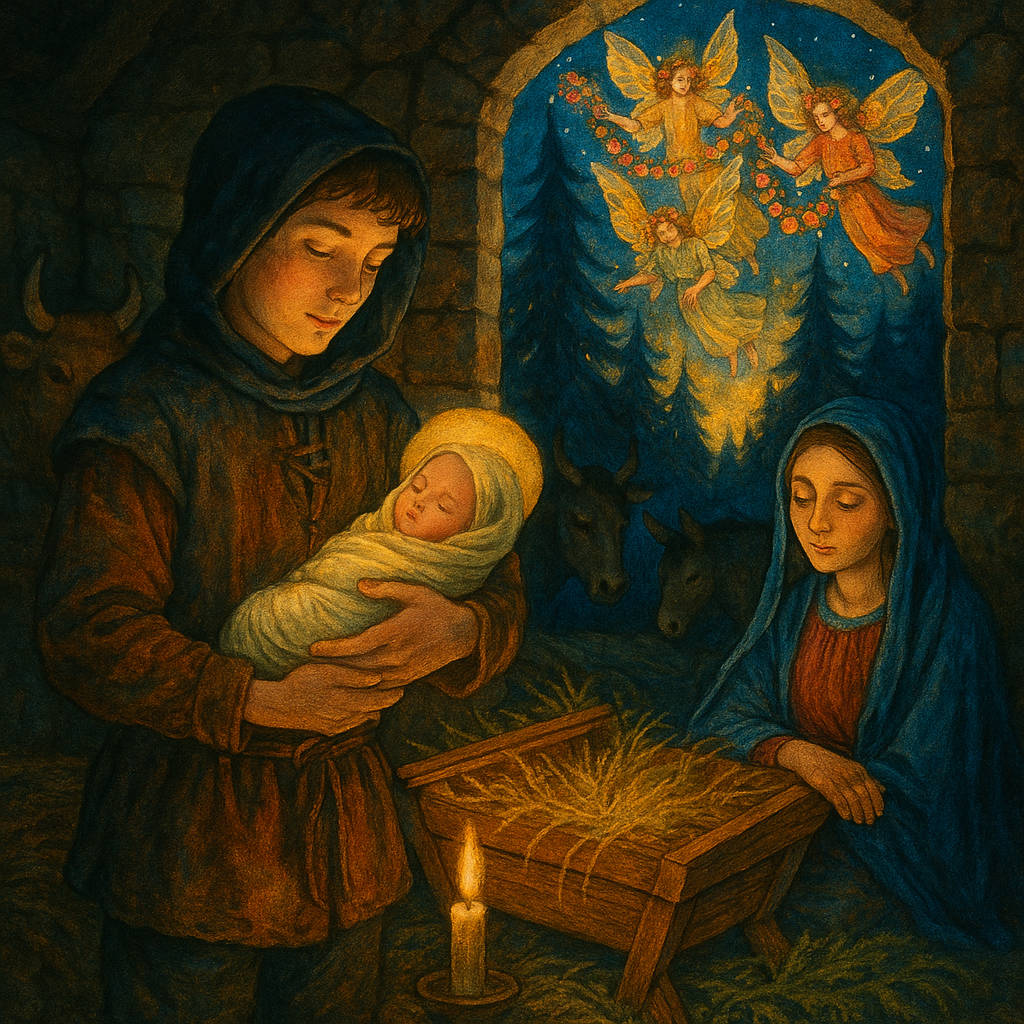
At last one night, as Hilarion heard the songs, he opened his eyes — and behold, the whole place was filled with light. A great staircase of light, like golden cobwebs, stretched up to heaven, and hosts of angels appeared, coming and going, with hair like honeycomb and robes of rose and green, azure and white, thickly worked with pearls. They had wings like butterflies and peacocks’ tails, and a golden radiance shone about their heads. They moved to and fro carrying garlands and scattering flowers, so that, though it was midwinter, it was like a garden in June, sweet with roses and lilies and gilliflowers. The angels sang; and when they had finished their work they said, “It is well,” and departed, holding hands as they flew up into the sky above the fir trees. And Hilarion was filled with wonder, and prayed fervently.
The next day, while he was cutting a fir tree in the wood, he met among the rocks a man old and venerable, with a long grey beard and a solemn air. He was dressed in crimson and carried written books under his arm, and a scourge.
“Who are you?” Hilarion asked. “The forest is haunted by spirits, and I would know whether you are of them or of men.”
The old man answered: “I am a wise man and a king. I have spent all my days learning the secrets of things. I know how the trees grow, how the waters run, and where treasures lie hidden. I can tell you what the stars sing, and how the ruby and the emerald gather their light in the heart of the earth. I can chain the wind and stop the sun, for I am wiser than any man alive — but I seek one wiser than myself. I am going through the woods in search of him, my master.”
“Stay here,” said Hilarion, “and you shall see, if I am not mistaken, the one you seek.”
So the old man stayed in the forest and built himself a hut of stones.
The following day, as Hilarion went to catch fish in the river, he met on the bank a lady of beauty beyond compare. He asked the same question: “Who are you? The forest is haunted by spirits — are you one of them?”
She answered: “I am a princess, the fairest of women. Kings and princes have brought gifts to me. They have hung wreaths on my palace and strewn flowers in my garden. I am beautiful beyond compare — but I seek one more beautiful than myself. Day by day I go searching by the lakes and rivers for my master.”
Hilarion made the same reply: “Stay here, and you shall see, if I am not mistaken, the one you seek.”
And so she stayed by the river and built herself a cabin of reeds and leaves.
That night was the coldest and longest of winter. Hilarion made himself a bed of fern and hay in the stable of the ox and the ass, and lay close to them for warmth. In the middle of the night the ass brayed and the ox bellowed, and Hilarion started up. He saw the heavens open with a great brightness, like beaten and hammered gold. Angels wreathed in roses were coming and going, and as they held each other’s hands they sang: “Glory to God in the highest, and on earth peace, good will toward men.” And Hilarion wondered again, and prayed fervently.
Toward noon the following day, there came through the wood a man bearing a staff, leading a mule on which a woman sat. They were poor folk, road-worn and travel-stained.
The man said: “My name is Joseph. I am a carpenter of the city of Nazareth. My wife is called Mary. Will you let us rest, and give my wife a place to lie on this straw in the stable?”
“You are welcome,” said Hilarion.
He laid down more fern and hay, and gave feed to the mule.
And Mary brought forth her firstborn son, and Hilarion took the child and laid it in the manger. Then he went out into the woods, where he found the wise man and the beautiful woman.
“Come with me,” he said, “to my stable, where the fir trees were cleared above the river.”
They followed him to the ruined house, and they saw the child lying in the manger. The wise man and the beautiful woman knelt down before it.
“He is surpassingly fair,” said the princess.
“He is wiser than I am,” said the king. “Surely this is the one who is our Master.”
And the skies opened, and there came forth angels such as Hilarion had seen before, golden radiance about their heads and garlands of roses about their necks. And they sang again: “Glory to God in the highest, and on earth peace, good will toward men.”