“Keeps coming right down, doesn’t it, Bill?”
Bill could not deny it, and did not wish to admit it; so he said nothing.
What was coming down was the snow. It had been falling, thicker and faster, since just after daylight, and now it was nearly dark. Stumps of trees and gate-posts were capped with great white masses; here and there a path shovelled up to a farmhouse back door showed a tall bank of snow on either side, fluted from the broom strokes.
The boy who had made the observation was Master Winfield Scott Burnham — Win, to everyone who knew him. He was a slender boy with a pale face, dark eyes, and brown hair, and he sat pressing his nose against the car window, watching the fast-falling snow with a rather rueful look. The young man sitting opposite, whom he was bold enough to address as Bill, was his older brother William, a junior in college and long Win’s hero — and worthy of it, for William was not only strong, swift, and skilled at every sport, but too much of a man to treat small boys, even his own brothers, roughly or with contempt.
Just across the aisle sat Win’s eldest sister Grace, a sophomore at Smith College. Facing her on the reversed seat was Win’s younger brother, Philip Sheridan.
The reason the Burnhams were all travelling together was this: the Christmas vacation had come, and William and Grace were on their way home to Pittsfield, Massachusetts. The two younger boys, whose school had closed a week before the colleges, had been visiting cousins in Hartford; and it had been arranged that William would come over from Amherst to join Grace at Northampton, and that they would both wait at Springfield for Win and Phil, who were to be put on the train by their uncle. But every road in the region had been badly delayed by snow, and it was four o’clock before the noon express, with the Burnhams aboard, finally left Springfield heading west. Darkness was closing in, the wind was rising, and William had already mentioned his worry about a snow-blockade up on the mountain. This had made Win sober, and he had been watching the storm with an anxious face ever since.
“How long until we reach Pittsfield?” he asked his brother.
“Hard to say. We ought to make it in two hours, but at this rate it’ll be four at the earliest.”
“That’ll be eight o’clock,” Win sighed. “I’m afraid the Christmas tree will be completely unloaded before we get there.”
“I’m sorry, but you might as well make up your mind to that.”
Win started to cross the aisle — this disappointment was too big to carry alone, he had to share it with Phil. But William touched his arm.
“Hold on, Win. What’s the good of telling him now? Let him enjoy himself as long as he can.”
Win sat back down in silence. Phil was filling Grace’s ear with great stories from the Hartford visit, his cheerful voice carrying through the whole car. Grace was laughing at his grand tales, and the two of them seemed to be having a fine time. But the train had just stopped at Westfield and was having trouble starting again. The wind howled, and great gusts of snow swept in sheets against the windows. Presently the two engines backed up to get a running start, then plunged forward into the drift.
Ch-h! Ch-h! ch-ch! Ch-h-h-h-h-!
The wheels spun on the icy rail and the train lurched to a stop.
Back they went again, a little further, for another go; and this time the two engines, working together perfectly, cleared the way, and the train crawled slowly up the grade. Grace and Phil had stopped talking. They came across the aisle and joined their brothers.
“You’re worried about the mountain, aren’t you, Will?” said Grace.
“A bit,” he admitted.
“But what in the world would we do if we got stuck?”
“Sit tight and wait to be shovelled out. We couldn’t exactly walk from here.”
“Snowed in! That’s wonderful!” cried Phil. The boy’s love of adventure had quite crowded out any thought of the Christmas tree waiting at home. “I read about a train that was stranded three or four days out west — the station wasn’t far, they had plenty to eat, and the passengers put on all sorts of entertainments.”
“I’d rather see the show at the Christmas tree tonight,” said Win, “than any show on this old train. Wouldn’t you, Bill?”
“Perhaps,” said William. It was clear he had his own reasons for not wanting to miss the evening.
Meanwhile, the train inched along. Now and then it ground to a halt where snow had drifted across a cut, but a party of shovellers who had come aboard at Westfield usually managed, after a short delay, to clear the way. Progress was very slow. An hour and a half was spent between Springfield and Russell, and it was almost seven o’clock when the train finally pulled into Chester.
By this time the boys were quite hungry, and the prospect of a night in a snowbank held considerably less charm for Phil than it had two hours before. At Chester, where the train stopped for a good while, most of the passengers climbed out to find something to eat. A couple of sandwiches, a piece of custard pie, a round doughnut, and a glass of cold milk did wonders for Phil’s courage and greatly improved Win’s mood, and they went back to the car ready to face whatever the night might bring.
The snow had stopped falling, but the wind still blew. Two or three more shovellers came aboard, and thus reinforced, the train pushed on. But it was hard work — the grade was getting steeper and the drifts deeper every mile. Still, Middlefield was passed and Becket left behind, and at nine o’clock the train was toiling up toward the summit at Washington when it suddenly stopped and both engines let out a long blast of their whistles. A moment later, a brakeman came through the car, took one of the red lanterns from the rear, and hurried back down the track with it.
“Where’s he going with that lantern?” asked Phil.
“Back along the line,” said William. “It’s a signal to warn any train behind us. That means we’re stopping for a while. I’ll go out and see what’s happening.”
He came back shortly, looking cold and serious.
“Well?” they all asked.
“There’s a freight train in the cut just ahead of us — two cars off the rails, and the cut’s half full of snow. If our Christmas goose isn’t already cooked, we’ll have plenty of time to cook it before we get out of here.”
“Is that the deep cut below the Washington station?” asked Grace.
“The very one. And it’s about the likeliest place to spend Christmas you could find in western Massachusetts.”
“Can’t they dig out the snow?” Win asked.
“They can, but it takes time and shovels, and we’ll have to wait for more men and wrecking equipment to come up from Springfield. We might be here twenty-four hours.”
“Can’t you telegraph Father?”
“I asked. The lines are down. Nothing for it but to settle in as best we can and wait for rescue.”
Just then the rear door of the car opened, and a figure appeared who had not been seen before on the train. He was a powerfully built man of about fifty-five, with long white hair and beard, bright ruddy cheeks, and sharp grey eyes. He wore a grey fur cap and a long grey overcoat, and he looked enough like — well, like someone we are all thinking of around Christmas — to have been that someone’s twin brother.
“Good evening, friends!” he said cheerfully, pulling the car door shut behind him. “Pleased to have such a big Christmas party visiting! Merry Christmas to every one of you — it isn’t often I can welcome so many guests at once!”
The man’s good humour was simply irresistible. The passengers all laughed.
“Likewise,” said a travelling salesman in a fur cap, “and the sooner you can bid us goodbye the better we’ll like it.”
“And never mind the happy returns,” added a dark-whiskered man in a tartan overcoat. “If we ever get away from here, you won’t be seeing us again.”
“What place is this?” asked a grey-haired woman sitting just ahead of the Burnhams.
“Washington, they call it,” said the jolly farmer. “Popular enough name — though the place doesn’t seem to be sitting too well with some of you just now.” He let out a big, rolling laugh.
“Is it, like our capital, a city of magnificent distances?” asked the tartan-coat man.
“I’d say so — it’s a considerable distance from everywhere else on earth. But it’s closer to heaven than anywhere else around here.”
“What do you raise on this hill?” asked the salesman.
“Wind, mostly. Is that your line of trade?”
Everyone laughed — including the salesman.
A small girl of about three, clutching a flaxen-haired doll under one arm, came toddling down the aisle.
“Ith oo Thanty Kauth?” she said, lifting solemn dark eyes to the farmer’s face.
The laugh was on him now, and he joined in it with a roar.
“Not quite, little one,” he said, scooping her up in his arms. “But you’re not far wrong. Sandy Ross is what they call me.”
“Has oo dot a thleigh and a waindeer?” she persisted.
“No reindeer — but I’ve got a first-rate wood sled and a pair of Canadian ponies as fine as you’ll ever see.”
The farmer stroked the child’s hair with his great, rough hand, and she settled against his shoulder as if he’d been her grandfather.
The Burnhams had been laughing along with everyone else, but when the little girl climbed down from Sandy Ross’s arms, William stood and drew him toward an empty seat.
“How far do you live from here, Mr. Ross?”
“Just up the bank there. See that light in the window? That’s my house.”
It was a solid white farmhouse with a sloping rear roof and a big central chimney.
“Mr. Ross, we live in Pittsfield, and I’m very keen to get there before noon tomorrow. I don’t think this train will move before tomorrow night. Could you take my sister and my two brothers and me, and drive us home early in the morning on your wood sled — if it’s not too cold for the journey?”
“Let me think. Yes, I believe I could. I was already thinking of going over to Pittsfield tomorrow with a small load of firewood, and I expect live passengers like yourselves won’t be any more trouble — ha! The snow isn’t as deep on the other side of the mountain. There’ll be drifts here and there, but the fences are mostly blown down, so we can cut across the fields and go around them.”
“How long would the drive take?”
“It’s no more than fifteen or sixteen miles. I reckon I can do it in three to four hours.”
“If you’ll get us there safely before noon, I’ll give you five dollars.”
“Done — though it’s too much, I’d say. But look here: bring the young lady and the little ones up to my house and spend the night. We’ll have an early breakfast, and start when we’re good and ready.”
In five minutes the Burnhams, with their bags and bundles, were following Sandy Ross out of the car.
That was the last they saw of their fellow passengers on the Western Express. The train finally rolled into Pittsfield late the following afternoon — but the Burnhams were otherwise occupied by then.
Sandy Ross’s house was only a short walk from the stranded train. William carried Grace through the deepest drifts, and the boys trudged after them with the bundles, delighted at the prospect of an adventure in a farmhouse. Good Mrs. Ross was as warm and cheerful as her husband, and she quickly made the young visitors feel at home. Grace was given what Mrs. Ross called the spare room, while William and the two boys found sleeping quarters in the attic.
The tallow candle that lit them upstairs revealed all kinds of curiosities. In one corner stood two tall old clocks, facing each other, long stopped — their hands folded, their pendulums still, as though resting after long service. An antique chest of drawers stood nearby. Braids of yellow seed-corn hung from the rafters. At the far end of the big room stood the handloom on which Mrs. Ross’s mother had woven cloth for her family’s clothing — a true heirloom in every sense. The boys thought what a fine place it would be to explore, but they were too well-mannered to go poking about uninvited, and contented themselves with admiring what was in plain view. Before long they were sound asleep in a deep, warm nest of feathers.
When they woke in the morning, breakfast was ready and Farmer Ross and William had already made all the preparations for the journey. They sat down to a proper farmhouse breakfast of ham and eggs, country sausages, and buckwheat cakes with maple syrup, and did it full justice.
“It does me good to see boys eat,” said Mrs. Ross warmly — and there were tears in her eyes as she said it, thinking of other boys who used to sit at this same table. Farmer Ross and his wife were alone in the world now. Two of their sons lay in unmarked graves at Chancellorsville. A third had died in infancy. But sorrow had not made them bitter; it had only made them gentler and more generous.
After breakfast, the wood sled came round to the door, and Mr. Ross looked in a moment to say a word to his wife.
“Put on a good pot or two of strong coffee, Mother, and hard-boil a few dozen eggs, and warm up a big batch of those mince pies. The folks down on the train will be hungry this morning, and I’ve told them to come up here in about half an hour and help themselves. Don’t charge them — let them pay what they like. Some of them may have nothing to pay with, and they’ll need it just as much as anyone. We can’t let people go hungry when they’re stranded right at our door. Now — all aboard for Pittsfield!”
The Burnhams piled out of the warm kitchen into the wood sled. It was a long, open rack of upright stakes set in a frame and held together by side rails. A board about a foot wide had been placed inside the stakes on each side, and the space between was filled with clean oat straw. Grace bundled herself in a heavy shawl borrowed from Mrs. Ross over her coat; each of the boys wrapped himself in a blanket; William pulled on his travelling rug; and they all settled into the straw, two facing forward and two back, their feet resting against four hot flatirons wrapped in thick wool and nestled together in a heap between them. A big buffalo robe was spread across their laps, and Farmer Ross piled the straw up behind their backs.
Away they went, shouting a cheerful goodbye to Mrs. Ross — warm and snug and happy at the thought of reaching home in time for Christmas dinner. Down in the railroad cut they could see the shovellers and the wrecking crew still labouring at the derailed freight cars. The snow on this side of the mountain was not as deep as they had feared, and the ponies moved along at a good clip. Here and there the wind had scoured the ground bare; the drifts they met were easily skirted by turning into the open fields.
Sandy Ross was in fine spirits on his driver’s perch up ahead.
“Warm enough?” he called back. “You don’t often get a stove like that for a sleigh ride.”
“Warm as toast,” Win called back. “I’d say it’s a genuine base-burner.”
“Shouldn’t your feet be cold up there?” Grace asked.
“Not in this weather. And if they do get cold, I knock them together a bit, or jump off and trot alongside for a while — soon sets them right.”
As they talked, William mentioned that Grace and he had been worried about the evergreens Mr. Ross had mentioned — a pile of pine boughs he’d meant to sell in Pittsfield and been prevented from taking down. They were there now, stacked at the edge of the trees. Grace asked if he’d mind loading the nearest pile onto the back of the sled.
“Not a bit of trouble,” said Mr. Ross; and with two or three great armfuls the beautiful pine boughs were stacked aboard.
By nine o’clock the sun was climbing and the air was noticeably warmer. The road was improving steadily and the ponies were trotting well. The boys grew restless.
“I’m not going to sit buried in this straw any longer,” said Win, standing up. “I need to move about.”
“Same,” said Phil.
It was perfectly easy to stand on the moving sled and hold the wooden rails for balance; even if you stumbled and fell, the snow was soft enough that it didn’t matter. After a while Win, who had an eye for design, began pulling long trailing vines of the pine boughs free and winding them round the upright stakes of the wood rack.
“Phil — if we only had some string, we could make this old frame look really fine!”
“Here’s your string,” said William, pulling a ball of twine from his coat pocket and tossing it over. “I put it in by mistake when I was tying packages yesterday morning, and have been meaning to throw it away ever since.”
“Excellent!” Win shouted. “Now, Mr. Ross, you’ll see what we make of your wood sled.”
“Going to make a sort of Cinderella coach out of it, are you? Go right ahead — I won’t be ashamed of it no matter how grand you make it.”
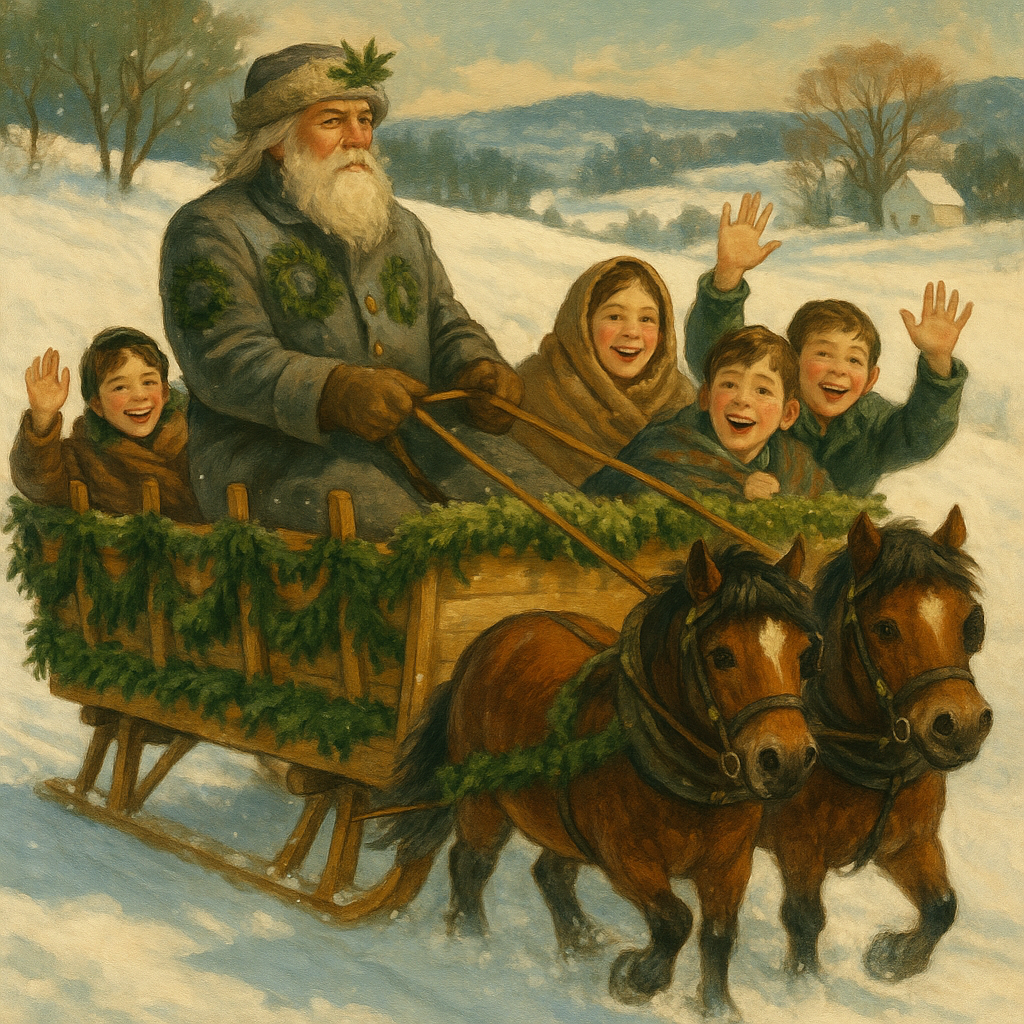
The boys worked fast and happily. Before long every stake was trimmed with green, and a spiral wreath of pine had been wound all the way round the side rails of the rack. It was beginning to look quite magical. William and Grace laughed at first, then started offering suggestions; and presently William was on his feet as well, helping with the work. They wound twine through pine boughs diagonally, from the top of each stake to the base of the next, until the whole rack resembled what poets would call a woodland bower. It only needed a roof. William borrowed Mr. Ross’s jackknife, leapt from the sled, cut eight willow rods, and they were quickly woven through with pine. The ends were lashed with twine to the rails on either side, arching up overhead — and the transformation was complete. The plain old wood sled had become a moving arbour of Christmas green.
The boys danced with delight.
“Isn’t it just wonderful?” cried Phil. “I never thought we could make it look so beautiful!”
“We couldn’t have done it without Bill and Grace,” Win said. “But what will the other boys say when they see us coming down the street?”
“What I most want to see,” said William, “is the faces of Father and Mother and Baby when this magnificent vehicle comes up the drive. They’ve been worried sick about us — and I think we have a fine surprise in store for them.”
“I hope they won’t be as frightened as Macbeth was,” Grace said with a smile, “when he saw Birnam Wood coming.”
William laughed. “Very good, Grace.”
“What’s the joke?” asked Win.
“Too much Shakespeare for small boys,” said William. “You’ll have to do your reading first.”
“It seems to me,” called Mr. Ross from his perch, “that a rig as fine as this ought to have a slightly finer driver. I’m not ashamed of the sled, as I said — but I think I ought to be dressed up to match it.”
“You shall be!” cried Grace. “Boys — help me wind a couple of wreaths.”
Two light twisted wreaths of pine were quickly ready, and Mr. Ross, laughing all the while, threw them over his shoulders and crossed them front and back, like the straps of a soldier’s kit. His fur cap was trimmed with sprays of pine that rose in a crown all round the brim.
Their journey was nearly over. How fast the time had gone! Every few minutes they met sleighs and cutters full of people happy that Christmas and good sleighing had arrived together. These merry-makers all stared in wonder as the green arbour came rolling toward them, and answered the travellers’ shouted “Merry Christmas!” with cheers and laughter.
By the time they entered the streets of Pittsfield they had collected a fine tail of small boys with hand-sleds hitched to the back of the sled. The small boys weren’t quite sure what it all meant, but whoever this driver was — if not Santa Claus himself, then someone equally generous-spirited — he bowed and laughed to all their greetings, and the little procession grew.
Grace was completely hidden by the pine boughs and enjoyed the fun thoroughly.
Meanwhile, the morning had been passing slowly at the Burnham house. Mr. and Mrs. Burnham had not slept much, too anxious about the children to rest. They could get no word from the train after it passed Chester, and the uncertainty wore on them. Mr. Burnham had just returned from the station with news that the telegraph was working again — the train had been heard from, stranded in the cut beyond the summit, unlikely to move until late in the day.
“Oh, I can’t bear it!” cried the mother. “Isn’t there any way to reach them? I’m afraid they’ll go hungry. We had counted so much on this Christmas — and now think of them stuck in those cold cars all day, waiting to be shovelled out of a snowdrift. It seems impossible to just sit here.”
“I’m sorry, my dear,” said Mr. Burnham quietly, “but I don’t see what we can do. We can trust William to look after them. We’ll just have to wait.”
Just then the ponies turned in at the gate.
The small boys with hand-sleds respectfully unhitched and waited outside.
“Drive slowly!” William said. “Give them a proper chance to see us coming.”
Baby Burnham was at the window. “Thanty Kauth!” she cried. “Look, Papa! Look!”
Mr. Burnham came to the window. “What on earth is that coming up the drive? It’s a bower of evergreens on runners — and an old man with a white beard and a white coat all trimmed with pine is sitting up top, shaking with laughter. What can it possibly mean?”
Then the sled drew alongside the porch, and four heads burst simultaneously out between the garlanded stakes, and four voices shouted:
“Merry Christmas!”
“The children! Oh, bless their hearts!”
In a moment, parents and baby and four cold, cheerful travellers were all mixed up on the porch together, hugging and laughing and crying at once — while Sandy Ross up on the sled was laughing softly, and crying just a little too. What made him cry, I wonder?
Presently Mr. Burnham looked up.
“Will — you haven’t introduced us to your driver.”
“This is Mr. Ross, Father. He took us into his house up on Washington Mountain last night and treated us royally. This morning he drove us home, and helped us make the whole thing into an adventure.”
“Mr. Ross, we are in your debt,” said Mr. Burnham warmly. “You’ve lifted a great worry from us and brought us real joy.”
“Well,” said the farmer, “I didn’t like to think of these children being kept away from home on Christmas Day — and if I’ve helped them have a good time, why — God bless them — I can’t think of a better thing for an old man like me to be doing on a day like this.”
Just then Mr. Burnham’s coachman hurried round the corner.
“The shafts of the sleigh are broken, sir — and I don’t see how I’ll ever get those baskets delivered.”
“The baskets!” Mr. Burnham exclaimed. “Our Christmas baskets haven’t gone out yet — it’s nearly eleven o’clock. The storm and worrying about the children — we forgot them completely. I’m afraid those poor families will have a very late Christmas dinner.”
“Charity baskets for folks’ dinners?” said Sandy Ross. “Let me take them round.”
“Oh yes, Father!” Win shouted. “Let Phil and me come too! It’ll be tremendous fun to deliver them from this sled.”
In a minute the baskets — half a dozen of them — were loaded in, and within half an hour they had all been delivered to their addresses. An elderly couple hobbled to the door and took in their basket with wondering eyes, staring after the strange green vehicle as it pulled away. The Widow Blanchard’s children, playing outside, fled indoors when they saw the ponies coming — but came back out quickly enough to take in their basket, entirely convinced they had caught a glimpse of the real Santa Claus. To every household on the list, the gifts — though a little late — were welcome; and the bright vision of the moving evergreen bower brought something like happiness into each of those quiet homes.
Farmer Ross went back to the Burnham house with the boys; his ponies were unhitched and given a comfortable Christmas dinner in the stable; and he himself was persuaded to stay and share the feast that could not have taken place without him — a feast that lost none of its merriment for his company. At about three in the afternoon the Christmas bower, stripped of its greens but loaded with a few good presents for Mrs. Ross, set off on the return journey to Washington Mountain.
And my young readers will be glad to know that the Christmas celebration at the church had been postponed from Christmas Eve to Christmas evening, on account of the storm — so the Burnhams arrived in time to help with the unloading of the Christmas tree after all.
As for Farmer Ross’s house and barn and orchard and pasture and woods and trout brook and blackberry bushes and dog and ponies and cows and oxen and hens — and pretty much everything else he owned — they all had a chance to become well acquainted with Win and Phil during the summer holiday that followed. The Rosses and the Burnhams will be friends for a long time to come; and none of them will ever forget the strange adventures of a wood sled.