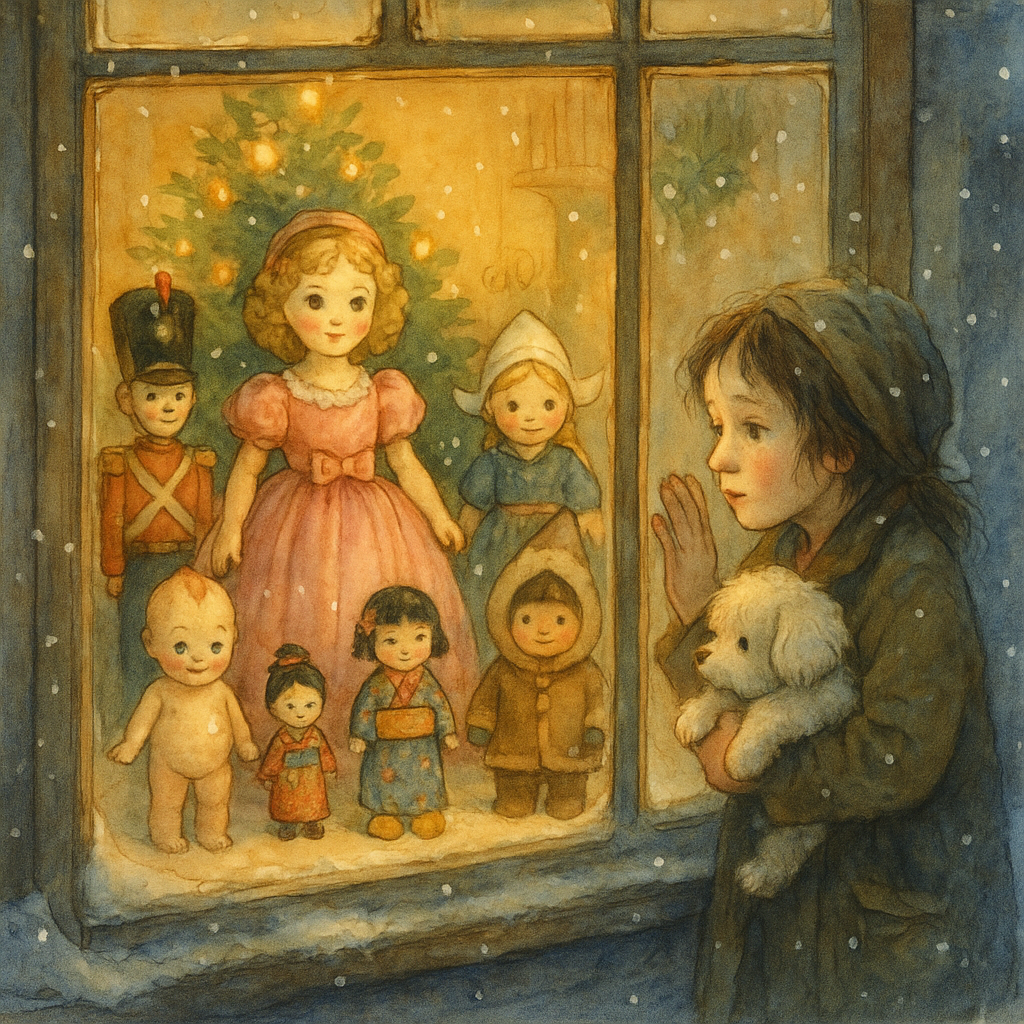
The children liked the tiny shop around the corner better than any of the big stores on the main street. It was a doll shop! No wonder boys and girls loved to press their noses against the show window. There they saw all kinds of dolls — rubber babies, fat kewpies with roguish eyes, doll soldiers, tiny Japanese ladies in flowered silk kimonos, little Arctic boys in pointed hoods and woolly coats, Dutch dolls in wooden shoes and snow-white caps, brown-eyed dolls with rich dark hair, blue-eyed dolls with golden curls.
Nothing looked lovelier than the little shop at Christmastime, when the ground was white with snow. The dolls wore their gayest dresses, and when the lights came on, the show window sparkled like fairyland.
One night, at about twelve o’clock, a brown-haired doll with bright dark eyes said, “Oh, how glad I am the lights are out at last! At least five hundred people stopped in front of this window today.”
“It has been a long day,” said the soldier boy who stood near her. “Even a soldier gets tired once in a while.”
“It’s only a few days until Christmas,” whispered a wide-eyed kewpie. “I do wonder where we shall all be this time next week.”
“I hope I shall be in a pleasant, beautiful home,” said a lovely doll, smoothing out her pale blue silk dress. “A lady in a rich fur coat looked at me for a long while this morning.”
“Some of us are sure to go to rich homes,” answered the golden-haired maiden in white lace. “You and I are worth a good deal of money. There is only one doll in this window more expensive than we are.”
“You mean the large doll dressed in pink satin?”
“Yes. I heard several children call her the most beautiful doll of all.”
“Did you notice the little girl in the shabby coat who stood at the window for such a long time this morning?” asked the doll in blue.
“I did,” answered the soldier boy. “She was carrying a sweet-looking little dog in her arms. If I went to live where that silky-haired dog lives, my uniform would be ruined in about ten minutes.”
“I should be very unhappy in that little girl’s home,” said the doll in blue. “She must be very poor.”
“I liked her sweet face very much,” said the most beautiful doll of all, the one in pink satin. “She was very kind to the little dog.”
“A cozy place is what I want,” said the lass in wooden shoes. “I hope I shall live somewhere warm and cheerful.”
“Yes, that suits you, I suppose,” said the Arctic boy. “These clothes will be far too warm if I go to a house where every room is heated like a summer’s day.”
“Where would you like to go?” asked the little Dutch maiden.
The Arctic boy thought for a moment. “I hope I shall live with some romping boy who will take me along when he builds a snowman. That would be jolly! I’m from the north, where there is nothing but ice and snow.”
“Oh, do you really think so?” asked the tiny doll dressed in green gauze.
“I would rather stand here in the show window than sit on a parlour mantel,” pouted little Kewpie.
“Never mind,” said the Japanese doll kindly. “I think you are going to a lovely little girl. I saw one looking at you this afternoon, and she clapped her hands with delight.”
“Where do you think you will go?” asked Kewpie.
“I’m not sure,” said the Japanese doll. “My style is quite different from the others. I do hope I shall be allowed to keep my kimono. It is very comfortable.”
“Perhaps someone will add you to a collection of dolls from all nations,” said the soldier boy.
“Oh, I hope not,” spoke up the most beautiful doll of all. “A doll in a collection would hardly be loved at all — collections are kept chiefly for show.”
“You haven’t told us where you would like to go,” said the doll in white lace. “No doubt some very rich person will buy you. We all heard the shopkeeper say you are the costliest doll here. So — where would you like to go?”
“I am longing to go to some little girl who will love me with her whole heart,” said the most beautiful doll. “I don’t care how humble the home is. I only want to be loved.”
“How strange!” said the others.
“I hope we shall all be satisfied,” yawned Kewpie.
“We shall soon know,” sighed the soldier boy. “Good night to all!”
“Good night! Good night!”
A hard snowstorm did not keep the people away from the doll shop the next morning. Among those who crowded in was an old gentleman with a kind, generous face.
“Show me a pretty doll,” he said.
“There are some beauties in the window, sir,” answered the shopkeeper. “Come and have a look.”
“I’ll take the large one dressed in pink,” said the gentleman. “I’m sending it to a dear little girl who did me a great kindness. My little dog strayed far from home, and she found him and carried him all the way back to me. A child with a heart like that will love a doll.”
That afternoon the old gentleman knocked at the door of a very humble home. “I have brought a gift for the little girl who took the trouble to carry my lost dog home,” he said. “Please give it to her on Christmas Day.”
And so the most beautiful doll’s wish came true.