The day before Thanksgiving that year was mild and sunny — a real Indian-summer day — and little Sea Bird was having a lively romp in the yard with her kitten, Jet.
Through a gap in the hedge, a pair of hungry eyes watched their fun enviously. After a moment a faint, unhappy mew caught Sea Bird’s attention. At the same instant Jet arched his back, bristled his fur, and stalked warily toward a stray little cat that stood looking very bewildered.
In a flash, Mr. Lester’s three hunting dogs caught the scent of the intruder and came tearing around the corner of the house. The trembling little creature made a hasty scramble up a tree.
Grace ran after the dogs, her face flushed and indignant.
“Shame on you, chasing a poor little thing so much smaller and more helpless than you are!” she cried. “You dogs always seem to think you’re better than cats — and why, I’d like to know? Some of the kindest, greatest people who ever lived were gentle to animals. Are you better than they were?”
“Woof,” said Gay.
“Bow-wow,” said Swift.
And Don stood perfectly still and watched the tree, not even daring to blink for fear the cat would get away.
Just then Grace noticed half of a tousled head and one peeping eye at the gateway. Then the other eye appeared, and a little hand beckoning. As Grace came closer, the child twisted her skirts tightly around her to hide how torn they were.
“Will the boss scold if I stand here a minute?” she whispered.
“Of course not. Come and sit under the trees, and tell me your name,” said Grace.
“Dare I?” the little girl whispered again, wide-eyed, pointing to her rags.
“Why, you’re lovely and clean — even if you’re a little bit torn.”
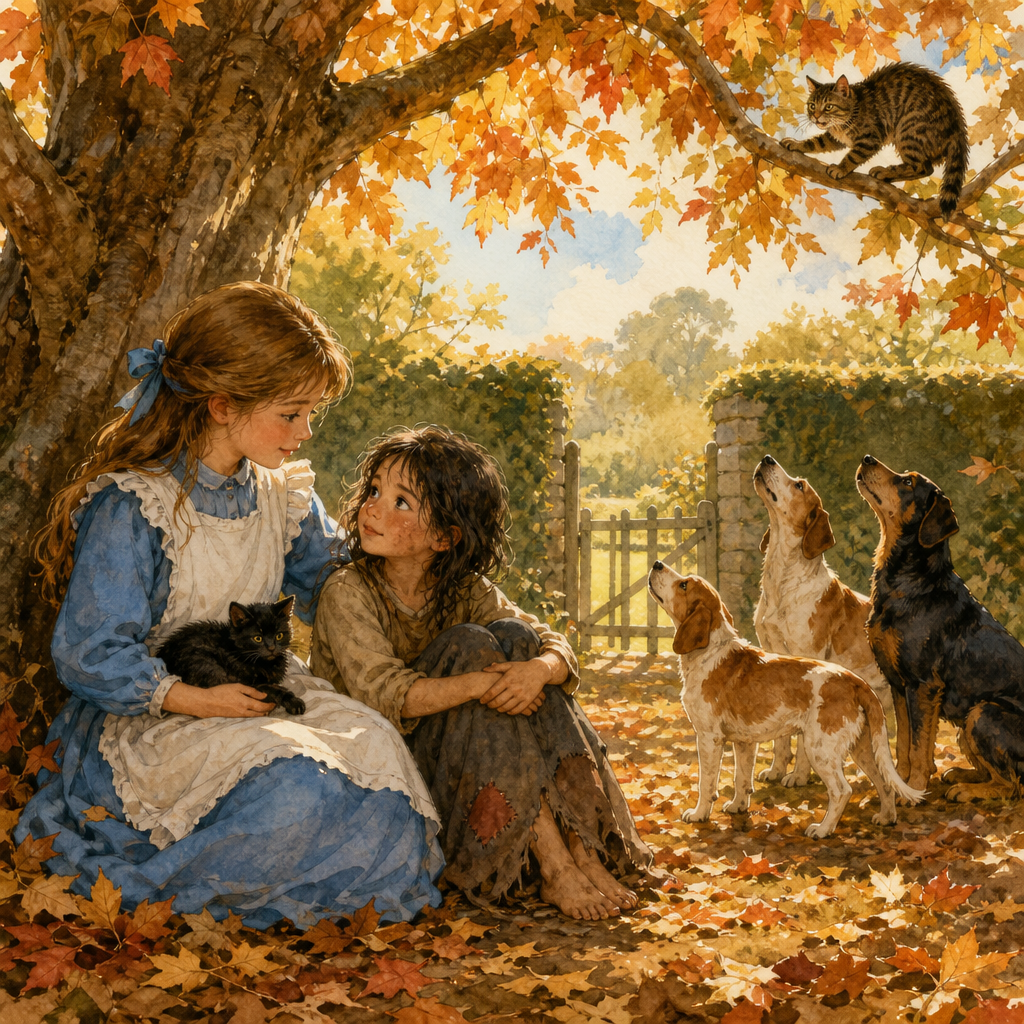
“I’m torn clear through,” the child admitted, sidling in to hide the worst of the rips. As she sat down she added, “That’s my kitten up the tree. I put him under the hedge.”
“Why — don’t you like him?”
“I like him better than anything in the whole world. He’s all I’ve ever had to play with. I never had dolls or things like other girls — I never had a mother or father at all, only the poorhouse. Grannie Orr found me there and took me home. She’s deaf and blind now. She took me in and named me ‘Deb.’ It’s a horrid name, I think. What’s yours?”
“Grace. Though Father calls me Sea Bird, because I love the birds that fly over the ocean, where my home is. I’m only visiting here. But tell me more about you and the kitten.”
“Well, I found him one night in the street, in front of a fine big house, nearly starved. That’s the way some grand people are, you know — they pet a cat all winter, and when they go away for the summer they just turn it out to fend for itself. Cats don’t even have a poorhouse to go to. When he rubbed against my legs and cried, I picked him right up and carried him home and hid him in my room and shared my food with him.
“We’re awful poor, and we don’t get much to eat, so I never dared tell Grannie. But oh, how happy I’ve been to have him for company! He loves me with all his might — and nobody ever did that before. I took him in, just like Grannie took me in, only I didn’t give him an awful name like ‘Deb.’ If she’d only call me Debbie I wouldn’t mind, but it’s Deb this and Deb that, till I hate it. I just call him ‘Kit.’ You can give him a fine name.
“The reason I have to give him away is he got into Grannie’s room and jumped in her lap, and she scolded terribly when I told her how long I’d had him. She said if I didn’t take him away she’d have him killed — so I set out to find him a home. And I cried when I started. When I passed here and saw you hugging your own little kitten before your romp, I said to myself, ‘She’ll be good to my dear little Kit.’ So I hope you’ll take him — and let me come and peep in the yard sometimes, won’t you?”
“Yes, indeed. Here comes Mrs. Lester now. I’ll ask if I may keep him too, until I go home.” Then Grace paused. “But when I go, I’ll have to take him with me, and you won’t be able to see him. What will you do?”
“Can you write?”
“Yes, a little.”
“Well — if you’ll write and tell me he’s happy, way off there, then I reckon I can bear it.”
Everything was explained to Mrs. Lester, who gladly gave permission to keep the kitten until Grace went home.
As the tattered little girl rose to leave, Mrs. Lester asked if she knew that tomorrow would be Thanksgiving.
“Thanksgiving? What’s that?” came the surprised — and surprising — reply.
So Mrs. Lester explained, and promised that she would bring Grace to call on Deb and her Grannie the very next day — and bring a Thanksgiving dinner with them.
When Grace’s brother came by a little later and found her cuddling a strange cat, she told him the whole story, and how she meant to take the kitten home as her own pet.
“Then we’ll have a Sea Mew as well as a Sea Bird,” the boy laughed.
“What’s a Sea Mew?”
“A kind of gull.”
And so the kitten was named. When they made their promised visit, Grace told “Debbie” — who thought her new name was wonderful.
In one basket they carried a beautifully browned turkey and all the trimmings. Debbie took it straight to Grannie and shouted in her ear: “You can’t hear or see — but you can smell! Do you know what it is?”
“Turkey! I haven’t tasted one in years and years,” the old woman said, lifting her sightless eyes and her trembling hands with a joy Debbie had never seen in her before.
Debbie’s eyes flew to the clock, and she wished she could push the hands forward to bring dinner sooner.
In the other basket were a dress of Grace’s, some aprons, stockings, shoes, and warm underthings — and, tucked underneath it all, a beautiful doll.
“I know what Thanksgiving means now,” the child said softly, slipping her hand into Grace’s.
And that night, Grace said it had been the very happiest Thanksgiving of her life.