In a little town in Belgium, children wore wooden shoes called sabots and pointed up at stork nests perched high on the red rooftops. Great draft dogs of Flemish breed pulled small carts through the cobbled streets, gazing at their owners with patient, faithful eyes. The old churches and houses told their stories in wood and stone to anyone who cared to look.
In one such house — built with gabled rooftops and little balconies, the builder’s name and date carved above the door — lived two brothers, Jan and Peter Stein. Their father was a thrifty, honest burgher who gave generously to the poor, though there were a great many poor in those days, after all the sad wars. The household lived plainly enough throughout the year, except at Christmas, when the whole town kept feast.
The children of Belgium had a charming legend about Santa Claus’ pony. Every Christmas eve, they would stuff their wooden sabots with oats and hay and set them on the windowsill. In the early morning they would tiptoe out to look — and the hay was always gone, the shoes brimming over with toys and sweetmeats. How they clapped their hands with glee! And how they wished they could have woken in time to see the pony munching his oats!
Christmas week in the Stein household was one of great plenty. Every friend and every beggar who knocked at the side door had a share. There were black-puddings and liver-puddings, geese stuffed with chestnuts, and more than one noble turkey with truffles. For at least a week beforehand, the boys’ mother was busy in the kitchen making rich Walloon wafers — the kind that made little Peter’s mouth water even on a hot summer’s day.
Jan was four and a half years older than Peter, and he cared less about the plain living or the Christmas feast than about one great burning wish: to study at the Griffin House. That was his name for the old stone school carved with griffins and dragons for waterspouts and gargoyles, where they taught drawing and carving and architecture. As it was, he and Peter attended old Captain Jacobi, who charged little and taught less — for what does a soldier know of art, especially one who spent his life fighting until he lost his leg? Jan wanted to build churches and palaces, to give shape in stone and marble to the fairy-tale structures he saw in his dreams. He even loved the old stone griffins on the schoolhouse, with their impossible, quirky tails.
But the Griffin School cost money, and their father’s open hand to the poor left little in his purse — certainly not enough to send both boys. And Jan would never go without Peter. They had never once been separated in all of Peter’s short life. No; it was altogether impossible.
“Go, boys,” called their mother from the warm, spicy kitchen on Christmas eve. “Go and bring home the red cow. She’s strayed away to the marsh — but be careful, and don’t stay out after sunset. It’s Christmas eve, remember.”
As if they could forget! Their Sunday sabots were already arranged on the tall windowsill, stuffed with oats and hay for the Christmas pony.
To Peter, the Christmas pony was a wonderful and almost magical creature. On summer days, when Santa Claus was busy in his workshop making toys, Peter would imagine the white pony galloping free across some paradise pasture, its fiery eyes bright and its long mane streaming. Once he had seen a picture of the Greek winged horse Pegasus, and he confessed to Jan that he never again thought of the Christmas pony without imagining wings — hidden, no doubt, by its long silver mane. He believed firmly that one night he had actually heard it neigh softly and paw at the wooden windowsill.
Both boys were restless — Christmas was in their bones — and they ran with delight along the frozen path toward the marsh to find Kneidel, their strayed red cow.
The ground was so flat they could see a great distance in all directions. There was Kneidel at last, looking disappointedly at the withered grasses on the far edge of the marsh. She seemed redder than ever against the winter sky, which glowed deep crimson with a few dark clouds drifting above like smoke.
“It looks like a goblin smithy,” said Jan.
“Where they shoe the Christmas pony with silver,” added Peter, laughing.
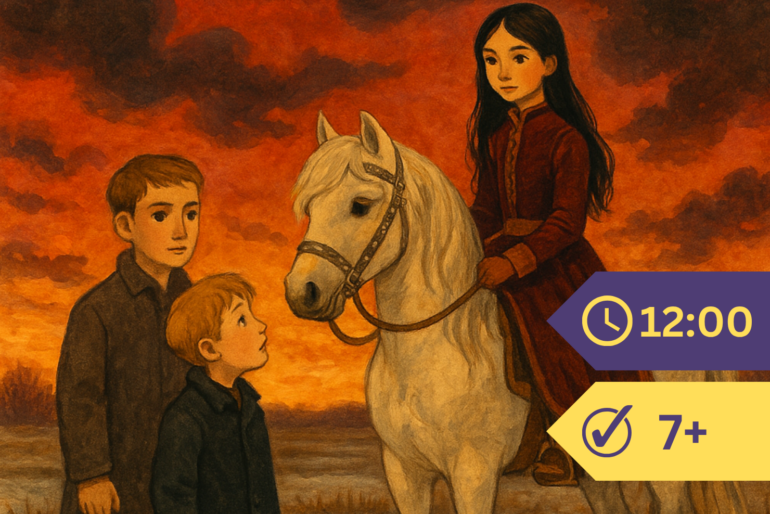
He had just cupped his hands to call Kneidel home when a sharp, ringing sound — the clatter of hooves on frozen ground — made him stop. Around a small grove of trees came a girl of thirteen or fourteen, riding a white pony. Peter’s breath caught in his throat. The pony had bright eyes and a long silky mane and tail, and the bridle shone with rich metalwork.
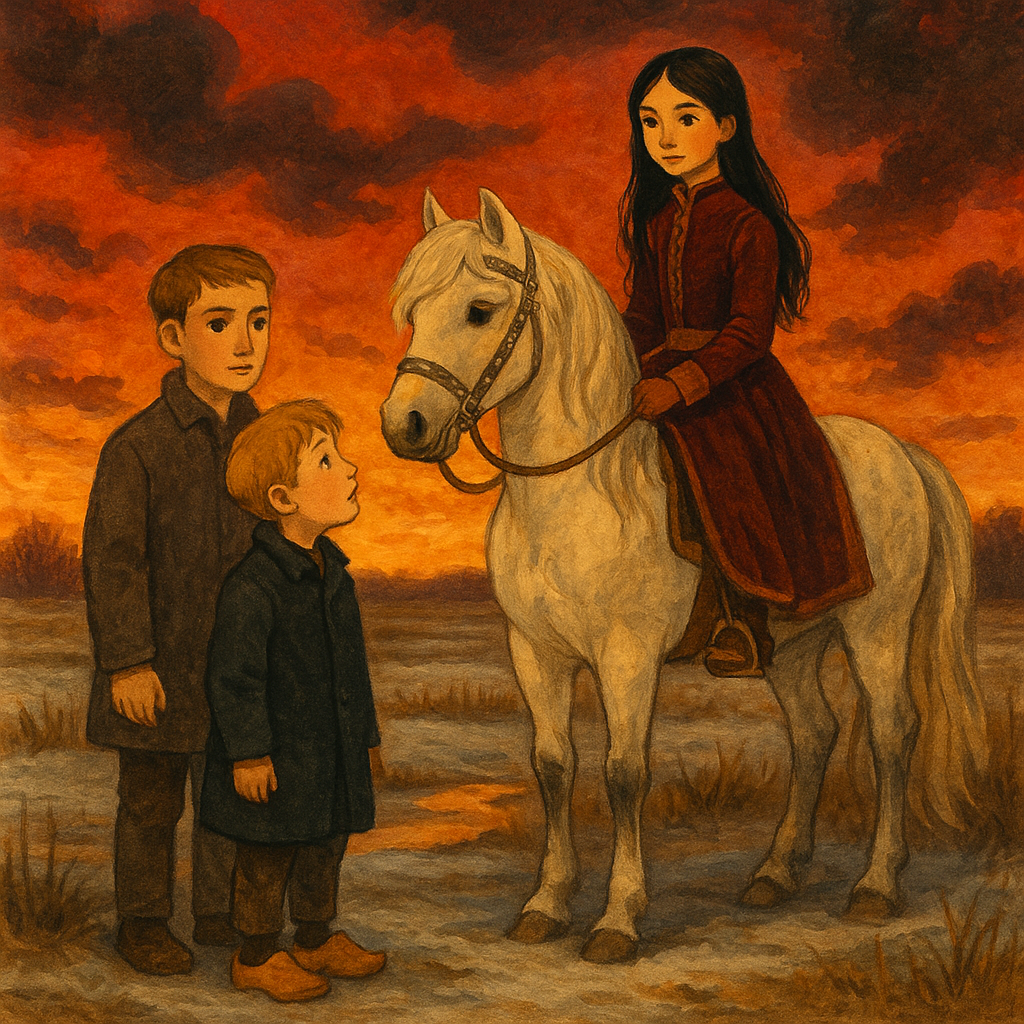
The girl drew rein when she saw the boys. Her eyes were dark and lustrous, her hair black. She was not from Flanders — her clothes were different, and when she spoke it was with a foreign accent.
“You are Flemish boys, I see,” she said, and her voice was very sweet. “Can you tell me where the castle lies? I thought you could see it from anywhere in this flat country.”
“It’s the old windmill that cuts off the view here,” Jan answered. “But once you cross the marsh, it’s visible again. It’s not far.”
“Then I’ll wait for the others,” said the girl — she had the manner of a little lady. “I was going to spend Christmas eve with my godmother at the castle, but my father was delayed. The steward and my governess prepared to come with me, and they were so slow — oh, so slow! — that my pony simply ran away, and now I find myself lost.”
There was a ring of mischievous laughter in that last sentence. Jan shrewdly suspected the pony was not entirely to blame.
“Is this the Christmas pony?” Peterkin asked suddenly, gazing at the pretty white creature with wide eyes.
“Is it? — oh, yes, it is Santa Claus’ pony!” she answered, with a merry glance at Jan, her eyes and lips and dimples brimming with silent laughter. She had clearly heard the Flemish legend.
“Come,” she said to Jan, with a sudden childlike impulse. “While I wait — tell me about yourselves! Tell me what you would most wish for in all the world for a Christmas gift!”
Children’s hearts open quickly to kindness, and Jan soon found himself telling her about his dream of the Griffin House — of learning to build churches and palaces — and why he could not go: he couldn’t bear to deprive the poor of his father’s charity. Nor would he leave without Peter.
She was listening with wide, eager eyes when another rider appeared: a tall, dark, dignified gentleman in a long Spanish cloak and a plumed hat. The girl cried “Father!” with rapturous delight — and at that word, Jan’s expression shifted. A sullen, guarded look crossed his open face. He replied only briefly to the Spaniard’s thanks and turned to his brother. “Call Kneidel, Peter. We’re going home.”
“Kneidel’s already gone, brother” — and indeed she had, like any sensible cow thinking of supper and shelter. The sunset had burned down to embers.
They had started to leave, the girl watching them with a hurt, bewildered expression, when Jan stopped and turned back. “Don’t cross the marsh there,” he said to the gentleman. “The holes are black and deep, and dangerous for horses. Take the longer road around — you’ll reach the castle sooner, and safer.”
The Spaniard studied Jan’s half-averted face with curiosity. “You didn’t want to warn us. Why?”
“Because you are Spanish,” the boy said, his honest gray eyes suddenly fierce.
“Who is your father?” the Spaniard asked.
Jan’s heart lurched — he remembered that he had already told the daughter. “There’s no need to say,” he answered steadily. “I haven’t been treacherous to you. That’s all that matters.” His eyes found the girl’s in a silent warning.
She spoke quickly, before her father could reply. “No. You’ve been a generous foe. We owe you only thanks.”
There was something like tears in her dark lashes. As Jan walked home through the frozen dark, he found it hard to pay attention to Peter’s voice.
“It’s strange she should have the Christmas pony,” his little brother was saying, puzzled.
“Strange things always happen at Christmas,” Jan answered softly, still thinking.
Next morning, a silken purse of gold coins hung outside their window. A small scroll was attached, written in an elegant hand:
For Jan and Peter Stein, that they may go to the School of the Griffins. From Santa Claus’ Pony.
And so Jan’s great wish was granted. Both brothers went to the Griffin School, and Jan learned everything he had dreamed of — carving and building in wood and stone. In the evenings they planned what they would create when they were grown: big churches, stately houses, but above all a new town hall for their own dear town, whose old one had been ruined by Spanish shells. Jan would fill it with pictures from the town’s history and carvings of familiar things: the storks on their rough nests, the great dogs harnessed to their carts, the ordinary, beloved animals of everyday Flemish life.
“And the Christmas pony!” Peter would exclaim, his eyes kindling with the old enthusiasm. “On the central tablet I would carve him — but with wings, to show he is of no common stock, of heavenly breed, with little panniers on his back overflowing with toys, and in front a child’s sabots stuffed with hay and barley. That would be my part. And under it I’d carve only one name: Peterkin.”
“Why?” Jan asked, puzzled. “That’s only your home-name.”
“Because I shall always be little Peter beside you, brother.”
Peter dreamed often of how great Jan would become — and how, one day, Jan would meet the little Spanish lady again, and they would be true friends. But Peter did not live to see it. He died while they were still students.
Jan never finished a piece of work without carving his brother’s name beneath his own. It was Peter’s thought as well as his, after all — even if only Jan’s hand had given it shape in stone.